 English
 Türkçe
 Français
 Deutsch

Turkish-linked organised crime in Europe has evolved beyond its historical association with heroin trafficking and long-standing diaspora rivalries. Recent investigations reveal a fragmented landscape comprising established networks, younger urban gangs, temporary alliances and specialised criminal-service providers operating across several jurisdictions. Narcotics remain important, but firearms trafficking, extortion, migrant smuggling, illegal gambling, fraud and money laundering increasingly demonstrate the poly-criminal character of these networks. A particularly significant development is violence-as-a-service, in which commissioners, intermediaries, recruiters, weapons suppliers and perpetrators may operate separately and across different countries. This organisational flexibility complicates the identification of criminal responsibility and requires investigators to follow digital evidence, financial flows, communications and logistics beyond the immediate act of violence. Effective enforcement therefore depends on coordinated use of domestic investigations, Europol and INTERPOL cooperation, mutual legal assistance, extradition mechanisms and asset recovery measures. Legal and journalistic analysis must nevertheless distinguish Turkish nationality, Turkish origin, residence in Türkiye and membership of a Turkish-linked criminal organisation, while preserving the distinction between allegations, arrests, charges and final judicial findings. The central challenge for Türkiye and European states is to disrupt the transnational networks, services and financial structures sustaining organised crime without compromising legality, procedural safeguards or individual rights.
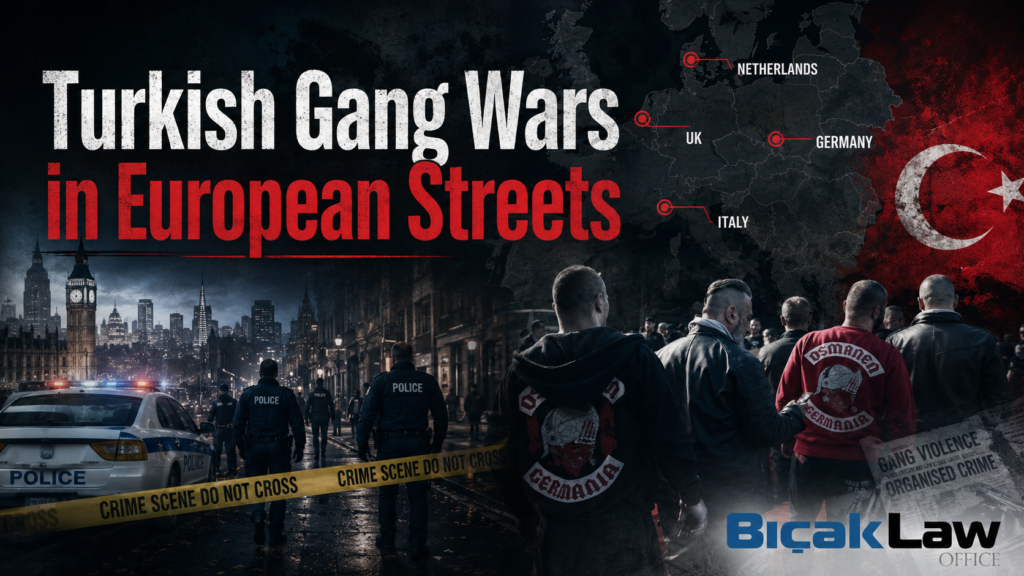
Turkish Gang Wars in European Streets
1. Turkish Organised Crime in Europe: What Is Changing?
Shootings, assassinations, extortion cases and coordinated law-enforcement operations across Europe have renewed attention to criminal networks involving Turkish nationals, Türkiye-based actors and Turkish-origin groups. Developments in the United Kingdom, Germany, Spain, Switzerland, Greece, Italy, the Netherlands and Scandinavia show that the phenomenon can no longer be understood solely through heroin trafficking or long-standing diaspora gang rivalries.
The contemporary picture is fragmented. Established trafficking networks coexist with younger groups, cross-border alliances, local criminal partners and individuals who supply specialised criminal services without permanently belonging to a single hierarchical organisation. Drug trafficking remains important, but recent cases also concern firearms, extortion, migrant smuggling, illegal gambling, fraud and other illicit markets.
Terminology matters. The expression “Turkish mafia” is widely used by the media and sometimes by public authorities, but it should not imply a single, unified Turkish organisation operating throughout Europe. A Turkish national suspected of an offence abroad, a Türkiye-based fugitive, a diaspora gang with historical links to Türkiye and a transnational network operating between Türkiye and several European states are legally and factually different categories.
Criminal responsibility attaches to individuals and legally relevant organisations on the basis of evidence and conduct, not ethnicity, nationality or a broad media label. An allegation must also be distinguished from an investigation, arrest, charge, conviction and final judicial finding.
The significance of the 2025–2026 evidence is therefore not the emergence of one new “Turkish mafia”. It is the evolution of a heterogeneous transnational landscape marked by wider geographic reach, diversification across illicit markets, younger participants, flexible organisational relationships and, in some cases, the outsourcing of serious violence.
2. Historical Roots of Turkish Organised Crime in Europe
Turkish-origin organised crime in Europe substantially predates the recent wave of public shootings. For decades, networks connected with Türkiye have appeared in European law-enforcement assessments, particularly in relation to heroin transported from Afghanistan and Southwest Asia through Türkiye and the Balkans to Western European markets.
Those networks never followed one organisational model. Some relied on family or community relationships; others were held together mainly by trafficking connections, commercial opportunities or access to local criminal markets. Legitimate migration, transport and trade created cross-border connections that criminal actors could attempt to exploit, but the existence of those connections is not itself evidence of criminality.
Germany illustrates this longer history. Academic work identified organised crime of Turkish origin as part of Germany’s organised-crime landscape well before today’s younger violent groups attracted attention. That literature also cautioned against treating every gang or multi-offender enterprise as organised crime: continuity, coordination, division of functions, profit orientation, intimidation and other structural features remain relevant.
Historical examples also show substantial diversity. Osmanen Germania emerged in Germany during the 2010s as a Turkish-nationalist boxing and motorcycle-style group before the German authorities banned it in 2018. London’s long-running rivalry commonly associated with the Hackney and Tottenham Turkish groups arose in a different diaspora and criminal environment. The present landscape therefore combines older trafficking structures and local rivalries with newer, more fluid forms of organisation.
3. From Legacy Networks to a New Generation of Criminal Groups
Generational change is one of the clearest contemporary developments. Traditional accounts of organised crime emphasise durable hierarchies, family or clan relationships, territorial control and sustained participation in particular illicit markets. Those structures remain relevant, but authorities now also encounter younger groups with looser organisation, identities amplified through social media and a conspicuous willingness to use firearms.
Reporting from Türkiye has described highly violent youth gangs in Istanbul associated with synthetic drugs, armed confrontations and carefully constructed criminal identities; the Daltons are a prominent example. Le Monde has examined this younger gang environment. In Switzerland, the head of the Federal Office of Police publicly linked a generational shift to a greater propensity to settle rivalries with weapons. Berlin reporting adds a related dimension: younger perpetrators may allegedly be recruited to carry out shootings or intimidation for more established criminal actors. That possibility connects youth violence to a broader criminal market without establishing that every young offender belongs to a transnational organisation.
Legacy diaspora structures, established trafficking organisations, younger urban gangs and temporary criminal-service networks may coexist, compete or occasionally cooperate. The better analytical model is therefore a mixed criminal ecosystem rather than one hierarchy.
4. Changing Criminal Markets and Drivers of Violence
No single cause explains the recent violence. Changes in drug supply, competition over illicit markets, extortion, personal and organisational rivalries, generational change and access to firearms can each matter in a particular conflict.
Turkish-origin networks historically played an important role in European heroin trafficking. Restrictions on opium cultivation in Afghanistan have since altered the supply environment, prompting debate about whether established networks may diversify into other drugs or revenue sources. That is useful context, but not proof that a particular supply shock caused a particular shooting. Existing stocks, routes, prices, enforcement pressure and a network’s capacity to enter another market all affect the outcome.
Cocaine has become increasingly important in Europe’s illicit drug economy. Turkish-linked actors entering that market encounter European, Balkan, Latin American and other transnational networks. Their relationships may be competitive in one transaction and cooperative in another, including over transport, storage, distribution, laundering or enforcement. Synthetic drugs add a further dimension, especially for younger groups in Türkiye.
Nor are narcotics the only source of revenue. Recent reporting has linked Turkish-origin or Turkish-linked actors, with varying evidential status, to extortion, migrant smuggling, illegal gambling, telephone fraud and firearms trafficking. Violence may arise from territory, debts, stolen drugs, failed transactions, retaliation or personal disputes. Once reprisals begin, the cycle can acquire a momentum independent of the commercial disagreement that triggered it. Changing criminal markets are therefore an economic setting for violence, not a universal explanation.
5. Changing Organisational Models
5.1 Legacy and Diaspora Networks
Relatively durable networks can develop through family, community, commercial or diaspora relationships. Shared language, trust and established personal connections can facilitate illicit transactions across jurisdictions. These features help explain the resilience of some trafficking routes and long-running rivalries, but diaspora communities must never be conflated with criminal groups operating within them. Even durable networks need not be rigid pyramids. They may engage independent transporters, brokers, money launderers, suppliers and local partners who remain outside permanent membership.
5.2 Younger Urban Gangs
Younger groups may organise around neighbourhood, reputation and social-media identity rather than a stable trafficking hierarchy. They can also provide a recruitment pool for established actors seeking people willing to undertake high-risk tasks. Youth gang crime and organised crime are nevertheless not synonymous. Continuity, coordination, criminal purpose, division of functions and links with wider illicit markets remain necessary parts of the assessment.
5.3 Flexible, Networked and Transactional Criminal Structures
A third model consists of temporary networks assembled around a transaction. A drug operation may connect a supplier, broker, transporter, local distributor, money launderer and independent enforcement provider without placing them inside one permanent organisation. The same can apply to serious violence. This flexibility permits geographic expansion without a formal “branch” in every country. Local actors and specialised service providers supply access, logistics or coercive capacity. Temporary cooperation can therefore coexist with competition, which explains why organisational boundaries in contemporary cases are often difficult to draw.
6. The Expanding European Footprint
The jurisdictions below reveal different parts of this uneven landscape. They should not be read as proof of one organisation expanding systematically across Europe.
6.1 United Kingdom
The United Kingdom shows continuity between older diaspora-based rivalries and present organised violence. The feud associated with the Hackney Turks and Tottenham Turks has long been linked in reporting and prosecutions to drug markets and retaliatory attacks. The May 2024 Dalston shooting demonstrated the danger to the public. A gunman on a motorcycle fired towards three men outside a restaurant and seriously injured a nine-year-old girl inside. The later prosecution resulted in convictions for attempted murder in relation to the intended targets and causing grievous bodily harm with intent to the child. The case shows how violence directed at alleged criminal rivals can inflict catastrophic harm on bystanders.
6.2 Germany
Germany is central to the newer landscape. Berlin reporting describes alleged extortion arrangements in which Turkish-linked figures, local groups, firearms suppliers and younger perpetrators performed different roles. Its significance lies not in proving that one organisation controls Berlin, but in indicating a criminal marketplace in which intimidation and violence may be commissioned through intermediaries.
6.3 Spain
Spain is both a location for targeted violence and an operational environment for transnational crime. In March 2026, the Mossos d’Esquadra and Spanish National Police conducted an Europol-coordinated operation against an alleged Turkish group suspected of distributing marijuana and cocaine and trafficking weapons. Nineteen arrests were reported, while other persons were investigated in Greece. Those were investigative allegations, not final judicial findings. Spain’s transport connections and illicit markets make it relevant to both logistics and distribution.
6.4 Switzerland
In November 2025, the head of Switzerland’s Federal Office of Police said that Turkish organised-crime activity was spreading from Germany into Switzerland and referred to drug trafficking, human smuggling, illegal gambling and telephone fraud. She also warned that a younger generation was more willing to settle rivalries with firearms. The statement is an official assessment reported by Swiss public media; it does not establish the membership or guilt of any individual.
6.5 Italy
Italy has also been an operational base. In May 2024, Europol reported that Italian authorities, working with Turkish police, arrested 17 Turkish nationals in an investigation into an alleged organisation suspected of homicides, firearms offences, drug trafficking, migrant smuggling and counterfeit-cigarette distribution. The investigation had begun in Como in October 2023; the reported arrests and suspicions did not themselves constitute convictions. Other violent incidents involving Turkish nationals have generated speculation about wider links, but nationality, criminal history and organisational membership remain separate propositions.
6.6 Greece
Greece has become important in cases involving Turkish criminal figures, fugitives and apparent retaliatory violence. Its proximity to Türkiye and position in south-eastern Europe are relevant to the movement of people, weapons and criminal logistics. High-profile killings have been attributed in media and investigative accounts to rival groups, while other investigations have concerned firearms and support networks. Those attributions must remain tied to their stated evidential source.
6.7 Netherlands
The Netherlands’ ports and position in Europe’s cocaine market make it relevant to many transnational networks. Cases involving Turkish or Türkiye-linked actors have produced allegations concerning drugs, violence and politically sensitive relationships. Claims based on statements by criminal participants, fugitives or informants require careful attribution and should not be treated as established merely because they receive extensive coverage.
6.8 Scandinavia and Other European Jurisdictions
Swedish gang conflicts further expose the limits of nationality-based classification. A Swedish network involving a person of Turkish origin, a Turkish national sought by Swedish authorities and a Türkiye-based organisation directing offences abroad are different legal situations. Beyond Scandinavia, the July 2024 killing of Izzet Eren in Chișinău and later UK extradition proceedings concerning an alleged organiser of the plot illustrate how a local gang rivalry may generate investigative and surrender proceedings in several countries. The allegations against the person sought by Moldova remained matters for trial.
7. Violence-as-a-Service and the Outsourcing of Serious Violence
A particularly important development is the supply of serious violence as a criminal service. Europol’s Operational Taskforce GRIMM addresses networks involved in commissioning, facilitating and carrying out serious violence. In May 2026, Europol reported the arrest in Türkiye of a Turkish national sought by Germany for attempted murder in a GRIMM-related investigation.
The model separates the commissioner from intermediaries, recruiters, weapons suppliers and the eventual perpetrator. Participants may belong to different networks and reside in different countries. Identifying the shooter may therefore reveal only the final link in a chain of instruction, financing and facilitation.
This is an investigative model, not a presumption about every shooting. Violence-as-a-service is not uniquely Turkish, and the Europol case concerns a wanted suspect rather than a final determination of guilt. Its relevance is that Turkish-linked cases appear within a broader European shift towards transactional criminal services.
8. Extortion, Firearms and Criminal Logistics
Violence can be both a means of resolving criminal disputes and an economic instrument. Berlin reporting on alleged extortion shows how threats, shootings, local actors and firearms suppliers may intersect. The March 2026 Catalonia investigation likewise included suspected weapons trafficking alongside narcotics offences. Behind visible violence lies logistical infrastructure: transport, accommodation, communications, storage, financial channels, forged documents and facilitators. A network need not own that infrastructure if services can be purchased. Investigators who focus only on the attack may therefore miss relationships revealed through weapons procurement, travel, communications and payment flows.
9. From Drug Trafficking to Poly-Criminal Networks
Analysis centred mainly on heroin is no longer sufficient. Poly-criminality describes the capacity to participate in several forms of offending or to shift activity as risks and opportunities change. Recent investigations and official assessments have associated Turkish-linked actors – without implying that they form one network – with narcotics, firearms, extortion, migrant smuggling, illegal gambling and fraud.
Academic research into counterfeiting in Türkiye illustrates more generally how logistics and smuggling capabilities may be reused across illicit markets. It does not establish that the gangs discussed in this article engage in counterfeiting. Springer The wider point is that transporters, money launderers, weapons suppliers and violent intermediaries can sell capabilities to otherwise unrelated groups. Money laundering consequently occupies a central position. Proceeds from different predicate offences must be held, moved, concealed or integrated into the legitimate economy. The enduring threat lies not only in visible violence but also in the capacity to preserve profits, finance further crime and penetrate lawful commercial activity.
10. Social Media, Youth Recruitment and Criminal Reputation
Digital platforms have altered how younger groups communicate and construct reputations. Displays of wealth, weapons, gang identity and rivalry can carry criminal reputation beyond physical territory. Intermediaries may also use digital communications to recruit people for particular tasks, reducing the need for a long period of membership before involvement in serious violence. Online presentation must be treated cautiously. Individuals may exaggerate their status or affiliations, and uncritical repetition of gang imagery can reinforce criminal mythology. At the same time, messages, accounts, photographs, videos and location data may help reconstruct links among organisers, intermediaries and perpetrators. In transnational proceedings, their use raises questions of attribution, preservation, lawful access, disclosure and admissibility.
11. Cross-Border Criminal Investigations
Transnational organised crime creates a structural mismatch: networks move across borders, while investigative powers remain principally territorial. One case may involve violence in Germany, a suspected organiser in Türkiye, financial or communications records elsewhere and witnesses in several states. No authority necessarily holds all the evidence. International cooperation may therefore be required for witness testimony, banking information, communications data, searches, seizures and other measures. Outsourced violence adds a further challenge: arresting the immediate perpetrator may not identify who commissioned or financed the attack, recruited the offender or supplied the weapon.
Modern investigations increasingly combine conventional evidence with digital forensics, financial analysis and international judicial cooperation. Fugitive tracing is one part of that response, as recent Europol-supported arrests in Türkiye and Spain demonstrate. Operational speed cannot displace procedural sustainability. Evidence obtained abroad may later be tested for legality, reliability, authenticity, chain of custody, disclosure and compliance with defence rights. Early coordination between competent authorities is therefore important not only to locate evidence, but also to preserve its usability in court.
12. Extradition, Nationality and International Judicial Cooperation
International police cooperation may locate a person sought abroad, but surrender requires a separate legal process. In Türkiye, extradition is governed by the Constitution, Law No. 6706 on International Judicial Cooperation in Criminal Matters, applicable treaties and relevant human-rights standards. Nationality, dual criminality, the nature of the offence, procedural safeguards and other statutory or treaty grounds may affect the result.
An INTERPOL Red Notice is not an international arrest warrant and does not decide extradition. Where surrender is unavailable, other mechanisms – including mutual legal assistance, transfer of proceedings or domestic prosecution where jurisdiction exists—may still be relevant.
These issues are fact-sensitive. For detailed treatment, see Bıçak Law Firm’s Extradition guide and its wider Cross-Border guide. The present point is limited: fugitive tracing, provisional arrest, extradition, mutual legal assistance and domestic jurisdiction are connected but legally distinct mechanisms.
13. Financial Investigations, Asset Freezing and Confiscation
Violence makes organised crime visible; profit sustains it. Drug trafficking, extortion, fraud, migrant smuggling, gambling and firearms trafficking generate proceeds that must be held, moved, concealed, spent or reinvested. Financial investigation can expose relationships not apparent from the predicate offence alone.
Investigators may examine who financed an operation, how participants were paid, where proceeds moved and who actually controls relevant accounts, companies or assets. This is especially important where the commissioner has no physical connection to the crime scene or proceeds generated in one jurisdiction are invested in another.
Freezing measures can preserve property pending judicial determination; confiscation may then remove proceeds or instrumentalities where the applicable legal conditions are established. Formal title may not reflect beneficial ownership or control, but complex or international ownership is not itself evidence of criminality. Effective action must therefore combine asset tracing with judicial safeguards and third-party rights.
14. Europol, INTERPOL, Eurojust and European Law-Enforcement Cooperation
The principal cooperation bodies perform different functions. Europol supports criminal-intelligence exchange, analysis and operational coordination; Operational Taskforce GRIMM is particularly relevant to violence-as-a-service. INTERPOL facilitates global police cooperation and fugitive tracing, including through notices and diffusions, but does not decide extradition.
ENFAST connects specialist national fugitive-search teams, while Eurojust supports coordination among judicial authorities where investigations or prosecutions span jurisdictions. Depending on the case, authorities may need to combine intelligence exchange, joint operational planning, mutual legal assistance, judicial coordination, extradition and financial investigation.
Türkiye does not participate in every EU internal mechanism on the same basis as an EU Member State. Nevertheless, recent operations show that Turkish authorities can be important partners where a suspect, evidence or criminal asset is located in Türkiye. The objective is not cooperation for its own sake, but legally sustainable enforcement capable of following offenders, evidence and proceeds across borders.
15. Legal and Public-Security Implications
The consequences extend beyond conventional gang policing. Public shootings endanger civilians and can intimidate businesses, families, witnesses and entire communities. The Dalston case is stark: an attack directed at alleged rivals caused life-changing injury to a child.
Organised crime should not be equated with terrorism merely because it employs spectacular violence. The concepts are legally distinct. Authorities should use the investigative, financial and cooperation powers applicable to serious organised crime, subject to legality, necessity, proportionality, judicial oversight and defence rights.
Flexible structures complicate attribution. The perpetrator, recruiter, weapons supplier, intermediary, financier and commissioner may act in different countries. Prosecuting only the immediate offender can leave the underlying infrastructure intact. Poly-criminality creates a similar risk of fragmentation when drugs, firearms, fraud, smuggling and laundering are handled in separate investigations despite overlapping actors.
Responsible enforcement and reporting must also avoid nationality-based assumptions. A Turkish national involved in a European offence is not necessarily a member of Turkish organised crime, and a network containing Turkish nationals is not necessarily directed from Türkiye. The inquiry must remain actor-specific and evidence-based.
16. What These Developments Mean for Türkiye and Europe
The phenomenon should not be described simply as criminality being “exported” from Türkiye. Turkish-origin structures have existed within European jurisdictions for decades. Contemporary networks may connect actors in Türkiye with people and service providers already established in European markets, while Türkiye itself is affected by organised-crime violence and younger gangs.
Turkish authorities also participate in investigations and arrests concerning persons sought abroad. Europol’s May 2026 report of an arrest in Türkiye at Germany’s request is one example. Türkiye and Europe are connected both by transnational criminal activity and by criminal-justice cooperation.
The wider European environment is multinational and transactional. Cocaine trafficking, firearms supply, migrant smuggling, laundering and violence-as-a-service involve actors of many nationalities. Turkish-linked networks may compete with, cooperate with or purchase services from other groups according to the transaction.
The policy challenge is therefore broader than responding to “Turkish gangs”. It is to disrupt transnational ecosystems through evidence gathering, financial investigation, asset recovery and prosecution while maintaining legality, proportionality, judicial supervision and individual rights.
17. How Bıçak Law Firm Assists in Cross-Border Criminal Matters
Cross-border criminal matters involving Türkiye may require the simultaneous application of Turkish substantive criminal law, criminal procedure and international judicial-cooperation rules. Bıçak Law Firm advises and represents individuals, businesses and other affected parties in criminal matters with an international dimension. Depending on the case, the work may include Turkish investigations and proceedings, cross-border criminal defence, coordination with foreign counsel, international judicial cooperation, INTERPOL-related issues and financial investigations.
Where proceedings concern assets or transactions, the Firm also advises on freezing, tracing and recovery issues. Coordination between Turkish and foreign counsel can be important where evidence, proceedings or enforcement measures in one jurisdiction affect strategy in another. Extradition forms part of this wider practice and is addressed in the Firm’s dedicated Extradition guide and Cross-Border guide.
Organised-crime allegations carry serious legal and reputational consequences. Representation must therefore be case-specific: media descriptions, nationality, association with an individual or the existence of an international notice cannot substitute for analysis of the competent authority, legal basis, alleged conduct and supporting evidence.
18. Conclusion
Recent violence associated with Turkish-linked actors across Europe is significant, but the description “Turkish gang wars” no longer captures its complexity. Turkish-origin organised crime has historical roots extending beyond the current shootings. Established trafficking structures and diaspora rivalries now coexist with younger urban groups, flexible networks, specialised service providers and shifting alliances.
Criminal markets have also diversified. Investigations and official assessments refer to narcotics, firearms, extortion, migrant smuggling, illegal gambling, fraud and other offences. This does not reveal one unified enterprise. It points to a poly-criminal environment in which logistics and criminal services cross organisational boundaries.
Violence-as-a-service is especially important. Where commissioners, intermediaries, recruiters, suppliers and perpetrators operate separately, the visible attacker may be only the final link in a wider chain. A local investigation may be insufficient where organisers are abroad, evidence is dispersed, proceeds have crossed borders or suspects have fled.
Precision remains essential. There is no single organisation accurately described as “the Turkish mafia” encompassing all the actors discussed here. Turkish nationality, Turkish origin, residence in Türkiye and membership of a Turkish-linked network are different propositions. Allegation, investigation, arrest, charge, conviction and final judicial finding must also remain distinct.
The Türkiye – Europe relationship is not one-directional. Türkiye is both affected by contemporary organised crime and relevant to cross-border investigation and law-enforcement cooperation. The enduring task is to identify and disrupt the people, services, logistics and financial structures that make transnational crime possible while preserving the evidential standards, procedural safeguards and individual rights on which legitimate criminal justice depends.
…
© 2026 Prof. Dr. Vahit Bıçak / Bıçak Law Firm – All rights reserved. This article was written by Prof. Dr. Vahit Bıçak for publication on the website www.bicakhukuk.com. Even if cited as a source, the full text of the article may not be used without prior permission. However, a portion of the article may be quoted, provided that an active link is included. Publishing the article in whole or in part without indicating the author and the source constitutes a violation of personal and intellectual property rights.
Reference: Bıçak Vahit (2026) “Turkish Organised Crime in Europe: Gang Violence, Transnational Networks and Cross-Border Criminal Law”, Bıçak Law Firm Blog, https://www.bicakhukuk.com/en/turkish-gang-wars-in-european-streets/, Prgf. __., Access Date:








Comments
No comments yet.