 English
 Türkçe
 Français
 Deutsch

Prof. Dr. Vahit Bıçak developed an innovative human rights training method at the Turkish Police Academy in the mid-1990s to help future police officers understand suspects’ rights not as obstacles to effective policing, but as essential safeguards of lawful public authority. The initiative brought real courtroom proceedings involving police officers prosecuted in connection with human rights violations into the classroom, transforming ten videotapes of proceedings into a focused 90-minute educational film. By placing police officers themselves in the position of defendants, the method combined visible accountability with empathy, reinforcing the principle that human rights are not the rights of “others” but protections that belong to everyone. Anonymous questionnaires administered before and after the year-long educational process sought to assess whether students’ attitudes toward concrete procedural safeguards – including the right to silence, access to counsel and protection against ill-treatment – had changed. Integrated with Human Rights, Criminal Law and Criminal Procedure Law education, the approach connected legal knowledge with real-world consequences, professional judgement and the practical exercise of state authority. What began as a classroom innovation was subsequently discussed beyond the Police Academy and documented internationally by New Tactics in Human Rights as a transferable human rights tactic. Reconsidered three decades later, the experiment also highlights enduring lessons about institutional culture, the measurement of training outcomes, low-cost innovation and the ethical responsibilities involved in using real cases for professional education. Its central insight remains highly relevant today: human rights protection becomes more effective when legal rules are connected to real-world accountability, professional empathy, institutional culture and measurable outcomes.
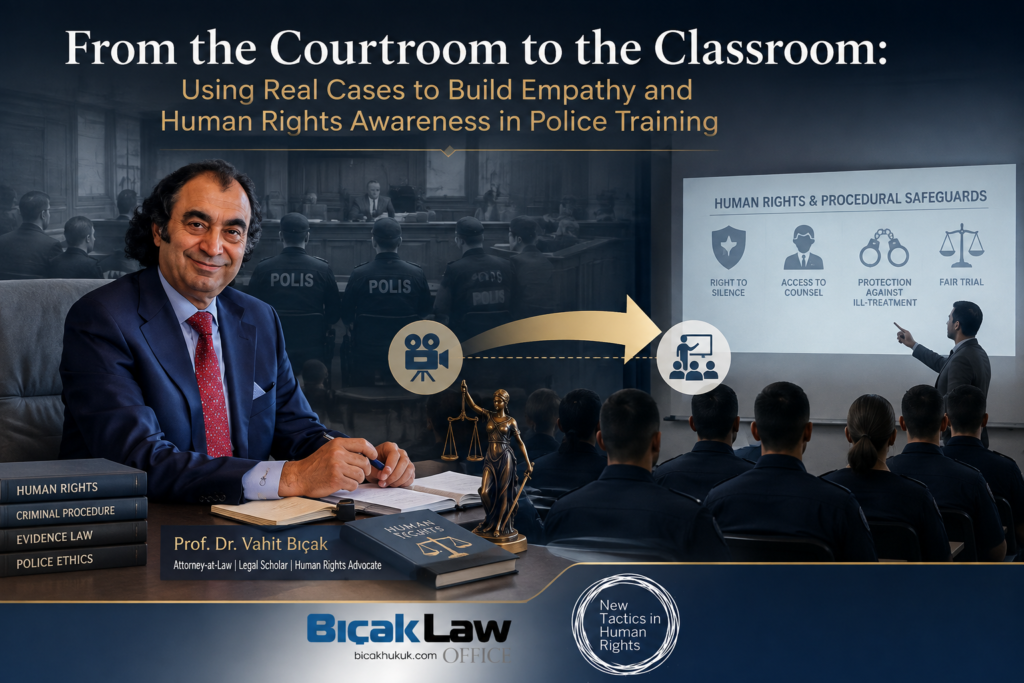
Building Human Rights Awareness Through Training
Developed by Prof. Dr. Vahit Bıçak at the Turkish Police Academy in the mid-1990s, an innovative training method used real courtroom footage, anonymous pre- and post-training questionnaires and year-long legal education to challenge misconceptions about suspects’ rights and foster empathy among future police officers. Later documented internationally by New Tactics in Human Rights, the initiative offers enduring lessons about professional education, institutional culture and the challenge of turning legal standards into everyday practice.
1. Introduction: Changing Laws, Changing Behaviour
Legal reform and institutional change do not necessarily move at the same pace. A state may strengthen procedural safeguards, revise legislation and embrace international human rights standards, yet still face a more difficult question: how can those standards be translated into the everyday decisions of professionals entrusted with public authority? The challenge is particularly acute in law enforcement (The police, The Gendarmerie, The Coast Guard and Custom Control Officers) Academy. Law enforcement officers operate where the coercive powers of the state come into direct contact with individual liberty. Arrest, detention, questioning, searches and the collection of evidence are not merely technical stages of criminal investigation. They are also moments in which guarantees such as the right to remain silent, access to legal counsel, protection against ill-treatment and the presumption of innocence must become operational realities.
Against this background, Prof. Dr. Vahit Bıçak developed an experimental training method at the Turkish Police Academy in the mid-1990s. The initiative emerged during a period when Türkiye’s efforts to improve its human rights record and align domestic practice with European standards were matters of significant institutional and public concern. The problem Bıçak identified, however, went beyond legislative reform. Some future police officers appeared to regard safeguards for suspects as constraints on effective crime control rather than integral elements of lawful policing.
His response was deliberately practical. Instead of relying exclusively on lectures and legal texts, he brought the consequences of rights violations into the classroom. Real court proceedings involving police officers prosecuted in connection with such violations were recorded and edited into a 90-minute teaching film. The footage formed part of a year-long educational process accompanied by anonymous questionnaires designed to compare students’ attitudes before and after the training.
The premise was simple but ambitious: professional education should do more than tell future officers what the law requires. It should help them understand why procedural protections matter, what may follow when public authority is exercised unlawfully and why the rights of a suspect are ultimately rights that anyone – including a police officer – may one day need. Almost three decades later, the premise remains relevant beyond its original setting. It raises a question that continues to confront law-enforcement agencies and other institutions: can professional education move beyond transmitting rules and influence attitudes, judgement and institutional culture?
2. Human Rights Are Not “Other People’s Rights”
At the conceptual heart of Bıçak’s approach was a deceptively simple proposition: human rights are not the rights of “other people”; they are the rights of all of us. The difficulty he encountered was not simply a lack of knowledge about human rights instruments or criminal procedure. It concerned how those rights were perceived. Some police candidates appeared to regard them primarily as protections afforded to the people whom police investigated and, consequently, as external restrictions on the ability of law enforcement to combat crime.
The assumptions recorded in the project included the belief that respect for human rights could weaken the operational capacity of security forces; that policing resembled a “war” against crime in which restrictions on methods were counterproductive; and that coercion against those regarded as criminals could be accepted as part of ordinary police work. Bıçak’s approach sought to reverse that perspective.
Police officers do not stand outside the human rights system. They are themselves rights-holders. Their families, colleagues and communities benefit from the same protections as everyone else. At the same time, because officers exercise coercive powers on behalf of the state, they carry a particular responsibility to ensure that those who come within their authority can enjoy those guarantees in practice.
The distinction between a suspect, accused and a convicted offender was therefore fundamental. The project challenged the assumption that contact with the criminal justice system justified treating a person as already guilty. Bıçak used contemporary Turkish criminal-justice figures to illustrate that many people could become suspects without ultimately being convicted. Those figures belong to their historical context, but the principle they were intended to demonstrate remains fundamental: being suspected or accused of an offence does not extinguish a person’s rights.
This perspective also reframed the teaching of criminal procedure. The right to silence, access to counsel, notification of detention, medical examination and the opportunity to present exculpatory evidence need not be understood as concessions made to an adversary. They are safeguards built into the justice system because the coercive power of the state can affect anyone. The questionnaire developed for the project tested students’ attitudes toward these and other concrete protections, linking the broader language of human rights directly to the mechanics of criminal investigation.
The educational objective therefore went beyond compliance with a catalogue of rules. It sought a change in professional perspective: from seeing suspects’ rights as limitations imposed upon policing to understanding them as part of the rule-of-law framework within which legitimate policing takes place. In this sense, the tactic rested on a dual conception of the police officer: both a bearer of rights and a guardian of the rights of others. Once those roles are understood together, respect for procedural protections no longer needs to be framed as being in tension with effective law enforcement. It becomes part of what distinguishes the lawful exercise of public authority from its abuse.
3. Challenging Misconceptions About Policing and Suspects’ Rights
The tactic did not emerge from an assumption that future police officers simply needed more information about human rights. It addressed a more difficult educational problem: how to challenge entrenched perceptions about crime control, police authority and the status of the suspect. Through sustained interaction with his students, Prof. Dr. Vahit Bıçak identified recurring assumptions that made the internalisation of rights-based standards more difficult. These included the belief that respect for individual rights could restrict effective crime control; that policing resembled a “war” against crime in which legal constraints weakened those expected to conduct that fight; and that police dealt essentially with criminals, making coercion or pressure against suspects appear compatible with ordinary police work.
These perceptions revealed a problem deeper than unfamiliarity with legal doctrine. If a person under investigation is already mentally classified as a criminal, procedural protections can appear unnecessary or even obstructive. The educational challenge was therefore to reconnect police powers with a foundational principle of criminal justice: a suspect is not synonymous with a convicted offender, and investigative authority must operate within legal safeguards precisely because guilt has yet to be judicially established.
Bıçak also observed doubts about accountability itself. The project materials record perceptions that the sanctions attached to rights violations were insufficiently understood, that existing sanctions might not operate effectively in practice and that officials who exceeded their authority were not necessarily thought to suffer adverse consequences. Such attitudes reinforced the need for a method capable of demonstrating that the limits placed on public authority were not merely theoretical. The response was not to replace conventional legal education, but to make it more concrete.
3.1. From General Principles to Procedural Safeguards
A defining feature of the initiative was the translation of broad principles into specific decisions that police officers might face during an investigation. The questionnaire administered at the beginning and end of the academic year addressed ten practical safeguards concerning the treatment of suspects and accused persons. Students were asked, for example, whether a suspect should be informed of the right to remain silent and the right to legal counsel before questioning. Other questions concerned notifying a relative of the place of detention, communicating the reasons for arrest or custody, allowing the presentation of exculpatory evidence and providing access to medical examination capable of identifying possible ill-treatment. The questionnaire also examined the practical relationship between lawyer and suspect: confidential consultation with counsel, the lawyer’s presence when a statement was taken, access to legal assistance during questioning and counsel’s participation in the statement record.
The significance of these questions lies in their practical orientation. Students were not simply being asked whether they endorsed “human rights” in the abstract. Their attitudes were tested against the procedural mechanisms through which those rights become effective during criminal investigation. This practical focus was reinforced by the wider curriculum. Although Human Rights had been taught as a separate subject at the Faculty since 1992, the tactic was also integrated into Criminal Law and Criminal Procedure Law, with the relevant courses extending throughout the academic year. Human rights were therefore not presented as an ethical layer imposed upon police work from outside the criminal justice system. They were connected directly to the legal framework governing investigative powers.
3.2. Reframing Effective Policing
At the heart of the experiment was a reconsideration of the supposed tension between individual rights and effective law enforcement. The misconception identified in the project presented a binary choice: either protect individual rights or fight crime effectively. Bıçak’s approach challenged that premise. Rights-compliant investigation was not presented as an alternative to effective policing, but as the framework within which legitimate investigative authority should operate.
For future officers, understanding this required more than memorising prohibited conduct. It required reconsidering what lawful and professional policing meant. Yet conventional classroom discussion had limits. Students could understand the applicable rules intellectually while continuing to regard personal accountability as remote. The project therefore confronted another important assumption: the possibility that police officers themselves might become suspects or defendants had largely been excluded from the students’ perspective. Students expressed an interest in observing court proceedings, but routinely taking groups of police candidates into courtrooms was technically difficult. That practical constraint produced the idea that would become the tactic’s defining feature: if the students could not readily be taken to the courtroom, the courtroom could be brought into the classroom.
4. Bringing the Courtroom into the Classroom
The defining feature of the tactic emerged from a practical educational problem. Students wanted greater exposure to judicial proceedings, yet routinely taking groups of police candidates into courtrooms was neither straightforward nor sustainable. The alternative was conceptually simple: if the students could not be taken to the courtroom, the courtroom could be brought into the classroom. This transformed the initiative from conventional instruction in human rights and criminal procedure into a form of experiential learning. Instead of encountering accountability only through legislation, textbooks or hypothetical cases, students would see actual police officers appearing before a court in proceedings concerning alleged human rights violations.
4.1. Turning Real Proceedings into a Teaching Tool
With the cooperation of the Turkish Police Academy’s television unit, Akademi TV, proceedings involving police officers prosecuted in connection with human rights violations were recorded. The project materials place the filming in 1995 and 1996, with the relevant trial extending over approximately one year. The resulting material amounted to ten videotapes of courtroom footage. The recordings alone, however, did not constitute an effective teaching resource. Complete proceedings were too extensive for classroom use and contained substantially more material than the educational objective required. Bıçak reviewed the footage and identified the portions most relevant to the training. The ten tapes were then condensed into an approximately 90-minute film, with the editing process taking about a week.
The significance of the exercise lay less in the technology than in what the footage made visible. A proposition such as “a police officer who violates human rights may face legal consequences” can remain abstract when communicated in a lecture. A real courtroom proceeding changes its character. Students could see members of the profession they were preparing to enter occupying the position of defendants and observe allegations concerning police authority being subjected to judicial scrutiny. The relationship between law and consequence became tangible: legal norm → professional conduct → judicial scrutiny → individual accountability.
4.2. An Approach Shaped Through Interaction
The tactic was not designed as a fully formed institutional programme and then imposed upon students. Bıçak’s account describes an approach that evolved through years of interaction with those he taught. This experience helped identify recurring misconceptions, sources of resistance and the forms of teaching capable of engaging students more effectively. The detailed project materials reinforce this bottom-up character. Students encouraged greater use of visual material; the institutional environment afforded the instructor flexibility in selecting teaching methods; Bıçak identified the proceedings to be recorded and requested the assistance of Akademi TV; and he subsequently reviewed the footage to determine what should be retained for classroom use.
The methodology therefore developed through a combination of classroom observation, student engagement, academic initiative and institutional support. This feature is significant because educational innovation does not always originate in a large reform programme. It can begin with an educator identifying a recurring practical problem, testing a different method and refining it through experience.
4.3. Innovation Without a Dedicated Budget
The project was also modest in material terms. The dossier records that there was no dedicated budget for developing the tactic. The recording and preparation of the video and the development of the questionnaire did not depend on a specially funded programme. Existing personnel and technical resources were used, while classrooms already equipped with televisions and video players enabled the material to be incorporated into teaching.
The project materials identify four characteristics that contributed to support for the initiative: it was considered original, beneficial, relatively easy to implement and inexpensive. The broader lesson is not that institutional innovation should be inexpensive, but that its value need not depend upon technological or financial complexity. Here, the principal innovation lay in how existing resources were combined to address a clearly identified educational problem.
4.4. Making Accountability Visible
The footage also addressed perceptions that sanctions for rights violations were remote or ineffective. Seeing police officers subjected to judicial proceedings made accountability visible in a way that a description of criminal liability could not necessarily achieve. Yet the objective was not simply to deter future officers through the prospect of prosecution. If deterrence had been the sole purpose, the lesson could have ended with the legal consequences displayed on screen. Bıçak’s method went further. Once students saw police officers themselves occupying the position of defendants, another question arose: What rights should those officers have when they become subject to the criminal process?
At that point, procedural protections acquire a different meaning. The right to counsel, the right to silence, protection against ill-treatment and procedural fairness no longer belong exclusively to an imagined category of “criminals”. They become safeguards that a police officer, colleague, family member – or any other person – may one day need. The courtroom was therefore brought into the classroom for two complementary purposes: to make accountability real and to create the conditions for empathy. That transition – from the deterrent force of visible consequences to an understanding of the universality of procedural rights – forms the next stage of the tactic.
5. From Deterrence to Empathy
The courtroom footage gave the tactic an immediate deterrent dimension. Future police officers could see that alleged human rights violations could lead to criminal proceedings and that the exercise of public authority did not place an officer beyond judicial scrutiny. Yet deterrence alone does not explain the methodology developed by Prof. Dr. Vahit Bıçak. Its more distinctive objective was empathy. The initiative sought to change the perspective from which students viewed suspects’ rights. If procedural safeguards were understood primarily as protections granted to people whom the police regarded as criminals, they could easily appear to obstruct investigation. The courtroom footage introduced a different possibility: a police officer could also become a suspect or defendant. That reversal of perspective allowed the meaning of procedural rights to be reconsidered.
5.1. Seeing the Criminal Process from the Other Side
A police officer appearing before a court is no longer exercising investigative authority; that officer is subject to it. In such circumstances, guarantees that might previously have seemed inconvenient – the right to remain silent, access to counsel, protection against ill-treatment, the opportunity to present evidence and procedural fairness – acquire a different significance. The tactic therefore invited students to view the criminal process from the position of the person subjected to state authority.
Its purpose was not to suggest that the students themselves would engage in misconduct or inevitably become defendants. Rather, it demonstrated a more fundamental principle: procedural rights do not depend upon the identity, profession or social status of the person who needs them. This directly reflected Bıçak’s central proposition that human rights should not be understood as “other people’s rights”. Police officers, their families and their colleagues are beneficiaries of the same protection mechanisms that officers are expected to respect when exercising authority over others. Their coercive powers, in turn, give them a particular responsibility to ensure that those protections remain meaningful in practice. The courtroom footage gave this principle a concrete setting.
5.2. Accountability and Empathy as Complementary Tools
Deterrence and empathy performed different but complementary functions. Accountability demonstrated the possible consequences of misconduct; empathy demonstrated the universality of procedural rights.
The first challenged perceptions that human rights obligations lacked practical enforcement. Seeing police officers subjected to judicial proceedings provided a visible counterpoint to the assumption that abuses of authority would necessarily go without legal consequences. The second addressed a deeper question of professional attitude. Understanding that unlawful conduct may be punished does not necessarily explain why a person under investigation should enjoy procedural protections. Empathy was intended to help bridge that gap.
A professional culture based solely on fear of sanctions may encourage formal compliance without producing an understanding of the values underlying the rules. Conversely, values-based instruction detached from visible accountability may leave legal principles remote from operational reality. The tactic sought to connect the two.
5.3. From Knowing the Rule to Internalising the Safeguard
The questionnaire used in the project illustrates this distinction. Rather than asking students whether they supported “human rights” in general, it required them to confront concrete protections encountered during criminal investigation: the right to silence and counsel, notification of detention, information about the reasons for arrest or custody, the opportunity to present exculpatory evidence and access to medical examination where ill-treatment might need to be identified. Other questions concerned confidential consultation with counsel, the lawyer’s presence during the taking of a statement, access to legal assistance during questioning and counsel’s participation in the statement record.
These were precisely the safeguards whose significance could change when considered from the position of the person subjected to investigative authority. The educational progression can therefore be understood in three stages: knowing the rule → seeing its significance from another perspective → internalising the value behind the safeguard. The courtroom footage provided the bridge between legal knowledge and perspective-taking.
5.4. Human Rights as Part of Professional Identity
The approach carried a broader implication for police education. If respect for individual rights is taught only as a set of external restrictions imposed upon law enforcement, compliance may remain fragile. Such rules can be perceived as constraints on professional discretion rather than as elements of legitimate professional conduct. Bıçak’s tactic approached the issue differently. It sought to integrate respect for suspects’ rights into the professional identity of future officers. The choice was not between effective policing and human rights; lawful policing itself required the exercise of investigative powers within procedural guarantees. This helps explain why the tactic was incorporated not only into human rights teaching but also into Criminal Law and Criminal Procedure Law. The relevant principles were connected directly to the framework governing police powers rather than treated as a separate ethical subject detached from operational practice.
The distinction is important. Knowledge of the law tells an officer what is required. Accountability demonstrates what may follow when those requirements are disregarded. Empathy contributes to understanding why the safeguard matters to the person affected by state power. Bringing these dimensions together was the central ambition of the experiment. But the project did not simply assume that exposure to courtroom footage and sustained teaching had changed students’ attitudes. It incorporated another important element: an attempt to measure whether change had actually occurred.
6. Measuring Change: From Intuition to Evaluation
One of the most forward-looking features of the tactic was that it did not rely solely on the instructor’s impression that the training had worked. Prof. Dr. Vahit Bıçak incorporated an evaluation mechanism designed to compare students’ attitudes at the beginning and end of the academic year. This moved the initiative beyond the use of courtroom footage as an engaging teaching aid. It introduced a more demanding question: had the educational process actually contributed to a change in how future police officers viewed suspects’ rights and procedural safeguards? The surviving project materials describe a six-stage methodology combining real-case observation, sustained legal education, perspective-taking and pre- and post-training assessment.
6.1. Recording Real Proceedings
The first stage involved recording court proceedings concerning police officers prosecuted in connection with human rights violations. Akademi TV provided the technical support, producing approximately ten videotapes of courtroom material. The use of actual proceedings was central to the design. Students were not presented with a hypothetical case constructed to illustrate a legal principle. They observed the criminal justice system dealing with allegations involving members of the profession they were preparing to enter.
6.2. Creating a Focused Training Film
The complete recordings were too extensive for classroom use. Bıçak reviewed the footage and selected the portions most relevant to the educational objective. The ten tapes were condensed into an approximately 90-minute training film. The project dossier places the filming in 1995 and 1996 and records that the underlying proceedings extended over approximately one year. The selection process transformed documentation into a teaching instrument: the purpose was not to reproduce an entire trial, but to make judicial scrutiny and the practical consequences of professional conduct visible.
6.3. Establishing a Baseline
At the beginning of the academic year, students completed a ten-question questionnaire assessing their attitudes toward suspects’ rights. They were instructed not to identify themselves, allowing them to express their views more freely rather than provide answers they believed their instructor expected. The questions focused on concrete protections: the right to remain silent, access to counsel, notification of the reasons for arrest or detention, informing a relative of the place of detention, the opportunity to present exculpatory evidence and access to medical examination where possible ill-treatment needed to be identified. Further questions addressed confidential consultation with counsel, the lawyer’s presence during the taking of a statement, legal assistance during questioning and counsel’s participation in the statement record. The baseline therefore examined students’ attitudes toward the practical operation of procedural safeguards, rather than merely their general support for human rights.
6.4. Introducing the Courtroom Experience
Students were then shown the 90-minute film. The educational purpose was twofold. First, the footage demonstrated that police officers could themselves become subject to criminal proceedings and judicial scrutiny. Second, seeing members of their own profession in the position of defendants was intended to encourage students to reconsider procedural rights from the perspective of the person subjected to state authority. The film thus combined visible accountability with perspective-taking: it demonstrated the potential consequences of misconduct while reinforcing the universality of procedural protections.
6.5. Reinforcing the Learning Throughout the Academic Year
The video was not treated as a stand-alone intervention. Teaching throughout the academic year continued around the interconnected objectives of discouraging human rights violations and developing empathy. This distinction matters when assessing the initiative. Any change observed at the end of the year cannot properly be attributed to the film alone. It formed part of a broader educational process involving sustained instruction, including integration with Criminal Law and Criminal Procedure Law. The tactic is therefore better understood as a combined educational methodology rather than a single-video experiment.
6.6. Repeating the Questionnaire and Comparing Responses
At the end of the academic year, the same ten-question anonymous questionnaire was administered again. The later responses could then be compared with those collected at the outset. The project dossier reports that this comparison indicated a positive change in students’ attitudes toward human rights and, particularly, greater empathy toward suspects. It also records a longer-term observational indication: former students encountered years later continued to remember the courtroom video. These findings are noteworthy, but they require appropriate methodological caution.
6.7. What the Evaluation Can – and Cannot – Tell Us
The surviving documentation establishes that the project deliberately incorporated pre- and post-training assessment, used the same questionnaire at both stages and reported a positive difference between the responses. The materials presently available do not, however, provide the underlying dataset, statistical analysis, a control group or other elements that would permit the initiative to be characterised as a contemporary experimental study. Nor do they establish that any observed change resulted from the video independently of the wider year-long educational process. It would therefore be inappropriate to retrospectively claim a quantified causal effect.
The significance lies elsewhere. Bıçak did not assume that delivering instruction meant that its objectives had been achieved. The methodology established a baseline, introduced an educational intervention, reinforced the relevant principles over time and returned to the same questions to examine whether attitudes had changed. In contemporary terms, it can reasonably be described as an early impact-assessed or evidence-informed approach to professional education, provided that the limits of the surviving evidence remain explicit.
6.8. From Training Activity to Learning Outcome
This distinction retains considerable relevance. Training programmes are often measured through inputs: courses delivered, participants attending, hours completed or materials covered. Such indicators demonstrate that training occurred. They do not necessarily show what participants learned or whether their attitudes changed. Bıçak’s experiment posed a different question: What changed in the learner? That question is particularly important in human rights education. A participant may correctly identify the right to counsel in an examination while continuing to regard a lawyer’s presence during questioning as an unnecessary impediment. Knowing that a safeguard exists and accepting its legitimacy are different educational outcomes.
By using the same practical questions before and after the educational process, the methodology attempted to examine that distinction. It ultimately connected four elements: legal knowledge → real-world accountability → empathy → evaluation. The ambition was not merely to teach future officers what the law required, but to examine whether sustained engagement with those principles and real judicial experience could contribute to a different professional perspective.
This evaluation component also helped give the initiative significance beyond the classroom. What began as a practical response to a teaching problem at the Turkish Police Academy would subsequently be discussed outside the Academy and documented within a wider international human rights context.
7. From a Classroom Experiment to an International Human Rights Tactic
The methodology developed at the Turkish Police Academy began as a response to a specific educational problem. It was not originally conceived as an internationally transferable “human rights tactic”, nor was that terminology part of its initial design. Its wider significance emerged gradually as the approach was presented outside the Academy, discussed with human rights practitioners and considered within the broader challenge of preventing violations. This progression is important. It shows how a locally developed teaching method could move beyond its original setting while retaining the practical problem it was designed to address.
7.1. Taking the Method Beyond the Police Academy
The project materials record that the methodology was presented at meetings organised by the Helsinki Citizens’ Assembly in Ankara and İzmir. These presentations brought the approach before audiences beyond the Police Academy and generated criticism, suggestions and encouragement that contributed to its further development. External engagement added another layer to an initiative already shaped through interaction. Within the Academy, the method had evolved through exchanges among instructor, students, academic colleagues, administrators and the technical personnel involved in recording the proceedings. Outside that environment, it could be examined from the perspective of civil society and the wider human rights community. The process was therefore not simply one of presenting a finished model. Feedback became part of its continuing refinement, consistent with the way the tactic had developed from the outset: observation, experimentation, feedback and adaptation rather than a fixed methodology imposed from above.
7.2. When a Teaching Method Became a “Tactic”
One of the most revealing details in the surviving documentation concerns the terminology itself. Bıçak records that he had not originally regarded or described the educational method as a “tactic”. It was Ali Bayramoğlu, then involved in the New Tactics initiative in Türkiye, who identified the approach in those terms. The distinction is more than semantic. Within the Police Academy, the method had developed as a practical answer to an educational challenge: how to engage future officers more effectively with suspects’ rights and overcome resistance to principles that could otherwise remain abstract. Viewed from a wider human rights perspective, however, the same method represented something more transferable: a preventive means of influencing the attitudes of professionals who exercise state power before violations occur. The transition from teaching method to human rights tactic thus broadened the conceptual significance of the initiative without changing its underlying purpose.
7.3. From Accountability to Prevention
Human rights protection is often associated with mechanisms activated after an alleged violation: investigation, prosecution, litigation, compensation and other forms of accountability. Those mechanisms are indispensable, but Bıçak’s initiative used the reality of post-violation accountability for a preventive educational purpose. A judicial process arising from past conduct became a resource intended to influence future conduct: past violation → judicial accountability → professional education → prevention. The courtroom footage therefore performed two functions. In the underlying proceedings, the justice system examined allegations concerning past police conduct. In the classroom, those proceedings became a means of shaping the professional perspective of future officers. This transformation of judicial experience into preventive education helps explain why the initiative could acquire significance beyond its original academic setting.
7.4. International Documentation by New Tactics in Human Rights
The methodology was subsequently documented by New Tactics in Human Rights under the title “Using Videotaped Prosecution of Police Officers for Human Rights Violations as an Educational Tool”. New Tactics describes an approach developed by Vahit Bıçak at the Turkish Police Academy involving videotaped proceedings against police officers, an approximately 90-minute educational film, the use of the officers’ position as defendants to foster empathy with suspects and questionnaires administered before and after the educational process.
The significance of this international documentation should be stated precisely. It did not transform the initiative into an award-winning programme or constitute a formal certification. Rather, it identified and documented a locally developed practice as a tactic from which the wider human rights community could learn. This distinction preserves the real importance of the recognition. The achievement lies not in attaching an accolade to the project, but in the movement of an idea: a methodology developed in response to a specific challenge in Turkish police education became sufficiently transferable to be documented and shared internationally.
7.5. From Local Context to Transferable Method
The original project itself anticipated wider application. Its primary target group consisted of students at the Faculty of Security Sciences, while potential audiences included students in police vocational schools, participants in police in-service programmes and those involved in pre-service and in-service training within the gendarmerie. The significance of transferability, however, lies less in reproducing the precise historical technique than in identifying the underlying method. The institutional circumstances of the Turkish Police Academy could not simply be replicated elsewhere, nor would every organisation have appropriate courtroom footage or confront identical attitudes. What could travel was the educational logic: identify a persistent professional misconception; connect legal standards to real consequences; use perspective-taking to challenge assumptions; reinforce learning over time; and assess whether attitudes have changed. The videotape was the medium. The deeper innovation was the educational architecture surrounding it.
7.6. A Local Innovation with Wider Relevance
The tactic should nevertheless remain anchored in its historical context. It emerged during a period of significant debate and reform concerning human rights, policing and Türkiye’s alignment with European standards. Its design responded to attitudes observed within a particular educational and institutional environment. Yet its international documentation also demonstrated that the underlying challenge was not exclusively Turkish. Many institutions confront a gap between formal rules and professional culture, training delivered and values internalised, legal reform and behavioural change. The lasting significance of the initiative therefore does not depend on suggesting that a 90-minute film solved the complex problem of police misconduct. The surviving materials support no such claim.
Its contribution is more measured and, for that reason, more instructive: it provides a documented example of an educator attempting to narrow the distance between legal norms and professional attitudes through real cases, visible accountability, empathy, sustained teaching and evaluation. Three decades later, those elements allow the experiment to be considered not only as a chapter in the history of police education, but also as a case study in the continuing challenge of translating institutional standards into professional conduct.
8. What the Experiment Teaches Us Today
The historical significance of the initiative lies in its originality within the setting in which it was developed. Its contemporary value lies in the questions it continues to raise. Training technologies have changed dramatically since the mid-1990s. Videotape has given way to digital platforms, simulations and increasingly sophisticated forms of professional education. Yet the institutional challenge identified by Prof. Dr. Vahit Bıçak remains familiar: how can an organisation move from having rules to developing a culture in which those rules influence everyday judgement and conduct? The experience at the Turkish Police Academy suggests several lessons that extend beyond the technology, institution and historical circumstances of the original tactic.
8.1. Legal Rules Alone Do Not Change Professional Culture
The experiment did not arise from an absence of legal rules. Human rights and procedural safeguards could already be taught through legislation, doctrine and conventional classroom instruction. The difficulty lay in attitudes that treated those safeguards as external constraints on effective policing. This distinction between formal knowledge and internalised professional values remains fundamental. An individual may know what a rule requires without accepting the rationale behind it. An institution may have comprehensive policies without those policies determining behaviour under operational pressure. The project materials themselves recognised this limitation. Newly trained officers could encounter established police culture and working practices inconsistent with the values they had learned at the Academy, making those values more difficult to apply in professional life. The lesson is clear: individual education and institutional culture must reinforce one another.
8.2. Real Cases Can Make Abstract Obligations Tangible
The tactic also demonstrates the educational value of connecting legal rules to actual consequences. A statute, professional code or internal policy can explain what conduct is required. A real case can show what happens when professional judgement is tested in practice. For the police candidates, courtroom footage transformed accountability from an abstract proposition into something observable. The individuals appearing before the court belonged to the profession the students were preparing to enter. Judicial scrutiny was therefore no longer remote from their future professional identity. The transferable principle is not that every training programme should use courtroom recordings. Rather, abstract obligations can become more meaningful when connected to credible situations in which professional choices produce visible consequences.
8.3. Empathy and Accountability Can Reinforce One Another
Perhaps the tactic’s most distinctive feature was its combination of deterrence and empathy. Accountability answered one question: What can happen when public authority is exercised unlawfully? Empathy answered another: Why should procedural protection matter to the person subjected to that authority? By showing police officers themselves in the position of defendants, the method disrupted the distinction between the professional exercising state power and the supposedly distant “other” who needed protection. The experiment therefore suggests that accountability and values-based education need not be alternatives. External accountability can establish boundaries; perspective-taking can help professionals understand the legitimacy of those boundaries. This combination becomes particularly relevant when education seeks not merely technical compliance but the internalisation of professional standards.
8.4. Training Effectiveness Should Be Measured, Not Assumed
Another enduring lesson concerns evaluation. The project did not treat completion of the course as sufficient evidence of success. Anonymous questionnaires were administered before and after the academic year so that students’ responses to the same procedural-rights questions could be compared. The project materials report a positive change in attitudes and empathy, although the limitations of the surviving evidence do not permit stronger statistical or causal claims. The underlying principle nevertheless remains compelling: delivery is not the same as effectiveness. Attendance, training hours and completion rates measure activity. They do not necessarily measure learning, changes in attitude or behavioural outcomes. For contemporary professional education, this encourages a shift from asking “Was the training delivered?” to asking “What changed as a result?”. The appropriate method will depend on the context, but establishing learning objectives, identifying a baseline and assessing outcomes makes training more accountable to its own purpose.
8.5. Innovation Does Not Necessarily Require a Large Budget
The original tactic also illustrates that meaningful innovation need not depend upon substantial financial or technological resources. There was no dedicated project budget. Existing institutional capabilities were combined: Akademi TV recorded the proceedings; available classroom equipment enabled the footage to be shown; the questionnaire provided a simple assessment mechanism; and the educational design developed through academic initiative and interaction with students. The project materials themselves identify originality, usefulness, relative ease of implementation and low cost among the characteristics that attracted support. The broader lesson is that innovation may lie in identifying the right problem and recombining existing resources, rather than in the complexity of the technology employed.
8.6. Training Individuals is not Enough
The most challenging lesson is also among the most important. The project documentation recognised that newly trained officers could struggle to apply what they had learned when they entered a professional environment shaped by different habits and expectations. Training can influence knowledge, attitudes and judgement. Whether those changes endure, however, also depends on what happens afterwards: how supervisors behave, what colleagues regard as normal, which practices an institution rewards or tolerates, whether accountability mechanisms function and whether leadership reinforces the standards taught. Training is therefore one component of institutional change, not a substitute for it.
8.7. Beyond Police Training: A Broader Professional Lesson
These lessons invite comparison with professional environments beyond law enforcement. The original tactic was designed specifically for police education, and the surviving materials do not establish that Bıçak’s methodology was applied to corporate compliance, internal investigations or other professional settings. Any such connection is therefore a contemporary analytical inference, not a historical claim. The underlying challenge, however, is recognisable. Organisations today invest heavily in professional ethics, anti-bribery and corruption, AML/CTF compliance, human rights due diligence, internal controls and conduct training. In each of these areas, a gap can emerge between knowing a rule and incorporating it into professional judgement.
A policy may establish what is prohibited or when an issue must be escalated. The more difficult question is whether professionals recognise the relevant risk in an ambiguous real-world situation – and whether the surrounding culture supports the decision the policy expects them to make. Viewed through that contemporary lens, the Police Academy experiment suggests a broader educational proposition: connect rules to realistic consequences, create opportunities for perspective-taking, reinforce learning over time, assess outcomes and ensure that institutional culture supports the behaviour being taught. The technology can change. The educational logic does not depend on videotape.
8.8. The Innovation was not the Camera
Viewed from 2026, recording a trial and showing edited footage in a classroom may appear technologically straightforward. Assessing the tactic on that basis would miss its principal innovation. The important step was not the camera. It was the decision to use a real judicial proceeding to confront professional assumptions; to transform accountability into a preventive educational resource; to connect suspects’ rights with the possibility that officers themselves might need those protections; and to ask whether the resulting educational process had changed attitudes. Those choices lead to a question that remains relevant across institutions: How do we turn rules into judgement, judgement into professional conduct and professional conduct into institutional culture?
The experiment did not claim to provide a complete answer. Its own documentation recognised both the limits of training and the resistance that institutional environments could create. What it offered was a practical method for approaching the problem: make legal consequences visible, make rights personally intelligible and examine educational outcomes rather than assume them. Reconsidering the tactic three decades later also reveals another dimension. The power of real-case learning derives from the experiences of real people. Using those experiences for educational purposes therefore raises questions of privacy, dignity, fairness and the rights of the individuals whose proceedings become teaching material. The effectiveness of experiential learning cannot be separated from those responsibilities.
9. Human Rights Training, Ethics and the Limits of Real-Case Learning
The use of actual proceedings gave the tactic much of its educational force. Authenticity made accountability visible, transformed procedural protections into lived realities and encouraged students to view the criminal process from a perspective different from their own. Yet the same feature that made real-case learning powerful also raised questions that deserve careful consideration.
The original documentation itself recognised this tension. Reflecting on the implementation of the tactic, Prof. Dr. Vahit Bıçak identified concerns about the position of the police officers appearing in the recordings, the preservation of the material and the possibility that those whose proceedings were used might object to becoming part of an educational exercise. The dossier specifically considers whether obtaining the consent of the officers shown in the film would have been more appropriate. Seen from a contemporary perspective, these observations reveal an important principle: the educational value of authentic material cannot be separated from the rights and legitimate interests of the people whose experiences make that authenticity possible.
9.1. The Rights of Those Who Become the Case Study
There is an inherent tension in using a human rights case to teach human rights. Individuals appearing in real proceedings do not cease to possess rights because their cases have educational value. A police officer prosecuted for an alleged violation remains entitled to the protections associated with criminal proceedings. A preventive educational purpose does not eliminate considerations of dignity, privacy, fairness or the proper treatment of the person depicted.
This point reinforces rather than contradicts the central philosophy of the tactic. If human rights are not “other people’s rights”, the proposition must apply equally to those whose conduct is under scrutiny. The universality of procedural protections cannot depend on whether an individual occupies the sympathetic position in a particular case. A programme designed to teach respect for rights must therefore remain attentive to rights in the way it teaches them.
9.2. Accountability is not Stigmatisation
Real-case learning can also create a risk of simplifying the underlying proceedings. A courtroom case is complex. Allegations, evidence, procedural decisions and legal outcomes may not fit neatly into the lesson an educator wishes to communicate. When selected portions of lengthy proceedings are condensed into a teaching resource, context is inevitably reduced. The original tactic transformed approximately ten tapes of courtroom material into a 90-minute film. That selection was necessary for classroom use, but selection itself involves judgement. For contemporary real-case training, this underlines the importance of distinguishing between using proceedings to illustrate accountability and presenting an individual merely as an example of wrongdoing. Where proceedings have not resulted in a final conviction, the presumption of innocence requires particular care. Even where responsibility has been established, educational use should remain proportionate to the legitimate learning objective rather than becoming punitive or stigmatising in its own right. Accountability can be made visible without reducing the person subject to it to a teaching object.
9.3. Consent, Privacy and Stewardship of Training Materials
The dossier records another practical difficulty: the original ten tapes and edited film went missing. A replacement could be produced because Bıçak had retained a backup copy. The surviving material does not establish why the recordings disappeared, and no conclusion about deliberate destruction or responsibility should be drawn from their loss. The episode nevertheless illustrates a broader issue: sensitive real-case material requires responsible stewardship. In the mid-1990s, the material consisted of physical videotapes. Today, equivalent recordings would ordinarily be digital and capable of being copied, altered or distributed almost instantaneously. This technological change magnifies questions already implicit in the original experiment: who should have access, for what purpose, for how long, under what safeguards and with what degree of identification or anonymisation? These are contemporary considerations rather than standards that should simply be imposed retrospectively on an initiative designed three decades ago. They do, however, illustrate how its implementation would need to evolve if the underlying methodology were used today.
9.4. Preserve the Method, Not Necessarily the Historical Technique
The continuing relevance of the tactic does not depend on reproducing its original implementation. A contemporary programme need not show identifiable defendants in recorded proceedings to preserve the educational principle. Depending on the legal and institutional context, alternatives might include anonymised judgments, appropriately redacted case materials, reconstructed scenarios, simulations, role-playing exercises or audiovisual resources produced with appropriate permissions. What should be preserved is the pedagogical architecture: authenticity → consequences → perspective-taking → reflection → evaluation. The closer the material moves toward identifiable individuals and actual proceedings, the greater the need to consider the rights and interests affected by its educational use. This principle extends beyond police training. Similar questions arise whenever organisations transform disciplinary proceedings, internal investigations, compliance failures, professional misconduct or other real incidents into learning materials.
9.5. Ethical Safeguards Can Strengthen Experiential Learning
Recognising these constraints does not diminish the value of real-world professional education. Properly addressed, they can make it more credible. A programme that demonstrates care for dignity, privacy, procedural fairness and the presumption of innocence communicates those principles not only through its curriculum but also through its own design. There are therefore two levels of learning. At the first, participants learn from the case. At the second, they learn from how the institution chooses to use the case. Responsible handling of real-world material can itself model the respect for rights that the programme seeks to cultivate. This leads to a contemporary refinement of the original proposition: the more powerful a real case is as a teaching instrument, the greater the responsibility to ensure that its educational use respects the people whose experiences give the case its power.
9.6. Learning from the Limits of the Experiment
The surviving documentation is particularly valuable because it does not portray the tactic as flawless. It records practical obstacles, resistance, concerns about those depicted in the footage and difficulties graduates could encounter when the professional culture they entered did not reinforce the values taught at the Academy. It also identifies preservation of the recordings as a problem and reflects on ways in which the method could have been improved.
These limitations are not peripheral to the story. They help distinguish between the principle worth preserving and the implementation capable of improvement. The enduring principle is the use of real-world accountability to make legal protections tangible and encourage professionals to consider rights from the perspective of those affected by their authority. The implementation, by contrast, should evolve alongside legal standards, technology, institutional capabilities and ethical expectations. That distinction allows a methodology developed in the mid-1990s to remain relevant without presenting its historical form as a template to be replicated unchanged.
Ultimately, this critical perspective is consistent with the premise from which the initiative began: human rights become meaningful not merely when they are stated as rules, but when institutions examine how those rules operate in practice. The same principle applies to human rights education itself. A training method should be capable not only of teaching accountability, but also of being subjected to reflection, evaluation and improvement. In that sense, the limitations identified in the original experiment are not weaknesses to be edited out of its legacy. They are part of the lesson.
10. A Continuing Commitment to Criminal Justice, Evidence and Human Rights
The experiment at the Turkish Police Academy was shaped by a particular period in Türkiye’s human rights and law-enforcement history, but the questions underlying it reach beyond that setting. At its core was an issue at the intersection of criminal justice, procedural safeguards, evidence and public authority: how can legal protections move from the text of the law into the decisions of those responsible for applying it?
For Prof. Dr. Vahit Bıçak, this was not simply a matter of teaching human rights as an independent subject. The tactic developed in an academic environment in which human rights principles were connected to Criminal Law and Criminal Procedure Law and, more specifically, to the practical decisions through which investigative powers are exercised.
The ten questions used to assess students’ attitudes make that relationship particularly clear. They addressed the right to remain silent, access to counsel, notification of detention, information about the grounds for arrest or custody, the opportunity to present exculpatory evidence, medical examination and the practical participation of defence counsel during questioning. These protections are not peripheral to criminal investigation. They concern the conditions under which information is obtained, statements are taken, evidence is developed and state authority is exercised over a person whose guilt has not been judicially established.
The tactic therefore brought together fields that are sometimes considered separately: human rights provided the normative framework; criminal procedure translated those guarantees into operational safeguards; and evidence formed part of the context in which investigative choices acquired legal consequences.
10.1. From Legal Knowledge to Professional Judgement
Law can define powers, prescribe procedures and establish consequences when legal limits are exceeded. Yet many of the most consequential decisions in criminal justice occur before a court has an opportunity to examine them. Police officers must decide how to exercise investigative authority. Prosecutors evaluate material collected during investigations. Defence lawyers scrutinise whether evidence was obtained consistently with procedural guarantees. Courts may ultimately have to assess the legality, reliability and evidential significance of what occurred at those earlier stages. The quality of criminal justice therefore depends not only on the existence of legal rules but also on professional judgement exercised within them.
Bıçak’s experiment addressed this earlier point in the process. Rather than waiting for future officers to encounter the consequences of questionable practices in professional life, it used actual judicial proceedings to make those consequences visible during their education. The courtroom thus became more than evidence that accountability existed. It became a setting through which students could examine how professional decisions might eventually be subjected to legal scrutiny.
10.2. From Accountability to Prevention
The tactic also reflected an understanding of human rights protection extending beyond remedies for completed violations. Courts, investigations and disciplinary mechanisms necessarily play a central role once allegations of misconduct arise. The Police Academy initiative asked whether experience generated by those mechanisms could also serve a preventive purpose.
A judicial proceeding concerning past conduct could become a source of learning for those who would exercise public authority in the future: experience → accountability → education → reflection → prevention. This sequence treated the justice system not only as a mechanism for determining responsibility but also as a potential source of institutional learning.
The project itself contemplated wider application among police and gendarmerie trainees and the institutionalisation of the approach within relevant training structures. Its ambition therefore extended beyond delivering an innovative class. It explored whether lessons drawn from actual cases could contribute to the formation of professional judgement before future violations occurred.
10.3. A Scholar-Practitioner Approach
The way the tactic developed is as significant as its content. It did not begin with a theoretical model followed by a search for practical application. Bıçak’s account describes a methodology that evolved through sustained interaction with students: observing misconceptions, encountering resistance, responding to requests for more engaging teaching methods and adapting the educational process accordingly.
The resulting approach combined several forms of inquiry. There was legal analysis, because the substance concerned criminal procedure and rights-based safeguards. There was observation, because the method responded to attitudes encountered in the classroom. There was experimentation, through the introduction of real courtroom footage. There was evaluation, through comparison of students’ responses before and after the academic year. And there was critical reflection, because the surviving documentation identifies resistance, practical limitations and aspects of the method that could have been improved. Together, these elements illustrate a scholar-practitioner approach in which legal principles are examined not only for their doctrinal content, but also for how institutions and professionals translate them into practice.
10.4. Three Decades Later
Much has changed since the courtroom proceedings were recorded in 1995 and 1996. Legal frameworks have evolved, professional education has been transformed by technology, and contemporary expectations concerning privacy, personal data and identifiable real-case material require safeguards that would need to be considered differently today. The tactic should therefore be understood in its historical context rather than reproduced unchanged.
Its central questions, however, remain strikingly familiar. How should institutions respond when professionals regard legal safeguards as obstacles to operational effectiveness? How can education address attitudes rather than merely transmit information? Can accountability for past conduct contribute to prevention? Can perspective-taking deepen understanding of procedural protections? How should training outcomes be evaluated? And how can values taught in the classroom survive within a professional culture that may reinforce different practices? These questions concern a wider and enduring tension between law on the books and law in action.
10.5. From the Courtroom to the Classroom – and Back to Practice
The title of this Insight describes the physical movement that made the original tactic distinctive: proceedings from a courtroom were recorded and brought into the classroom. The more important movement, however, was conceptual.
The courtroom made accountability visible. The classroom created space for reflection. The questionnaire examined whether attitudes had changed. Sustained legal education reinforced the safeguards that students would later be expected to observe when exercising public authority.
The ultimate destination was neither the courtroom nor the classroom. It was professional practice. That is why the experiment remains instructive almost three decades after its development. Its value does not depend on videotape as a technology, nor on claiming that one educational intervention could resolve the complex causes of human rights violations. It lies in the architecture of the approach: connecting legal rules to real consequences, accountability to empathy, education to evaluation, and individual learning to institutional culture.
The initiative was later documented internationally as a human rights tactic. Yet its most enduring proposition may be the one from which it began: human rights are not the rights of “others”. They belong to everyone – including those who exercise public authority and those who become subject to it. Three decades later, the central insight remains strikingly current: human rights protection becomes more effective when legal rules are connected to real-world accountability, professional empathy, institutional culture and measurable outcomes.
…
© 2026 Prof. Dr. Vahit Bıçak / Bıçak Law Firm – All rights reserved. This article was written by Prof. Dr. Vahit Bıçak for publication on the website www.bicakhukuk.com. Even if cited as a source, the full text of the article may not be used without prior permission. However, a portion of the article may be quoted, provided that an active link is included. Publishing the article in whole or in part without indicating the author and the source constitutes a violation of personal and intellectual property rights.
Reference: Bıçak Vahit (2026) “From the Courtroom to the Classroom: Using Real Cases to Build Empathy and Human Rights Awareness in Police Training”, Bıçak Law Firm Blog, https://www.bicakhukuk.com/en/building-human-rights-awareness-through-training/, Prgf. __., Access Date: ….




Comments
No comments yet.