 English
 Türkçe
 Français
 Deutsch

Formal certification of passports and primary identity documents remains a critical legal requirement in many international administrative, regulatory, and professional procedures. Despite advances in digital identity tools, authorities worldwide continue to rely on certified copies to ensure reliability, traceability, and legal accountability in cross-border contexts. Certification is a distinct legal act that confirms conformity between an original document and its copy, and it must not be confused with notarization, apostille, or legalization processes. Global practice reveals a high level of convergence in formal requirements, particularly regarding physical examination of originals, legibility of copies, mandatory certification statements, and the use of English or French language formats. Improper certification frequently results in delays, rejections, or procedural disruptions, especially in time-sensitive applications such as immigration, licensing, examinations, and regulatory approvals. Lawyers play a central role in international certification practice due to their professional mandate, ethical obligations, and broad recognition by foreign institutions. Cross-border certification presents practical challenges arising from language incompatibilities, differing professional standards, and varying institutional expectations. In this context, Bıçak provides structured legal support for the compliant certification of identity documents for international acceptance.
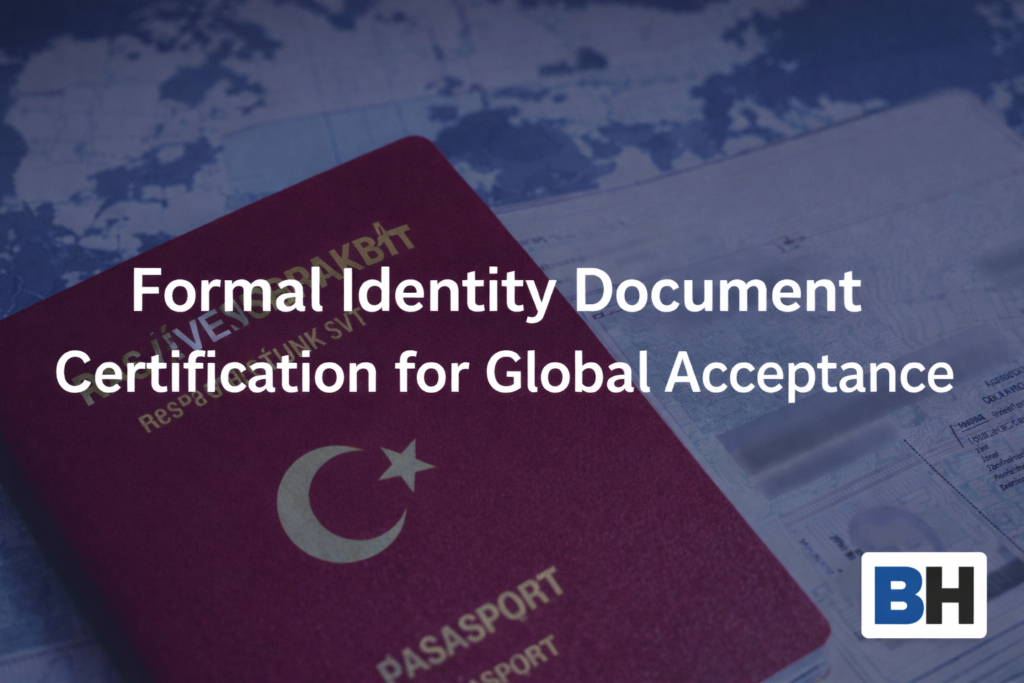
Identity Document Certification for Global Acceptance
Introduction: Why Identity Document Certification Still Matters in a Digital World
Despite rapid advances in digital identification systems, biometric technologies, and online verification tools, the certification of physical identity documents remains a critical legal requirement in many international processes. Immigration authorities, professional licensing bodies, academic institutions, courts, regulators, and examination boards across the world continue to rely on certified copies of passports and primary identity documents as a foundational safeguard against fraud, misrepresentation, and identity abuse.
Certification of identity documents is often perceived by applicants as a routine administrative step. In practice, however, it is a legally meaningful act that carries evidentiary consequences. Improper certification frequently leads to processing delays, rejection of applications, suspension of procedures, or requests for resubmission that can jeopardize time-sensitive opportunities such as licensing deadlines, immigration quotas, employment offers, or regulatory approvals.
The persistence of strict certification requirements reflects a broader reality: while identity verification methods may evolve, institutions still require a legally accountable professional to attest that a copy faithfully represents an original document. In cross-border contexts, where authorities must rely on documents issued and certified abroad, this legal accountability becomes even more important.
This article examines the certification of passports and primary identity documents from a global perspective, clarifies common misunderstandings, outlines universal formal requirements, highlights frequent pitfalls, and explains why lawyer-led certification plays a central role in international practice.
What Is Certification of Identity Documents?
Certification of an identity document is the formal declaration by an authorized professional that a photocopy or reproduction is a true and complete copy of an original document that has been physically examined. The certifying official does not validate the authenticity of the document’s issuance, nor do they guarantee the legal status of the document holder. Their role is limited, but legally significant: they attest that the copy corresponds exactly to the original presented.
Certification is often confused with notarization, legalization, or apostille procedures. These processes serve different legal purposes and are governed by different rules. Certification focuses on conformity with the original, while notarization may involve authentication of signatures, apostille concerns the international recognition of public documents, and legalization relates to diplomatic or consular validation. Many authorities explicitly require certification and reject apostilled or legalized copies when certification rules are not met.
Another common misunderstanding is the assumption that certification is a purely technical act. In reality, certification is a professional declaration that exposes the certifying official to ethical and legal responsibility. This is precisely why institutions insist that certification be carried out by individuals who are subject to professional regulation and disciplinary oversight, such as lawyers or notaries.
Identity Documents Commonly Requiring Certification
Passports are the most frequently certified identity documents in international procedures. Typically, the biographic data page is required, and in some cases additional pages containing signatures, visas, entry stamps, or residence permits must also be certified. National identity cards, where used as primary identification, are similarly subject to certification requirements.
Residence permits, refugee travel documents, and stateless person travel documents often require certification, particularly when submitted to foreign authorities unfamiliar with the issuing format. Birth certificates are sometimes included as identity anchors, especially in cases involving name changes, nationality claims, or family-based applications, although many institutions distinguish between identity documents and civil status documents.
It is important to note that numerous authorities expressly limit certification requirements to identity documents and do not require certified copies of academic diplomas, professional qualifications, or medical credentials. Applicants frequently incur unnecessary costs by certifying documents that are not required to be certified.
Who Can Certify? A Comparative Overview Across Jurisdictions
Across jurisdictions, the category of acceptable certifying officials varies, but there is a growing international convergence around the acceptance of lawyers as certifying authorities. Lawyers who are members of an official bar association, acting within the scope of their professional mandate, are widely recognized as competent certifying officials regardless of the country in which they practice.
The rationale is straightforward. Lawyers are regulated professionals, bound by ethical duties, subject to disciplinary sanctions, and capable of understanding the legal consequences of certification. Their professional status provides assurance to receiving institutions that the certification is traceable and accountable.
In some jurisdictions, notaries public may also certify documents. However, the role and authority of notaries differ significantly between civil law and common law systems, which can create uncertainty for international applicants. Public officers or government officials may have limited certification powers, but their acceptance is often restricted to domestic procedures and may not extend to international applications.
As a result, lawyer-certified copies have become the most universally accepted form of certification in cross-border practice.
Core Formal Requirements for Valid Certification: Universal Standards
Although certification rules are issued by individual institutions, there is remarkable consistency in their formal requirements worldwide. These requirements reflect a shared understanding of what constitutes a reliable certified copy.
First, the certifying official must physically examine the original document. Certification must be based on direct comparison between the original and the copy. Photographs sent by email, scanned images, or digital reproductions do not satisfy this requirement.
Second, the quality of the photocopy is critical. The entire document must be visible, including all borders. Text, numbers, photographs, signatures, and security elements must be clear and legible. Cropped images, blurred copies, or partial reproductions frequently lead to rejection.
Third, each certified page must contain specific mandatory information. The certifying official must clearly indicate their name and professional title. Full contact information, including address, telephone number, and email address, must be provided to allow verification by the receiving authority. An original signature is required, and the certification must be dated.
Fourth, the certification statement itself must explicitly declare that the copy is a true copy of the original. Many institutions require this declaration to be written in English or French, and some accept bilingual statements. The wording must be unambiguous and must appear on each certified page.
Fifth, the certifying official must apply an embossed seal or ink stamp. The seal or stamp must be clearly attributable to the professional and, in many cases, must be in English or French. Seals in other languages may be rejected even if the certification statement is translated.
Language Requirements and the Dominance of English and French
English and French occupy a unique position in international administrative practice. They function as procedural languages for many global institutions, professional bodies, and examination authorities. Consequently, certification statements, seals, and stamps are often required to be in one of these languages.
Applicants frequently overlook this requirement, assuming that certification in the local language of the certifying official will suffice. In practice, this is one of the most common reasons for rejection. Institutions are not obliged to translate certification statements or interpret foreign-language seals.
Where domestic professional stamps are issued only in the local language, practical solutions may include adding a bilingual certification statement or supplementary annotation in English or French, provided this is permitted under professional rules. Careful coordination is essential to avoid non-compliance.
What is Not Accepted: High-Risk Errors Leading to Rejection
Certain practices are almost universally rejected. Candidates may not certify their own documents under any circumstances. Certifications performed online, virtually, digitally, or electronically are generally not accepted, regardless of technological safeguards.
Scanned signatures, electronic stamps, undated certifications, or certifications lacking contact details are treated as invalid. Certification by individuals who lack an explicit professional mandate is also a common source of refusal.
These errors are procedural in nature, but their consequences are substantive. They can delay applications by months and, in some cases, result in permanent exclusion from a given intake or examination cycle.
Cost, Responsibility, and Risk Allocation
The financial cost of certification is borne by the applicant. More importantly, the responsibility for ensuring compliance rests entirely with the candidate. Receiving institutions rarely assume responsibility for advising on certification requirements beyond general guidelines.
This allocation of responsibility underscores the importance of verifying, in advance, that the chosen certifying official has the authority, language capability, and professional tools required to perform a compliant certification. From the certifying professional’s perspective, certification is not a risk-free service. It carries ethical and, in some jurisdictions, legal liability if performed negligently or improperly.
Certification, Apostille, and Legalization: Clearing the Confusion
Applicants often assume that apostille or legalization provides a higher level of validity than certification. This assumption is incorrect in many contexts. Apostille and legalization serve specific purposes related to the recognition of public documents, not to the conformity of copies with originals.
Many authorities expressly state that apostilled copies are not a substitute for certified copies of identity documents. In some cases, apostille may even complicate matters by altering the format of the document in a way that does not meet certification requirements.
Understanding which procedure is required, and which is unnecessary or inappropriate, is essential to avoid wasted time and expense.
Cross-Border Certification in Practice: Practical Challenges
Cross-border certification presents unique challenges. Applicants may reside in countries where local professionals are unfamiliar with foreign certification standards. Language incompatibilities, differences in professional seals, and varying interpretations of mandate create uncertainty.
Time sensitivity compounds these challenges. Licensing examinations, immigration programs, and regulatory approvals often operate on fixed timelines. A single certification error can disrupt an entire application strategy.
In this context, coordinated legal assistance becomes particularly valuable, ensuring that certification is aligned with the expectations of the receiving authority from the outset.
The Role of Law Firms in International Certification Processes
Law firms engaged in international practice are uniquely positioned to manage identity document certification. They can interpret foreign authority requirements, ensure compliance with language and formatting rules, and integrate certification with related services such as sworn translation or document legalization when appropriate.
By acting as a single point of professional accountability, law firms reduce the risk of rejection and provide predictability for both applicants and receiving institutions. This approach transforms certification from a procedural obstacle into a managed legal process.
Centralized certification services offer consistency across multiple applications and jurisdictions. They enable standardized certification formats, reliable record-keeping, and traceability. For regulators and institutions, this consistency enhances trust. For applicants, it reduces uncertainty and administrative burden.
In an increasingly interconnected world, such centralized legal services play a quiet but critical role in facilitating global mobility, professional recognition, and regulatory compliance.
Conclusion: Certification as a Gatekeeper to Global Mobility
Certification of passports and primary identity documents is not a mere formality. It is a gatekeeping mechanism that underpins trust in international administrative systems. Errors are often procedural, but their consequences can be severe.
Understanding global certification standards, avoiding common pitfalls, and relying on professionally accountable certifying officials are essential steps for any individual or institution operating across borders. Lawyer-led certification services, grounded in international practice and legal accountability, remain one of the most reliable means of navigating this complex landscape.





Comments
No comments yet.