 English
 Türkçe
 Français
 Deutsch

Global legal benchmarking has become an essential tool for improving legal certainty, regulatory quality and the business environment by enabling objective comparisons of legal and institutional frameworks across jurisdictions. The World Bank has progressively refined its methodology through initiatives such as the Enabling the Business of Agriculture (EBA), Digital Business Indicators (DBI), the Global Data Regulation Diagnostic (GDRD) and the Business Ready (B-READY) programme. These projects evaluate not only legal frameworks but also the effectiveness of public services and the practical implementation of regulations, providing policymakers and investors with valuable evidence-based insights. Since 2015, Bıçak Law Firm has contributed to these initiatives by providing legal expertise in areas including agricultural regulation, information and communication technologies, the digital economy, data governance, financial services and dispute resolution. The firm’s contributions have evolved from individual expert participation into a multidisciplinary institutional effort involving Prof. Dr. Vahit Bıçak, Ayşe Bıçak, Beyza Gözde Bıçak and Vahdet Talha Bıçak, reflecting the growing complexity of international legal benchmarking. This long-standing cooperation has strengthened the firm’s capabilities in comparative legal analysis, legislative evaluation, regulatory benchmarking and evidence-based legal research. Today, these competencies enable Bıçak Law Firm to provide sophisticated legal advice to multinational companies, foreign investors, financial institutions, embassies and international organisations operating in or considering investment in Türkiye. By combining internationally recognised benchmarking experience with practical legal expertise, Bıçak Law Firm remains committed to supporting transparent regulation, legal certainty and sustainable economic development through high-quality cross-border legal advisory services.
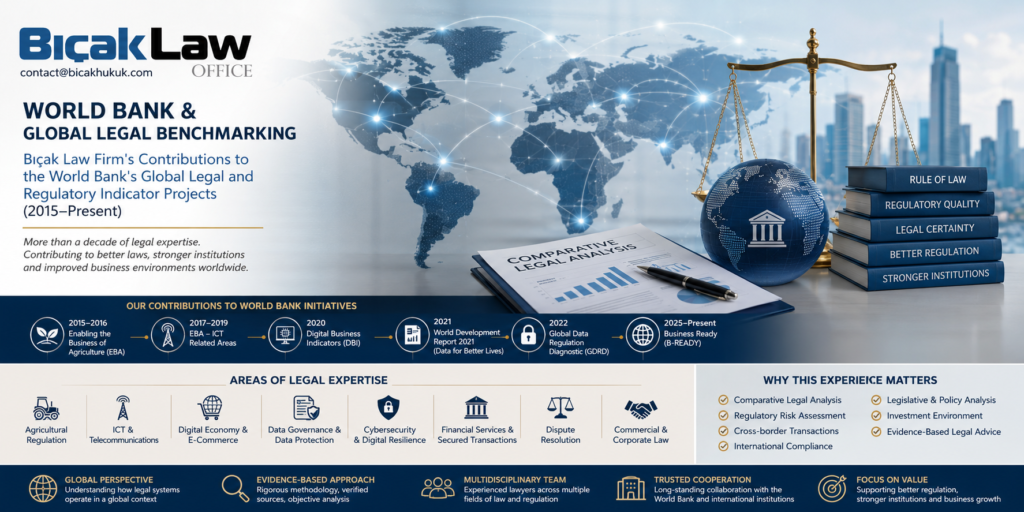
World Bank & Global Legal Benchmarking
1. Introduction
In an increasingly interconnected global economy, the quality, predictability and transparency of legal and regulatory systems have become decisive factors in attracting investment, facilitating international trade and supporting sustainable economic development. Businesses considering investments in foreign jurisdictions no longer evaluate markets solely on the basis of taxation, labour costs or market size. They also examine whether contracts are enforceable, regulatory procedures are transparent, disputes can be resolved efficiently, property rights are protected and public institutions function effectively. Consequently, comparative assessments of legal and regulatory environments have become an essential component of international decision-making.
International organisations play a significant role in this process by developing objective methodologies that enable governments, businesses, researchers and policymakers to compare legal frameworks across jurisdictions. Rather than ranking countries based solely on economic performance, these initiatives seek to evaluate how legal systems operate in practice, identify regulatory strengths and weaknesses, and encourage evidence-based legal reform. Over the past two decades, the World Bank Group has emerged as one of the leading institutions in this field through a series of global legal and regulatory indicator projects.
These projects have evolved considerably over time. While earlier initiatives focused primarily on measuring the existence of legal rules, more recent methodologies examine the effectiveness of public services, institutional capacity and the practical implementation of legislation. This evolution reflects an important recognition that well-drafted laws alone are insufficient; their implementation, accessibility and enforcement are equally critical for creating a favourable business environment.
Developing reliable global legal indicators requires extensive international cooperation. Comparative legal research depends on the contributions of experienced legal practitioners, academics and subject-matter experts who possess detailed knowledge of their national legal systems. These experts assist in interpreting legislation, explaining institutional practices, identifying recent reforms and providing the documentary evidence necessary to ensure that the resulting data are both accurate and comparable across jurisdictions. Their work is subsequently subjected to rigorous validation, cross-checking and quality assurance procedures before becoming part of the World Bank’s global datasets.
Since 2015, members of Bıçak Law Firm have had the privilege of contributing to several of these international legal benchmarking initiatives. Over the years, different members of the firm have participated in projects covering agricultural regulation, information and communication technologies, digital economy, data governance, cybersecurity, dispute resolution and financial services. These contributions have been made through successive World Bank programmes, including the Enabling the Business of Agriculture (EBA) initiative, the Digital Business Indicators (DBI) project, the Global Data Regulation Diagnostic (GDRD) and, most recently, the Business Ready (B-READY) programme.
Our participation has provided valuable insight into the methodologies used to evaluate legal systems on a global scale. Beyond contributing country-specific legal expertise, it has enabled our team to develop a deeper understanding of comparative legal analysis, regulatory benchmarking, legislative evaluation and the relationship between legal institutions and economic development. These experiences have strengthened our ability to advise international clients operating in Türkiye while contributing to broader discussions on regulatory quality and legal reform.
This article examines the evolution of the World Bank’s legal and regulatory indicator projects, explains how global legal benchmarking operates in practice, and describes how Bıçak Law Firm has contributed to these initiatives over more than a decade. Rather than serving as a historical account of our participation alone, the article aims to provide a broader perspective on the importance of comparative legal benchmarking and its relevance for governments, businesses, investors and legal professionals engaged in cross-border activities.
2. Why Global Legal Benchmarking Matters
The legal environment in which businesses operate has become an increasingly important determinant of economic competitiveness. Whether establishing a new company, financing an investment, acquiring property, protecting intellectual assets or resolving commercial disputes, investors rely upon predictable legal systems that reduce uncertainty and facilitate efficient economic activity. Consequently, legal certainty has become an integral component of national competitiveness and sustainable economic growth.
For governments, legal benchmarking serves a different but equally important purpose. Comparative assessments enable policymakers to identify regulatory gaps, evaluate the effectiveness of existing legislation and measure progress against internationally recognised good practices. Rather than prescribing identical legal solutions for every jurisdiction, modern benchmarking methodologies seek to understand how different legal systems achieve similar policy objectives while respecting national legal traditions and institutional structures.
Global legal benchmarking has also transformed the way legal reforms are designed. Historically, legislative reform often focused on adopting new statutes without adequately considering implementation, institutional capacity or administrative efficiency. Contemporary benchmarking initiatives increasingly recognise that effective regulation depends not only on the content of legislation but also on the quality of public institutions responsible for its administration. As a result, modern indicator projects evaluate legal frameworks alongside regulatory services, administrative procedures and practical outcomes.
The growing importance of digitalisation has further expanded the scope of legal benchmarking. Issues such as cybersecurity, personal data protection, digital transactions, cross-border data flows, artificial intelligence and electronic communications now occupy a central place in international regulatory discussions. Similarly, developments in international finance have increased attention to secured transactions, collateral registries, insolvency frameworks and dispute resolution mechanisms that facilitate commercial certainty and access to finance.
From the perspective of international businesses, comparative legal indicators provide valuable information during market entry and investment planning. They assist companies in identifying regulatory risks, estimating compliance costs and understanding institutional practices before making strategic decisions. While no indicator system can capture every aspect of a country’s legal environment, carefully developed comparative methodologies offer a structured framework for analysing complex legal systems across multiple jurisdictions.
For legal practitioners, participation in such projects requires a distinctive combination of skills. Experts must not only possess detailed knowledge of domestic legislation but also understand comparative law, international best practices and the methodological requirements of large-scale empirical research. They are expected to interpret legislation objectively, distinguish between legal rules and administrative practice, provide documentary support for their conclusions and respond to rigorous validation procedures. In this sense, global legal benchmarking represents a unique intersection between legal scholarship, professional practice and evidence-based public policy.
Against this background, the World Bank’s legal and regulatory indicator programmes have become influential instruments for promoting legal transparency, regulatory quality and institutional development. Their evolution over the past decade illustrates a broader shift from measuring legal texts alone towards evaluating how legal systems function in practice. Understanding this evolution provides the necessary foundation for appreciating both the significance of these initiatives and the role played by legal experts who contribute to them.
3. The Evolution of the World Bank’s Legal and Regulatory Indicator Projects
The World Bank Group has long recognised that a well-functioning legal and regulatory framework is fundamental to economic development, private sector growth and investment confidence. However, measuring the quality of legal systems across diverse jurisdictions presents a considerable methodological challenge. Legal traditions differ significantly from one country to another, administrative structures vary widely, and identical legislative provisions may produce very different outcomes depending on institutional capacity and practical implementation.
To address these challenges, the World Bank has progressively developed a series of legal and regulatory indicator projects that have evolved in both scope and methodology. Rather than representing isolated initiatives, these programmes form part of a continuous effort to improve the way legal systems are analysed, compared and understood. Each successive project has built upon the experience of its predecessors while expanding the range of legal issues examined and refining the methodologies used to collect, validate and interpret legal information.
Although each programme has its own objectives and sectoral focus, they share a common philosophy: legal frameworks should be evaluated not merely by reference to statutory provisions but by considering how effectively they support economic activity, protect legal certainty and facilitate the operation of public institutions.
3.1. From Sector-Specific Assessment to Comprehensive Legal Benchmarking
One of the earliest initiatives in this evolution was the Enabling the Business of Agriculture (EBA) programme. Recognising the importance of agriculture as a driver of economic development, particularly in developing economies, the project sought to identify legal and regulatory barriers affecting agricultural markets. Rather than focusing solely on agricultural production, EBA examined the broader legal ecosystem surrounding agricultural business activities, including transport, seed regulation, fertiliser, machinery, finance, market access and information and communication technologies.
The programme demonstrated an important methodological innovation. Instead of asking whether legislation formally existed, questionnaires examined whether regulatory systems functioned effectively in practice. Experts were expected to explain licensing procedures, administrative requirements, institutional responsibilities and documentary evidence supporting their responses. Consequently, legal analysis became closely integrated with regulatory implementation.
It was within this framework that members of Bıçak Law Firm first contributed to World Bank legal indicator projects. Beginning in 2015, the firm’s expertise supported comparative assessments concerning agricultural transport regulation and, subsequently, information and communication technologies. These early contributions introduced our team to the rigorous methodology underlying international comparative legal benchmarking, including structured questionnaires, documentary evidence requirements and multiple rounds of expert validation.
3.2. Expanding into the Digital Economy
As digital transformation accelerated across the global economy, the World Bank expanded its focus beyond sector-specific regulation. Digital technologies were fundamentally changing the way businesses operated, governments delivered public services and individuals interacted with legal institutions. Consequently, entirely new legal questions emerged concerning electronic commerce, digital identities, cybersecurity, electronic signatures, data protection, privacy and cross-border data flows.
The Digital Business Indicators (DBI) programme reflected this changing regulatory landscape. Rather than concentrating on a single economic sector, DBI examined the legal infrastructure supporting digital business activity across participating jurisdictions. The project recognised that digital economies depend upon coherent legal frameworks governing electronic transactions, secure communications, digital infrastructure and regulatory certainty.
For legal experts, this represented a significant methodological expansion. Traditional commercial law increasingly intersected with technology law, telecommunications regulation, cybersecurity, intellectual property and administrative law. Comparative legal analysis therefore required not only an understanding of domestic legislation but also familiarity with rapidly evolving international regulatory standards.
Members of Bıçak Law Firm participated actively in this transition. Building upon earlier contributions under the EBA programme, the firm’s expertise expanded into digital economy regulation, telecommunications law, cybersecurity and data governance. The participation of multiple lawyers within the firm also reflected the increasingly multidisciplinary character of comparative legal research, where expertise in different legal fields became essential for accurately interpreting complex regulatory environments.
3.3. Data Governance as a New Regulatory Frontier
The publication of the World Development Report 2021: Data for Better Lives marked another significant milestone in the World Bank’s approach to legal benchmarking. The report recognised data as a strategic economic resource capable of generating innovation, improving public services and supporting economic growth. At the same time, it acknowledged the legal and ethical challenges associated with the collection, processing, sharing and protection of data.
These developments naturally led to the Global Data Regulation Diagnostic (GDRD), which sought to assess how countries regulate data throughout its lifecycle. Rather than concentrating exclusively on personal data protection legislation, the Diagnostic adopted a broader perspective by examining regulatory frameworks governing data collection, processing, access, sharing, cross-border transfers and institutional oversight.
This evolution illustrates an important characteristic of the World Bank’s methodology. New indicator projects are not created in isolation; instead, they build upon knowledge generated by previous initiatives while responding to emerging global regulatory challenges. Consequently, expertise developed through earlier projects becomes increasingly valuable as methodologies become more sophisticated and interdisciplinary.
For legal practitioners, participation in the Global Data Regulation Diagnostic required an integrated understanding of constitutional law, privacy, administrative law, commercial regulation, cybersecurity and international legal developments. The project demonstrated that modern legal benchmarking increasingly extends beyond traditional business regulation to encompass the broader legal architecture supporting digital economies.
3.4. The Emergence of Business Ready (B-READY)
The most recent stage in this methodological evolution is represented by the Business Ready (B-READY) programme. While previous projects concentrated on specific sectors or regulatory themes, B-READY adopts a comprehensive approach to evaluating business environments throughout the lifecycle of a firm.
Its methodology reflects important lessons learned from earlier indicator projects. Rather than measuring legislation alone, B-READY examines three complementary dimensions: the quality of the regulatory framework, the effectiveness of public services and the efficiency with which regulations operate in practice. This integrated approach acknowledges that businesses interact not only with legal texts but also with administrative institutions responsible for implementing those rules.
Another notable methodological development is the increasing emphasis placed on quality assurance. Legal experts contribute through structured questionnaires supported by legislative references and documentary evidence. Their responses are subsequently compared with those of other experts, reviewed for consistency, supplemented by secondary sources and, where necessary, clarified through follow-up correspondence. This iterative validation process strengthens both the reliability and the comparability of the resulting datasets.
Bıçak Law Firm’s contributions to the Business Ready programme have focused on Dispute Resolution and Financial Services – Secured Transactions, reflecting the firm’s established expertise in commercial litigation, arbitration, financial regulation and comparative legal analysis. These contributions represent the continuation of a relationship with the World Bank that has developed over more than a decade and has evolved alongside the Bank’s own methodological transformation.
3.5. An Evolving Methodology Reflecting Evolving Legal Systems
The progression from EBA to DBI, the Global Data Regulation Diagnostic and Business Ready demonstrates more than the expansion of individual projects. It illustrates the evolution of comparative legal benchmarking itself. Modern legal systems are increasingly interconnected, and economic activity now depends upon regulatory areas that received comparatively little attention only a decade ago, including digital governance, cybersecurity, financial infrastructure, data regulation and technology-enabled public services.
As legal complexity increases, so too does the importance of experienced legal experts capable of interpreting legislation within its broader institutional context. Comparative legal benchmarking therefore represents not merely the collection of legal information but the systematic transformation of legal knowledge into evidence capable of supporting policy development, regulatory reform and international investment decisions.
This methodological evolution also explains why long-term participation by experienced experts and institutions has become increasingly valuable. Successive projects benefit from accumulated expertise, institutional memory and a deeper understanding of both national legal systems and international benchmarking methodologies. For Bıçak Law Firm, continuous participation across multiple World Bank initiatives has enabled the development of precisely this combination of comparative legal knowledge, regulatory analysis and international perspective, forming a core component of the firm’s advisory practice for domestic and international clients.
4. How Global Legal Benchmarking Works
Developing internationally comparable legal indicators is a far more sophisticated undertaking than simply collecting legislative texts from different jurisdictions. Legal systems are shaped by distinct constitutional traditions, institutional structures, administrative practices and judicial interpretations. Two countries may have legislation addressing the same regulatory issue while achieving markedly different outcomes because of differences in implementation, institutional capacity or administrative efficiency. Consequently, meaningful legal benchmarking requires a methodology capable of distinguishing legal rules from their practical operation.
Over the past decade, the World Bank has progressively refined its approach to comparative legal research by combining structured legal analysis with multiple layers of validation and quality assurance. Although the precise methodologies vary among individual programmes, the underlying principles have remained remarkably consistent. These principles seek to ensure that legal information collected from participating jurisdictions is accurate, verifiable, comparable and sufficiently robust to support evidence-based policy analysis.
Participation in these projects has provided members of Bıçak Law Firm with first-hand experience of this rigorous methodological framework. Our involvement has demonstrated that international legal benchmarking is not merely an academic exercise; it is a highly structured research process requiring technical legal expertise, methodological discipline and continuous interaction between legal experts and project teams.
4.1. Selecting Subject-Matter Experts
The reliability of any comparative legal indicator depends fundamentally upon the quality of the experts who contribute country-specific information. For this reason, the World Bank devotes considerable attention to identifying professionals with recognised expertise in the relevant areas of law.
Expert selection typically considers several factors, including professional qualifications, academic background, practical legal experience, publications, previous research, institutional knowledge and familiarity with the relevant regulatory framework. Depending on the project, contributors may include practising lawyers, judges, academics, government officials or specialists with extensive experience in a particular regulatory field.
The objective is not simply to identify knowledgeable individuals but to ensure that responses reflect objective legal analysis rather than institutional or commercial interests. Contributors are therefore expected to provide independent professional opinions supported by legislation, official regulations, publicly available documents and other verifiable sources.
Our firm’s participation across successive World Bank initiatives reflects this long-term emphasis on professional expertise and continuity. As new projects addressed emerging legal fields – including digital regulation, data governance, secured transactions and dispute resolution – different members of our team contributed specialised knowledge corresponding to their respective areas of practice. This multidisciplinary participation mirrors the increasingly interdisciplinary nature of contemporary legal benchmarking.
4.2. Structured Legal Questionnaires
The principal instrument used in most World Bank indicator projects is the structured legal questionnaire. These questionnaires are carefully designed to obtain consistent information from experts across a large number of jurisdictions while minimising ambiguity and improving comparability.
Questions typically require considerably more than a simple affirmative or negative response. Experts are expected to explain relevant legal rules, identify competent authorities, describe administrative procedures, cite applicable legislation and, where appropriate, clarify how statutory provisions operate in practice.
Many questions examine hypothetical but realistic scenarios designed to ensure that legal systems are evaluated under comparable factual circumstances. By presenting identical situations to experts in different jurisdictions, the methodology enables legal differences to be identified without being distorted by variations in commercial practice or individual cases.
From the perspective of legal experts, completing these questionnaires often requires comprehensive legal research extending across multiple branches of law. Commercial legislation, administrative regulations, procedural rules, constitutional principles and sector-specific legislation frequently interact within a single response. Consequently, the preparation of accurate submissions requires both technical legal expertise and a systematic understanding of the broader regulatory framework.
4.3. Beyond Legislation: Understanding How Legal Systems Function
One of the most significant methodological developments in recent World Bank projects has been the increasing recognition that legislation alone cannot adequately describe the quality of a legal system. Historically, comparative legal studies frequently concentrated on determining whether specific legal provisions existed. Modern regulatory benchmarking adopts a more nuanced perspective. It seeks to understand how legal frameworks function within their institutional environment and whether businesses are capable of using those legal mechanisms efficiently in practice.
This distinction is particularly important because formal legislation may differ substantially from administrative reality. Procedures established by law may be implemented differently across jurisdictions. Administrative institutions may possess varying levels of capacity, resources or technical expertise. Digital government services may significantly reduce regulatory burdens despite unchanged legislation, while inefficient administrative procedures may diminish the practical effectiveness of otherwise well-designed legal frameworks.
For these reasons, contemporary legal benchmarking increasingly combines analysis of legal rules with evaluation of administrative processes, institutional performance and service delivery. This broader perspective produces a more realistic assessment of the legal environment experienced by businesses and investors.
4.4. Documentary Evidence and Secondary Sources
An essential characteristic of the World Bank’s methodology is its reliance upon verifiable evidence. Expert opinions, regardless of their professional authority, are not treated as sufficient in themselves. Contributors are generally expected to support their responses by identifying relevant legislation, official regulations, judicial decisions where appropriate, administrative guidance or other authoritative materials.
Project teams also conduct extensive independent research using publicly available sources. Legislation, government publications, regulatory databases and official institutional materials may all be reviewed as part of the validation process. This independent examination serves two complementary purposes: verifying the accuracy of expert responses and ensuring consistency across participating jurisdictions.
Where discrepancies arise between expert submissions and documentary evidence, further clarification may be requested. Contributors may receive follow-up questions seeking additional legal references, explanations of recent legislative amendments or clarification concerning administrative practice. This iterative process significantly enhances the reliability of the final dataset.
From our own experience, this aspect of the methodology illustrates the collaborative nature of global legal benchmarking. Rather than simply collecting questionnaires, project teams engage in an ongoing professional dialogue with contributors, refining legal interpretations until an accurate and fully documented understanding of the national legal framework has been achieved.
4.5. Cross-Validation and Quality Assurance
Another distinguishing feature of World Bank legal indicator projects is the extensive quality assurance process applied before information is incorporated into comparative datasets. Responses submitted by individual experts are not accepted automatically. Instead, they are reviewed through multiple layers of validation designed to identify inconsistencies, ambiguities or incomplete information. Depending on the project, this may include comparison with submissions from other experts, review by specialised research teams, consultation of independent documentary sources and further correspondence with contributors.
This process serves several important objectives. First, it improves the internal consistency of the data by ensuring that identical methodological standards are applied across all participating jurisdictions. Secondly, it reduces the risk of subjective interpretation by requiring legal conclusions to be supported by objective evidence. Finally, it strengthens international comparability by ensuring that similar legal concepts are interpreted consistently regardless of national legal terminology.
For participating experts, this validation process frequently extends well beyond the initial submission of questionnaires. Additional requests for clarification, supplementary legal references or confirmation of legislative developments may continue throughout the research cycle. Consequently, participation represents an ongoing collaborative process rather than a single contribution.
4.6. Confidentiality, Professional Integrity and Institutional Trust
International legal benchmarking depends not only upon technical methodology but also upon professional ethics. Contributors are entrusted with providing accurate, impartial and evidence-based information that may ultimately influence comparative assessments, policy discussions and future legal reforms. Accordingly, confidentiality forms an important element of many World Bank research projects. Draft questionnaires, preliminary analyses, internal methodological discussions and validation procedures are generally conducted within a confidential professional framework. Experts are expected to respect these requirements while maintaining the independence and objectivity of their legal analysis.
Long-term participation in successive projects naturally contributes to the development of institutional trust between project teams and legal experts. Such continuity enables researchers to benefit from accumulated expertise while allowing contributors to develop an increasingly sophisticated understanding of comparative methodologies and evolving regulatory priorities.
For Bıçak Law Firm, participation in multiple World Bank initiatives over more than a decade has provided valuable opportunities to engage with this evolving methodological framework. Beyond individual projects, the experience has strengthened our capabilities in comparative legal research, legislative analysis, regulatory evaluation and evidence-based legal assessment. These competencies now form an integral part of the firm’s international advisory practice, particularly in matters involving foreign investment, regulatory compliance, cross-border transactions and complex comparative legal analysis.
4.7. Comparative Legal Research as a Bridge Between Law and Public Policy
Perhaps the most important lesson emerging from global legal benchmarking is that comparative legal analysis extends beyond the interpretation of statutes. It represents a bridge between legal doctrine, institutional practice, economic policy and regulatory reform. By transforming complex legal systems into structured, comparable and evidence-based information, international indicator projects help governments identify opportunities for improvement while providing businesses with greater transparency and predictability.
For legal professionals, participation in this process offers a unique perspective on how domestic legal systems are viewed within an international comparative framework. It requires balancing detailed knowledge of national legislation with an appreciation of broader policy objectives, methodological consistency and global regulatory developments. In this respect, global legal benchmarking has become not merely a research methodology but an increasingly important discipline within contemporary comparative law itself.
5. Bıçak’s Contributions to World Bank Legal and Regulatory Indicator Projects )
Meaningful participation in international legal benchmarking is rarely confined to a single questionnaire or research project. Instead, it develops through sustained collaboration, accumulated expertise and the ability to contribute consistently to increasingly sophisticated research initiatives. The evolution of Bıçak Law Firm’s involvement in World Bank legal and regulatory indicator projects reflects this progression.
Beginning in 2015, members of the firm have contributed to a succession of World Bank programmes examining diverse areas of law and regulation. Although each project addressed different legal questions and adopted its own methodological framework, together they illustrate the firm’s continuing engagement with comparative legal research and international regulatory analysis.
Over more than a decade, these contributions have expanded from sector-specific regulatory issues to complex questions involving digital governance, financial regulation, dispute resolution and data policy. Equally important, participation gradually evolved from the contribution of an individual legal expert into a multidisciplinary institutional effort involving several members of the firm, each contributing specialised expertise within their respective fields of practice. This continuity has enabled the firm not only to follow the evolution of the World Bank’s methodologies but also to develop a deeper understanding of how comparative legal analysis supports evidence-based policymaking, regulatory reform and international investment.
5.1. 2015–2016: Building the Foundation
Bıçak Law Firm’s collaboration with the World Bank began with the Enabling the Business of Agriculture (EBA) programme. During its initial phase, the project focused on identifying legal and regulatory barriers affecting agricultural markets, recognising that efficient legal frameworks play an essential role in supporting agricultural productivity, market access and private investment.
The firm’s earliest contribution concerned transporting agricultural goods, an area requiring analysis of legislation governing transportation services, regulatory licensing, infrastructure-related legal requirements and institutional responsibilities. Although sector-specific in appearance, the assignment required a broader understanding of commercial regulation, administrative law and regulatory governance.
This initial participation introduced our team to the structured methodology that would become characteristic of subsequent World Bank projects. Rather than providing general legal commentary, contributors were expected to analyse legislation systematically, identify competent authorities, explain administrative procedures and support their conclusions with documentary evidence.
The following year, our work expanded to Information and Communication Technologies (ICT) within the same programme. This transition reflected the increasing importance of digital infrastructure in agricultural markets and demonstrated how rapidly evolving technologies were beginning to influence regulatory assessment. Questions relating to telecommunications regulation, electronic communications and digital infrastructure required expertise extending beyond traditional commercial law into technology-related regulatory frameworks.
These early assignments established the methodological foundation upon which subsequent contributions would be built. They also marked the beginning of a long-term professional relationship with World Bank research teams based on technical expertise, methodological consistency and evidence-based legal analysis.
5.2. 2017–2019: Expanding Comparative Legal Expertise
As the Enabling the Business of Agriculture programme matured, so too did the firm’s involvement. Participation during this period became increasingly comprehensive, reflecting both accumulated experience and the World Bank’s growing emphasis on data quality, methodological consistency and cross-country comparability.
An important development during this phase was the expansion of participation beyond a single contributor. Ayşe Bıçak joined selected project activities, reflecting the firm’s developing institutional capacity and its ability to contribute specialised expertise through multiple legal professionals. This collaborative approach anticipated the multidisciplinary nature of later World Bank initiatives.
Repeated invitations to participate in subsequent research cycles also illustrate an important characteristic of international legal benchmarking. Because longitudinal studies seek to measure regulatory developments over time, methodological continuity becomes particularly valuable. Contributors who are familiar with both the legal system under examination and the research methodology itself are well positioned to identify legislative changes, explain institutional developments and ensure consistency between successive data collection exercises.
For Bıçak Law Firm, these years represented a period of methodological consolidation. Participation was no longer limited to responding to individual questionnaires; it increasingly involved understanding the broader objectives of comparative legal benchmarking, appreciating the significance of consistency in legal interpretation and recognising the importance of high-quality documentary support. The experience gained during these projects subsequently proved invaluable as the World Bank expanded its research beyond sector-specific regulation into broader questions concerning digital economies and regulatory governance.
5.3. 2020–2022: Supporting the Digital Transformation of Legal Benchmarking
The global acceleration of digital transformation fundamentally altered the legal questions addressed by international regulatory research. Digital commerce, electronic government services, cybersecurity, artificial intelligence and data governance emerged as central components of modern regulatory systems. Responding to these developments, the World Bank introduced new initiatives designed to evaluate the legal infrastructure supporting digital economies.
This period marked an important milestone for Bıçak Law Firm. Participation evolved from the work of an individual expert into a genuinely multidisciplinary institutional effort involving several members of the firm. Prof. Dr. Vahit Bıçak continued to contribute his extensive experience in comparative legal analysis and regulatory evaluation, while additional expertise was provided by Beyza Gözde Bıçak and Vahdet Talha Bıçak, whose work focused on areas directly related to digital regulation, emerging technologies and contemporary commercial law. Their participation reflected the increasing complexity of modern legal benchmarking. Questions concerning digital economies cannot be answered through the application of a single legal discipline. Instead, they require integrated analysis combining constitutional law, administrative law, commercial law, data protection, cybersecurity, telecommunications regulation and international legal developments.
During this period, members of the firm contributed to projects including the Digital Business Indicators (DBI) initiative and research associated with the World Development Report 2021: Data for Better Lives. These programmes examined the legal infrastructure supporting digital business environments and highlighted the growing importance of data as both an economic asset and a regulatory challenge.
The firm’s expertise also contributed to the Global Data Regulation Diagnostic, reflecting the increasing international focus on legal frameworks governing data collection, processing, sharing, cross-border transfers and institutional oversight. These projects required contributors to analyse not only existing legislation but also the institutional architecture responsible for implementing increasingly sophisticated regulatory regimes. This phase significantly broadened the firm’s comparative legal expertise, particularly in areas that now occupy a central place in international legal practice, including data governance, digital regulation and technology-related compliance.
5.4. 2025–Present: Business Ready and a Mature Institutional Partnership
The introduction of the Business Ready (B-READY) programme represents the most recent stage in the World Bank’s continuing efforts to evaluate business environments through comprehensive legal and regulatory analysis. Unlike earlier initiatives that focused on individual sectors or thematic areas, Business Ready examines the legal environment encountered throughout the lifecycle of a business. Its methodology evaluates not only the quality of regulatory frameworks but also the effectiveness of public services and the operational efficiency with which legal rules are implemented.
Bıçak Law Firm’s contributions to Business Ready have focused primarily on Dispute Resolution and Financial Services, including the legal framework governing secured transactions. These subjects correspond closely with the firm’s long-standing areas of practice in commercial litigation, arbitration, banking and finance, corporate law and comparative legal analysis. Participation in Business Ready has also demonstrated the continuing evolution of the World Bank’s research methodology. The validation process has become increasingly comprehensive, involving detailed follow-up correspondence, clarification of legal interpretations, comparison with documentary evidence and iterative review of expert submissions. Rather than treating legal benchmarking as a static data collection exercise, the programme emphasises continuous dialogue between researchers and country experts to ensure methodological consistency and analytical accuracy.
For Bıçak Law Firm, this latest phase represents not simply another research project but the continuation of an institutional relationship spanning more than a decade. The experience accumulated across successive initiatives has strengthened the firm’s ability to interpret complex legal systems within an international comparative framework while maintaining the methodological discipline required by global benchmarking projects.
5.5. From Individual Expertise to Institutional Capacity
Viewed collectively, Bıçak Law Firm’s contributions illustrate more than a sequence of individual research assignments. They demonstrate the gradual development of an institutional capability in comparative legal analysis. Over time, the firm’s expertise has expanded across multiple practice areas, while participation has increasingly involved collaboration among lawyers with complementary specialisations. This multidisciplinary approach reflects the reality of modern regulatory systems, where commercial law, administrative law, digital regulation, financial law and dispute resolution frequently intersect.
Perhaps most importantly, continuous participation across multiple World Bank programmes has enabled the firm to develop an institutional understanding of comparative legal benchmarking that extends beyond substantive legal knowledge. It encompasses research methodology, legislative evaluation, evidence-based analysis, regulatory assessment and the interpretation of legal systems within an international comparative context. Today, these competencies form an integral part of Bıçak Law Firm’s international advisory practice. They support our work for foreign investors, multinational companies, financial institutions, embassies, international organisations and cross-border commercial clients seeking sophisticated legal analysis grounded in both domestic legal expertise and an informed understanding of international regulatory standards.
6. International Recognition and Continuing Cooperation
Participation in international legal benchmarking projects is based on professional expertise, methodological consistency and the ability to contribute objective, evidence-based legal analysis. Over time, sustained collaboration naturally gives rise to professional relationships founded upon mutual confidence, technical competence and demonstrated reliability.
Bıçak Law Firm’s continuing involvement in successive World Bank initiatives over more than a decade reflects this ongoing professional cooperation. Throughout this period, members of the firm have received invitations to participate in new research projects covering increasingly diverse areas of law and regulation. While each invitation has related to a specific project with its own objectives and methodology, collectively they illustrate the continuity of the firm’s engagement with comparative legal research.
An important feature of this cooperation has been the breadth of legal subjects entrusted to the firm’s experts. Beginning with agricultural regulation and information and communication technologies, subsequent projects expanded into digital business, data governance, financial services and dispute resolution. This progression reflects not only the World Bank’s evolving research priorities but also the firm’s capacity to contribute across multiple fields of law through a multidisciplinary team.
The World Bank has also acknowledged these contributions through formal certificates of appreciation and letters recognising the valuable role played by participating experts. These acknowledgements represent professional recognition of the time, expertise and analytical work contributed to complex international research projects. Equally significant has been the iterative dialogue between project teams and contributors during questionnaire validation, follow-up reviews and methodological clarification, demonstrating that participation extends well beyond the completion of initial surveys.
Bıçak Law Firm’s engagement with World Bank-related initiatives has also extended beyond legal and regulatory benchmarking. Since 2020, the firm has been included in the World Bank Domestic Abuse Prevention Project‘s (DAPP) international legal referral resources for Türkiye, developed to identify attorneys by country with the capacity and expertise to assist survivors of gender- and power-based violence. The referral resources facilitate access to legal assistance for eligible World Bank Country Office employees and spouses experiencing domestic abuse. The firm’s participation has involved Prof. Dr. Vahit Bıçak, Attorney Vahdet Talha Bıçak, Attorney Beyza Gözde Bıçak, Attorney Ayşe Bıçak and Attorney Melih Burak Bıçak. Relevant areas of assistance include domestic violence and protective measures, family and cross-border family law, divorce and custody matters, international child abduction, and related legal advice and representation. Although distinct from the World Bank’s legal benchmarking programmes discussed in this article, the firm’s continuing inclusion in the DAPP referral resources represents another dimension of its long-standing engagement with World Bank initiatives and its broader commitment to supporting the international community in Türkiye.
For Bıçak Law Firm, the greatest value of this continuing cooperation lies not in the recognition itself, but in the opportunity to contribute to initiatives that promote transparency, comparative legal understanding and evidence-based regulatory reform. The experience gained through successive World Bank projects has strengthened the firm’s institutional expertise and reinforced its commitment to providing international clients with legal advice informed by rigorous comparative analysis, practical experience and a global perspective.
7. Why This Experience Matters for International Clients
International clients rarely seek legal advice for purely domestic matters. Whether entering a new market, establishing a subsidiary, acquiring a local company, financing an investment, protecting intellectual property or resolving a cross-border dispute, they require legal counsel capable of interpreting national legislation within a broader international context. This expectation has become increasingly important as businesses operate across multiple jurisdictions subject to different legal traditions, regulatory cultures and administrative practices. International investors are not merely interested in knowing what the law says. They seek to understand how legal systems function, how regulatory authorities apply legislation in practice, how institutional procedures operate and how legal risks can be anticipated before commercial decisions are made.
The experience gained through long-term participation in the World Bank’s legal and regulatory indicator projects has significantly enhanced Bıçak Law Firm’s ability to provide precisely this type of strategic legal advice. Our involvement in comparative legal benchmarking has required us to examine Turkish legislation not only from the perspective of domestic legal practice but also through internationally recognised analytical frameworks. This broader perspective enables us to identify regulatory strengths, explain institutional characteristics and assess legal risks in a manner that is both legally rigorous and commercially relevant. Rather than viewing Turkish law in isolation, we regularly analyse how domestic legal rules compare with international practices, how regulatory reforms influence business environments and how evolving legal frameworks affect cross-border commercial activities. This comparative approach has become one of the defining characteristics of our advisory practice.
7.1. Comparative Legal Analysis Beyond Traditional Legal Advice
Traditional legal advice often focuses on answering a specific legal question arising under existing legislation. Comparative legal analysis requires a different methodology. Instead of asking only whether a legal rule exists, comparative analysis examines its practical operation, institutional context, administrative implementation and relationship with broader regulatory objectives. It seeks to understand why legal systems differ, how alternative regulatory approaches function and what consequences these differences may have for businesses operating internationally.
Participation in successive World Bank initiatives has strengthened our ability to conduct precisely this form of analysis. Our experience has demonstrated that effective legal advice increasingly depends upon understanding not only legislation itself but also the institutional environment within which that legislation operates. This perspective is particularly valuable for multinational corporations considering investment in Türkiye. International businesses frequently compare several jurisdictions simultaneously before making strategic decisions. They therefore require legal advisers capable of explaining not only Turkish law but also its relative position within broader international regulatory developments.
7.2. Regulatory Risk Assessment
One of the most significant challenges facing international businesses is regulatory uncertainty. Commercial risks do not arise solely from contractual disputes or judicial proceedings. They frequently originate from evolving legislation, administrative practice, licensing procedures, institutional interpretation or regulatory enforcement. The analytical methodology employed in international legal benchmarking naturally supports comprehensive regulatory risk assessment. It encourages systematic examination of legislative frameworks, administrative institutions, implementation mechanisms and practical regulatory outcomes rather than isolated legal provisions.
Consequently, our advisory work increasingly incorporates broader regulatory analysis alongside conventional legal opinions. This enables clients to identify potential legal risks at an earlier stage, evaluate regulatory developments affecting their business operations and design strategies that anticipate future legal changes rather than merely reacting to them. Such an approach is particularly valuable in highly regulated sectors including financial services, digital technologies, cybersecurity, energy, defence industries, healthcare and cross-border investment.
7.3. Supporting Cross-Border Investment Decisions
Foreign investment decisions require considerably more than legal due diligence. Investors seek confidence that the jurisdiction in which they intend to operate offers legal certainty, transparent institutions and predictable regulatory processes. They also require an understanding of administrative procedures, licensing requirements, dispute resolution mechanisms and regulatory expectations that may not be immediately apparent from statutory legislation alone. The comparative perspective developed through participation in World Bank projects enables Bıçak Law Firm to assist international investors in understanding these broader regulatory dimensions.
Whether advising on market entry, acquisitions, joint ventures, commercial contracts, regulatory compliance or ongoing corporate operations, we seek to explain not only the applicable legal rules but also the institutional environment within which those rules operate. This broader understanding contributes to more informed commercial decision-making while reducing legal uncertainty during investment planning.
7.4. Evidence-Based Legal Advice
One of the enduring lessons of international legal benchmarking is the importance of evidence-based analysis. Throughout successive World Bank projects, legal conclusions have been expected to be supported by legislation, official documentation, institutional practice and verifiable legal sources. Opinions unsupported by objective evidence are insufficient for comparative research involving numerous jurisdictions. This methodological discipline has influenced our broader professional practice.
Our legal opinions, regulatory assessments and comparative analyses are founded upon careful examination of legislation, judicial decisions, administrative practice and authoritative legal sources. Where appropriate, comparative perspectives and international developments are incorporated to provide clients with a more comprehensive understanding of the issues under consideration. Such an evidence-based approach is particularly valuable in complex commercial matters involving foreign investors, international financial institutions, multinational enterprises and cross-border regulatory questions.
7.5. A Multidisciplinary Perspective
Modern business regulation increasingly transcends traditional legal categories. Corporate transactions may involve data protection, cybersecurity, financial regulation, competition law, intellectual property, administrative licensing and dispute resolution simultaneously. Addressing these issues effectively requires collaboration among lawyers with different areas of expertise. The multidisciplinary participation of several members of Bıçak Law Firm in World Bank initiatives reflects this reality. By combining expertise in comparative law, commercial law, dispute resolution, financial regulation, digital governance and technology law, the firm is able to approach complex legal problems from multiple perspectives. This integrated methodology enables us to provide advice that considers not only individual legal questions but also their interaction within broader regulatory frameworks. For international clients operating across jurisdictions, such multidisciplinary analysis often proves more valuable than advice confined to a single area of law.
7.6. Looking Ahead
Global legal benchmarking continues to evolve alongside economic transformation, technological innovation and changing regulatory priorities. Artificial intelligence, digital identity systems, cross-border data governance, sustainable finance, cybersecurity, digital public infrastructure and climate-related regulation are likely to play an increasingly prominent role in future international benchmarking initiatives. At the same time, governments around the world continue to modernise commercial legislation, improve regulatory services and strengthen institutional capacity to support investment and economic growth. These developments reinforce the importance of comparative legal expertise.
For Bıçak Law Firm, continued engagement with international legal research reflects a broader professional commitment to remaining at the forefront of legal developments affecting international business. Comparative legal analysis is not an academic exercise separate from legal practice; it is an essential component of advising clients operating in an increasingly interconnected global economy. Our objective is therefore not merely to interpret existing legislation but to assist clients in understanding how evolving legal systems influence commercial opportunities, regulatory obligations and long-term strategic decision-making.
8. Conclusion
Over the past decade, the World Bank’s legal and regulatory indicator projects have significantly advanced the methodology of comparative legal research. Their evolution from sector-specific assessments to comprehensive evaluations of regulatory frameworks, public services and operational efficiency reflects an increasingly sophisticated understanding of how legal systems influence economic development and business activity.
Bıçak Law Firm has been privileged to contribute to this evolution through sustained participation in successive World Bank initiatives addressing agriculture, information and communication technologies, the digital economy, data governance, financial services and dispute resolution. These contributions have involved not only Prof. Dr. Vahit Bıçak, but also Ayşe Bıçak, Beyza Gözde Bıçak and Vahdet Talha Bıçak, demonstrating the firm’s multidisciplinary capacity to support international comparative legal research across diverse regulatory fields.
The experience gained through these projects extends well beyond individual research assignments. It has strengthened the firm’s institutional expertise in comparative law, legislative analysis, regulatory benchmarking and evidence-based legal assessment. It has also reinforced our understanding that effective legal advice requires more than technical interpretation of legislation; it requires appreciation of the broader institutional, regulatory and economic context in which legal systems operate.
Today, these capabilities form an integral part of Bıçak Law Firm’s international advisory practice. They support our work with multinational corporations, foreign investors, financial institutions, diplomatic missions, international organisations and cross-border commercial clients seeking sophisticated legal advice grounded in both Turkish law and international best practices.
As legal systems continue to evolve in response to technological innovation, economic integration and emerging regulatory challenges, comparative legal analysis will remain an increasingly valuable tool for governments, businesses and legal professionals alike. Bıçak Law Firm remains committed to contributing to this evolving field through rigorous legal research, international cooperation and practical legal advice that promotes transparency, regulatory quality and legal certainty in an increasingly interconnected world.




Comments
No comments yet.