 English
 Türkçe
 Français
 Deutsch

White-collar crime has become one of the most significant legal and commercial risks for businesses operating in today’s global economy, extending far beyond traditional criminal proceedings to include regulatory enforcement, internal investigations and reputational consequences. In Türkiye, white-collar offences are governed by a combination of the Turkish Criminal Code, the Criminal Procedure Code and sector-specific legislation regulating financial markets, anti-money laundering, corporate governance and international trade. Modern investigations frequently involve multiple authorities, complex financial transactions, digital evidence and cross-border cooperation, requiring organisations to adopt coordinated legal and compliance strategies. Effective corporate governance, robust compliance programmes, whistleblowing mechanisms and timely internal investigations play a critical role in preventing misconduct and mitigating legal exposure. Businesses should also recognise the growing importance of anti-money laundering controls, sanctions compliance, export controls and data governance within the broader framework of corporate risk management. Directors and senior executives must carefully manage their legal responsibilities while balancing the interests of the company, shareholders and other stakeholders throughout an investigation. For organisations operating internationally, successful management of white-collar risk requires the integration of criminal defence, regulatory compliance, commercial strategy and cross-border legal coordination. Bıçak Law Firm provides comprehensive legal advice across the entire lifecycle of white-collar matters, assisting domestic and international clients with prevention, investigations, compliance, regulatory enforcement and corporate defence.
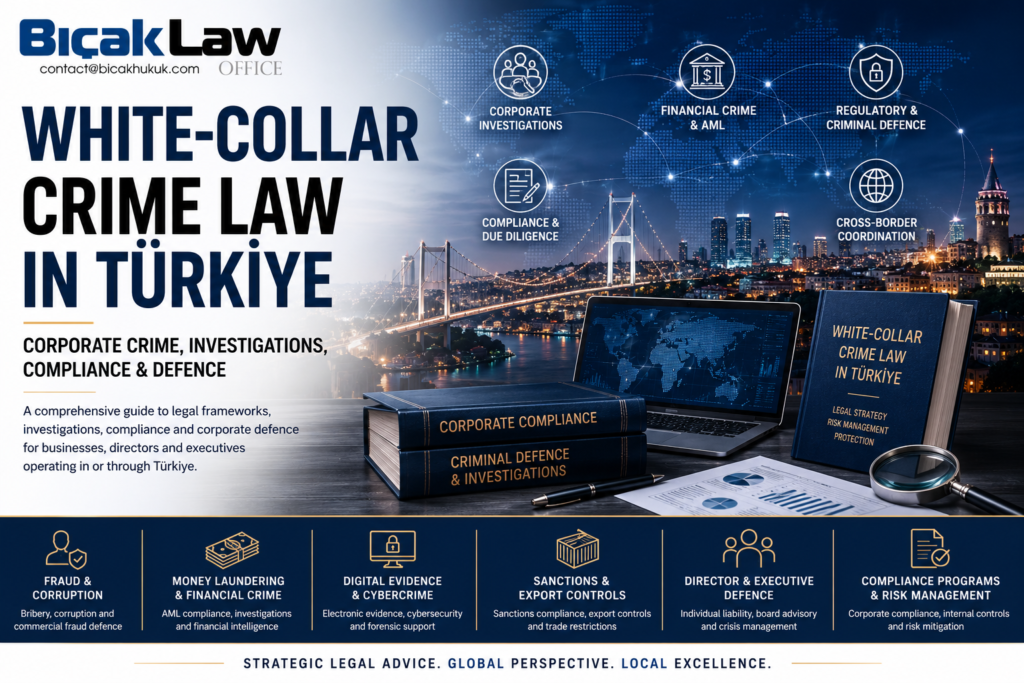
Guide to White-Collar Crime Law in Turkey
Part I
1. Understanding White-Collar Crime
The term white-collar crime describes a broad category of financial, corporate and regulatory misconduct typically committed through deception, abuse of trust, manipulation or misuse of professional or commercial authority. Although these offences are generally non-violent, they can cause substantial economic loss, undermine confidence in financial markets, disrupt business operations and expose companies to significant criminal, regulatory and commercial consequences.
The concept was first introduced by the American criminologist Edwin H. Sutherland in 1939. While his original definition focused on offences committed by persons of respectability during the course of their occupation, the modern understanding has expanded considerably. Today, the concept encompasses corporate fraud, bribery and corruption, money laundering, securities offences, cyber-enabled financial crime, sanctions-related misconduct, tax offences, market manipulation and numerous other forms of economic crime investigated by criminal and regulatory authorities.
International enforcement authorities similarly recognise that white-collar crime extends far beyond conventional financial fraud. The Federal Bureau of Investigation (FBI) identifies corporate fraud, financial institution fraud, securities and commodities fraud, money laundering, healthcare fraud and intellectual property offences among its principal areas of investigation, emphasising that such offences may affect investors, financial markets, public institutions and the wider economy.
The practical significance of white-collar crime has therefore changed fundamentally. It is no longer viewed solely as a criminal law issue. Instead, it represents an intersection between criminal justice, corporate governance, regulatory compliance, financial supervision and enterprise risk management.
2. Why This Guide Matters
Modern white-collar investigations rarely involve a single allegation or a single authority. A suspected fraud may trigger criminal proceedings, regulatory inquiries, internal corporate investigations, financial reporting obligations and cross-border cooperation simultaneously. Understanding how these processes interact is essential for organisations seeking to protect their legal rights, commercial interests and long-term reputation.
This guide has been prepared from a practical business perspective. Rather than presenting a catalogue of criminal offences, it explains how investigations develop, how companies should respond, what responsibilities directors and executives face, and how effective compliance programmes can reduce legal and commercial risk before problems arise.
3. Bıçak Law Firm Perspective
White-collar matters increasingly require legal advice extending well beyond courtroom defence. Bıçak Law Firm regularly advises domestic and international clients on corporate investigations, financial crime, anti-money laundering, sanctions and export controls, regulatory compliance, digital evidence, internal investigations and complex cross-border matters involving Turkish law. The analysis presented throughout this guide reflects that multidisciplinary perspective as well as more than three decades of academic and professional experience in criminal law, regulatory compliance and international legal advisory work.
4. Why White-Collar Crime Matters
The consequences of white-collar allegations extend far beyond criminal liability. A company under investigation may experience disruption to banking relationships, contractual uncertainty, regulatory scrutiny, shareholder concerns, difficulties obtaining finance and damage to its commercial reputation long before a court determines whether any criminal offence has been committed.
For directors and senior executives, investigations may also create personal legal exposure, restrictions on professional activities and substantial reputational consequences. Even where allegations ultimately prove unfounded, poorly managed investigations can consume significant management time, interrupt commercial operations and undermine stakeholder confidence. Accordingly, successful management of white-collar risk requires organisations to think beyond criminal defence alone. The objective is to preserve legal rights while simultaneously protecting business continuity, corporate governance and long-term commercial value.
Leading international investigations practices increasingly organise their services around this broader concept of business risk management, integrating internal investigations, regulatory engagement, compliance advice and crisis response into a single multidisciplinary framework rather than treating criminal proceedings as an isolated area of practice.
Part II
5. White-Collar Crime Under Turkish Law
Unlike certain areas of criminal legislation, white-collar crime is not defined as a separate offence under Turkish law. Instead, it is a practical and internationally recognised term describing a broad category of financial, corporate and regulatory offences committed within commercial, professional or institutional settings.
In Türkiye, conduct commonly regarded as white-collar crime is regulated through a combination of the Turkish Criminal Code, the Turkish Criminal Procedure Code and numerous specialised statutes governing banking, capital markets, anti-money laundering, taxation, customs, public procurement, personal data protection and corporate governance. Accordingly, the legal analysis rarely depends upon a single statute. Most significant investigations require simultaneous consideration of several legislative and regulatory frameworks.
This legislative structure reflects the increasingly sophisticated nature of economic crime. Modern investigations often concern complex commercial transactions, financial reporting, electronic communications and cross-border business activities rather than isolated criminal acts. As a result, effective legal advice requires an understanding of both criminal law and the commercial environment in which the alleged conduct occurred.
For international businesses, it is also important to recognise that conduct attracting regulatory attention may not initially appear criminal. An accounting irregularity, an internal audit finding, a sanctions-screening alert or an unusual payment identified during due diligence may ultimately develop into a criminal investigation if evidence suggests fraud, corruption, money laundering or another offence. Early legal assessment therefore plays a critical role in determining both the legal position and the appropriate strategic response.
6. The Principal Categories of White-Collar Crime
Although every case is fact-specific, white-collar investigations in Türkiye generally fall within several broad categories.
6.1. Financial and Corporate Fraud
Financial fraud remains one of the most common forms of corporate criminality. Allegations may arise from misleading financial statements, deceptive accounting practices, fraudulent investment schemes, procurement irregularities, insurance fraud, false invoicing or deliberate misrepresentation during commercial transactions.
The legal challenge frequently lies in distinguishing criminal fraud from a genuine commercial dispute. Not every failed business transaction constitutes a criminal offence. Turkish courts examine whether the alleged deception existed at the time of the relevant conduct, whether unlawful benefit was obtained and whether the statutory elements of the offence are satisfied.
From a business perspective, fraud investigations often require extensive review of contracts, accounting records, internal communications, payment flows and electronic evidence. Consequently, corporate fraud matters commonly evolve into multidisciplinary investigations involving lawyers, forensic accountants and digital evidence specialists.
6.2. Bribery and Corruption
Corruption continues to represent one of the most significant regulatory and criminal risks facing organisations engaged in public procurement, infrastructure, defence, healthcare, energy and other highly regulated sectors. Investigations may concern unlawful payments, improper advantages, procurement irregularities or abuse of official position. However, for multinational businesses, the legal analysis rarely stops with Turkish legislation. Transactions involving Türkiye may also attract scrutiny under foreign anti-corruption regimes where the relevant jurisdictional connections exist. Accordingly, organisations should approach anti-corruption compliance as an international governance issue rather than merely a domestic criminal law requirement.
6.3. Money Laundering and Financial Crime
The movement of criminal proceeds through the financial system remains a primary enforcement priority both internationally and in Türkiye. Money laundering investigations often extend well beyond the underlying predicate offence. Authorities may examine complex financial structures, beneficial ownership arrangements, international fund transfers, digital assets and corporate transactions to determine whether assets represent proceeds of crime or have been used to conceal unlawful activity. The preventive framework established under Turkish anti-money laundering legislation imposes significant compliance obligations on financial institutions and other obliged entities, including customer due diligence, suspicious transaction reporting and record-keeping requirements. These obligations have become an integral component of corporate compliance programmes, particularly for organisations operating internationally.
6.4. Securities and Financial Market Offences
Financial markets depend upon transparency, market integrity and investor confidence. Consequently, insider dealing, market manipulation and other capital markets offences receive close regulatory attention. Investigations frequently involve complex financial evidence and may proceed in parallel with regulatory action by the Capital Markets Board alongside criminal proceedings where appropriate. For listed companies and financial institutions, these matters require careful coordination between criminal defence, regulatory strategy and corporate disclosure obligations.
6.5. Cyber-Enabled Financial Crime
The digital transformation of business has fundamentally changed the nature of white-collar investigations. Electronic payment systems, cloud computing, cryptocurrency, remote working environments and sophisticated cyber threats have created new opportunities for financial crime while simultaneously increasing the complexity of investigations. Today’s investigations commonly involve:
- business email compromise;
- identity theft;
- digital payment fraud;
- ransomware-related financial flows;
- insider cyber misconduct;
- manipulation of electronic accounting systems;
- unauthorised access to corporate information.
Digital evidence has therefore become one of the defining characteristics of modern white-collar practice.
6.6. Tax, Customs and Trade-Related Offences
Corporate investigations increasingly extend into areas traditionally regarded as regulatory rather than criminal. Tax reporting irregularities, customs valuation disputes, export documentation, trade compliance failures and cross-border commercial transactions may all create circumstances in which criminal, administrative and regulatory issues overlap. For businesses engaged in international trade, legal strategy should therefore consider not only criminal liability but also customs compliance, tax obligations, sanctions, export controls and contractual exposure.
6.7. Practical Insight: White-collar investigations rarely begin with an arrest.
In many cases, the first indication of potential criminal exposure is an internal audit finding, a whistleblower report, a suspicious transaction alert, an unexpected regulatory inquiry or a dispute between commercial parties. Organisations that seek legal advice at this early stage are generally better positioned to preserve evidence, understand their legal obligations and manage commercial risk before formal enforcement action begins.
7. Corporate and Individual Liability
One of the most important issues arising in any white-collar investigation is identifying who may ultimately bear legal responsibility. Under Turkish criminal law, criminal responsibility is fundamentally personal. Individuals who satisfy the statutory elements of an offence may be prosecuted and, where appropriate, convicted. Companies, however, occupy a more nuanced position. Although legal entities are not subject to criminal liability in the same manner as natural persons, Turkish law permits certain security measures to be imposed on legal entities under specific statutory conditions, particularly where offences have been committed through their organs or representatives for the benefit of the entity. For multinational organisations, this distinction is particularly important. A criminal investigation may simultaneously affect:
- the corporate entity;
- members of the board;
- senior management;
- compliance officers;
- employees;
- shareholders; and
- affiliated companies operating in other jurisdictions.
Each may have different legal interests and require separate strategic advice.
Director’s Note: One of the most common mistakes during corporate investigations is assuming that the interests of the company and its directors are always identical. In practice, investigations frequently require an early assessment of whether separate legal representation is appropriate. A director may wish to demonstrate that a particular decision reflected established corporate policy, while the company may argue that the conduct fell outside authorised procedures. Identifying potential conflicts at an early stage protects both the integrity of the investigation and the legal rights of all parties involved.
Part III
8. Regulatory and Investigative Authorities
White-collar investigations in Türkiye are rarely conducted by a single authority. Depending on the nature of the alleged misconduct, a matter may involve criminal prosecutors, law enforcement agencies, financial intelligence authorities and sector-specific regulators operating simultaneously within their respective statutory powers. For businesses, understanding this institutional framework is as important as understanding the underlying criminal offences. A regulatory inquiry may ultimately develop into a criminal investigation, while a criminal investigation may trigger additional administrative proceedings, licensing consequences or financial reporting obligations. For international companies entering the Turkish market, early identification of the competent authorities is therefore an essential element of legal risk management.
8.1. Public Prosecutors
The Public Prosecutor’s Office occupies the central position within the Turkish criminal justice system. Where sufficient information suggests that a criminal offence may have been committed, prosecutors are responsible for directing the investigation, gathering evidence, requesting judicial measures where necessary and determining whether criminal proceedings should ultimately be initiated before the competent court. In complex financial investigations, prosecutors frequently work together with specialist law-enforcement units, forensic experts and financial analysts. Corporate investigations commonly involve:
- extensive documentary evidence;
- electronic communications;
- accounting records;
- banking information;
- expert reports;
- witness interviews.
Accordingly, early legal engagement is often essential to ensure that the company’s legal rights are protected while maintaining constructive cooperation with investigating authorities.
8.2. Financial Crimes Investigation Board (MASAK)
The Financial Crimes Investigation Board (MASAK) serves as Türkiye’s financial intelligence unit and plays a central role in combating money laundering, terrorist financing and other forms of financial crime. MASAK receives and analyses suspicious transaction reports, conducts financial intelligence analysis and communicates relevant findings to competent authorities where appropriate. It also administers electronic reporting systems and guidance for obliged entities. For companies, MASAK is particularly significant because anti-money laundering obligations are preventive rather than merely reactive. Banks, financial institutions and other obliged entities must establish appropriate customer due diligence procedures, maintain records and submit suspicious transaction reports when the statutory thresholds are met. These obligations increasingly influence corporate compliance practices well beyond the financial sector.
Cross-Border Perspective: International businesses often assume that anti-money laundering compliance is primarily a banking issue. In practice, companies engaged in international trade, cross-border investment, mergers and acquisitions, defence procurement, technology transactions or complex supply chains may all encounter AML-related obligations during ordinary commercial operations.
8.3. Capital Markets Board (SPK)
The Capital Markets Board (SPK) exercises extensive supervisory and enforcement powers within Türkiye’s capital markets. Where inspections identify conduct that may constitute offences defined under capital markets legislation, the Board may refer matters to the Public Prosecutor’s Office while also exercising its own regulatory powers, including administrative sanctions and preventive measures. Investigations commonly concern:
- insider dealing;
- market manipulation;
- misleading disclosures;
- unauthorised capital markets activities;
- investor protection issues.
For listed companies and financial institutions, regulatory strategy should therefore be coordinated with criminal defence from the earliest stages of an investigation.
8.4. Other Competent Authorities
Depending upon the sector and factual circumstances, additional authorities may also become involved. These may include:
- banking regulators;
- customs authorities;
- tax authorities;
- competition authorities;
- public procurement authorities;
- data protection authorities;
- specialised cybercrime units.
Large corporate investigations increasingly involve cooperation between several domestic institutions while also requiring coordination with foreign authorities where transactions extend beyond Türkiye. Accordingly, businesses should avoid analysing investigations through a purely criminal-law perspective. Most significant white-collar matters involve overlapping legal regimes requiring an integrated legal strategy.
Practical Insight: One of the first questions experienced counsel asks is not “What offence is alleged?” but “Which authorities are or may become involved?” The answer often determines document preservation obligations, reporting requirements, investigation strategy and the sequencing of legal responses.
9. The Lifecycle of a White-Collar Investigation
Contrary to popular perception, most white-collar investigations do not begin with a search warrant or an arrest. More commonly, they evolve gradually through a sequence of events that initially appears administrative, financial or commercial. Understanding this lifecycle enables organisations to respond strategically rather than reactively.
9.1. Stage One – Early Warning Signs
Investigations frequently originate from relatively ordinary business events. Examples include:
- whistleblower reports;
- internal audit findings;
- suspicious transaction alerts;
- compliance reviews;
- customer complaints;
- supplier disputes;
- regulatory inspections;
- due diligence exercises;
- cybersecurity incidents;
- media allegations.
At this stage, companies should resist reaching immediate conclusions. Instead, management should focus on understanding the facts, preserving evidence and obtaining appropriate legal advice before taking irreversible decisions.
9.2. Stage Two – Preliminary Legal Assessment
Before launching a formal investigation, organisations should conduct an initial legal assessment. Key questions include:
- What exactly has been alleged?
- Which individuals may be involved?
- Which legal regimes may apply?
- Are regulators already aware?
- Could reporting obligations arise?
- Is immediate evidence preservation required?
- Does the company require external legal counsel?
This early assessment frequently determines whether the matter can be resolved internally or whether a broader investigation becomes necessary.
9.3. Stage Three – Preservation of Evidence
Evidence preservation represents one of the most critical stages of any white-collar investigation. Business records today exist in multiple formats. Relevant evidence may include:
- emails;
- messaging applications;
- enterprise resource planning systems;
- accounting software;
- cloud storage;
- mobile telephones;
- CCTV recordings;
- access-control systems;
- electronic payment records;
- contracts;
- board minutes.
Routine deletion policies should be reviewed immediately once serious allegations arise. Failure to preserve relevant evidence may complicate both internal investigations and subsequent legal proceedings.
9.4. Stage Four – Internal Investigation
Where circumstances justify further examination, companies frequently conduct internal investigations before any formal criminal proceedings commence. The objective is not to determine criminal guilt. Rather, it is to establish an accurate understanding of:
- what occurred;
- who was involved;
- what legal risks exist;
- whether immediate remedial action is required.
A properly conducted internal investigation also enables management to make informed decisions regarding governance, regulatory engagement and future compliance improvements.
9.5. Stage Five – Regulatory or Criminal Investigation
If authorities commence formal proceedings, organisations may be required to respond to requests for documents, interviews or other investigative measures. At this stage, legal strategy should be carefully coordinated. Different authorities may pursue different objectives simultaneously. A company may therefore face:
- criminal investigation;
- regulatory inspection;
- financial reporting obligations;
- contractual notification duties;
- shareholder communications;
- insurance considerations.
Managing these issues separately often creates unnecessary inconsistency. An integrated legal strategy generally produces better outcomes.
9.6. Stage Six – Resolution and Remediation
Not every investigation culminates in prosecution. Depending upon the available evidence and the applicable legal framework, possible outcomes include:
- closure without further action;
- administrative sanctions;
- criminal proceedings;
- internal disciplinary measures;
- compliance reforms;
- governance improvements;
- civil litigation;
- asset recovery actions.
Regardless of outcome, every significant investigation should conclude with an assessment of lessons learned and appropriate improvements to internal controls.
10. Internal Investigations
Internal investigations have become one of the defining features of modern white-collar practice. Leading international law firms increasingly regard them not as a reactive exercise but as an essential component of corporate governance. An appropriately structured internal investigation enables organisations to establish the facts, preserve evidence, assess legal exposure and determine whether remediation or voluntary engagement with authorities is appropriate.
10.1. Defining the Scope
Every investigation should begin with a clearly defined mandate. This should identify:
- the allegations;
- the relevant business units;
- the applicable time period;
- reporting responsibilities;
- investigative authority;
- expected deliverables.
Poorly defined investigations frequently become unnecessarily expensive while failing to answer the most important legal questions.
10.2. Independence
The credibility of an internal investigation depends heavily upon its independence. Where allegations concern senior executives or members of the board, organisations should consider whether oversight should be exercised by:
- an independent committee;
- external legal counsel;
- another appropriately authorised body.
This helps preserve confidence in both the investigative process and its conclusions.
10.3. Documentary Review and Interviews
Most investigations combine document review with interviews of relevant personnel. The sequencing of these activities is important. Investigators generally benefit from understanding the documentary evidence before conducting substantive interviews. This approach improves both efficiency and the quality of factual findings.
10.4. Bıçak Law Firm Perspective
Internal investigations should not attempt to replicate criminal proceedings. Their primary purpose is to provide management with reliable legal and factual analysis, enabling informed decisions regarding compliance, governance, regulatory engagement and business continuity.
Part IV
11. Search, Seizure and Digital Evidence
Modern white-collar investigations are increasingly driven by electronic evidence rather than traditional paper documents. Financial records, corporate emails, messaging applications, cloud-based storage systems, enterprise resource planning platforms, mobile devices and digital accounting systems frequently contain the most significant evidence in corporate investigations. Consequently, organisations should regard digital evidence management as a critical component of corporate risk management rather than merely a technical issue for information technology departments.
Under the Turkish Criminal Procedure Code, searches, copying and seizure of computer systems, computer programs and electronic data are subject to specific procedural safeguards and judicial oversight. Electronic evidence must be collected, preserved and examined in accordance with applicable legal requirements to maintain its evidential integrity and admissibility. For companies, the practical challenge is often less about understanding the legislation than about responding appropriately when investigators arrive.
11.1. Responding to a Search
Searches of corporate premises frequently occur without extensive prior notice. Accordingly, organisations should establish response procedures before any investigation arises. A structured response should include:
- notifying external legal counsel immediately;
- identifying the legal basis and scope of the search;
- preserving a clear record of documents and electronic material examined or copied;
- ensuring cooperation within the limits established by law;
- identifying potentially privileged communications where applicable;
- coordinating internal communications to avoid unnecessary disruption;
- protecting confidential commercial information while complying with lawful investigative measures.
The objective is neither obstruction nor passive acquiescence. Rather, organisations should cooperate professionally while ensuring that their procedural rights and legitimate commercial interests are appropriately protected.
11.2. Preserving Digital Evidence
Corporate information is increasingly dispersed across multiple technological environments. Relevant evidence may be stored within:
- cloud platforms;
- corporate email systems;
- encrypted messaging applications;
- mobile telephones;
- laptops;
- external storage devices;
- accounting software;
- enterprise resource planning systems;
- cybersecurity monitoring platforms;
- remotely hosted servers.
Once an organisation reasonably anticipates a regulatory inquiry or criminal investigation, it should consider whether routine deletion policies, automatic backups and document retention procedures require temporary modification in order to preserve potentially relevant information. Failure to preserve electronic evidence may significantly complicate both internal investigations and subsequent legal proceedings.
Practical Insight: Digital evidence is often more fragile than physical evidence.
Metadata, timestamps, access logs and electronic communications may become as important as the underlying documents themselves. Organisations should therefore ensure that evidence is preserved in a manner capable of demonstrating authenticity and integrity throughout the investigative process.
12. Anti-Money Laundering and Financial Investigations
Financial investigations have become one of the defining characteristics of contemporary white-collar enforcement. Unlike many conventional criminal investigations, financial investigations rarely focus solely upon whether an offence has occurred. Instead, investigators seek to understand how assets were generated, transferred, concealed or integrated into the legitimate economy. As a result, investigations frequently involve extensive analysis of financial records, beneficial ownership structures, banking transactions, international payment flows and corporate relationships.
12.1. The Preventive Nature of AML Compliance
Modern anti-money laundering regulation extends far beyond criminal prosecution. Its primary objective is preventive. Financial institutions and other obliged entities are expected to identify unusual transactions, understand customer relationships, assess risk and report suspicious activities where required by law. Consequently, AML compliance has evolved into an essential element of corporate governance rather than merely a regulatory obligation imposed upon banks. For many multinational businesses, AML considerations now arise during:
- mergers and acquisitions;
- international trade;
- foreign investment;
- corporate restructuring;
- third-party onboarding;
- supply chain management;
- cross-border payments.
Accordingly, effective AML programmes contribute not only to regulatory compliance but also to broader enterprise risk management.
12.2. Financial Investigations
Financial investigations often require reconstruction of complex commercial activity over extended periods. Investigators may examine:
- banking transactions;
- accounting records;
- corporate ownership structures;
- invoices;
- procurement documentation;
- payment authorisations;
- cryptocurrency transactions;
- beneficial ownership information.
Accordingly, financial investigations increasingly require collaboration between lawyers, forensic accountants, auditors and digital forensic specialists.
12.3. Cross-Border Perspective
International financial investigations frequently extend across several jurisdictions. Corporate records may be located in one country. Financial institutions may operate in another. Electronic evidence may be stored elsewhere. Successful legal strategy therefore depends upon coordinated management rather than isolated jurisdiction-by-jurisdiction responses.
13. Bribery and Corruption
Bribery and corruption remain among the most commercially significant forms of white-collar crime worldwide. Beyond criminal liability, allegations of corruption may result in regulatory sanctions, procurement restrictions, shareholder disputes, contractual termination, financing difficulties and lasting reputational damage. For multinational organisations, corruption risk has become increasingly international. Conduct occurring in Türkiye may simultaneously attract scrutiny under foreign legislation where sufficient jurisdictional connections exist. Accordingly, organisations should approach anti-corruption compliance as an integral component of corporate governance rather than merely a criminal law issue.
13.1. Higher-Risk Business Activities
Although corruption risks differ significantly between industries, certain commercial activities generally require enhanced compliance controls. These commonly include:
- public procurement;
- defence and security projects;
- infrastructure development;
- customs and border activities;
- healthcare;
- pharmaceuticals;
- energy;
- construction;
- public licensing.
This observation does not imply that these sectors are inherently problematic. Rather, they involve substantial commercial interests together with regular interaction between private organisations and public authorities, increasing the importance of transparent governance and effective compliance procedures.
13.2. Third-Party Risk
Many significant corruption investigations originate not from direct payments made by the company itself but through intermediaries. Accordingly, organisations should conduct proportionate due diligence regarding:
- distributors;
- consultants;
- commercial agents;
- customs brokers;
- joint venture partners;
- local representatives;
- procurement consultants.
Appropriate contractual safeguards and ongoing monitoring may significantly reduce legal exposure.
Director’s Note: Boards should regard anti-corruption programmes as governance mechanisms rather than legal formalities. Effective oversight requires periodic review of policies, training programmes, third-party relationships and reporting procedures. Compliance documents that exist only on paper rarely provide meaningful protection when serious allegations arise.
14. Sanctions and Export Controls
International sanctions and export controls have become increasingly significant components of corporate compliance. Although traditionally viewed as separate legal disciplines, they now intersect closely with anti-money laundering, fraud investigations, customs enforcement and corporate governance. For internationally active businesses, sanctions compliance should therefore be integrated into broader enterprise risk management rather than addressed in isolation.
14.1. Areas of Exposure
Sanctions-related legal issues may arise through:
- international payments;
- supply chain relationships;
- dual-use goods;
- defence products;
- software exports;
- shipping documentation;
- beneficial ownership structures;
- high-risk jurisdictions;
- financial institutions.
Companies should appreciate that legal risk may arise not only from direct transactions but also through indirect commercial relationships involving distributors, logistics providers or corporate affiliates.
14.2. Export Controls
Export controls increasingly extend beyond traditional military products. Advanced technology, software, electronics, telecommunications equipment and dual-use goods may all become subject to complex regulatory requirements depending upon the applicable jurisdiction. Accordingly, export compliance programmes should be coordinated with procurement procedures, logistics functions, contractual review and third-party due diligence. For organisations operating internationally, sanctions and export controls are no longer niche legal issues. They have become central elements of responsible corporate governance.
14.3. Bıçak Law Firm Perspective
Cross-border compliance increasingly requires organisations to consider criminal law, regulatory enforcement, anti-money laundering obligations, sanctions, export controls and international trade as components of a single integrated compliance framework rather than isolated legal disciplines. Our advisory work reflects this multidisciplinary approach, particularly for multinational companies operating across multiple jurisdictions.
Part V
15. Cross-Border Investigations
The internationalisation of business has fundamentally transformed the way white-collar crime investigations are conducted. Corporate structures now frequently span multiple jurisdictions, financial transactions pass through several banking systems, electronic evidence is stored across different countries and decision-making processes often involve directors, employees and advisers located in different legal systems. Consequently, investigations involving businesses operating in Türkiye increasingly possess an international dimension from their earliest stages.
A transaction negotiated in London may be implemented through a Turkish subsidiary, financed by a European bank, supported by consultants in the Middle East and documented on cloud servers located elsewhere. If allegations subsequently arise, investigators in several jurisdictions may seek access to the same evidence while applying different legal standards and procedural rules. Managing these parallel processes requires considerably more than knowledge of Turkish criminal law. It requires careful coordination between local counsel, foreign lawyers, forensic specialists and corporate decision-makers.
15.1. Parallel Investigations
One of the defining characteristics of modern white-collar practice is the increasing frequency of parallel investigations. The same underlying conduct may simultaneously attract the attention of:
- criminal prosecutors;
- financial regulators;
- tax authorities;
- customs authorities;
- anti-money laundering authorities;
- competition authorities;
- foreign enforcement agencies.
Each authority exercises different statutory powers and pursues different objectives. A company responding separately to each investigation risks producing inconsistent explanations, unnecessary duplication of work and avoidable legal exposure. Accordingly, organisations should develop a single coordinated investigation strategy that takes account of all relevant proceedings rather than approaching each authority independently.
15.2. International Evidence
Evidence relevant to a Turkish investigation may be located almost anywhere. Common examples include:
- emails stored on foreign servers;
- cloud-based accounting systems;
- overseas banking records;
- electronic communications;
- multinational ERP systems;
- contracts executed abroad;
- digital payment platforms;
- cryptocurrency exchanges.
The international location of evidence does not necessarily prevent its use during investigations. However, obtaining and transferring evidence frequently requires compliance with domestic procedural law, international cooperation mechanisms and applicable data protection rules. Accordingly, organisations should avoid assuming that electronically stored information may simply be collected and transferred without legal analysis.
15.3. Data Protection Considerations
Cross-border investigations increasingly require organisations to balance criminal procedure with data protection obligations. Personal data collected during internal investigations should be processed lawfully, proportionately and only for legitimate investigative purposes. Where investigations involve multinational groups, additional questions may arise concerning:
- international data transfers;
- employee privacy;
- banking confidentiality;
- legal professional privilege;
- document retention.
Accordingly, internal investigations should be designed with both criminal procedure and data governance in mind.
15.4. Cross-Border Perspective
International investigations rarely become less complicated over time. Early legal coordination frequently reduces duplication, preserves evidence more effectively and enables organisations to adopt a consistent position across multiple jurisdictions before formal enforcement action intensifies.
15.5. Mutual Legal Assistance
Criminal investigations increasingly require cooperation between authorities in different jurisdictions. This cooperation commonly occurs through Mutual Legal Assistance (MLA) mechanisms established under bilateral agreements, multilateral conventions and domestic procedural legislation. Although procedures differ depending upon the applicable legal framework, MLA commonly facilitates:
- obtaining documentary evidence;
- examining witnesses;
- executing searches;
- identifying financial assets;
- tracing proceeds of crime;
- transferring evidence between competent authorities.
For multinational businesses, these mechanisms demonstrate that evidence located outside Türkiye may nevertheless become relevant to Turkish proceedings and vice versa. Consequently, organisations should anticipate international cooperation when assessing potential legal exposure.
15.6. Extradition
Certain white-collar investigations may also involve extradition issues. Extradition generally concerns requests for the surrender of individuals sought for criminal prosecution or execution of criminal judgments under applicable treaty arrangements and domestic legislation. Although extradition is governed by specialised legal principles – including dual criminality, procedural safeguards and international human rights obligations – it frequently overlaps with broader white-collar investigations involving fraud, corruption, financial crime or organised economic activity.
Where extradition issues arise, legal strategy should be coordinated with the underlying criminal proceedings rather than treated as an isolated procedure. For internationally mobile executives and multinational organisations, early legal assessment is particularly important because actions taken in one jurisdiction may produce consequences elsewhere.
16. Asset Freezing, Seizure and Confiscation
Protecting assets frequently becomes one of the most commercially significant aspects of white-collar investigations. Authorities may seek provisional measures designed to preserve property pending the outcome of criminal proceedings or to prevent dissipation of assets believed to be connected with alleged criminal conduct. Depending upon the applicable statutory framework, these measures may affect:
- bank accounts;
- real estate;
- company assets;
- movable property;
- electronic assets;
- digital currencies;
- financial investments.
For businesses, the practical impact may extend far beyond the value of the assets themselves. Restrictions affecting liquidity, banking relationships, contractual performance and ongoing commercial operations may significantly disrupt ordinary business activities. Accordingly, organisations should evaluate asset-related risks as soon as investigations commence rather than waiting until enforcement measures have already been implemented.
16.1. Asset Tracing
When companies become victims of fraud, corruption or other forms of financial misconduct, identifying recoverable assets is often as important as establishing criminal liability. Asset tracing may require examination of:
- financial transactions;
- corporate ownership structures;
- international payment chains;
- beneficial ownership information;
- accounting records;
- digital assets.
The effectiveness of asset recovery frequently depends upon the speed with which investigations begin. Delays may significantly reduce the likelihood of identifying assets before they are transferred, dissipated or concealed through increasingly complex financial structures.
17. Representing Victims of White-Collar Crime
White-collar practice should not be viewed exclusively from the perspective of defence. Many organisations require legal assistance because they are the victims – not the perpetrators – of sophisticated financial misconduct. Corporate victims may include:
- multinational companies;
- financial institutions;
- investors;
- manufacturers;
- technology companies;
- family-owned businesses;
- public institutions.
Their objectives often differ substantially from those of criminal prosecutors. While prosecutors focus upon establishing criminal liability, businesses generally seek:
- recovery of financial losses;
- preservation of commercial relationships;
- continuation of business operations;
- protection of confidential information;
- restoration of corporate reputation.
Accordingly, victim representation frequently combines criminal procedure, civil remedies, asset tracing and commercial strategy.
Practical Insight: Successful white-collar representation is not measured solely by the outcome of criminal proceedings.
For many businesses, preserving commercial continuity, protecting shareholder confidence, recovering assets and strengthening governance may be equally important objectives. Legal strategy should therefore support both litigation and long-term business resilience.
Part VI
18. Corporate Compliance and Prevention
The most effective response to white-collar crime begins long before an investigation. Although no compliance programme can eliminate every legal risk, organisations with effective governance structures, clearly defined internal controls and a strong culture of compliance are generally better positioned to prevent misconduct, identify concerns at an early stage and respond effectively when allegations arise. For this reason, compliance should not be viewed solely as a regulatory obligation or a legal function. It should form part of an organisation’s broader governance strategy and contribute directly to operational resilience, investor confidence and long-term enterprise value. Increasingly, regulators, financial institutions, insurers and international business partners expect companies to demonstrate that compliance is embedded within day-to-day decision-making rather than existing only in written policies.
18.1. Building an Effective Compliance Framework
An effective compliance programme should be proportionate to the organisation’s size, activities and risk profile. While every organisation requires an individual assessment, comprehensive compliance programmes commonly include:
- a clearly articulated code of conduct;
- anti-bribery and anti-corruption policies;
- anti-money laundering procedures;
- sanctions and export controls compliance;
- third-party due diligence;
- internal reporting mechanisms;
- conflict-of-interest procedures;
- financial controls and approval processes;
- regular compliance training;
- periodic independent reviews.
Organisations should also ensure that compliance programmes evolve alongside their business activities. Expansion into new markets, acquisitions, new technologies or changes in the regulatory environment frequently require reassessment of existing controls.
18.2. Compliance as a Strategic Investment
International experience increasingly demonstrates that effective compliance generates commercial value as well as legal protection. Strong governance may enhance:
- investor confidence;
- financing opportunities;
- relationships with multinational business partners;
- public procurement eligibility;
- regulatory credibility;
- operational efficiency.
Conversely, weak governance frequently becomes apparent only after allegations emerge, when remedial action is substantially more difficult and costly. Accordingly, organisations should view compliance not as an expense but as an investment in sustainable business operations.
Compliance Tip: The most successful compliance programmes are those that become part of the organisation’s culture rather than remaining isolated within the legal department. Regular training, visible leadership support and practical implementation are often more effective than lengthy policy documents.
19. Whistleblowing and Internal Reporting
Many significant white-collar investigations originate not from external enforcement but from information provided by employees, suppliers, business partners or other individuals familiar with an organisation’s operations. An effective internal reporting mechanism therefore serves two complementary purposes. First, it enables organisations to identify concerns before they develop into major legal or regulatory problems. Secondly, it demonstrates a commitment to transparency, accountability and responsible corporate governance. To achieve these objectives, reporting procedures should provide:
- accessible reporting channels;
- appropriate confidentiality;
- protection against retaliation;
- objective assessment of allegations;
- independent investigation where necessary;
- appropriate follow-up and remediation.
Employees are considerably more likely to report concerns internally where they have confidence that reports will be handled professionally and fairly.
20. Practical Checklist for Boards and General Counsel
When allegations of corporate misconduct arise, the actions taken during the first days of an investigation frequently influence its long-term outcome. Although every matter requires individual assessment, the following considerations provide a useful framework for boards, senior management and general counsel.
20.1. Immediate Response
- Preserve potentially relevant documents and electronic evidence.
- Suspend routine document destruction procedures where appropriate.
- Identify individuals responsible for coordinating the response.
- Engage external legal counsel at an early stage.
- Consider whether insurers or contractual counterparties require notification.
- Assess whether regulators or law enforcement authorities are already involved.
20.2. Governance
- Clarify reporting responsibilities.
- Identify potential conflicts of interest.
- Determine whether independent oversight is appropriate.
- Ensure board-level awareness where required.
20.3. Investigation
- Define the scope of the investigation.
- Identify principal sources of evidence.
- Prioritise document review before interviews.
- Consider forensic accounting or digital forensic assistance.
- Establish a realistic investigation timetable.
20.4. Communications
- Coordinate internal communications.
- Avoid speculative public statements.
- Preserve confidentiality.
- Ensure employees understand document preservation obligations.
20.5. Cross-Border Issues
- Identify all potentially relevant jurisdictions.
- Consider data transfer restrictions.
- Coordinate legal strategy with foreign counsel.
- Evaluate sanctions, export controls and international reporting obligations.
Director’s Note: An investigation should never be managed solely as a legal exercise. Decisions concerning governance, communications, business continuity and stakeholder confidence are often as important as the underlying criminal proceedings. Effective boards recognise that legal strategy and commercial strategy must operate together.
21. Frequently Asked Questions
21.1. What is white-collar crime?
White-collar crime is a collective term describing financial, corporate and regulatory offences committed in commercial or professional settings. Although it is not a separate offence under Turkish law, it encompasses a wide range of criminal conduct, including fraud, bribery, corruption, money laundering and other forms of economic crime.
21.2. Can companies be investigated?
Yes. Companies may become subject to criminal investigations, regulatory proceedings, administrative sanctions and security measures depending upon the applicable legislation and the nature of the alleged misconduct.
21.3. Can directors be personally liable?
Potentially. Liability depends upon the individual’s own conduct, knowledge, authority and involvement rather than simply holding a management position.
21.4. What is an internal investigation?
An internal investigation is an independent review conducted by or on behalf of an organisation to establish the relevant facts, assess legal exposure and determine whether remedial action is required.
21.5. Why is digital evidence so important?
Modern white-collar investigations frequently depend upon electronic records, emails, financial systems, cloud storage and mobile devices. Preserving electronic evidence at an early stage is therefore essential.
21.6. What is MASAK?
MASAK is Türkiye’s Financial Crimes Investigation Board and serves as the country’s financial intelligence unit. It plays a central role in anti-money laundering and counter-terrorist financing efforts, including the analysis of suspicious transaction reports and financial intelligence.
21.7. Why is legal due diligence important?
Legal due diligence enables organisations to identify legal, regulatory and compliance risks before transactions are completed, reducing the likelihood of future disputes and investigations.
21.8. How do cross-border investigations differ?
Cross-border investigations frequently involve multiple jurisdictions, different regulatory authorities, international evidence, data protection issues and foreign legal systems. Coordinated legal strategy is therefore essential.
22. How Bıçak Law Firm Assists
Bıçak Law Firm advises domestic and international clients across the full spectrum of white-collar crime, corporate investigations and regulatory enforcement. Our services include:
- strategic advice during criminal investigations;
- corporate internal investigations;
- representation of companies, directors and senior executives;
- anti-money laundering advisory services;
- anti-bribery and corruption compliance;
- sanctions and export controls;
- financial crime investigations;
- corporate compliance reviews;
- digital evidence and cyber-related investigations;
- cross-border investigations;
- mutual legal assistance and extradition;
- asset tracing and recovery;
- criminal litigation before Turkish courts.
Our multidisciplinary approach reflects the reality of modern white-collar practice. Corporate investigations rarely involve criminal law alone. They frequently require coordinated advice across regulatory compliance, corporate governance, financial crime, international trade, digital evidence and commercial risk management. Whether advising multinational corporations, financial institutions, family-owned businesses, investors or senior executives, we focus on delivering practical legal solutions that protect both our clients’ legal rights and their long-term commercial interests.
23. Conclusion
The legal landscape governing white-collar crime continues to evolve alongside technological innovation, financial markets and international business. Investigations have become increasingly complex, involving not only criminal law but also corporate governance, regulatory compliance, digital evidence, financial intelligence and cross-border cooperation. As a result, organisations can no longer rely upon reactive legal strategies alone. Effective management of white-collar risk requires preparation, sound governance and timely legal advice before problems escalate into formal enforcement proceedings.
Companies that invest in compliance, establish effective internal controls and respond strategically to emerging concerns are generally better positioned to protect their operations, reputation and long-term commercial objectives. For businesses operating in or through Türkiye, understanding the legal framework governing corporate crime, financial investigations and regulatory enforcement has become an essential element of responsible corporate governance. As enforcement continues to become more international and increasingly interconnected, organisations that combine prevention, preparedness and strategic legal advice will be best positioned to navigate the evolving challenges of modern white-collar investigations.







Comments
No comments yet.