 English
 Türkçe
 Français
 Deutsch

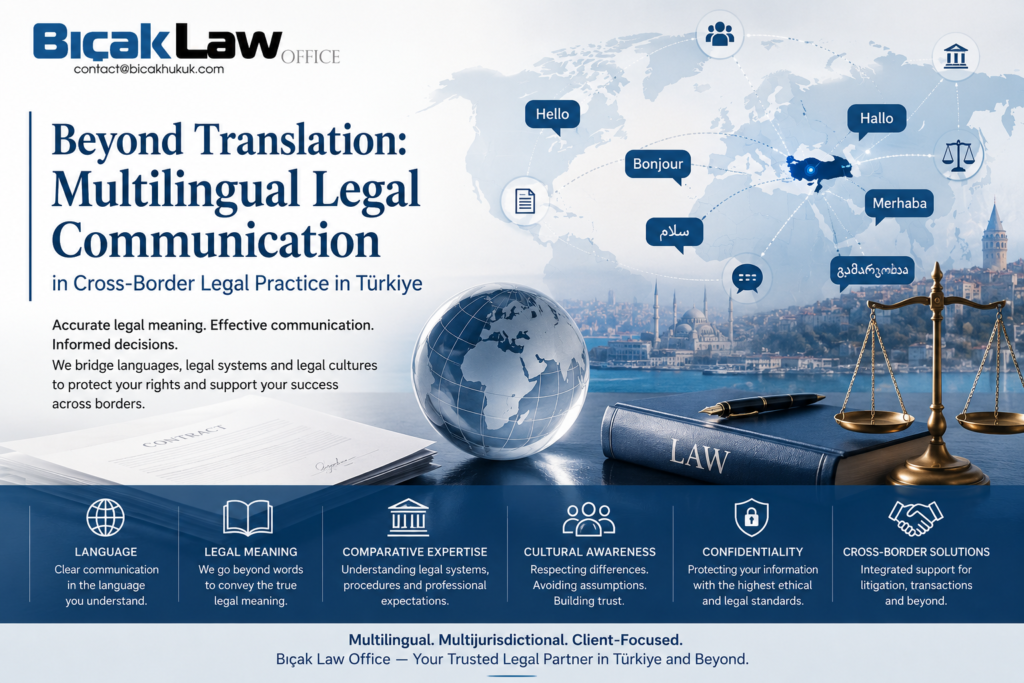
Cross-border legal matters involve far more than translating documents, requiring the accurate communication of legal meaning across different languages, legal systems and professional cultures. Effective multilingual legal communication combines language skills with legal analysis, procedural awareness, cultural competence and confirmation that clients genuinely understand their rights and obligations. Literal translation alone is often insufficient because legal concepts rarely have perfect equivalents across jurisdictions, particularly between civil law and common law systems. Lawyers must therefore explain not only the words used in legal documents but also the legal consequences and institutional context behind them. Successful communication also depends on the appropriate use of translators, interpreters, technology and confidentiality safeguards throughout the lawyer-client relationship. In international transactions, litigation and arbitration, multilingual communication plays a vital role in protecting procedural rights, managing legal risks and ensuring informed decision-making. Law firms with professionals who possess multilingual and multijurisdictional legal and cultural backgrounds can bridge differences in legal terminology, client expectations and legal practice more effectively than language skills alone. Bıçak Law Firm supports international clients through multilingual lawyers, consultants, professional interpreters and an international network, providing cross-border legal communication that goes beyond translation to deliver accurate, culturally informed and legally meaningful advice.
Cross-Border Legal Communication in Türkiye
1. Giriş
Cross-border legal matters rarely involve only one language, one legal system or one professional culture. A foreign investor may negotiate an English-language agreement governed by Turkish law. A person living abroad may instruct a Turkish lawyer through a power of attorney issued in another country. A witness may give evidence in one language while the proceedings are conducted in another. A company may receive advice from Turkish counsel, foreign counsel, translators, accountants and technical experts working across several jurisdictions. In each of these situations, translation is important, but translation alone is not enough.
Effective cross-border legal communication requires the accurate transfer of legal meaning, procedural position, commercial intention and practical consequences between people who may speak different languages and understand law through different conceptual frameworks. The relevant question is not merely whether the words have been translated. It is whether the parties, lawyers and decision-makers have understood the same legal issue in substantially the same way.
This distinction is critical. A document may be linguistically accurate but legally misleading. A client may speak conversational English fluently but remain unable to evaluate a complex waiver, settlement offer or litigation risk in that language. A lawyer may understand the foreign words used in a contract but fail to appreciate the legal assumptions behind them. An interpreter may accurately reproduce a sentence while missing the significance of the procedural stage in which it was spoken. Multilingual legal communication must therefore be understood as a broader professional discipline. It combines language ability, legal analysis, comparative understanding, procedural awareness, cultural competence, professional ethics and careful confirmation of client understanding.
2. What Is Multilingual Legal Communication?
Multilingual legal communication is the use of more than one language for the purpose of giving, receiving, explaining, recording or implementing legal information. It may arise during an initial consultation, a negotiation, the drafting of a contract, a criminal investigation, litigation, arbitration, mediation, a regulatory filing or communication with a public authority. It may involve clients, lawyers, judges, prosecutors, witnesses, translators, interpreters, notaries, foreign counsel and technical experts. The concept is therefore wider than legal translation.
Legal translation concerns the written transfer of a document from one language into another. Interpretation concerns oral communication, whether consecutive or simultaneous. Multilingual legal advice involves a lawyer explaining legal rights, risks and strategy in a language understood by the client. Comparative legal communication goes further by addressing differences between legal concepts, institutions, procedures and professional expectations. These functions may overlap, but they are not interchangeable.
A translator may reproduce the wording of a foreign judgment accurately without being responsible for advising the client on its recognition in Türkiye. An interpreter may facilitate a meeting without assessing the legal accuracy of the advice being given. A bilingual lawyer may explain Turkish law directly in another language but may still require a sworn translator for a document intended for official use.
For this reason, every cross-border matter should begin by identifying the purpose of the communication. Is the objective to understand a document, to obtain legal advice, to create an officially usable translation, to communicate during a hearing or to explain the consequences of Turkish law to a person familiar with another legal system? The appropriate professional and method depend on the answer.
3. Legal Meaning Cannot Be Separated from the Legal System
Legal language does not operate independently from the legal system that created it. Terms such as “trust”, “consideration”, “disclosure”, “injunction”, “indictment”, “privilege” and “settlement” carry meanings shaped by particular legal traditions. Some may have no precise counterpart in Turkish law. Others may appear to have a direct equivalent but perform a different function in practice.
The same difficulty arises in the opposite direction. Turkish legal concepts may be translated into English using familiar words, but the foreign reader may associate those words with institutions that differ from their Turkish equivalents. For example, translating the name of a Turkish court does not necessarily explain its jurisdiction, place in the judicial hierarchy or procedural role. Translating a party’s procedural status does not automatically convey the rights and restrictions attached to that status. Translating a Turkish power of attorney as a “power of attorney” does not explain the special authorities, form requirements or authentication steps that may be required for its use in Türkiye. This is why linguistic equivalence and legal equivalence must be distinguished.
Linguistic equivalence asks whether two words or expressions correspond in ordinary or professional language. Legal equivalence asks whether they refer to institutions, powers, procedures or consequences that are functionally comparable. The distinction becomes particularly important when communication takes place between civil-law and common-law jurisdictions. A literal translation may create the false impression that an institution is identical in both systems. In reality, its legal source, evidentiary effect, procedural operation or enforcement mechanism may be substantially different. The lawyer’s task is therefore not simply to select a foreign-language label. It is to explain the legal function behind the label.
4. From Multilingual Communication to Comparative Legal Communication
Successful cross-border practice depends not merely on multilingual communication but on what may be described as comparative legal communication. Comparative legal communication is the ability to transfer legal meaning accurately across different languages, legal systems, procedural frameworks and legal cultures. This requires more than vocabulary. It requires the communicator to identify what the recipient is likely to understand from a particular term, how that understanding may differ from Turkish law and which additional explanation is necessary to avoid a false equivalence.
Consider a foreign company receiving advice that a Turkish proceeding has reached a particular stage. A direct translation of the procedural expression may be technically correct, yet the company’s foreign counsel may assume that the stage carries consequences familiar from their own system. Unless Turkish counsel explains the relevant time limits, available remedies, evidentiary implications and enforcement consequences, the communication remains incomplete.
The same applies to commercial negotiations. Parties may use the same English expression while attaching different legal meanings to it. Words such as “guarantee”, “representation”, “warranty”, “indemnity”, “penalty” and “termination” may appear familiar to all participants, but their legal effect depends on the governing law, contractual drafting and applicable mandatory rules. Comparative legal communication therefore asks a further question: What must be explained, in addition to what must be translated? That question is central to responsible cross-border legal practice.
5. Language and Access to Justice
Language can determine whether a person is able to participate meaningfully in a legal process. A party who cannot understand the allegations, evidence, legal advice or procedural consequences affecting them may be physically present but functionally excluded. The issue is especially acute in criminal proceedings, where liberty, reputation and procedural rights may be at stake. Article 6 of the European Convention on Human Rights guarantees the free assistance of an interpreter to a person who cannot understand or speak the language used in court. The protection reflects the principle that a fair hearing requires more than formal attendance; the accused must be able to understand and participate effectively. Directive 2010/64/EU similarly establishes minimum rules on interpretation and translation in criminal proceedings within the European Union. It addresses interpretation during proceedings and the translation of essential documents necessary to safeguard defence rights and the fairness of the process. Turkish criminal procedure also provides for the use of an interpreter where an accused person or victim does not know sufficient Turkish to express themselves effectively. These legal guarantees are particularly visible in criminal justice, but the underlying communication problem is not limited to criminal cases.
Similar concerns arise when a foreign party considers a settlement, signs a waiver, accepts an inheritance, enters into a property transaction or authorises a lawyer to act on their behalf. In private-law matters, the consequences may not always be framed as a formal right to an interpreter. Nevertheless, informed decision-making still requires the person to understand the legal and financial significance of the step being taken.
6. Conversational Fluency Is Not Legal Comprehension
A person may communicate confidently in a second language and still be unable to evaluate sophisticated legal advice in that language. Conversational fluency and legal comprehension are different capabilities. A client may be able to discuss their personal history, commercial objectives or factual concerns in English. The same client may struggle to understand concepts such as limitation periods, burden of proof, interim measures, waiver, release, indemnification, procedural default or the difference between appeal and retrial.
The difficulty becomes greater where the legal advice concerns probability and uncertainty. Expressions such as “reasonable prospects”, “material risk”, “without prejudice”, “subject to evidence” or “not guaranteed” require more than vocabulary. They require an understanding of professional caution, evidentiary limits and legal consequences.
The same is true of consent. A client’s statement that they “understand” should not automatically be treated as proof of informed understanding. Some clients may avoid asking questions because they are embarrassed, deferential or concerned about appearing difficult. Others may understand the general message while missing a qualification that significantly changes the advice. Lawyers should therefore verify comprehension rather than assume it.
Useful methods include asking the client to explain the proposed step in their own words, providing a short written summary, identifying the main risks separately and confirming critical instructions in writing. This is particularly important for settlement authority, guilty pleas, waivers, powers of attorney, fee arrangements, acknowledgements of debt and instructions that may be difficult to reverse.
7. Translation, Interpretation and Legal Advice Perform Different Functions
The distinction between translation, interpretation and legal advice should be made clear at the beginning of every multilingual legal matter. Translation concerns written content. It may involve contracts, judgments, certificates, correspondence, witness statements, corporate documents or official records. Interpretation concerns spoken communication. It may be consecutive, where the speaker pauses for interpretation, or simultaneous, where interpretation takes place in real time. Legal advice in another language involves the analysis and explanation of legal rules, options, risks and strategy by a lawyer. The fact that a person is bilingual does not mean that they are qualified to perform all three functions.
A bilingual staff member may assist with routine communication but may not possess the training required for court interpretation. A professional translator may accurately translate a legal document but should not be expected to advise on Turkish law. A lawyer who speaks the client’s language may explain the legal position but may still need a certified translation for submission to a court, notary or administrative authority.
The function should determine the professional role. Where an official translation, notarial certification or international authentication is required, the matter should be handled under the appropriate formal process. These procedural issues are addressed separately in Bıçak Law Firm’s existing guides on Certified Translation of Legal Documents, International Apostille Services in Turkey and Granting a Power of Attorney Valid in Turkey. Those pages explain document formalities and international use; the present article addresses the broader communication relationship.
8. Multilingual Communication Throughout the Lawyer-Client Relationship
Language management should not begin only when a document is ready to be translated. It should be considered throughout the entire lawyer–client relationship.
Initial Contact: The first challenge is often identifying the client’s actual communication needs. The client’s preferred language should be distinguished from the language in which they can manage basic conversation. It may also be necessary to determine whether the client can read legal documents in that language or only communicate orally. At this stage, the firm should also identify who is communicating on behalf of the client. A relative, employee, commercial intermediary or foreign lawyer may assist with contact, but their involvement should not obscure the identity, wishes or confidentiality interests of the actual client.
Preliminary Consultation: During the first substantive meeting, the lawyer must obtain facts accurately and explain the initial legal framework. Open-ended questions may be particularly valuable because rigid or highly technical questioning can produce incomplete answers through an interpreter. The lawyer should avoid unnecessarily long sentences, ambiguous terminology and culturally specific idioms. The lawyer should address the client directly, even when an interpreter is present. The interpreter facilitates communication but does not replace the client in the professional relationship.
Engagement and Fees: The client must understand who is being retained, the scope of the work, the basis of the fee, the services excluded from the engagement and the responsibilities of the client. A translated engagement letter may be useful, but translation alone does not remove the need for explanation. The lawyer should identify any important differences between the client’s expectations and the actual scope of Turkish legal representation.
Strategy and Risk Assessment: Cross-border clients may approach legal strategy with expectations formed by another system. They may expect discovery, jury trial, contingency fees, punitive damages, immediate freezing orders or forms of settlement procedure that do not operate in the same manner in Türkiye. These expectations should be addressed explicitly. Merely informing the client of the Turkish rule may not be enough; the lawyer should explain how the Turkish procedure differs from the process the client anticipated.
Ongoing Reporting: Regular updates should identify not only what happened but also why it matters. A translated procedural notice may be incomprehensible to a client without explanation. Effective reporting should therefore distinguish between the official document, the lawyer’s summary and the recommended next step.
Settlement and Final Instructions: Instructions involving settlement, withdrawal, waiver or acceptance of liability require particular care. The lawyer should ensure that the client understands both the immediate outcome and the rights being surrendered. Where necessary, material instructions should be confirmed in the client’s preferred language or accompanied by a clear summary.
9. Working Effectively with Interpreters
The presence of an interpreter does not automatically guarantee effective communication. The quality of interpretation depends on language competence, legal familiarity, preparation, impartiality and the circumstances of the meeting. Before the meeting, the interpreter should receive sufficient background to understand the subject matter, while respecting confidentiality and data minimisation. A terminology list may be useful in technical, financial, medical or criminal matters.
During the meeting, the lawyer should use clear sentences and allow adequate time for interpretation. Questions should be addressed to the client rather than phrased as instructions to the interpreter. For example, the lawyer should ask, “When did you receive the notice?” rather than “Ask the client when they received the notice”.
The interpreter should reproduce the communication as accurately as possible and should not summarise, soften, add advice or answer on behalf of the client. Where a term has no direct equivalent, the difficulty should be identified openly rather than concealed by an improvised translation. The lawyer should also be alert to non-verbal signs of confusion. A client may respond affirmatively because they understood the question, because they wish to be cooperative or because the interpreter’s version unintentionally suggested the desired answer. At important stages, understanding should be checked independently.
10. Why Family Members and Informal Interpreters May Be Unsuitable
Clients sometimes propose using a spouse, child, friend, employee or business partner as an interpreter. Although this may appear convenient, it can create serious risks. The informal interpreter may lack legal vocabulary, filter information, soften embarrassing facts or insert personal opinions. They may also have an interest in the outcome. In family, inheritance, criminal, medical and corporate disputes, the client may be unable to speak freely in the presence of the proposed interpreter. The interpreter may themselves be a witness, beneficiary, potential defendant or source of pressure. There may also be confidentiality concerns. The lawyer cannot assume that an informal interpreter understands professional secrecy, data protection or the sensitivity of the information being disclosed. For routine logistical communication, informal assistance may sometimes be manageable with the client’s informed agreement. For substantive advice, witness preparation, settlement instructions, criminal defence or conflicting family interests, an independent professional interpreter is generally safer.
11. Confidentiality, Privilege and Data Protection
Multilingual legal communication often requires information to pass through additional people and technologies. Each additional participant or platform increases the need for clear confidentiality controls. An interpreter or translator may have access to personal data, commercial secrets, medical records, criminal allegations, litigation strategy and privileged legal advice. Their role, confidentiality obligation, access level and document-retention practices should therefore be defined. The lawyer should also consider whether the client has consented to the involvement of the interpreter and whether the interpreter has any actual or potential conflict of interest.
Technology creates further risks. Documents may be uploaded to machine-translation services, transcription platforms, videoconferencing systems or generative artificial intelligence tools. Depending on the service, the data may be stored, reused, transferred internationally or processed under terms incompatible with the confidentiality expected in legal practice. The convenience of instant translation should therefore be balanced against:
- attorney–client confidentiality;
- personal data protection;
- commercial secrecy;
- cybersecurity;
- data localisation and transfer restrictions;
- the sensitivity of the particular file.
Confidential legal material should not be uploaded casually to a public translation tool merely because it produces a rapid result.
12. Bilingual and Multilingual Contracts
Bilingual contracts are common in international transactions, but the existence of two language versions creates additional legal and drafting risks. The parties should determine whether both versions are equally authoritative or whether one language prevails in the event of inconsistency. A prevailing-language clause is useful, but it is not a substitute for careful drafting. If the two versions contain materially different obligations, the existence of such a clause may determine which version controls, but it does not prevent misunderstanding during negotiation or performance.
Definitions require particular attention. A defined term must carry the same scope in every language version. Small differences in modal verbs, exclusions, qualifications, time periods or standards of liability may change the commercial allocation of risk. The same discipline should apply to annexes, schedules, technical specifications, amendments and notices. A contract may be described as bilingual while important attachments exist in only one language.
Parties should also distinguish between the language of the contract and the language of dispute resolution. The agreement may be drafted in Turkish and English while the arbitration is conducted in English. Conversely, the contractual text may be in English while proceedings before a Turkish court are conducted in Turkish. The drafter should therefore consider:
- governing law;
- prevailing language;
- language of notices;
- jurisdiction or arbitration;
- language of proceedings;
- treatment of untranslated annexes;
- responsibility for translation costs;
- method for resolving inconsistencies.
13. Multilingual Litigation and Arbitration
Litigation involving a foreign party may require several communication layers. The official proceedings may be conducted in Turkish. The client may receive advice in English, German, French, Arabic, Persian or another language. Evidence may originate abroad. Foreign counsel may participate in strategy discussions. Witnesses may require interpretation. Judgments and procedural orders may need to be explained or translated. These functions should not be confused.
A translation prepared for the client’s understanding may not satisfy the formal requirements for filing. A certified translation submitted as evidence may not explain the strategic consequences to the client. A courtroom interpreter may facilitate testimony but may not be responsible for translating the full case file.
International arbitration may create even greater linguistic complexity. The contract language, governing law, seat of arbitration, language of proceedings, language of witnesses and language of documentary evidence may all differ. The tribunal or parties may need to decide whether every document must be translated, whether extracts are sufficient, which party bears the cost, how terminology will be standardised and how objections to interpretation will be handled. In lengthy or technical matters, a shared bilingual glossary can reduce inconsistency. This may be particularly valuable where several translators, lawyers and experts are working on the same record.
The Court of Justice of the European Union provides an institutional example of structured multilingualism. Proceedings may be brought in any of the EU’s official languages, while pleadings are translated for the Court’s internal work and deliberation traditionally takes place in French. This illustrates that the language of the party, the language of the case and the internal working language may perform different functions within the same proceeding.
14. Cross-Cultural Communication Without Stereotyping
Language and culture are connected, but cultural awareness must not become stereotyping. Different professional and social environments may shape attitudes toward authority, hierarchy, direct questioning, negotiation, settlement, emotional expression and the role of the family. A client may expect the lawyer to make decisions on their behalf, while another may expect extensive consultation before every step. Silence may be interpreted as agreement in one setting and respectful hesitation in another.
These possibilities justify careful questioning, not assumptions based on nationality. A culturally competent lawyer should ask:
- How does the client prefer to receive advice?
- Who does the client expect to participate in discussions?
- Is the client comfortable disagreeing openly?
- Does the client understand the lawyer’s professional independence?
- Are there expectations imported from another legal system?
- Has the client interpreted a procedural event differently because of prior experience abroad?
Cultural competence is therefore an attitude of curiosity and verification. It encourages the lawyer to identify misunderstanding without treating individuals as representatives of a fixed national type.
15. Beyond Translation: Lawyers with Multijurisdictional Legal and Cultural Backgrounds
Some cross-border matters benefit from the involvement of lawyers whose experience extends beyond learning a foreign language. A lawyer who was born, raised or legally educated in another jurisdiction may understand the language together with the legal and professional context in which it is used. Such a lawyer may recognise the assumptions behind a foreign client’s questions, the terminology used by foreign counsel and the differences between the client’s expectations and Turkish legal practice.
This competence may be described as dual legal culture competence or, more broadly, multijurisdictional legal and cultural competence. It does not mean that the lawyer is automatically authorised to practise the law of every jurisdiction with which they are familiar. Professional qualification and practising rights must always be described accurately. Its value lies elsewhere. A legally and culturally experienced lawyer may help:
- identify false equivalents between legal concepts;
- explain Turkish procedures in terminology familiar to the client;
- understand documents produced within another legal culture;
- coordinate more efficiently with foreign counsel;
- anticipate differences in negotiation style;
- recognise expectations that would otherwise remain unstated;
- distinguish a linguistic misunderstanding from a legal disagreement.
A lawyer educated in France may bring familiarity with French legal terminology and legal education. A lawyer raised and legally educated in Germany may better understand how a German client or counsel frames procedural and contractual questions. Similar value may arise from lawyers with legal and cultural backgrounds connected to Georgia, Iran, Iraq or other jurisdictions.
The advantage is not simply that such professionals speak French, German, Georgian, Persian or Arabic. It is that they may understand how legal meaning is organised, communicated and received within more than one professional environment.
For an international legal team, this can create a more reliable bridge than language ability alone. At Bıçak, the international character of the team includes lawyers and consultants who were born, raised or legally educated in jurisdictions such as France, Germany, Georgia, Iran and Iraq before continuing their professional lives in Türkiye. Their experience assists the firm in understanding not only the languages used by international clients but also the legal terminology, institutional expectations and communication cultures surrounding those languages.
16. Artificial Intelligence and Machine Translation
Artificial intelligence and machine translation have made multilingual communication faster and more accessible. They can assist with preliminary translation, document classification, terminology comparison, transcription and the identification of repeated language across large document sets. They may also help lawyers prepare for meetings or produce an initial working draft.
These benefits should not be dismissed. However, the appropriate model for legal practice is generally human-led and technology-assisted, not technology-led and human-corrected only when a problem becomes visible. Machine translation may fail to recognise:
- jurisdiction-specific legal meaning;
- procedural status;
- ambiguity deliberately preserved in the original;
- differences between mandatory and discretionary language;
- defined contractual terms;
- culturally dependent meaning;
- omissions caused by formatting or scanned documents;
- confidentiality risks associated with the platform.
A fluent-looking translation can be particularly dangerous because its errors may not be obvious to a reader who does not know the source language. Human review should therefore be proportionate to the legal significance of the communication. Informal scheduling messages may require limited control. Court filings, settlement agreements, legal opinions, witness statements, powers of attorney and waivers require a substantially higher level of scrutiny. Technology should support professional judgment, not replace it.
17. The CLEAR Framework for Multilingual Legal Communication
A practical multilingual communication process can be organised through the CLEAR Framework.
Context: Identify the legal matter, the relevant jurisdictions, the procedural stage, the intended audience and the purpose of the communication. A document intended for internal understanding requires a different process from a document intended for filing before a public authority.
Language: Determine the client’s preferred language and the language in which they can understand legal consequences, not merely conduct everyday conversation. The languages of the documents, proceedings, negotiations and professional team should also be mapped.
Equivalence: Examine whether key legal concepts have true functional equivalents. Where no reliable equivalent exists, the concept should be explained rather than concealed behind a familiar but misleading word.
Accuracy and Access: Ensure linguistic accuracy while also enabling the client or participant to engage meaningfully with the legal process. Accuracy concerns the content. Access concerns whether the recipient can use and understand that content.
Review and Record: Review critical translations, confirm important instructions and maintain an appropriate record of what was communicated and in which language. Material decisions should not depend solely on an unrecorded multilingual conversation where later disagreement is foreseeable.
The CLEAR Framework is most effective when accompanied by comparative legal and cultural competence. The objective is not merely to make the same words available in another language. It is to preserve legal meaning and informed participation.
18. Multilingual Legal Communication in Türkiye
Türkiye is involved in extensive cross-border commercial, family, immigration, criminal and investment relationships. Foreign individuals and companies regularly interact with Turkish courts, notaries, administrative bodies, banks, registries, counterparties and legal professionals. In many of these interactions, Turkish is the operative language of the official process, while the client’s communication language is different. Effective representation therefore requires coordination between:
- the language of Turkish law and procedure;
- the language understood by the client;
- the language of foreign documents;
- the language used by foreign counsel;
- the language of contracts or commercial negotiations.
The lawyer’s responsibility is not satisfied by forwarding Turkish documents to the client or by obtaining a literal translation. The client should understand the legal significance of the document, the available options, the relevant deadline and the consequences of action or inaction. The same principle applies when foreign legal material is brought into a Turkish matter. The Turkish lawyer must identify not only what the foreign document says, but also what legal function it performs in its jurisdiction of origin and what relevance it may have under Turkish law.
Where formal document use is required, separate questions of certified translation, notarisation, apostille and valid authorisation may arise. Those matters should be handled under the relevant procedural rules and should not be confused with the wider duty to communicate legal advice effectively.
19. Frequently Asked Questions
19.1. What is multilingual legal communication?
It is the communication of legal information, advice, rights, evidence and instructions across more than one language. It includes but is not limited to translation and interpretation.
19.2. Is legal translation the same as legal advice?
No. Translation transfers written language. Legal advice analyses the law and explains its consequences. A translator should not be expected to replace a lawyer, and a lawyer’s foreign-language ability does not automatically satisfy formal translation requirements.
19.3. Can a client use a family member as an interpreter?
It may be possible for routine communication, but it can create risks involving accuracy, confidentiality, conflict of interest and client freedom. Independent professional interpretation is preferable for sensitive or legally significant matters.
19.4. Are bilingual contracts binding in both languages?
That depends on the drafting. The contract should specify whether both texts are equally authoritative or whether one language prevails in case of inconsistency.
19.5. Does a prevailing-language clause solve every translation problem?
No. It determines which version controls but does not prevent misunderstanding, inconsistent negotiation or poor drafting.
19.6. Can court proceedings in Türkiye be conducted entirely in a foreign language?
Turkish is generally the language of Turkish judicial proceedings. Interpretation and translation may be used where necessary, but foreign parties should distinguish the official language of the proceeding from the language in which they receive legal advice.
19.7. Is conversational English sufficient for receiving legal advice?
Not necessarily. A person may speak English well in everyday life but may not understand complex legal risks or procedural consequences in English.
19.8. Can artificial intelligence translate legal documents?
It can assist with preliminary work, but legally significant documents should receive appropriate human and legal review. Confidentiality and data-protection risks must also be considered.
19.9. What is dual legal culture competence?
It is familiarity not only with more than one language but also with the legal terminology, professional assumptions and communication practices of more than one jurisdiction.
19.10. When is certified translation required?
The answer depends on the document, authority and intended use. Formal requirements are examined separately in the firm’s guide on certified translation of legal documents.
20. Conclusion
Multilingual legal communication is not the mechanical replacement of words in one language with words in another. It is the disciplined transfer of legal meaning, rights, risk, strategy and intention across different languages, procedures and legal cultures. The quality of that communication can affect whether a client understands the advice received, whether a contract reflects the parties’ agreement, whether evidence is presented accurately and whether a person can participate meaningfully in proceedings.
Professional translation and interpretation remain essential. Yet effective cross-border legal practice also requires comparative legal analysis, cultural awareness, confidentiality controls, careful use of technology and confirmation that the client has understood the practical consequences of the advice. The strongest multilingual legal teams therefore combine language capability with legal and cultural competence. Bıçak Law Firm provides legal services in Turkish and English and supports international clients in additional languages, such as German, French, Persian, Georgian and Arabic, through multilingual lawyers, consultants, professional interpreters and its international network. The firm’s team includes professionals who were born, raised or legally educated in different jurisdictions and who later continued their professional lives in Türkiye. This combination assists the firm in communicating Turkish legal advice within the linguistic, conceptual and professional context required by international clients, while coordinating effectively with foreign lawyers, companies, diplomatic missions and individuals involved in cross-border matters.







Comments
No comments yet.