 English
 Türkçe
 Français
 Deutsch

Identity checks and verification play a central role in ensuring legal certainty and compliance in international transactions involving individuals located in Türkiye. In cross-border financial, corporate, and regulatory processes, reliable confirmation of personal identity is essential to mitigate fraud risks and meet institutional requirements. Identity verification goes beyond document inspection by establishing a verifiable link between the individual and their official identity documents through legally recognised procedures. In Türkiye, identity checks are closely connected to anti-money laundering obligations, know-your-customer rules, and professional due diligence standards. Face-to-face verification remains the most widely accepted method, particularly for high-risk or high-value transactions, while remote verification is permitted only under specific legal and technical conditions. Properly conducted identity verification enhances the acceptability of documents and declarations before foreign banks, regulators, employers, and counterparties. Failure to comply with applicable verification standards may lead to delays, rejection of transactions, or regulatory exposure. In this framework, Bıçak provides professional legal support for identity checks and verification in Türkiye tailored to international and regulatory requirements.
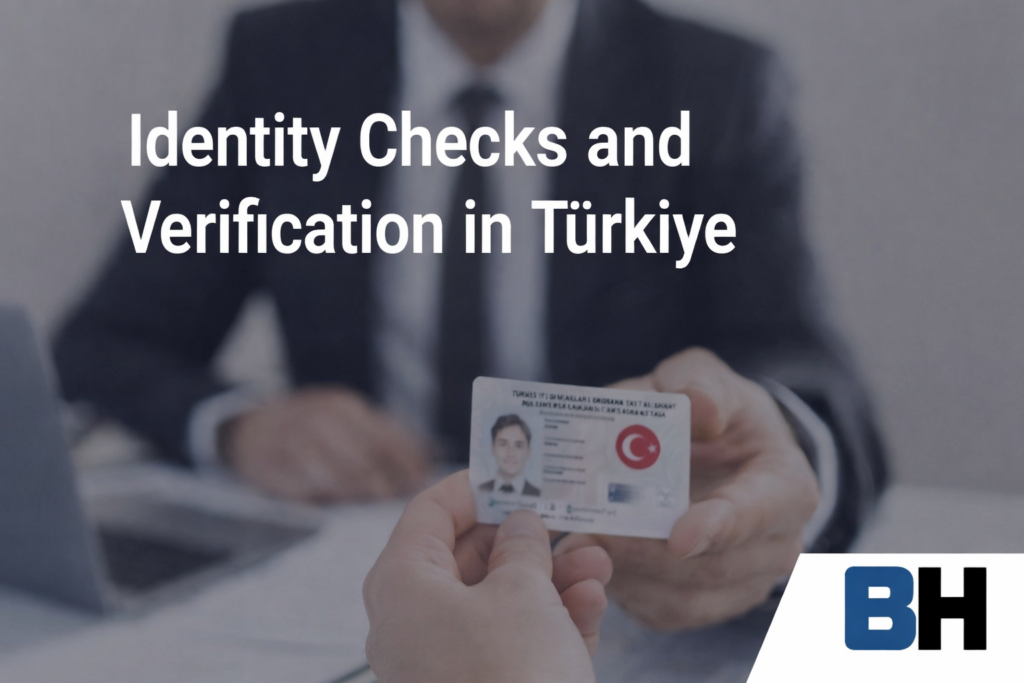
Identity Checks and Verification in Turkey
IIntroduction: Identity Verification as a Legal and Practical Necessity
Identity verification has become a foundational requirement in a wide range of legal, financial, and commercial processes, particularly in cross-border and remote transactions. Whether required for regulatory compliance, contractual security, financial integrity, or legal representation, identity verification serves as the first and most essential safeguard against fraud, misrepresentation, and unlawful activity. In an increasingly globalized environment, institutions and counterparties frequently rely on legally verified identity information obtained in foreign jurisdictions, making the reliability of verification procedures critically important.
In Turkey, identity verification is not merely a technical or administrative step. It is closely connected to legal obligations arising from anti-money laundering legislation, regulatory compliance frameworks, and professional due diligence standards. International clients engaging in business, financial transactions, or legal processes involving Turkey often require identity verification services that meet both Turkish legal requirements and the expectations of foreign institutions.
This page explains the legal and practical dimensions of identity verification services in Turkey, the contexts in which such services are required, and how professionally conducted verification supports international compliance and risk management.
What Is Identity Verification in a Legal Context?
Identity verification refers to the process of confirming that a person is who they claim to be by examining official identity documents and, where required, verifying the physical presence and identity of the individual. In legal and regulatory practice, identity verification goes beyond simple document inspection. It involves assessing the validity, consistency, and reliability of identity information for use in formal procedures.
Unlike document certification, which confirms that a copy corresponds to an original document, identity verification focuses on the individual behind the document. It establishes a direct link between the person and their identity documents and provides assurance to third parties that the verified identity information can be relied upon for legal, financial, or regulatory purposes.
Identity verification is therefore a core component of compliance frameworks, contractual safeguards, and professional responsibility standards, particularly in cross-border transactions where personal presence before the receiving institution is not possible.
Legal Importance of Identity Verification for International Transactions
In international practice, identity verification is frequently required by banks, financial institutions, corporate service providers, regulators, employers, and legal professionals. These entities rely on verified identity information to satisfy statutory obligations, manage risk, and comply with internal governance standards.
Failure to conduct proper identity verification can result in serious legal and financial consequences, including regulatory sanctions, invalidation of transactions, contractual disputes, and exposure to criminal liability. For international clients, deficiencies in identity verification may also lead to rejection of applications, suspension of procedures, or refusal by foreign authorities to recognize documents or declarations originating from Turkey.
Professionally conducted identity verification provides legal certainty and traceability. It ensures that the verification process can be audited, explained, and defended if challenged by regulators or counterparties.
Identity Verification Services Provided in Turkey
Identity verification services in Turkey typically involve an in-person process conducted by a qualified professional. The individual whose identity is being verified attends a meeting where original identity documents are examined and compared with the person presenting them. The verification process may include reviewing passports, national identity cards, residence permits, or other primary identity documents, depending on the purpose of verification.
Following the verification, an attestation or verification letter may be prepared. This document confirms that the individual appeared in person, presented original identity documents, and that their identity was verified based on those documents. Such letters are often required by foreign banks, institutions, or corporate entities as part of their compliance or onboarding procedures.
In international practice, verification documents are commonly prepared in English and delivered electronically to the requesting party, while maintaining proper records in accordance with professional and legal standards.
Contexts in Which Identity Verification Is Required
Identity verification services are required in a wide range of contexts. In financial and commercial transactions, verification is a key component of anti-money laundering and know-your-customer obligations. Banks and payment institutions routinely require identity verification before opening accounts, processing high-value transactions, or onboarding corporate clients.
In corporate and commercial practice, identity verification is used during shareholder onboarding, director appointments, beneficial ownership disclosures, and due diligence processes. Employers may require identity verification when hiring remote employees or engaging consultants located in Turkey.
Legal proceedings and legal representation may also necessitate identity verification, particularly where powers of attorney, affidavits, or declarations are issued for use abroad. In each of these contexts, verification ensures that the individual involved can be reliably identified and legally associated with the relevant transaction or process.
Face-to-Face Identity Verification in Turkey
Face-to-face identity verification remains the most reliable and widely accepted method of verification. It involves the physical presence of the individual before the verifying professional and allows for direct comparison between the person and their identity documents. This method minimizes the risk of impersonation, document misuse, and identity fraud.
In Turkey, face-to-face verification is commonly required for higher-risk transactions or where foreign institutions demand a strong level of assurance. The professional conducting the verification assumes responsibility for confirming that the person presenting the documents matches the identity information contained in them. Face-to-face verification also facilitates compliance with international standards that emphasize physical identification as a cornerstone of effective risk management.
Remote Identity Verification and Its Legal Framework
Technological developments have introduced the possibility of remote identity verification in certain contexts. Turkish law allows remote verification under specific conditions, particularly within the framework of financial services and electronic onboarding processes regulated by the Financial Crimes Investigation Board and related authorities.
Remote verification is subject to strict criteria, including technical safeguards, risk-based assessments, and compliance with detailed regulatory requirements. It is not universally accepted and may not be suitable for all purposes. Many foreign institutions continue to require face-to-face verification, especially for high-value or high-risk matters. Understanding when remote verification is legally permissible, and when it is insufficient, is essential for international clients seeking compliant solutions in Turkey.
Regulatory Background and Compliance Considerations
Identity verification in Turkey is closely linked to anti-money laundering legislation and regulatory oversight. Legal and financial professionals must adhere to statutory obligations concerning customer identification, record-keeping, and risk assessment. Compliance requirements are not static. They evolve in response to international standards, regulatory updates, and enforcement practices. As a result, identity verification services must be conducted with an awareness of both current legal requirements and the expectations of foreign institutions relying on the verification. Professional verification services provide an additional layer of compliance assurance by aligning verification practices with both domestic law and international norms.
Common Challenges and Errors in Identity Verification
In practice, identity verification often encounters avoidable problems. These include reliance on incomplete or unclear identity documents, failure to conduct proper in-person verification, preparation of vague or non-standard verification letters, and misunderstanding the requirements of the requesting institution. Another frequent challenge arises from confusing identity verification with document certification or notarization. Each process serves a different purpose, and substituting one for another can lead to rejection or non-compliance. Professional oversight and clear communication with the requesting institution are key to avoiding these pitfalls.
Relationship Between Identity Verification and Other Legal Services
Identity verification often operates alongside related legal services such as document certification, notarization, apostille, and sworn translation. While distinct, these services are frequently required together in cross-border procedures. Understanding how identity verification fits within the broader documentation and compliance framework allows for more efficient and legally sound outcomes. Coordinated handling of these services reduces delays and ensures consistency across international submissions.
Practical Use Cases for International Clients
International clients may require identity verification services in Turkey for various practical reasons. A foreign bank may request verification of a Turkish-based director or shareholder. An international employer may need identity confirmation for a remote hire. A legal representative abroad may require verified identity information to proceed with a transaction or application. In each case, the value of identity verification lies in providing reliable, professionally supported confirmation that can be accepted across jurisdictions.
Professional Legal Support for Identity Verification in Turkey
Identity verification is most effective when conducted within a professional legal framework. Lawyers providing verification services operate under ethical obligations, professional accountability, and regulatory oversight. This enhances the credibility of the verification and increases its acceptance by foreign institutions. Bıçak offers identity verification services in Turkey tailored to international requirements, supporting clients with compliant, reliable, and professionally documented verification processes suitable for cross-border use.






Comments
No comments yet.