 English
 Türkçe
 Français
 Deutsch

Conducting due diligence on a Turkish company is a fundamental step before investing, financing or entering into a significant commercial relationship in Türkiye. Effective company verification extends beyond confirming corporate registration and requires a comprehensive assessment of ownership, management authority, regulatory compliance, contractual commitments and litigation risks. Reliable due diligence combines information obtained from official registries, regulatory authorities, corporate documents and independent legal verification rather than relying on a single public source. The article explains the principal corporate information sources available in Türkiye and highlights the legal and practical limitations of publicly accessible records. It also examines modern due diligence topics such as beneficial ownership, sanctions screening, integrity assessments, adverse media reviews and ongoing monitoring of business partners. Adopting a risk-based approach enables investors and businesses to identify material legal issues, negotiate appropriate contractual protections and make informed commercial decisions. Understanding both the opportunities and the legal risks associated with Turkish companies is essential for establishing secure and sustainable business relationships. Bıçak Law Firm provides comprehensive legal due diligence and company verification services for international investors, multinational companies and foreign law firms doing business in Türkiye.
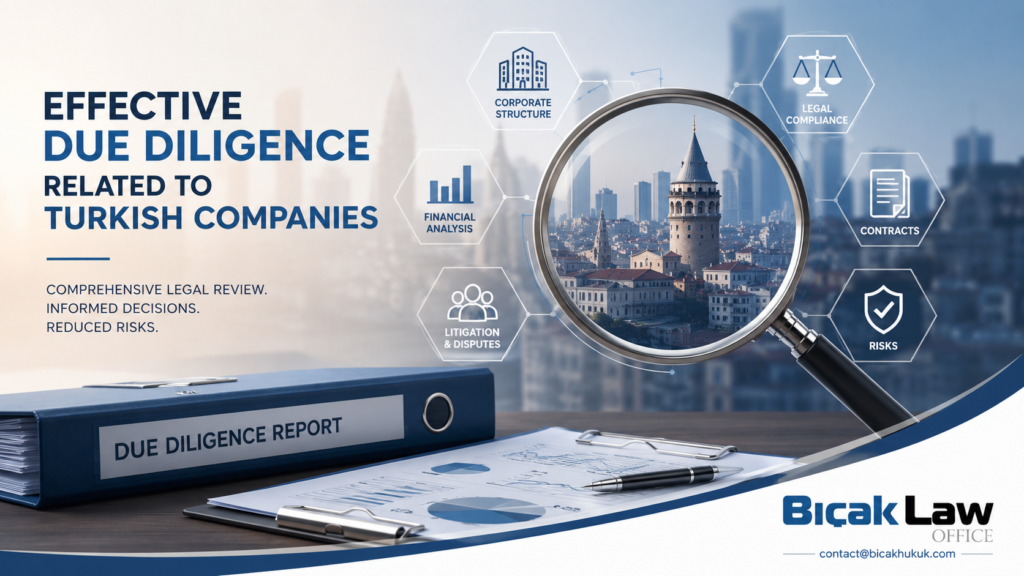
Legal Due Diligence Related to Turkish Companies
1. Introduction
Conducting due diligence on a Turkish company is an essential step before entering into almost any significant commercial relationship. Whether the proposed transaction involves an acquisition, a joint venture, a long-term supply agreement, the appointment of a distributor or agent, project financing, or a strategic investment, verifying the legal and commercial status of the prospective business partner helps identify potential risks before commitments are made.
Unlike a general legal due diligence exercise, which may examine every aspect of a contemplated transaction, company-focused due diligence seeks to answer a more practical question: Can this Turkish company be regarded as a reliable and legally compliant counterparty for the proposed business relationship? Achieving that objective requires considerably more than reviewing publicly available records. It involves understanding the company’s legal existence, ownership structure, management authority, regulatory status, litigation history, financial indicators, and, where appropriate, its reputation, compliance culture and integrity profile.
Türkiye offers a relatively transparent corporate registration system supported by commercial registry records and various public authorities. Nevertheless, no single database provides a complete picture of a company’s legal and commercial standing. Information is dispersed among different institutions, certain records are accessible only under specific legal conditions, and many commercially significant issues—such as contractual liabilities, undisclosed disputes, beneficial ownership arrangements or compliance weaknesses—cannot be identified solely through public sources.
An effective due diligence process therefore combines official registry searches, regulatory information, documents supplied by the target company, independent verification and legal analysis. Depending on the nature of the transaction and the level of identified risk, additional enquiries may be required, including enhanced integrity checks, sanctions screening, management interviews or specialised regulatory reviews.
This guide explains how companies operating in or entering the Turkish market can verify the legal status and reliability of Turkish companies, identifies the principal sources of corporate information available in Türkiye, discusses the practical limitations of publicly accessible records, and outlines the measures that should be considered before establishing a significant commercial relationship with a Turkish counterparty.
2. When Should You Conduct Due Diligence on a Turkish Company?
Legal due diligence should not be regarded as a procedure reserved exclusively for mergers and acquisitions. Any transaction that creates significant legal, financial or operational exposure may justify a structured review of the Turkish company involved. The scope and intensity of the review should always reflect the nature of the proposed transaction, the value at stake, the regulatory environment and the level of identified risk.
For many international businesses, the first contact with a Turkish company takes place long before any acquisition is contemplated. A foreign manufacturer may appoint a Turkish distributor, an investor may establish a joint venture, a bank may finance a project, or a technology company may outsource critical services to a local provider. In each of these situations, understanding who the counterparty is—and whether it possesses the legal capacity, regulatory standing and commercial reliability required for the proposed relationship—is an essential element of prudent risk management. Due diligence is particularly advisable before:
- acquiring shares in a Turkish company;
- purchasing the assets or business of a Turkish enterprise;
- establishing a joint venture or strategic alliance;
- investing in Turkish start-ups or privately held companies;
- providing loans or other forms of project financing;
- entering into long-term supply, manufacturing or distribution agreements;
- appointing commercial agents or authorised representatives;
- acquiring significant real estate through a Turkish corporate vehicle;
- participating in public procurement or infrastructure projects;
- engaging contractors in construction, energy or defence-related industries;
- licensing technology, intellectual property or software to a Turkish business; and
- commencing any long-term commercial relationship where regulatory compliance or corporate integrity is of material importance.
In many cases, the purpose of the review is not to determine whether a transaction should proceed, but rather to identify the legal risks that should be reflected in the transaction structure. The findings may influence the purchase price, contractual warranties, indemnity provisions, conditions precedent, financing arrangements or post-closing obligations. Even where no significant legal concerns are identified, the due diligence process provides valuable assurance that key legal issues have been examined before commitments become legally binding.
The required level of investigation should also be proportionate to the risk profile of the transaction. A minority investment in a small private company will ordinarily require a different level of scrutiny from the acquisition of a regulated financial institution or the appointment of an exclusive distributor responsible for an entire regional market. Similarly, businesses operating in highly regulated sectors—including banking, insurance, healthcare, pharmaceuticals, defence, energy, telecommunications and financial technology—often require sector-specific regulatory verification in addition to conventional corporate due diligence.
International businesses should also recognise that legal due diligence is not limited to reviewing documents supplied voluntarily by the target company. Effective verification frequently requires comparison of company-provided information with independent sources, including commercial registry records, regulatory databases, publicly available disclosures and, where appropriate, additional enquiries concerning litigation history, regulatory enforcement, sanctions exposure and corporate reputation.
Ultimately, the objective is not to eliminate every possible commercial risk – an impossible task in any jurisdiction – but to ensure that decision-makers understand the legal implications of the proposed transaction before assuming contractual or financial obligations.
3. What Should Be Verified Before Doing Business with a Turkish Company?
Verifying a Turkish company involves considerably more than confirming its registration in the commercial registry. While official registration establishes that a company legally exists, it does not by itself demonstrate that the company is financially sound, properly managed, legally compliant or suitable for the proposed transaction.
An effective due diligence process examines whether the target company possesses the legal authority, organisational capacity and regulatory standing necessary to perform its obligations while identifying issues that may expose the investor, lender, purchaser or commercial partner to unnecessary legal or commercial risks.
The precise scope of the review depends on the nature of the transaction. Nevertheless, several core areas should ordinarily be examined whenever a significant business relationship with a Turkish company is contemplated.
3.1. Corporate Identity and Legal Existence
The review should begin by confirming the company’s legal identity and current corporate status. This includes verifying its registered name, legal form, registered office, registration number, tax identification details and current operational status. It should also be confirmed that the company has not entered liquidation, bankruptcy, concordat proceedings or another restructuring process that may affect its ability to perform future obligations. The company’s constitutional documents should be reviewed to determine whether its corporate objects permit the proposed transaction and whether any restrictions exist regarding decision-making authority or shareholder approvals.
3.2. Ownership Structure and Beneficial Ownership
Understanding who ultimately owns and controls the company is frequently one of the most important aspects of due diligence. The registered shareholders should be identified together with any recent ownership changes, share transfers or capital increases. Where ownership structures involve holding companies, foreign entities or nominee arrangements, additional enquiries may be required to identify the ultimate beneficial owners (UBOs). This analysis may also reveal politically exposed persons (PEPs), sanctioned individuals or other integrity concerns requiring enhanced scrutiny. Ownership verification becomes particularly significant where the transaction is subject to anti-money laundering regulations, sanctions compliance or foreign investment approval requirements.
3.3. Management and Authority to Act
A company may exist legally while lacking the corporate authority necessary to conclude a particular transaction. Due diligence should therefore confirm the identity of directors, managers and authorised representatives together with the scope of their signing authority. Attention should also be given to whether board resolutions, shareholder approvals or other corporate authorisations will be required before the contemplated transaction can become legally binding. Failure to verify authority may result in disputes concerning the validity or enforceability of contractual commitments.
3.4. Regulatory Status and Licences
Many sectors in Türkiye operate under specific licensing or regulatory regimes. Businesses engaged in banking, insurance, healthcare, pharmaceuticals, defence, telecommunications, energy, financial technology, transportation and similar regulated industries may require permits, licences or ongoing regulatory approvals. Due diligence should therefore determine whether the company possesses all licences necessary for its current operations and whether any administrative investigations, suspension decisions or regulatory sanctions could affect the proposed transaction. The extent of this review should always reflect the regulatory environment applicable to the particular industry.
3.5. Material Contracts and Commercial Commitments
Significant contractual relationships often determine the commercial value of a business. Accordingly, material contracts should be reviewed to identify provisions that may affect the contemplated transaction. Particular attention should be given to:
- change-of-control clauses;
- termination rights;
- exclusivity obligations;
- long-term supply commitments;
- non-compete provisions;
- assignment restrictions;
- unusual liability clauses; and
- contractual penalties.
The objective is not to review every agreement individually but to determine whether contractual obligations could materially influence the legal or commercial viability of the transaction.
3.6. Litigation, Enforcement and Dispute History
Existing or potential disputes may represent significant legal and financial risks. Due diligence should therefore examine whether the company has been involved in material litigation, arbitration, enforcement proceedings or significant administrative investigations. The review should also consider whether recurring disputes reveal broader compliance deficiencies, governance weaknesses or systemic contractual problems rather than isolated legal disagreements. Where litigation information cannot be independently verified through publicly available sources, additional confirmations should be obtained from company management and supporting documentation.
3.7. Employment and Human Resources
The workforce may represent one of the company’s most significant assets as well as one of its largest potential liabilities. Employment-related due diligence commonly includes reviewing senior management arrangements, collective bargaining agreements, employee benefit obligations, workplace disputes and compliance with labour legislation. Depending on the transaction, additional attention may be required regarding occupational health and safety obligations, immigration compliance, confidentiality arrangements and post-employment restrictive covenants.
3.8. Intellectual Property and Technology Assets
For technology-driven businesses, intellectual property frequently constitutes the company’s principal asset. Due diligence should therefore verify ownership of trademarks, patents, copyrights, industrial designs, domain names and software rights together with any licence agreements governing their use. Particular attention should be given to ownership of internally developed software, open-source licensing issues, artificial intelligence systems and cybersecurity arrangements where these form part of the business model.
3.9. Data Protection and Cybersecurity
Companies processing personal data should be assessed for compliance with the Turkish Personal Data Protection Law (Law No. 6698) and, where applicable, international privacy frameworks. The review may include privacy policies, data processing agreements, international data transfers, information security measures, cyber incident history and regulatory investigations concerning data protection. For businesses operating internationally, compliance with foreign legal frameworks may also become relevant depending upon the geographical scope of their activities.
3.10. Compliance and Corporate Integrity
Modern due diligence extends beyond legal documentation. Increasingly, international investors evaluate whether a company maintains an effective compliance culture and demonstrates responsible corporate governance. The review may therefore include anti-corruption policies, anti-money laundering procedures, sanctions compliance, whistleblowing mechanisms, internal investigations, conflicts of interest, ESG governance, export control compliance and other integrity-related matters proportionate to the nature of the transaction. Although not every transaction requires enhanced integrity due diligence, businesses operating internationally or within highly regulated sectors often regard these issues as essential components of legal risk assessment.
3.11. Tailoring the Scope of Review
No universal checklist can adequately address every transaction involving a Turkish company. The appropriate scope of due diligence should always be determined by reference to the transaction’s objectives, value, industry, regulatory environment and identified risk factors. Accordingly, experienced legal advisers typically adopt a risk-based approach, allocating greater investigative effort to those issues most likely to influence the client’s commercial decision or expose the transaction to significant legal uncertainty.
4. Reliable Sources of Corporate Information in Türkiye
Effective due diligence depends not only on identifying the issues that require investigation but also on understanding where reliable information can be obtained. Unlike some jurisdictions where extensive corporate information is consolidated within a single public database, corporate information in Türkiye is dispersed among several registries, regulatory authorities and official institutions. Each source serves a different purpose and provides only part of the overall picture. Accordingly, no single database should be regarded as sufficient for conducting a comprehensive legal due diligence exercise. Effective verification requires information from multiple independent sources, supported by documents obtained directly from the target company and analysed within the context of the proposed transaction. The principal sources of corporate information in Türkiye include the following.
4.1. Trade Registry Records
The Turkish Trade Registry constitutes the primary official source for verifying a company’s legal existence and corporate history. Trade registry records typically provide information regarding:
- the company’s registered name;
- legal form;
- registered office;
- date of incorporation;
- articles of association and amendments;
- registered capital;
- mergers, demergers and conversions;
- liquidation decisions;
- directors and authorised representatives;
- representation and signing authority.
For most transactions, examination of the commercial registry represents the logical starting point of any due diligence exercise. Nevertheless, the commercial registry records should not be regarded as a complete record of the company’s legal position. Numerous commercially significant matters—including contractual obligations, contingent liabilities, shareholder arrangements, compliance failures and pending negotiations—are not reflected in the registry. Accordingly, trade registry records establish legal identity rather than overall commercial reliability.
4.2. MERSİS (Central Registration System)
MERSİS is the electronic central registration infrastructure supporting Türkiye’s commercial registration system. It facilitates the registration and maintenance of corporate information and serves as an important administrative platform for commercial registry procedures. Although MERSİS assists in verifying various corporate registration details, its function should not be misunderstood. It is not intended to operate as a comprehensive due diligence database. The information accessible to third parties may vary depending on the applicable legal framework and user permissions. Consequently, MERSİS should generally be used together with official trade registry records rather than as an independent source of legal verification.
4.3. Turkish Trade Registry Gazette
The Turkish Trade Registry Gazette provides official announcements concerning significant corporate events. Published notices commonly include:
- incorporation;
- amendments to the articles of association;
- capital increases and reductions;
- appointments and resignations of directors;
- changes in representation authority;
- mergers;
- demergers;
- liquidation decisions;
- relocation of the registered office.
Because these announcements form part of the official corporate record, they frequently assist in reconstructing the historical development of a company and identifying significant structural changes over time.
4.4. Public Disclosure Platform (KAP)
Where the target company is publicly listed, the Public Disclosure Platform (Kamuyu Aydınlatma Platformu – KAP) becomes one of the most valuable sources of information. KAP provides extensive disclosures concerning listed companies, including:
- audited financial statements;
- material event disclosures;
- corporate governance reports;
- shareholding disclosures;
- related-party transactions;
- public announcements required under capital markets legislation.
For listed entities, KAP often provides considerably more information than ordinary commercial registry records and should always form part of the due diligence process.
4.5. Regulatory Authorities
Many Turkish businesses operate under sector-specific regulatory supervision. Consequently, the relevant regulatory authority may provide valuable information regarding licences, administrative sanctions, compliance status and regulatory investigations. Depending upon the industry concerned, relevant authorities may include:
- the Banking Regulation and Supervision Agency (BDDK);
- the Capital Markets Board (SPK);
- the Energy Market Regulatory Authority (EPDK);
- the Personal Data Protection Authority (KVKK);
- the Competition Authority;
- the Public Procurement Authority;
- the Information and Communication Technologies Authority (BTK);
- the Turkish Medicines and Medical Devices Agency;
- other specialised regulators responsible for the relevant sector.
The significance of these authorities naturally depends upon the nature of the target company’s business activities.
4.6. Intellectual Property Registries
Where intellectual property forms an important part of the transaction, the Turkish Patent and Trademark Office provides essential information concerning registered trademarks, patents, industrial designs and other registrable intellectual property rights. The review should extend beyond confirming registration. It should also examine:
- ownership;
- renewal status;
- pending applications;
- licences;
- assignments;
- recorded disputes;
- expiration dates.
For technology-based businesses, intellectual property verification frequently represents one of the most commercially significant aspects of due diligence.
4.7. Court and Enforcement Information
Litigation history may significantly affect the legal and commercial value of a company. Nevertheless, foreign investors should appreciate that litigation verification in Türkiye differs from practice in certain other jurisdictions. Court records are not generally available through an unrestricted public search based solely on a company’s name. Access to litigation information depends upon applicable procedural rules, party status, powers of attorney and the nature of the proceedings concerned. Accordingly, legal advisers commonly verify litigation exposure by combining:
- information provided by the target company;
- publicly available court decisions where accessible;
- official documents;
- management confirmations;
- independent legal enquiries conducted within the limits of applicable law.
The absence of publicly available litigation records should therefore never be interpreted as confirmation that no disputes exist.
4.8. Publicly Available Information
Open-source information also plays an increasingly important role in modern due diligence. Depending upon the circumstances, this may include:
- official websites;
- annual reports;
- sustainability reports;
- press releases;
- reputable media coverage;
- industry publications;
- professional databases;
- insolvency announcements;
- public procurement records.
Such information may identify issues that do not yet appear in official corporate records but nevertheless warrant further investigation. However, open-source information should never be relied upon without independent verification.
4.9. International Compliance Sources
For cross-border transactions, international compliance databases frequently become as important as Turkish public records. Depending upon the transaction, legal advisers may review:
- United Nations sanctions;
- European Union sanctions;
- United Kingdom sanctions;
- United States sanctions programmes;
- politically exposed persons (PEP) databases;
- adverse media reports;
- international watchlists;
- beneficial ownership databases where available.
These sources become particularly relevant where the transaction involves international financing, multinational corporate groups or businesses operating in sectors subject to export controls, anti-money laundering legislation or international sanctions.
4.10. No Single Source Provides a Complete Picture
Perhaps the most important principle of company due diligence in Türkiye is that no official source, by itself, can establish whether a company represents an acceptable commercial risk. Official registries confirm legal facts. Regulatory authorities confirm compliance within their respective jurisdictions. Public disclosures provide valuable corporate information. Open-source intelligence may reveal integrity concerns. Only by combining these independent sources with information supplied by the target company, legal analysis and transaction-specific risk assessment can advisers develop a reliable understanding of the company’s legal and commercial position. Accordingly, effective due diligence should always be viewed as a process of verification rather than a process of document collection.
4.11. The Limits of Publicly Available Information
Publicly available information provides an indispensable starting point for due diligence, but it rarely provides a complete understanding of a company’s legal or commercial position. Official records establish certain legal facts, yet they do not reveal every circumstance that may influence the success or risk profile of a proposed transaction.
One of the most common misconceptions among foreign investors is the assumption that corporate due diligence consists primarily of collecting publicly available documents. In practice, public records answer only a limited number of questions. They confirm matters such as legal existence, registration details, authorised representatives and certain corporate changes. They generally do not explain how a business actually operates, whether significant legal risks exist or whether the company presents an acceptable commercial counterparty.
For example, a company may appear fully compliant in the commercial registry while simultaneously facing substantial contractual disputes, regulatory investigations, financial distress or governance issues that are not reflected in publicly accessible records. Likewise, the absence of adverse information in public databases should never be interpreted as confirmation that no legal or commercial concerns exist. Certain categories of information are inherently unlikely to be available through public sources. These commonly include:
- confidential commercial agreements;
- shareholder agreements;
- financing arrangements;
- contingent liabilities;
- legal opinions obtained by the company;
- internal compliance investigations;
- whistleblowing reports;
- ongoing negotiations;
- commercially sensitive disputes;
- legal risks that have not yet resulted in formal proceedings.
Consequently, the most significant legal risks often emerge not from public records but from documents voluntarily provided by the company, management interviews, contractual analysis and independent legal verification.
Another practical limitation concerns the timing of public information. Corporate registries necessarily reflect legal events after they have occurred. Certain transactions, board decisions, ownership changes or contractual developments may not yet appear in public records, while other information may require interpretation within its legal and commercial context.
Public records also differ considerably in evidential value. An official commercial registry entry, for example, carries a different legal weight from an online media report or an unofficial commercial database. Effective due diligence therefore requires not only collecting information but also evaluating its reliability, legal significance and relevance to the proposed transaction.
For these reasons, experienced legal advisers rarely rely upon a single source of information. Instead, they compare information obtained from public registries with corporate documentation, regulatory disclosures, contractual records and factual explanations provided by company management. Where inconsistencies arise, additional enquiries become necessary before reliable conclusions can be reached.
Ultimately, due diligence is not an exercise in document collection. It is a structured process of legal verification, critical analysis and professional judgement. Publicly available information forms an important foundation, but meaningful legal advice depends upon the ability to identify gaps, reconcile inconsistencies and assess the legal implications of the information obtained.
5. Assessing the Reliability of Information
Not all information obtained during a due diligence exercise carries the same evidential or practical value. A central task of legal due diligence is therefore to assess not only what information has been collected but also how much confidence can reasonably be placed in each source. As a general principle, information obtained directly from official governmental records is ordinarily regarded as more reliable than information derived from unofficial databases, commercial reports or media sources. Nevertheless, even official records must be interpreted carefully, since each registry reflects only the matters falling within its statutory purpose and may not provide a complete picture of the company’s legal position. For practical purposes, sources of information may broadly be evaluated in the following order of reliability:
- Official government records and certified documents, including commercial registry records, official regulatory decisions and notarised corporate documents.
- Statutory public disclosures, such as mandatory filings made to regulatory authorities or the Public Disclosure Platform (KAP).
- Original corporate documentation, including constitutional documents, material contracts, board resolutions and internal corporate records supplied by the company.
- Management representations, explanations provided during interviews and responses to due diligence questionnaires.
- Independent third-party databases and professional information providers, which may assist in identifying additional issues but should normally be verified through primary sources.
- Open-source material, including media reports, internet searches and industry publications, which may reveal potential concerns requiring further investigation but rarely constitute conclusive evidence on their own.
Where information obtained from different sources is inconsistent, legal advisers should avoid drawing immediate conclusions. Instead, inconsistencies should be analysed, discussed with the target company where appropriate and, if unresolved, expressly reflected in the due diligence report as identified risks, limitations or matters requiring further investigation.
Equally important is recognising the distinction between legal verification and commercial judgement. Due diligence cannot guarantee that a transaction will succeed or that future disputes will never arise. Rather, it enables decision-makers to assess the available information, understand the legal consequences of identified risks and make informed commercial decisions based upon an appropriate level of investigation. Accordingly, the value of due diligence lies not in the volume of documents reviewed but in the quality of the legal analysis applied to the information obtained.
6. Litigation, Enforcement and Regulatory Verification
A company’s litigation history frequently provides valuable insight into its legal risk profile, corporate governance and commercial practices. However, the existence—or absence—of litigation should never be viewed in isolation. The objective of legal due diligence is not to count lawsuits but to understand what those disputes reveal about the business.
Some disputes arise in the ordinary course of commercial activity and may have little practical significance. Others may indicate recurring contractual failures, ineffective compliance systems, financial distress or weaknesses in corporate governance. Effective due diligence therefore requires both legal analysis and commercial judgement.
6.1. Reviewing Litigation Exposure
Where legally permissible and proportionate to the transaction, due diligence should seek to identify material court proceedings, arbitration cases and significant legal disputes involving the target company. Particular attention should be given to proceedings that may:
- materially affect the company’s financial position;
- interfere with its ability to perform contractual obligations;
- restrict the use of key assets;
- jeopardise licences or regulatory approvals;
- expose directors or senior management to liability;
- create significant reputational risks.
The legal significance of litigation should always be assessed in light of the nature of the claim, the procedural stage of the proceedings, the financial exposure involved and the realistic likelihood of an adverse outcome. A company involved in several well-managed commercial disputes may present considerably less risk than a company facing only a single regulatory investigation capable of disrupting its entire business.
6.2. Enforcement Proceedings
Enforcement proceedings may reveal issues that are not immediately apparent from ordinary corporate documentation. Repeated enforcement actions initiated against the company may indicate:
- liquidity problems;
- persistent payment defaults;
- contractual non-performance;
- deteriorating supplier relationships;
- broader financial difficulties.
Conversely, enforcement proceedings commenced by the company may simply reflect ordinary debt collection activities associated with its business model. Accordingly, enforcement information should always be interpreted within its commercial context rather than evaluated solely by reference to the number of proceedings identified.
6.3. Arbitration and Alternative Dispute Resolution
Many international commercial disputes involving Turkish companies are resolved through arbitration rather than national courts. Accordingly, where relevant to the proposed transaction, due diligence should seek information concerning:
- pending arbitration proceedings;
- previous arbitral awards;
- settlement agreements;
- mediation processes involving material disputes.
Particular consideration should be given to disputes administered under institutional arbitration rules where the financial consequences could materially influence the transaction.
6.4. Regulatory Investigations and Administrative Sanctions
For businesses operating in regulated industries, administrative enforcement may present greater risks than ordinary commercial litigation. Regulatory investigations may affect:
- operating licences;
- market access;
- public procurement eligibility;
- financial reporting obligations;
- product approvals;
- export authorisations;
- professional certifications.
Administrative sanctions may include:
- monetary penalties;
- suspension of activities;
- licence restrictions;
- corrective orders;
- compliance undertakings;
- temporary or permanent prohibitions affecting specific business operations.
The commercial consequences of regulatory action frequently extend well beyond the immediate financial penalty and should therefore receive careful consideration during due diligence.
6.5. Sector-Specific Regulatory Verification
The appropriate scope of regulatory review depends upon the industry in which the target company operates. Examples include verifying:
- banking licences and prudential compliance;
- insurance authorisations;
- energy generation or distribution licences;
- pharmaceutical manufacturing approvals;
- medical device registrations;
- telecommunications authorisations;
- defence industry permits;
- environmental permits;
- customs authorisations;
- export control registrations;
- personal data protection compliance.
Certain industries require continuous regulatory compliance rather than one-time licensing. Consequently, legal advisers should examine not only whether a licence exists but also whether the company continues to satisfy the legal conditions necessary to maintain it.
6.6. Practical Challenges in Türkiye
International clients frequently expect litigation searches comparable to those available in certain common law jurisdictions, where court records can often be searched comprehensively using the name of a company. The Turkish legal system operates differently. Court files, enforcement records and procedural information are subject to legal rules governing confidentiality, procedural rights and authorised access. Consequently, the availability of litigation-related information depends upon the nature of the proceedings, the legal basis for access and the status of the person requesting the information. Accordingly, litigation verification in Türkiye often requires a combination of:
- documents supplied by the company;
- publicly accessible judicial information where available;
- lawyer-led enquiries conducted within the limits of applicable law;
- management representations;
- contractual disclosures and warranties.
Foreign investors should therefore recognise that litigation due diligence is not merely a database search but a structured legal assessment of available information together with the limitations inherent in that information.
6.7. Red Flags Requiring Further Investigation
Certain findings commonly justify enhanced legal review before a transaction proceeds. Examples include:
- recurring litigation concerning substantially similar issues;
- repeated enforcement proceedings arising from unpaid debts;
- ongoing regulatory investigations;
- significant tax disputes;
- allegations of corruption, fraud or serious misconduct;
- repeated employment litigation;
- environmental enforcement actions;
- sanctions-related investigations;
- disputes involving key intellectual property;
- litigation affecting ownership of essential assets.
The existence of one or more red flags does not necessarily prevent a transaction from proceeding. However, such findings ordinarily require additional investigation and may influence transaction structure, contractual protections or commercial negotiations.
6.8. Litigation Risk Should Inform the Transaction Structure
The purpose of litigation due diligence is not simply to determine whether disputes exist. Rather, it is to assess how identified legal risks should influence the proposed transaction. Depending on the findings, the parties may decide to:
- renegotiate the purchase price;
- require additional warranties or indemnities;
- introduce conditions precedent;
- defer completion until specified disputes are resolved;
- establish escrow arrangements;
- obtain specialist legal opinions;
- require enhanced regulatory confirmations.
Accordingly, litigation due diligence should be regarded as a tool for informed decision-making rather than an exercise directed towards identifying reasons to abandon a transaction.
7. International Sanctions, Integrity and Adverse Media Checks
Corporate due diligence has evolved significantly over the past decade. While traditional legal due diligence focused primarily on corporate records, contracts and litigation, modern cross-border transactions increasingly require a broader assessment of compliance, corporate integrity and reputational risk. International investors, financial institutions and multinational companies are expected to understand not only whether a prospective business partner is legally established, but also whether the relationship could expose them to sanctions risks, anti-money laundering concerns, corruption allegations or other issues capable of affecting regulatory compliance or corporate reputation. Accordingly, integrity due diligence has become an increasingly important component of legal risk assessment, particularly in transactions involving international financing, regulated industries or cross-border supply chains.
7.1. Sanctions Screening
One of the first integrity-related questions is whether the target company, its owners or key decision-makers are subject to international sanctions or restrictive measures. Depending upon the jurisdictions connected with the proposed transaction, sanctions screening may include publicly available measures adopted by:
- the United Nations;
- the European Union;
- the United Kingdom;
- the United States; and
- other jurisdictions whose sanctions regimes may be relevant to the transaction.
Even where a Turkish company is not itself designated under a sanctions programme, legal advisers should consider whether its shareholders, directors, ultimate beneficial owners or significant commercial relationships may create indirect sanctions risks. The scope of sanctions screening should always be proportionate to the nature of the transaction and the jurisdictions involved.
7.2. Beneficial Ownership Verification
Identifying the registered shareholders of a company does not necessarily reveal who ultimately controls or benefits from the business. Complex ownership structures involving holding companies, nominee shareholders, trusts or foreign corporate vehicles may obscure the identity of the ultimate beneficial owner (UBO). Understanding who ultimately owns or controls the company is often essential for legal compliance, anti-money laundering obligations and sanctions risk assessment. Beneficial ownership analysis may also assist in identifying hidden conflicts of interest, undisclosed control relationships or corporate structures designed primarily to conceal ownership. Where the ownership structure cannot be clearly established, additional enquiries may be necessary before significant commercial commitments are undertaken.
7.3. Politically Exposed Persons (PEPs)
Certain transactions justify determining whether the company’s owners, senior management or beneficial owners qualify as politically exposed persons (PEPs). The existence of a PEP relationship does not imply unlawful conduct. However, many financial institutions and multinational businesses apply enhanced due diligence where politically exposed persons are involved because such relationships may present increased corruption or reputational risks. Accordingly, the purpose of PEP screening is not to exclude particular counterparties but to ensure that appropriate risk management measures are implemented where justified by the circumstances.
7.4. Anti-Corruption and Compliance Culture
Modern due diligence increasingly evaluates how a company manages legal and ethical risks internally. Rather than focusing solely on whether compliance documents exist, advisers should consider whether the company demonstrates an effective compliance culture in practice. Relevant considerations may include:
- anti-corruption policies;
- gifts and hospitality procedures;
- third-party due diligence processes;
- whistleblowing mechanisms;
- internal investigation procedures;
- conflict-of-interest policies;
- employee compliance training;
- board oversight of compliance functions.
For multinational transactions, these issues frequently become as important as traditional corporate documentation.
7.5. Adverse Media and Reputational Risk
Open-source intelligence has become an increasingly valuable component of integrity due diligence. Reputable media reports, regulatory announcements, court decisions, industry publications and other publicly available information may reveal issues requiring further investigation. Examples include allegations concerning:
- corruption;
- fraud;
- environmental misconduct;
- labour rights violations;
- product safety;
- consumer protection;
- competition law infringements;
- export control violations;
- sanctions evasion;
- serious corporate governance failures.
The existence of adverse media should not automatically be interpreted as evidence of misconduct. Media reports vary considerably in reliability and should always be assessed critically and, where appropriate, verified through independent sources. The objective is to identify potential risks requiring further enquiry rather than to reach definitive conclusions solely on the basis of publicly available allegations.
7.6. Third-Party Risk
Many businesses present limited legal risk in their own operations but create substantial exposure through their business partners. Consequently, due diligence may also extend beyond the target company itself to include significant distributors, commercial agents, suppliers, subcontractors, logistics providers or other third parties whose activities could expose the transaction to legal or regulatory risk. This broader assessment has become increasingly important in sectors subject to anti-corruption legislation, export controls, sanctions compliance, defence procurement and international supply chain regulations.
7.7. Enhanced Due Diligence
Certain findings may justify a more intensive review than would ordinarily be undertaken. Enhanced due diligence may become appropriate where:
- ownership structures are unusually complex or opaque;
- beneficial ownership cannot readily be established;
- the transaction involves high-risk jurisdictions;
- sanctions-related concerns arise;
- corruption allegations require further examination;
- regulatory investigations remain unresolved;
- significant adverse media exists;
- unusually large cash transactions are involved; or
- the business operates in a sector presenting elevated compliance risks.
Enhanced due diligence does not necessarily indicate wrongdoing. Rather, it reflects the principle that higher-risk situations require a more detailed level of verification before commercial decisions are made.
7.8. Integrity Findings Should Support Risk Management
The objective of integrity due diligence is not to eliminate every possible reputational risk. Such an objective would be unrealistic in international commerce. Instead, the purpose is to enable decision-makers to understand the nature of identified risks and determine whether those risks can be appropriately managed through contractual protections, enhanced compliance measures, ongoing monitoring or, where necessary, reconsideration of the proposed transaction. Integrity due diligence therefore complements traditional legal due diligence by addressing risks that may not appear in corporate records but nevertheless have significant legal, regulatory and commercial implications.
8. Ongoing Monitoring of Turkish Business Partners
Completing a due diligence review before entering into a commercial relationship should not necessarily mark the end of the verification process. In many transactions, particularly those involving long-term business relationships, the legal and commercial risk profile of a company may change significantly over time. Ownership structures may change, new directors may be appointed, regulatory licences may be suspended or revoked, financial circumstances may deteriorate, and new litigation or enforcement proceedings may arise after the initial due diligence has been completed. Similarly, changes in sanctions regimes, export control regulations or anti-money laundering requirements may affect an existing business relationship even where no changes occur within the company itself. For these reasons, many international organisations now regard due diligence as an ongoing risk management process rather than a one-time investigation conducted before signing a contract.
8.1. When Should Ongoing Monitoring Be Considered?
The need for ongoing monitoring depends upon the nature of the business relationship and the level of identified risk. Periodic verification may be appropriate where the Turkish company:
- serves as an exclusive distributor or commercial agent;
- forms part of a long-term supply chain;
- participates in strategic infrastructure or defence projects;
- processes significant volumes of personal data;
- operates in a heavily regulated industry;
- receives substantial financing or investment;
- manages valuable intellectual property or technology;
- performs outsourced business-critical services; or
- represents the business in dealings with governmental authorities or major customers.
Long-term contractual relationships generally justify a higher degree of ongoing monitoring than isolated commercial transactions.
8.2. What Should Be Monitored?
The scope of ongoing monitoring should remain proportionate to the commercial relationship and the level of legal risk involved. Depending upon the circumstances, periodic reviews may include changes relating to:
- corporate ownership;
- ultimate beneficial ownership;
- directors and authorised signatories;
- representation authority;
- regulatory licences and permits;
- administrative sanctions;
- litigation and arbitration;
- enforcement proceedings;
- insolvency or restructuring;
- compliance programmes;
- sanctions exposure;
- adverse media;
- material contractual disputes.
Monitoring does not necessarily require repeating the entire due diligence process. Instead, the review should focus on identifying material developments capable of affecting the legal or commercial assumptions upon which the original transaction was based.
8.3. Event-Driven Due Diligence
In practice, due diligence is often triggered not by the passage of time but by significant corporate events. Additional verification should be considered where:
- the company undergoes a change of ownership;
- senior management is replaced;
- a merger, demerger or major restructuring occurs;
- new investors enter the business;
- significant regulatory investigations commence;
- major litigation arises;
- the company expands into higher-risk jurisdictions;
- international sanctions affect the relevant industry or region; or
- credible allegations of fraud, corruption or serious misconduct emerge.
These developments do not necessarily indicate that the commercial relationship should be terminated. However, they frequently justify a reassessment of legal risks and contractual protections.
8.4. Ongoing Monitoring as a Compliance Tool
For many multinational businesses, ongoing monitoring is no longer conducted solely to protect commercial interests. It also supports compliance with legal and regulatory obligations. International businesses are increasingly expected to maintain effective oversight of their counterparties throughout the duration of the relationship. This expectation may arise from contractual commitments, internal compliance policies, sector-specific regulatory requirements or internationally recognised governance standards. Accordingly, ongoing monitoring assists businesses in demonstrating that risk management measures remain appropriate as circumstances evolve.
8.5. A Risk-Based Approach
Continuous monitoring should not impose unnecessary administrative burdens. Resources should instead be allocated according to the level of identified risk. A low-value supplier providing routine goods may require little more than occasional verification of corporate registration and authorised representatives. By contrast, a strategic joint venture partner, an exclusive distributor, a defence contractor or a company operating within a highly regulated sector may justify periodic legal reviews covering corporate governance, regulatory compliance, litigation exposure and integrity risks. This risk-based approach enables businesses to focus their compliance efforts where they are likely to provide the greatest practical value.
8.6. Ongoing Monitoring Supports Better Commercial Decisions
Businesses inevitably evolve. Markets change, ownership changes, regulations change and commercial priorities change. A due diligence report prepared at the outset of a transaction reflects the circumstances existing at that particular moment. Ongoing monitoring helps ensure that significant developments are identified before they develop into legal disputes, regulatory concerns or commercial losses. It enables businesses to adapt contractual protections, strengthen compliance measures and make informed decisions based on current information rather than historical assumptions. For these reasons, ongoing monitoring should be regarded as a natural continuation of the due diligence process rather than as a separate compliance exercise.
9. Practical Considerations for International Investors
Conducting due diligence in Türkiye requires more than a familiarity with Turkish legislation. Foreign investors should also understand how legal information is generated, maintained and accessed in practice. A well-planned due diligence exercise therefore combines legal analysis with an appreciation of the practical characteristics of the Turkish legal and regulatory system. Although Türkiye maintains a sophisticated corporate registration framework and a broad range of electronic government services, the information relevant to legal due diligence remains dispersed among different institutions, registries and regulatory authorities. Consequently, successful verification depends not only on identifying relevant information but also on understanding where it can be found, how it should be interpreted and what limitations apply to its use.
9.1. Public Information Is Fragmented
Unlike jurisdictions that provide a single comprehensive corporate database, information concerning Turkish companies is distributed across several official sources. Corporate registration records, regulatory information, intellectual property registrations, public disclosures and judicial information are maintained by different institutions, each serving a distinct statutory purpose. Accordingly, effective due diligence rarely consists of consulting one registry alone. Instead, it requires the careful consolidation of information obtained from multiple independent sources.
9.2. Legal Interpretation Is as Important as Information Collection
Obtaining documents represents only one stage of the due diligence process. The greater challenge often lies in determining the legal significance of the information obtained. Corporate documents, regulatory decisions and contractual provisions must be interpreted within the framework of Turkish legislation and judicial practice. Information that appears straightforward when viewed in isolation may have materially different implications once considered in the context of the proposed transaction. Accordingly, effective due diligence depends not only upon access to information but also upon the quality of the legal analysis applied to that information.
9.3. Not Every Relevant Matter Appears in Official Records
Foreign investors occasionally assume that every legally significant issue affecting a company will appear in an official registry. In practice, many commercially important matters remain outside the scope of public registration. Examples may include:
- shareholder arrangements;
- internal governance issues;
- contractual allocation of commercial risks;
- pending negotiations;
- compliance deficiencies;
- internal investigations;
- unasserted legal claims;
- commercially sensitive disputes.
Consequently, due diligence should combine independent verification with a careful review of documents supplied by the target company and, where appropriate, management explanations.
9.4. Regulatory Practice May Influence Legal Risk
Understanding the applicable legislation is only one aspect of legal risk assessment. In certain sectors, the practical approach adopted by regulatory authorities may significantly influence the operation of the law. Licensing procedures, administrative expectations, supervisory practice and compliance standards may evolve over time through regulatory guidance, administrative decisions and sectoral practice. Accordingly, due diligence should evaluate not only the legal framework but also the practical regulatory environment within which the business operates.
9.5. Translation and Documentation
International transactions frequently require Turkish-language corporate documents to be reviewed by foreign investors, lenders or legal advisers. Articles of association, commercial registry records, board resolutions, licences, court decisions and regulatory correspondence may all require accurate legal translation before meaningful analysis can take place. Literal translation alone is often insufficient. Legal terminology should be interpreted in a manner consistent with Turkish law while remaining understandable to decision-makers unfamiliar with the Turkish legal system.
9.6. Due Diligence Should Be Tailored to the Transaction
No two transactions present identical legal risks. A minority investment in a privately owned software company requires a different review from the acquisition of a regulated financial institution, the appointment of a pharmaceutical distributor or participation in a defence procurement project. Accordingly, the scope of due diligence should always be determined by the commercial objectives of the transaction rather than by a standardised checklist. A well-designed due diligence exercise allocates investigative resources to those issues most likely to influence the client’s commercial decision, regulatory exposure or contractual risk.
9.7. Local Knowledge Adds Context
Many legal questions cannot be answered solely by reviewing legislation or corporate records. Market practice, administrative procedures, sector-specific expectations and judicial interpretation frequently influence the practical operation of Turkish law. For this reason, international investors commonly combine publicly available information with advice from Turkish legal professionals who can interpret the available information within its broader legal and commercial context. Such local insight helps distinguish routine commercial matters from issues that genuinely require contractual protection, additional investigation or reconsideration of the proposed transaction.
9.8. Effective Due Diligence Supports Better Investment Decisions
The objective of due diligence is not to eliminate every possible uncertainty. Commercial transactions inevitably involve a degree of business risk. Rather, the objective is to ensure that legal risks are identified, understood and managed before significant contractual or financial commitments are undertaken.A structured due diligence process enables investors to negotiate from an informed position, allocate risks appropriately and proceed with greater confidence when entering the Turkish market.
10. Conclusion
Effective due diligence related to Turkish companies extends far beyond verifying corporate registration or reviewing publicly available documents. It is a structured process of legal verification, risk assessment and professional judgement designed to provide decision-makers with a reliable understanding of the legal and commercial issues that may affect a proposed transaction.
No single registry, database or official source can provide a complete picture of a company’s legal position. Meaningful due diligence requires the careful integration of corporate records, regulatory information, company documentation, publicly available sources and independent legal analysis. Equally important is recognising the limitations of each source and evaluating the reliability, relevance and legal significance of the information obtained.
The appropriate scope of due diligence will always depend upon the nature of the transaction, the industry concerned and the level of identified risk. Whether the objective is an acquisition, a strategic investment, a financing arrangement, the appointment of a commercial partner or the establishment of a long-term business relationship, a risk-based approach enables legal resources to be focused where they provide the greatest practical value.
Ultimately, effective due diligence is not about eliminating every possible risk. It is about reducing uncertainty, identifying material legal issues at an early stage and enabling informed commercial decisions. Businesses that understand both the opportunities and the legal risks associated with their Turkish counterparties are better positioned to negotiate appropriate contractual protections, comply with applicable regulations and establish sustainable commercial relationships in Türkiye.
Bıçak Law Firm advises international investors, multinational corporations, financial institutions and foreign law firms on legal due diligence involving Turkish companies across a broad range of industries. Our work includes company verification, corporate governance reviews, regulatory compliance assessments, litigation risk analysis, integrity due diligence and transaction-specific legal advice, enabling clients to make informed business decisions when investing in or doing business with Turkish counterparties.
Note: These materials are not intended to provide legal advice for specific circumstances and should not be relied upon in place of professional advice and judgement.





Comments
No comments yet.