 English
 Türkçe
 Français
 Deutsch

Foreign companies operating in Türkiye increasingly face scrutiny from law enforcement, tax authorities, consumer protection bodies, and municipal authorities, even when fully compliant. Cross-border business models – particularly those involving digital services, contractors, and international payments – are often misunderstood at the local level. Payment discrepancies caused by bank commissions or currency differences may be incorrectly perceived as overcharging or fraud. The use of local contractors and communication channels can create the impression of a local presence, exposing individuals and companies to unexpected legal inquiries, including those initiated by municipalities in relation to licensing, business activities, or local compliance requirements. A single customer complaint may escalate into multi-authority investigations involving police, tax authorities, consumer bodies, and municipal authorities. Standard global compliance policies are often insufficient to address the practical realities of enforcement in Türkiye. Companies must implement localized operational legal guidance, including authority interaction protocols, information disclosure controls, and escalation mechanisms. Bıçak provides tailored legal support to international companies in Türkiye, helping them manage risks, respond effectively to authorities, and prevent legal escalation.
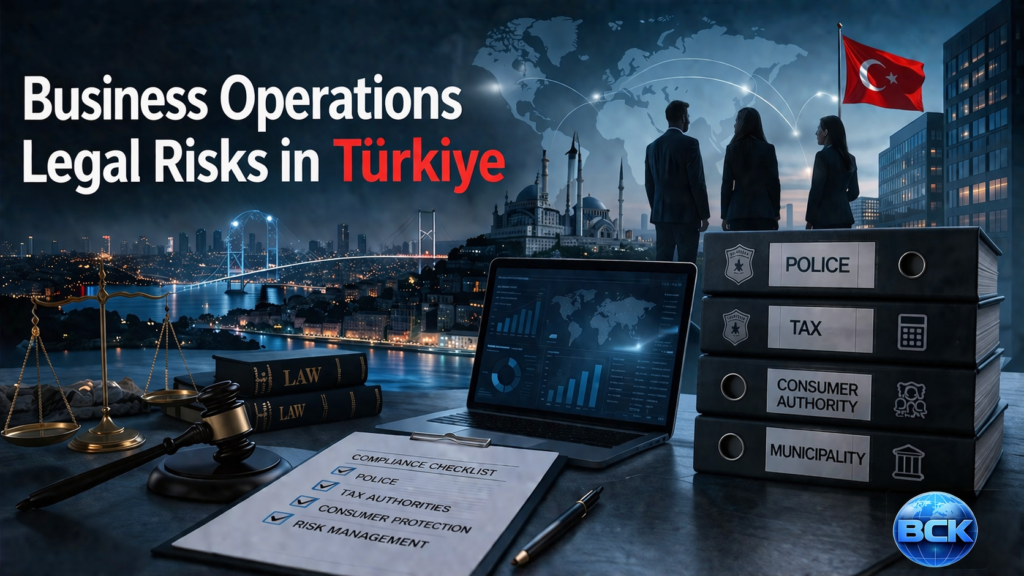
Business Operations Legal Risks in Türkiye
Why This Matters for International Companies
Türkiye has become an increasingly attractive market for international companies – particularly in sectors such as EdTech, SaaS, fintech, and digital platforms. However, alongside this growth, there has been a notable increase in scrutiny from local authorities, including law enforcement, tax authorities, and consumer protection bodies. Foreign companies often assume that operating cross-border – without a local entity – limits their exposure. In practice, the opposite may occur. Even fully compliant companies may face:
- police inquiries,
- tax audits, or
- consumer complaints escalating into legal proceedings
due to misinterpretation of their business model at the local level. This is especially true where local contractors, payment systems, or customer interactions create the impression of a physical or operational presence in Türkiye.
Typical Legal Risks for Foreign Companies in Türkiye
Misinterpretation of Cross-Border Business Models
Cross-border payment structures – particularly those involving:
- foreign currency transactions,
- intermediary banks, or
- commission-based pricing
may be misunderstood as:
- overcharging,
- unfair commercial practice, or
- even fraudulent conduct.
In many cases, discrepancies caused by bank commissions or FX differences are incorrectly attributed to the company.
Contractor vs. Employee Confusion
One of the most common risks arises from the use of local contractors. In Türkiye, authorities often look beyond contractual labels and focus on actual working relationships. As a result:
- contractors may be treated as employees, or
- worse, as company representatives
This may expose individuals – and indirectly the company – to:
- questioning by authorities,
- administrative scrutiny, or
- potential liability claims.
The “Local Presence Illusion”
Even without a registered entity, companies may appear locally established due to:
- local phone numbers,
- customer support channels,
- direct communication with Turkish users
Authorities may interpret this as:
- operational control,
- local ownership, or
- revenue generation within Türkiye
triggering regulatory interest.
Multi-Authority Exposure
A single issue can quickly escalate across multiple authorities. For example:
- a customer complaint →
- consumer authority review →
- tax inquiry →
- police investigation
Each authority operates independently, yet information may be shared across institutions.
A Real-World Scenario: When Misunderstanding Becomes Risk
In a recent case, a local contractor was questioned by police following a customer complaint alleging overcharging. The root cause was not fraud – but:
- a bank commission difference, and
- the fact that the contractor’s phone number was associated with customer support.
Authorities initially assumed:
- the contractor owned the platform, and
- personally received payments.
Although the matter was clarified, the situation illustrates a critical point: Legal risk often arises not from wrongdoing – but from misinterpretation.
Why Standard Corporate Policies Are Not Enough
Many international companies rely on global compliance policies. However:
- global policies are often too general,
- they do not reflect local enforcement practices, and
- they fail to address real-time operational risks.
Common mistakes include:
- providing informal explanations to authorities
- over-sharing information
- failing to escalate early
- allowing contractors to respond independently
What is needed instead is: A localized, operational legal playbook tailored to Türkiye
What Companies Must Have in Place
To effectively manage legal risk in Türkiye, international companies should implement:
Authority Interaction Protocol
Clear rules on how to interact with:
- police
- tax authorities
- consumer bodies
Information Disclosure Control
Defined boundaries on:
- what can be said
- what must never be disclosed
Escalation Mechanism
Immediate internal reporting and:
- centralized legal coordination
Contractor Risk Management
Clear separation between:
- company operations
- contractor roles
Documentation and Evidence Systems
Proper record-keeping to:
- protect legal position
- ensure consistency
Emergency Situations: What Can Go Wrong
In practice, the highest risk arises during unexpected interactions such as:
- police questioning
- temporary detention of contractors
- tax inspections
- municipality controls
- escalated consumer complaints
The critical issue is timing: What is said – or done – in the first 10 minutes can determine the outcome of the entire case. Improper responses may:
- escalate the situation unnecessarily
- create legal exposure
- complicate defense strategies
How We Support International Companies in Türkiye
At Bıçak Law Firm, we provide tailored legal support for international companies operating in Türkiye, particularly those without a local entity. Our services include:
✔ Legal Risk Assessment: Identifying exposure areas in your operational model
✔ Authority Interaction Protocol Design: Creating customized guidance for your teams
✔ Contractor Compliance Structuring: Reducing misclassification and representation risks
✔ Crisis Response & Legal Representation: Immediate support in case of:
- police inquiries
- tax audits
- consumer disputes
- municipality controls
✔ Team Training & Operational Guidance: Ensuring your personnel respond correctly under pressure
Our Practical Approach
We focus on real-world, scenario-based solutions, not theoretical advice. Our approach is:
- practical and operational
- tailored to cross-border business models
- aligned with Turkish enforcement practices
- responsive in urgent situations
We bridge the gap between:
- global compliance frameworks, and
- local legal realities
Who Should Be Concerned?
This issue is particularly relevant for:
- EdTech platforms
- SaaS companies
- fintech and payment providers
- e-commerce platforms
- marketplaces
and any company that:
- operates in Türkiye without a legal entity
- uses local contractors or support staff
- processes cross-border payments
Prevention is More Effective than Defense
Legal issues in Türkiye often arise not from non-compliance, but from:
- lack of local adaptation, and
- absence of structured response protocols.
A proactive approach – combining legal insight with operational guidance – can prevent escalation and protect both the company and its personnel.
Contact Us
If your company operates in Türkiye and:
- your team may be contacted by authorities,
- you want to reduce legal and regulatory risk, or
- you require immediate legal support
we would be pleased to assist.
👉 Contact Bıçak Law Firm for:
- tailored legal risk assessments
- operational guidance
- and rapid-response legal support







Comments
No comments yet.