 English
 Türkçe
 Français
 Deutsch

Holiday food poisoning can turn a long-awaited trip to Turkey into a distressing experience, causing illness, financial loss and disruption to family holidays. Travellers who become ill may have legal rights to seek compensation where unsafe food, poor hygiene or negligence contributed to their illness. Successful claims often depend on obtaining timely medical treatment, preserving evidence and understanding the legal framework applicable to the case. Depending on how the holiday was booked, claims may involve hotels, restaurants, tour operators, insurers or other parties. Proving causation and collecting evidence located in Turkey are frequently the most challenging aspects of these cases. Early legal advice can help protect important evidence and improve the prospects of resolving a claim successfully. Bıçak Law Firm assists injured tourists, foreign law firms and insurers with evidence collection, legal representation and cross-border coordination in holiday food poisoning claims arising in Turkey. With extensive experience in Turkish law and international legal matters, our team provides practical and reliable legal support throughout every stage of the claims process.
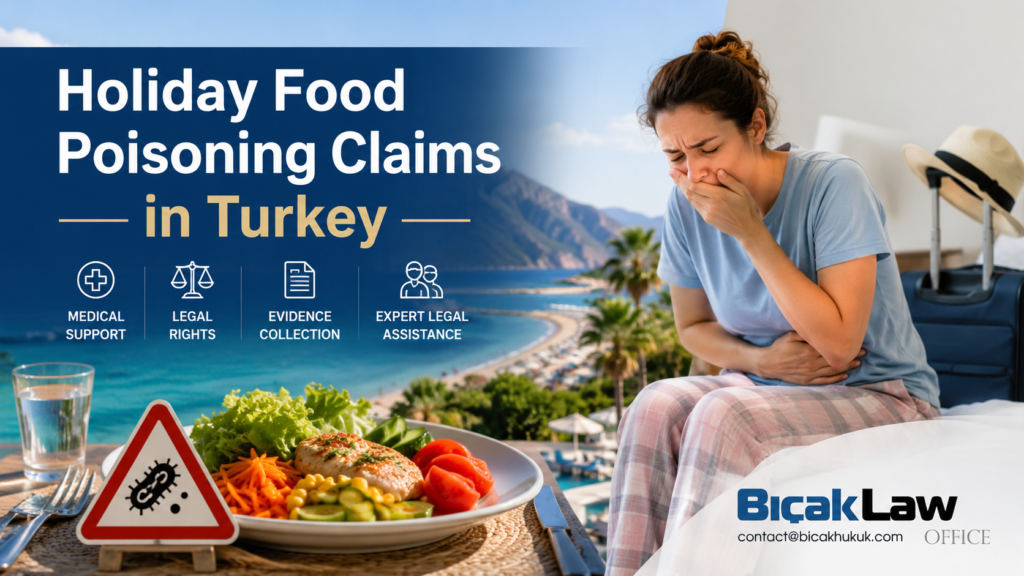
Holiday Food Poisoning Claims in Turkey
Anyone serving food to the public, anywhere in the world, has a legal and professional responsibility to follow proper health and safety procedures. Hotels, restaurants, cruise ships, shops and tour operators must ensure that food hygiene rules and international best practices are consistently applied. If you become ill with food poisoning because these standards were not met, you may be entitled to claim compensation from the venue responsible. If you were travelling as part of a package holiday, you may also be able to bring a claim against the tour operator, who has a legal duty to ensure that the accommodation and facilities provided to holidaymakers are safe.
Undercooked meals, poorly reheated dishes, contaminated buffet food and food left uncovered are among the most common causes of holiday food poisoning. The term “food poisoning” refers to a range of infections that share similar symptoms such as diarrhoea, vomiting and severe stomach discomfort. These illnesses not only disrupt or ruin a holiday but may also lead to long-term health complications. Holiday food poisoning cases often involve conditions such as gastroenteritis, norovirus, campylobacter, salmonella, E-coli, shigella, listeria, giardia and cryptosporidium, as well as longer-term outcomes like irritable bowel syndrome and haemolytic uraemic syndrome. Our lawyers regularly work with clients affected by these conditions and provide support throughout the claims process.
Symptoms, Risks and Prevention
Holiday food poisoning can spread quickly in hotels, restaurants and all-inclusive resorts, particularly where large numbers of guests share buffet facilities or common dining areas. Once an outbreak occurs, hotels and food service providers are expected to take immediate steps to reduce the risk of further infections. These measures may include recording incidents, isolating affected areas where appropriate, strengthening cleaning and sanitisation procedures, monitoring food handling practices and informing the relevant authorities where required. Failure to implement appropriate hygiene and safety measures may result in legal liability where guests suffer illness.
The most common symptoms of food poisoning include diarrhoea, vomiting, stomach cramps, abdominal pain, nausea and dehydration. Some individuals may also experience fever, chills, blood in the stool, headaches, muscle aches and general weakness. Symptoms can appear within a few hours or several days after consuming contaminated food or drink, depending on the type of bacteria, virus or parasite involved.
One of the pathogens most frequently associated with holiday food poisoning is Salmonella. According to the UK Health Security Agency (UKHSA), there has been a significant increase in Salmonella infections among travellers returning from Turkey in recent years. Although many patients recover within a few days with rest and hydration, Salmonella infections may cause serious complications, particularly for young children, elderly travellers, pregnant women and individuals with weakened immune systems. In severe cases, hospitalisation and prolonged medical treatment may be required.
Other microorganisms that may cause holiday illness include Campylobacter, Norovirus, Escherichia coli (E. coli), Shigella, Listeria and Cryptosporidium. Determining the exact cause of the illness often requires medical examination and laboratory testing, which may become important evidence in any subsequent compensation claim.
Why Holiday Food Poisoning Claims in Turkey Require Local Legal Support
Turkey is one of the world’s leading holiday destinations, particularly for visitors from the United Kingdom, Europe and the Middle East. Popular coastal destinations such as Antalya, Bodrum, Marmaris, Fethiye, Kuşadası, Didim and Alanya host millions of tourists every year, many of whom stay in large all-inclusive hotels and holiday resorts. Food poisoning claims in Turkey often require prompt local legal assistance because the relevant evidence is usually located in Turkey. Hotel records, hospital documents, laboratory results, witness statements, inspection reports, food safety records and communications with local authorities may all be essential in proving the claim. In many cases, the injured tourist has already returned home by the time legal action is considered. This makes it difficult to obtain evidence without the support of Turkish lawyers who can communicate with hotels, hospitals, public authorities, insurers and local witnesses. Bıçak Law Firm assists foreign tourists, families, insurers, tour operators and overseas law firms in relation to holiday illness and food poisoning claims arising in Turkey.
Package Holiday or Independent Travel: Why It Matters
The legal route for a holiday food poisoning claim may depend on how the holiday was booked. If the holiday was purchased as a package holiday through a tour operator, the claim may involve the tour operator, the hotel, the insurer and, in some cases, local service providers in Turkey. Package holiday claims often require careful coordination between foreign consumer protection rules and Turkish evidence-gathering procedures. If the traveller booked the hotel, villa, restaurant or accommodation independently, the claim may need to be pursued directly against the hotel operator, restaurant, property owner, insurer or other responsible party in Turkey. This distinction is important because it affects:
- who may be legally responsible;
- where the claim should be brought;
- which documents are needed;
- how evidence should be preserved;
- whether Turkish law, foreign law or both may be relevant;
- whether local proceedings in Turkey may become necessary.
For this reason, early legal assessment is strongly recommended.
Evidence Checklist: What Tourists Should Do Immediately
If you believe that you or a family member suffered food poisoning during a holiday in Turkey, it is important to preserve evidence as early as possible. The following steps may help protect your legal position:
- seek medical assistance immediately;
- obtain hospital, clinic or doctor records;
- request laboratory tests where medically appropriate;
- keep prescriptions, invoices and treatment receipts;
- report the illness to the hotel management in writing;
- notify the tour operator or travel representative;
- take photographs of food, buffet areas, unhygienic conditions or visible problems;
- keep copies of hotel complaint forms;
- save WhatsApp messages, emails and correspondence with the hotel or tour operator;
- record the names and contact details of other guests who were also ill;
- keep travel documents, booking confirmations and invoices;
- avoid deleting photos, videos or messages from the holiday period.
The absence of a single document does not necessarily mean that a claim is impossible. However, the stronger the evidence, the better the prospects of proving causation and liability.
The Main Legal Challenge: Proving Causation
One of the most important issues in holiday food poisoning claims is causation. In simple terms, it must be shown that the illness was probably caused by food, drink or hygiene conditions connected with the hotel, restaurant or holiday service provider. Hotels and insurers may argue that the illness was caused by another source, such as:
- food consumed outside the hotel;
- airport or airplane meals;
- a viral infection;
- another guest;
- pre-existing medical conditions;
- poor personal hygiene;
- unsafe water or ice from another source.
For this reason, medical evidence, incubation periods, the timing of symptoms, the number of affected guests, food hygiene records and local inspection findings may all become important. Bıçak Law Firm can assist with local evidence collection in Turkey, including communication with hospitals, hotels, public authorities and potential witnesses.
Potential Liability under Turkish Law
Food poisoning and holiday illness claims in Turkey may involve several areas of Turkish law. Depending on the facts of the case, liability may arise from:
- contractual obligations of the hotel or accommodation provider;
- negligence in food preparation, storage or service;
- breach of hygiene and food safety standards;
- consumer protection rules;
- tort liability under Turkish law;
- failure to warn guests of health risks;
- inadequate response after the illness was reported.
Hotels, restaurants and tourism businesses are expected to comply with applicable food safety, hygiene, consumer protection and tourism regulations. Where a failure in these duties causes harm to a guest, compensation may be claimed for medical costs, financial losses, pain and suffering, loss of enjoyment of holiday and other recoverable damages.
How We Manage Every Aspect for You
Pursuing a claim for food poisoning in Turkey can feel overwhelming, particularly due to unfamiliar laws, procedures and potential language barriers. Many people abandon legitimate claims for these reasons. When you instruct us, we handle every aspect of your claim – from gathering evidence to communicating with hotels, insurers and local authorities – ensuring you do not need to worry about Turkish regulations or translation. We also work with a trusted international network of partner law firms that can attend hearings or assist with local procedures whenever necessary. You will remain in direct contact only with our team at Bıçak, ensuring consistency and ease of communication. Food poisoning outbreaks often affect large groups of guests. We are experienced in coordinating group claims and negotiating with tour operators. Early settlement offers are common, but our track record shows that clients who proceed with our representation typically secure higher compensation than initial offers.
Claim Process
If you believe you have suffered food poisoning abroad, contact us for a free initial consultation. After reviewing your case, we will advise whether you can pursue a claim and how our legal services can assist you. If you choose to proceed, your case will typically follow these four stages:
Investigation: We determine who is legally responsible and arrange a medical examination to assess the full extent of your illness.
Rehabilitation: If you require ongoing medical care, we help ensure you receive appropriate treatment and professional support.
Compensation Assessment: We calculate your potential compensation based on:
- severity of illness
- medical expenses
- lost income
- long-term health impact
- cost of care
- pain and suffering
- loss of enjoyment of holiday
We then submit this assessment to the responsible party, who may accept or dispute liability.
Settlement: Most claims settle amicably. If the responsible party disputes liability, your case may proceed to court. If that occurs, we will support you at every step.
How Much Compensation Can You Expect?
Compensation varies depending on the nature and severity of your illness, its impact on daily life, and the financial losses you have suffered. Typical considerations include:
- Severity and duration of your condition
- Psychological distress
- Lost earnings (current and future)
- Medical costs in Turkey and your home country
- Ongoing care and support needs
- Mobility aids or home modifications
- Cost of the holiday and loss of enjoyment
- Pain and suffering
- Any additional financial losses linked to your illness
Can You Claim if You Have Fully Recovered?
Yes. Even if you recover completely, you may still claim compensation for:
- Medical expenses
- Lost wages
- Holiday disruption
- Pain and suffering experienced at the time
Recovery does not eliminate liability for the suffering and financial loss caused by a hotel or restaurant’s negligence.
Possible Long-Term Effects
While most people recover fully, some experience long-term health issues, including:
- Irritable Bowel Syndrome (IBS)
- Haemolytic Uraemic Syndrome (HUS)
- Chronic Fatigue Syndrome
- Organ impairment
Long-term symptoms often require ongoing medical support, which we will help you access as part of the claims process. Sadly, the most severe cases can lead to fatalities, and compensation claims may be pursued on behalf of affected families.
Turkish court decisions also provide important guidance on how liability for unsafe food or drink is assessed. Recent judgments offer valuable insight into the legal principles applied in these cases.
How Turkish Courts Evaluate Food and Drink Poisoning Cases
An examination of recent Court of Cassation decisions provides valuable insight into how Turkish courts approach cases involving unsafe food, contaminated meals and harmful beverages. Although each case arises in a different factual context, they collectively demonstrate the courts’ expectations, evidentiary standards and approach to public-health risks. These decisions also clarify an important point for foreign tourists: Turkish courts are not biased in favour of local businesses. Their assessment depends entirely on evidence, causation and compliance with food-safety obligations.
In the first decision (Yargıtay 10th Criminal Chamber, 2023/1661 E., 2023/2753 K.), a catering company serving meals to students was convicted after numerous children became ill. Laboratory analysis confirmed the presence of harmful bacteria in the food, and medical reports documented the resulting illnesses. The Court held that anyone who produces or serves food is legally required to ensure that it is safe, unspoiled and fit for consumption. When scientific analysis shows contamination, courts do not hesitate to establish responsibility. This case illustrates that, where evidence is strong, the courts recognise both the seriousness of foodborne illness and the duty of care owed to consumers – including tourists.
In the second decision (Yargıtay 10th Criminal Chamber, 2022/16589 E., 2023/3033 K.), the issue involved alcohol bottles alleged to be unsafe. The Court stressed that liability cannot be imposed without laboratory findings, expert assessments and a scientifically supported link between the product and the alleged harm. Because the evidence in that case did not establish a reliable connection between the seized items and the defendants’ conduct, the Court upheld acquittal. The decision demonstrates that criminal courts apply a stringent standard of proof – “beyond reasonable doubt” – and will not convict unless the case is supported by clear and objective evidence. For civil compensation claims, however, the standard is lower, which makes it easier for tourists to succeed when medical documentation and factual evidence are provided.
The third judgment (Yargıtay 1st Criminal Chamber, 2022/2425 E., 2022/6909 K.) concerned the sale of illicit alcohol that resulted in a consumer’s death from methanol poisoning. The Court overturned the lower court’s acquittal and held that the seller’s conduct amounted to “causing death by conscious negligence.” Expert reports confirmed that the alcohol was harmful, and the victim’s spouse consistently stated that it had been purchased from the defendant’s shop shortly before symptoms began. The Court accepted this as a sufficient causal link and emphasised that a food or drink provider who creates an obvious and serious risk is responsible for the consequences when that risk materialises. This decision is particularly relevant for tourists harmed by unsafe food or drink, as it confirms that Turkish courts recognise strong causation arguments and are prepared to impose serious consequences on negligent businesses.
The fourth judgment (Yargıtay 17. Hukuk Dairesi, 2015/18407 E., 2018/9420 K.) concerns a dispute between a hotel and its insurance company following a food poisoning incident involving a British tourist. After staying at the hotel, the tourist fell ill with salmonella and later brought a claim against a travel company in the United Kingdom. The UK court awarded compensation, and the travel company deducted this amount from the hotel’s account. The hotel, in turn, sought reimbursement from its own insurer under a liability insurance policy that expressly covered food poisoning cases, provided that food-safety regulations had been followed. The insurer rejected the claim, arguing that the incident was outside the scope of coverage, and the lower court accepted that view. The Court of Cassation overturned the decision. It held that the insurance policy contained a specific clause covering food poisoning, subject only to compliance with food-safety rules. Because this clause functioned as an exclusion, the burden of proof rested with the insurer. The hotel submitted hygiene inspection reports for the relevant period and showed that no other guests had experienced similar symptoms. The insurer failed to prove any breach of the applicable food regulations and therefore could not rely on the exclusion to avoid liability.
The Court also examined whether the illness originated at the hotel or elsewhere. Expert medical analysis indicated that the incubation period for salmonella is typically 8–24 hours but can extend up to 72 hours. The child’s parents stated that symptoms began while the family was still at the hotel, and the UK judgment also concluded that the most probable source of infection was food consumed during the hotel stay. Although it was theoretically possible that the illness developed during travel, the overall evidence strongly suggested that the hotel was the likely source. On this basis, the Court found that the lower court should not have dismissed the claim without a full factual and legal assessment.
This judgment illustrates that Turkish courts take a balanced and evidence-driven approach in food poisoning cases. When credible medical records, consistent witness statements and supporting documentation indicate that an illness likely originated from food served at a hotel, both the hotel and its insurer may be held responsible. It also shows that foreign medical records and foreign court decisions are considered relevant evidence in Turkish proceedings, providing additional reassurance to international tourists seeking compensation.
The fifth relevant judgment concerns a fatal methanol poisoning incident involving alcohol purchased from a retail shop (1st Criminal Chamber, E. 2022/6911, K. 2023/941). In this case, the victim bought two bottles of rakı from a small shop and became seriously ill shortly afterwards, eventually dying from methanol intoxication. Multiple expert reports from the Forensic Medicine Institute confirmed that the clinical presentation and laboratory findings were entirely consistent with methanol poisoning.
A crucial element in this case was the evidentiary chain:
- Witness testimony confirmed the purchase of alcohol from the defendant’s shop,
- The price was significantly lower than market value, raising suspicion,
- Chemical analysis of the residual liquid in the bottles showed the presence of methanol at levels capable of causing death,
- No evidence showed that the victim consumed alcohol from other sources.
Although the defendant denied wrongdoing, the Court held that the causal link between the contaminated alcohol and the victim’s death was sufficiently established. However, the Court also emphasised that there was no proof that the defendant intentionally produced or knowingly sold methanol-containing alcohol. Therefore, it overturned the acquittal and ruled that the defendant should be convicted of “bilinçli taksirle öldürme” (conscious negligence manslaughter), not intentional killing.
This judgment reinforces a consistent legal approach: Turkish criminal courts rely heavily on scientific evidence, price anomalies, witness statements, and causation analysis in contamination-related deaths. It also demonstrates that when vendors fail to ensure product safety—even without proven intent—they may face serious criminal liability.
The sixth judgment further illustrates how Turkish courts deal with deaths caused by contaminated alcoholic beverages. In this case (1st Criminal Chamber, E. 2023/4208, K. 2023/6146), the victim purchased a bottle of “İstanblue” vodka from a small shop and consumed it over two nights. Shortly thereafter, he became seriously ill, was hospitalised, and ultimately died. An autopsy by the Forensic Medicine Institute confirmed that the death resulted from methanol intoxication.
During the investigation:
- Witnesses confirmed that the victim purchased the vodka directly from the defendant’s shop.
- Laboratory analysis by the İstanbul Gıda Kontrol Laboratuvarı showed that the bottles contained methanol-contaminated alcohol.
- The shop’s licence had been revoked a year earlier, yet it continued operating illegally.
- The defendant admitted obtaining alcohol from an unknown supplier and selling it despite safety risks.
The First Instance Court convicted the defendant of “olası kastla öldürme” (probable intent homicide), but the Court of Cassation found no evidence that the defendant knew the product contained lethal levels of methanol or intended harm. However, it held that the defendant should have foreseen the fatal risk, given that he knowingly sold unlicensed and potentially dangerous alcohol. Therefore, the Court ruled that the correct qualification was “bilinçli taksirle öldürme” (conscious negligence manslaughter) and overturned the conviction so that a sentence could be imposed under this standard.
This judgment emphasizes that liability arises from foreseeability and reckless disregard for consumer safety, even when intent cannot be proven. It further confirms that Turkish courts rely on forensic evidence, witness statements, and regulatory compliance failures to impose criminal responsibility in contamination-related deaths.
Taken together, these six judgments show that Turkish courts evaluate food-poisoning and unsafe-drink cases strictly on the basis of evidence – not nationality, commercial considerations, or the identity of the parties. When contamination, adulteration or the presence of harmful substances is scientifically proven, courts take a firm approach and do not hesitate to establish liability, including in fatal methanol-poisoning cases. Where the evidence is inconclusive, criminal courts continue to apply the “benefit of doubt” principle; however, the case law also demonstrates that in civil and insurance-related disputes, the evidentiary threshold is significantly lower, and compensation may still be awarded when medical findings, expert reports, witness statements and documentation point to the hotel, restaurant or seller as the probable source of the illness.
For foreign tourists, the key takeaway is that Turkish law provides real and effective remedies for illnesses caused by unsafe food or drink. Medical documentation, prompt reporting of symptoms, consistent witness accounts and laboratory analysis substantially increase the likelihood of success. Importantly, Turkish courts are willing to consider foreign medical reports and even foreign court decisions when evaluating the origin of contamination and the chain of responsibility—ensuring that international travellers are not disadvantaged.
These six decisions collectively show that food safety and consumer protection are taken very seriously in Turkey. With the right medical evidence, supporting documentation and experienced legal representation, guests can effectively pursue compensation claims and hold hotels, restaurants, bars, and their insurers accountable when they fail to meet their legal obligations to serve safe food and beverages.
Helping you Receive the Compensation You Deserve
At Bıçak Law Firm, our goal is to secure the compensation you deserve with minimal stress. Our lawyers communicate directly with service providers, insurers and tour operators on your behalf and keep you informed at every stage. When you contact us, we begin with an initial assessment. If you are eligible and agree to proceed, we will connect you with a solicitor experienced in holiday food poisoning claims in Turkey.
- To strengthen your claim, it helps if you can provide:
- A written account of where and what you ate
- Receipts, bank records or booking confirmations
- Information about whether other guests were also ill
- Medical records or a doctor’s report
Don’t worry if you cannot collect all of this information. Contact us and we will guide you through the process and help you move your claim forward.
Support for Foreign Law Firms and Solicitors
Bıçak Law Firm also assists foreign law firms, solicitors, insurers and claims professionals dealing with holiday illness claims connected with Turkey. Our support may include:
- obtaining Turkish hospital and medical records;
- contacting hotels, resorts and restaurants;
- communicating with local authorities;
- collecting witness statements in Turkey;
- arranging Turkish legal opinions;
- assisting with translation and notarisation of documents;
- reviewing liability under Turkish law;
- sending legal notices to Turkish defendants;
- coordinating with medical and food safety experts;
- advising on litigation or settlement options in Turkey.
This local support can be particularly valuable where the injured tourist has returned home and the key evidence remains in Turkey.






Comments
No comments yet.