 English
 Türkçe
 Français
 Deutsch

Türkiye’s energy transformation is rapidly accelerating through the combined impact of renewable growth, natural gas and LNG expansion, storage development, and widespread digitalization. Market liberalization in the electricity sector—supported by YEKA tenders and unlicensed generation models—provides investors with scalable and predictable opportunities. Türkiye’s LNG terminals, pipeline network, and expanding storage capacity position the country as a strategic regional energy hub. The petroleum and LPG markets, characterized by strict regulatory oversight, offer secure yet compliance-intensive investment environments. Energy efficiency and decarbonization policies are shaping new legal obligations for industrial and commercial entities. Storage technologies, electric vehicle charging networks, and digital energy solutions are emerging as key pillars of the new energy ecosystem. Digitalization and cybersecurity frameworks are increasingly critical for the protection of Türkiye’s energy infrastructure. Collectively, these developments demonstrate that Türkiye offers significant investment potential, provided that legal compliance and professional risk management are carefully executed.
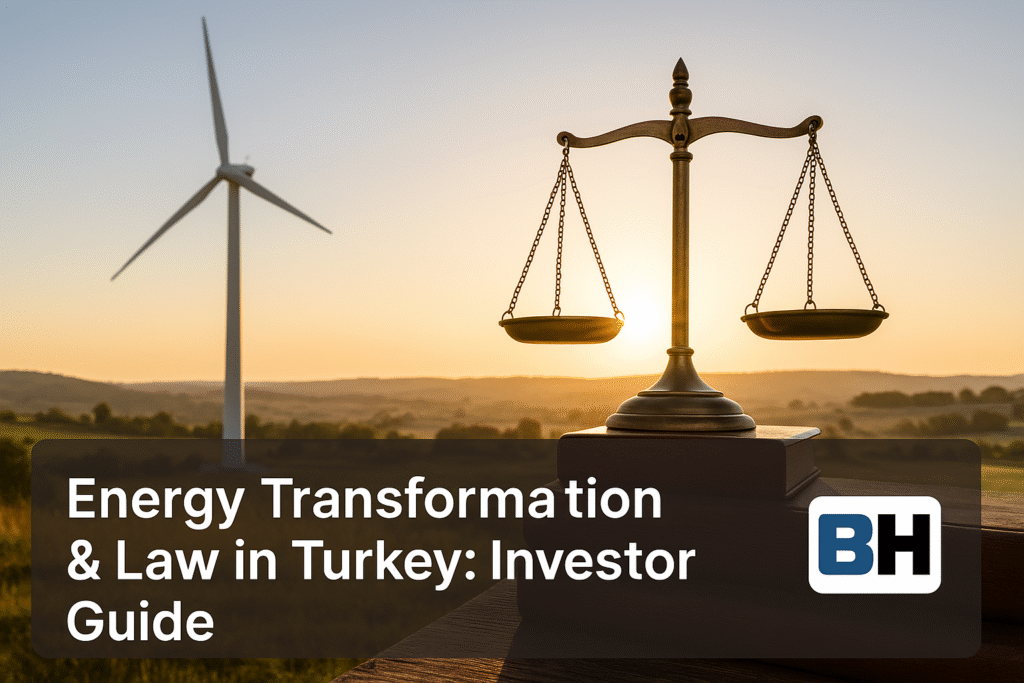
Energy Transformation Law in Turkey: Investor Guide
Turkey’s energy sector is undergoing one of the most comprehensive transformations in its recent history. This transformation is driven by increasing electricity demand, rapid growth in renewable energy investments, the need for modernization of energy infrastructure, and the global shift toward low-carbon technologies. The legal and regulatory structure of the Turkish energy market has evolved significantly to attract private investment, facilitate competition, and ensure security of supply. At the same time, complex licensing regimes, frequent regulatory amendments, and evolving technical standards require investors to conduct careful planning and legal due diligence before entering the market.
This article provides a detailed and practical guide for foreign and domestic investors who intend to invest in Turkey’s electricity, natural gas, renewable energy, storage, or electric-mobility sectors. It combines the core legal framework with practical insights into licensing, environmental permitting, grid access, financing, and long-term regulatory risks. While the Turkish energy market offers significant opportunities, investors must understand the legal architecture, institutional actors, and bureaucratic processes to succeed.
Structure of the Turkish Energy Market
The modern structure of the Turkish energy market is based on a gradual liberalization process that began in the early 2000s. The central pillar of this structure is the Electricity Market Law and its implementing regulations, supported by similar legislative frameworks in the natural gas, petroleum, and LPG markets.
The Energy Market Regulatory Authority (EPDK) is the primary regulator responsible for licensing, tariff approval, compliance supervision, market behavior rules, and the legal structuring of all energy sub-sectors. The Ministry of Energy and Natural Resources determines national policies and long-term strategies, while TEİAŞ operates the transmission grid and grants connection approvals. EPİAŞ conducts market operations for electricity and natural gas, including day-ahead, intraday, balancing and ancillary services markets.
This institutional architecture creates a sector that is centralized in governance yet competitive in operations. Investors operate in a legally structured environment, where rules are detailed but may also be subject to frequent amendments. Successful navigation of this structure requires not only legal expertise but close coordination with administrative authorities, transmission operators, and market participants.
Licensing and Pre-Licensing for Electricity Generation Projects
Licensing is one of the most critical steps in developing an energy project in Turkey. The Electricity Market Law distinguishes between pre-license and license phases. A pre-license is mandatory for large-scale generation projects and grants the investor a period to obtain site permits, land rights, environmental approvals, and transmission-connection commitments. The typical duration ranges from 24 to 36 months, depending on technology and project requirements.
During the pre-license period, companies must secure environmental impact assessment approvals (ÇED), zoning and land-use permits, water-use rights for hydro projects, technical approval from TEİAŞ or the relevant distribution company for grid connection, and construction rights. A failure to complete these obligations within the allotted time results in the cancellation of the pre-license. Investors are prohibited from transferring control of the project company during the pre-license period without regulatory permission.
After completing these steps, the investor applies for a full generation license, which entitles the company to construct and operate the power plant. Licenses usually have a term of forty-nine years. Investors must maintain minimum capital requirements, corporate governance standards, technical qualifications, and financial adequacy at all stages.
While the licensing process is structured, it is also time-consuming and administratively demanding. Investors should plan for potential delays and ensure that local environmental, land-use, and zoning requirements are integrated into early project design. The role of project-specific due diligence cannot be overstated.
Renewable Energy Investments: YEKA, Unlicensed Generation and Market Dynamics
Turkey has rapidly expanded its renewable energy portfolio, ranking among the top countries in Europe in installed geothermal and hydroelectric capacity. The most dynamic categories in recent years are solar and wind power. The Renewable Energy Law provides the main incentive frameworks, including the Renewable Energy Support Mechanism, although the market is now transitioning toward competitive auctions and price-setting through market dynamics.
The YEKA system (Renewable Energy Resource Areas) is a strategic mechanism through which the state allocates large-scale renewable resource areas to investors based on competitive bidding. YEKA tenders include local-content requirements, advanced technology commitments, and long-term purchase guarantees. These mechanisms attract global investors but require extensive technical and financial capacity.
Unlicensed generation has grown rapidly and allows small-scale and rooftop investors to generate electricity without a generation license. However, unlicensed plants must comply with strict rules, including self-consumption obligations and restrictions on installed capacity. Many investors mistakenly assume that unlicensed generation is a shortcut for commercial electricity sales. A clear understanding of regulatory constraints and grid-connection limits is essential.
Renewable projects must also comply with environmental legislation, including environmental impact assessments and nature-conservation restrictions. As renewable penetration grows, the grid faces capacity constraints. TEİAŞ periodically publishes connection capacity quotas, and delays in securing connection rights have become a significant investment barrier. Investors must incorporate grid limitations into financial modeling and project timelines.
Natural Gas, LNG and Gas Infrastructure Regulation
The Natural Gas Market Law regulates a market historically dominated by BOTAŞ but now open to private participants in import, storage, LNG operations, and wholesale. Investors in LNG terminals, floating storage regasification units, or underground storage must obtain the relevant licenses from EPDK, secure transmission-system approvals, and meet technical and safety standards.
Import licenses require long-term supply contracts, financial adequacy, and cross-border infrastructure commitments. Storage licenses require investment guarantees and technical capacity. Third-party access rules exist, but practical challenges remain due to transmission-system constraints.
The natural gas market is expected to evolve significantly in the coming decade as Türkiye positions itself as a regional trading hub. Regulatory amendments in 2024 and 2025 have expanded flexibility in the gas market, encouraged short-term contracts, and modernized market-operation mechanisms. Investors should closely follow forthcoming regulations on hydrogen blending, gas decarbonization, and new storage requirements.
Electric Vehicle Charging Infrastructure and E-Mobility Regulation
Turkey introduced a comprehensive legal regime for electric vehicle charging networks in 2021. Investors must obtain a Charging Network Operator License from EPDK, prepare technical compliance plans, and register all charging stations in the national information system. The charging network operator is responsible for ensuring technical standards, cybersecurity requirements, transparent pricing, and continuous service availability.
This regulatory regime creates a structured environment for both domestic and foreign investors and is part of a broader strategy to promote e-mobility. Rapid growth in EV sales, combined with the TOGG project, signals a strong future market. Investors must integrate energy-storage systems, grid-connection requirements, and tariff transparency into early planning phases.
Energy Storage, Hybrid Plants and New Technologies
Energy storage is emerging as a critical component of Turkey’s future energy mix. Recent legal amendments allow storage facilities to be developed together with renewable energy plants, creating hybrid projects. Investors may install storage units to stabilize power output or to participate in commercial markets such as balancing and ancillary services. The legal framework for standalone storage is evolving, and EPDK continues to issue secondary regulations.
Hydrogen technologies, offshore wind, carbon capture, and digitalized power-management systems are on the policy agenda. The government encourages pilot projects, and early investors may benefit from preferential licensing or accelerated approvals. However, investors should account for regulatory uncertainty, as the legal basis for these technologies is still developing.
Environmental Permitting, Land Use, and Grid Connection
Environmental impact assessment requirements apply to all medium- and large-scale energy projects. Zoning consistency, agricultural land restrictions, forestry permits, water-use rights, and protected-area limitations are key legal considerations. Some renewable projects have faced delays or litigation due to insufficient early-stage environmental feasibility studies.
Grid-connection permits are equally critical. TEİAŞ and distribution companies conduct load-flow studies and determine whether the grid can absorb additional capacity. Grid-capacity limitations are among the biggest constraints facing new renewable and storage projects. Connection agreements and system-use agreements must be obtained before construction begins.
Investors must also examine whether the project site has appropriate cadastral status, construction rights, and local zoning compliance. Errors in site selection frequently result in costly delays.
Regulatory Risks and Compliance Considerations
The Turkish energy market is regulated through a dynamic system in which laws and secondary legislation frequently change. Tariff methodologies, support mechanisms, licensing criteria, and market rules can be amended with short notice. Although regulatory updates aim to improve market efficiency, they also introduce uncertainty.
Investors should conduct periodic compliance audits, maintain updated legal opinions, and structure contracts with clauses that address regulatory change, force majeure, and grid-capacity limitations. Fluctuations in market prices, currency volatility, and financing conditions add to the complexity.
Despite these risks, the long-term trajectory of Turkey’s energy strategy remains clear: diversification of supply, decarbonization, digitalization, and increased private-sector participation.
Practical Guidance for Investors
Investors should form a Turkish joint-stock or limited company, depending on the licensing requirements. Pre-license applications require technical feasibility, financial adequacy, shareholding declarations, and minimum capital. Environmental and land-use approvals should be obtained in parallel with grid-connection steps.
For renewable and storage projects, investors should monitor YEKA announcements, grid-capacity quota allocations, and upcoming auction mechanisms. For natural gas and LNG investments, due diligence on transmission capacity, storage availability, long-term supply contracts, and BOTAŞ system-operation rules is essential.
Legal representation, due diligence, and continuous regulatory monitoring are indispensable for successful market entry. Engaging with local experts and maintaining active dialogue with regulators strongly improves the likelihood of success.
Conclusion
Turkey offers significant opportunities across electricity, renewable energy, natural gas, storage, and e-mobility sectors. The legal framework is comprehensive, detailed, and constantly evolving. Investors who understand the regulatory structure, licensing processes, environmental obligations, and market dynamics will find the Turkish energy sector a promising destination for long-term investment. A strategic approach, backed by strong legal and technical planning, is the key to navigating the complexities of this growing and increasingly sophisticated market.






Comments
No comments yet.