 English
 Türkçe
 Français
 Deutsch

The visa exemption introduced in 2026 allows citizens of the People’s Republic of China holding ordinary passports to enter Türkiye without a visa for tourism and transit purposes for up to 90 days within any 180-day period. The measure is grounded in Law No. 6458 on Foreigners and International Protection and reflects a lawful exercise of the executive’s authority to regulate short-term entry regimes. While the exemption removes pre-entry visa requirements, it does not confer any right to work, study, or reside long term in Türkiye. Compliance with the 90/180-day rule and adherence to purpose-based limitations remain decisive for the lawfulness of stay. In comparative terms, Türkiye’s decision places it among a relatively limited group of states granting full visa exemption to Chinese ordinary-passport holders. The policy is driven by tourism growth objectives, business mobility considerations, and broader diplomatic and economic strategy. At the same time, the exemption preserves enforcement mechanisms through border controls, administrative sanctions, and residence-permit requirements. For individuals and businesses seeking to navigate this framework correctly, Bıçak provides legal services on Turkish immigration law, compliance planning, and residence and investment-related mobility matters.
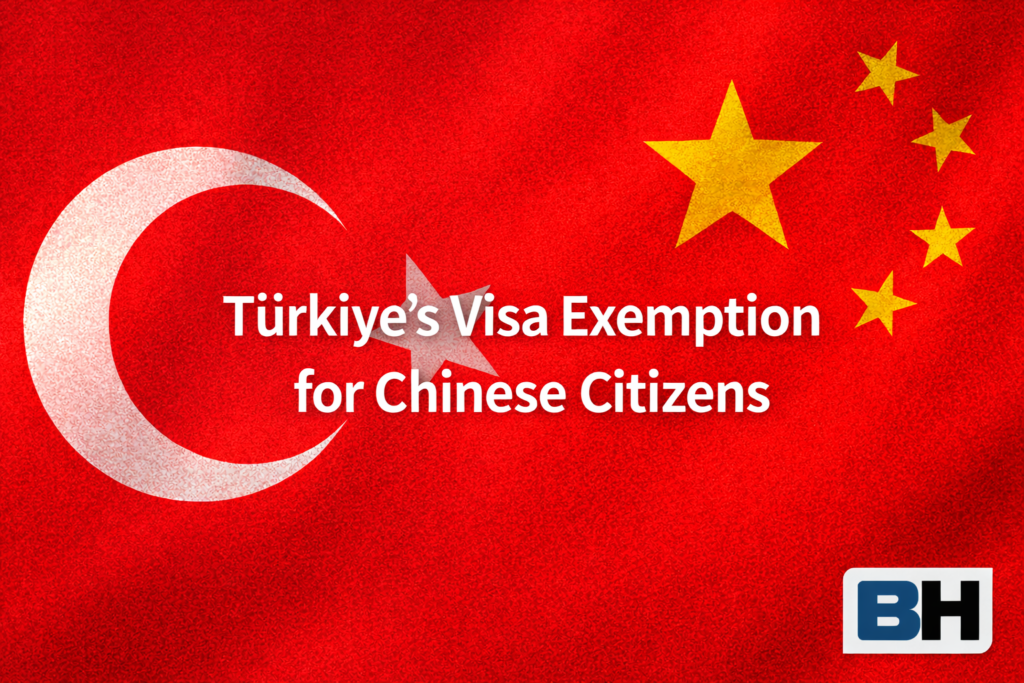
Türkiye’s Visa Exemption for Chinese Citizens
As of 2 January 2026, citizens of the People’s Republic of China holding ordinary (burgundy) passports are entitled to enter Türkiye without a visa for tourism and transit purposes, pursuant to a Presidential Decree published in the Official Gazette dated 31 December 2025. The exemption allows a maximum stay of 90 days within any rolling 180-day period, aligning the regime with Türkiye’s standard short-stay visa-free framework. The new regulation represents a significant shift in Türkiye’s visa policy toward Chinese nationals, who were previously subject to visa requirements for short-term travel. While the exemption removes the obligation to obtain a consular or electronic visa prior to entry, it does not confer any right to work, study, or reside long-term in Türkiye. Activities beyond tourism and transit remain subject to the applicable visa or residence-permit regimes under Turkish immigration law.
From a legal and practical standpoint, the exemption must be assessed not merely as a facilitation of entry, but as a conditional and purpose-restricted privilege. Compliance with the 90/180-day rule, accurate declaration of travel purpose, and adherence to post-entry obligations remain decisive in determining the lawfulness of stay. Misinterpretation of the scope of the exemption may expose travellers to administrative sanctions, entry bans, or removal proceedings.
At a policy level, the decision coincides with Türkiye’s broader objectives of enhancing tourism inflows, strengthening trade relations, and positioning itself as a regional transit and business hub. The inclusion of China – one of the world’s largest outbound tourism and investment markets -signals a calculated liberalisation step with economic and diplomatic implications extending beyond immigration law.
The Official Gazette Decision and Its Legal Architecture
The visa exemption for citizens of the People’s Republic of China was introduced through a Presidential Decree published in the Official Gazette dated 31 December 2025, with the regulation entering into force on 2 January 2026. As an executive regulatory act, the decree constitutes a secondary normative instrument that directly shapes Türkiye’s visa regime without requiring parliamentary amendment. Under Türkiye’s current constitutional system, visa policy falls within the executive regulatory competence of the President. Decisions concerning visa requirements, exemptions, duration of stay, and eligible nationalities are therefore commonly enacted through presidential decrees or decisions published in the Official Gazette. This mechanism enables the administration to respond rapidly to developments in international relations, migration trends, tourism demand, and economic policy priorities.
From a legal-structural perspective, the Official Gazette decision operates as a general administrative act of abstract and impersonal character. It applies uniformly to all Chinese nationals who meet the specified conditions (ordinary passport holders travelling for tourism or transit) and does not require individual administrative assessment at the consular stage. Nevertheless, the decree does not eliminate border control discretion; rather, it reallocates migration control from the pre-entry visa stage to the point of entry, where compliance with the conditions of stay is assessed by border authorities.
The publication of the decision in the Official Gazette is not merely a formal requirement but a constitutive element of its legal validity and enforceability. Only upon publication does the regulation acquire binding force vis-à-vis individuals and administrative authorities. The explicit specification of the effective date (2 January 2026) further ensures legal certainty for travellers, carriers, and enforcement bodies.
Finally, it is important to underline that the Official Gazette decision does not exist in isolation. It functions within a broader regulatory ecosystem composed of the Law on Foreigners and International Protection, implementing regulations, border management practices, and administrative circulars. As such, the decree must be interpreted systematically, in harmony with the overarching framework governing entry, stay, and exit of foreigners in Türkiye.
Legal Basis Under Turkish Immigration Law
The legal foundation of the visa exemption granted to citizens of the People’s Republic of China is found in Law No. 6458 on Foreigners and International Protection (“LFIP”), which constitutes the principal statutory framework governing the entry, stay, and exit of foreigners in Türkiye. The relevant authority for visa exemptions derives specifically from Article 18 of the LFIP.
Article 18 empowers the executive authority to determine the procedures and principles for visa-free entry of foreign nationals, including the identification of eligible countries, passport types, permitted purposes of travel, and duration of stay. Within the constitutional system currently in force, this competence is exercised by the President, replacing the former role of the Council of Ministers. The Presidential Decree introducing visa-free travel for Chinese ordinary-passport holders therefore rests on a clear and explicit statutory delegation.
From a doctrinal perspective, Article 18 establishes a crucial distinction between visa exemption and residence rights. Visa exemption merely removes the obligation to obtain a visa prior to entry; it does not alter the legal status of the foreigner once inside the country. Accordingly, the absence of a visa requirement does not exempt the individual from compliance with other substantive rules of immigration law, including those relating to purpose of stay, duration limits, registration obligations, and exit requirements.
The LFIP also preserves the principle of purpose-based entry, which is central to the interpretation of visa exemptions. Even where a foreign national is visa-exempt, entry and stay remain lawful only to the extent that the declared and actual purpose of travel falls within the scope defined by the exemption. In the case of Chinese citizens, this scope is explicitly limited to tourism and transit, excluding employment, education, and long-term residence. Any activity exceeding or deviating from these purposes triggers the applicability of visa or residence-permit requirements under the LFIP.
Furthermore, the legal framework retains administrative discretion at the border stage. While the visa exemption removes consular screening, it does not deprive border authorities of the power to assess admissibility under general immigration rules. Border officials may still verify compliance with entry conditions such as travel purpose, duration of stay, financial means, and return or onward travel arrangements. This reflects the LFIP’s underlying approach of balancing facilitation of lawful travel with effective migration control.
In sum, the 2026 visa exemption for Chinese citizens is not an exceptional or extra-legal measure but a lawfully grounded regulatory choice implemented through the mechanisms expressly provided by Turkish immigration law. Its practical implications, however, can only be properly understood when read together with the LFIP’s broader system of purpose limitation, duration control, and administrative enforcement.
Scope of the Visa Exemption
The visa exemption introduced for citizens of the People’s Republic of China is narrowly defined in terms of personal scope, passport type, and permitted purposes of travel. A precise understanding of this scope is essential, as misinterpretation may lead to unlawful stay despite lawful entry.
Beneficiaries of the Exemption
The exemption applies exclusively to citizens of the People’s Republic of China who are holders of ordinary (burgundy) passports. Other passport categories – such as diplomatic, service, or special passports – are governed by separate bilateral or multilateral arrangements and fall outside the scope of this specific regulation unless otherwise provided. The nationality criterion is decisive. Lawful residence in a third country, dual nationality (where applicable), or long-term residence permits issued by other states do not, in themselves, extend or modify the applicability of the exemption. Entry is assessed strictly on the basis of citizenship and passport type.
Permitted Purposes of Travel
The visa exemption is expressly limited to tourism and transit. Tourism encompasses short-term visits for leisure, cultural activities, sightseeing, and similar non-remunerative purposes. Transit covers passages through Türkiye en route to a third country, whether involving airport transit or short stopovers consistent with the duration limits of the exemption. Crucially, the exemption does not authorise:
- Employment or any form of income-generating activity,
- Professional services performed on behalf of a Turkish entity,
- Academic study, training, or internships,
- Long-term residence or settlement,
- Family reunification.
Even if the duration of stay remains within the 90/180-day threshold, engagement in activities outside tourism or transit renders the stay unlawful in terms of purpose, exposing the individual to administrative sanctions.
Duration of Stay Within the Scope
The exemption allows a maximum stay of 90 days within any rolling 180-day period. This temporal limitation is an integral part of the scope of the exemption, not a separate compliance rule. Exceeding the permitted duration results in loss of lawful stay status, irrespective of the original legality of entry. Importantly, the exemption does not grant a fixed “90-day visa” upon each entry. The cumulative calculation applies across multiple entries and exits, requiring continuous monitoring by the traveller.
Relationship with Residence Permits
The visa exemption does not replace or simplify residence permit procedures under Turkish law. Chinese citizens who intend to remain in Türkiye beyond the permitted short-stay duration, or whose purpose of stay changes after entry, must apply for the appropriate short-term residence permit or other relevant permit category in accordance with the Law on Foreigners and International Protection. Failure to transition from visa-exempt status to a residence permit when required may result in the same legal consequences as overstaying, including fines, entry bans, and removal decisions.
Practical Boundary of the Exemption
In practical terms, the scope of the exemption ends where tourism or transit ends, regardless of remaining days under the 90/180 calculation. The decisive factor is not only how long a Chinese citizen stays in Türkiye, but also why they stay and what activities they undertake during that period. Accordingly, the visa exemption should be understood as a facilitation of short-term, non-remunerative mobility, not as a preliminary step toward employment, residence, or establishment in Türkiye.
Duration and the 90/180-Day Rule
A central element of the visa exemption granted to Chinese citizens is the application of the “90 days within any 180-day period” rule, which governs the maximum lawful duration of stay in Türkiye. This rule is not unique to Chinese nationals; it reflects Türkiye’s standard short-stay framework applied to most visa-exempt nationalities and closely resembles the approach adopted in the Schengen system.
Nature of the 90/180-Day Limitation
The visa exemption does not confer a fixed right to remain in Türkiye for 90 consecutive days upon each entry. Instead, it allows a cumulative stay of up to 90 days during the 180 days preceding any given date of stay. The calculation operates on a rolling basis, meaning that the reference period moves forward day by day. This structure requires travellers to continuously assess their remaining lawful days rather than relying on a single entry date. Each day spent in Türkiye counts toward the 90-day maximum, regardless of whether the stay is continuous or interrupted by exits and re-entries.
Rolling Calculation in Practice
When a Chinese citizen seeks to enter Türkiye, border authorities assess the total number of days spent in Türkiye during the previous 180 days. If that total is less than 90, entry may be permitted for the remaining available days. If the total has already reached or exceeded 90 days, entry must be refused until sufficient time has elapsed outside Türkiye to fall below the threshold. For example, a traveller who has stayed in Türkiye for 60 days within the past 180 days may enter again for a maximum of 30 additional days. Conversely, a traveller who has reached the 90-day limit must remain outside Türkiye until earlier days of stay fall outside the 180-day reference window.
Multiple Entries and Exit–Re-Entry Risks
Frequent short visits can create compliance risks, particularly where travellers assume that leaving Türkiye “resets” the count. Exiting the country does not restart the 90-day entitlement. Only the passage of time outside Türkiye reduces the accumulated days within the rolling period. This is especially relevant for business visitors, property owners, or individuals exploring longer-term opportunities who may enter Türkiye repeatedly over short intervals. Without careful tracking, such patterns can easily result in unintentional overstays.
Consequences of Exceeding the Permitted Duration
Exceeding the 90-day limit, even by a short period, constitutes an overstay under Turkish immigration law. Overstays may give rise to:
- Administrative fines calculated based on the duration of unlawful stay,
- Entry bans of varying length,
- Removal (deportation) decisions in more serious or repeated cases.
Importantly, the existence of visa exemption does not mitigate these consequences. Once the permitted duration is exceeded, the individual’s stay becomes unlawful irrespective of the original legality of entry.
Interaction With Residence Permit Applications
The 90/180-day rule also determines when a residence permit application becomes mandatory. Chinese citizens who intend to remain in Türkiye beyond the permissible short-stay duration must apply for the appropriate residence permit before exhausting their available days. Filing an application after the 90-day limit has been exceeded does not retroactively legalise the prior overstay.
Practical Compliance Considerations
Effective compliance requires:
- Accurate record-keeping of entry and exit dates,
- Awareness of how the rolling 180-day period operates,
- Early assessment of whether a residence permit will be needed.
In practice, misunderstanding of the 90/180-day rule is among the most common sources of immigration-law violations for visa-exempt travellers. For Chinese citizens newly benefiting from visa-free access to Türkiye, familiarity with this calculation is therefore essential to maintaining lawful status.
Consequences of Non-Compliance
While the visa exemption facilitates entry into Türkiye for Chinese citizens, it does not relax the substantive and procedural obligations imposed by Turkish immigration law. Failure to comply with the conditions of stay – whether relating to duration, purpose, or status transition – may trigger a range of administrative sanctions. These consequences apply regardless of whether the individual initially entered Türkiye lawfully under the visa exemption.
Overstay and Unlawful Stay
Exceeding the permitted 90 days within any 180-day period constitutes an overstay and renders the foreigner’s presence in Türkiye unlawful. Overstay is assessed objectively, based on entry-exit records, and does not require proof of intent or fault. Even short overstays may give rise to sanctions, particularly where repeated or combined with other compliance issues.
Administrative Fines
Foreigners found to have overstayed are typically subject to administrative fines calculated in proportion to the duration of the unlawful stay. Payment of the fine does not, in itself, eliminate other possible consequences, such as entry bans or removal decisions. In practice, fines are often imposed at the time of exit, but may also arise in the context of enforcement actions within the country.
Entry Bans
In addition to monetary penalties, overstays or violations of purpose of stay may result in the imposition of an entry ban. Entry bans prevent re-entry into Türkiye for a specified period, which may range from several months to multiple years depending on the severity and frequency of the violation. Entry bans can significantly disrupt travel plans and may affect future visa or residence-permit applications.
Removal (Deportation) Decisions
More serious breaches – such as prolonged overstays, repeated violations, or engagement in unauthorised employment – may lead to removal (deportation) proceedings. Removal decisions are administrative acts taken under the Law on Foreigners and International Protection and may be accompanied by detention or reporting obligations pending enforcement. Although legal remedies exist, removal decisions can have immediate and lasting consequences for the individual concerned.
Purpose-Based Violations
A particularly sensitive area of non-compliance arises where a foreigner enters Türkiye under visa exemption for tourism or transit but engages in activities incompatible with that purpose, such as working for remuneration or providing professional services. In such cases, the violation is not merely temporal but substantive, and sanctions may be imposed even if the duration of stay remains within the 90-day limit.
Impact on Future Immigration Status
Non-compliance under the visa exemption regime may adversely affect a Chinese citizen’s future immigration prospects in Türkiye. Prior overstays or enforcement measures can be taken into account when assessing subsequent visa applications, residence permit requests, or applications for long-term status. In this respect, short-term non-compliance can produce long-term legal consequences.
Compliance as a Preventive Strategy
From a legal-risk perspective, the most effective strategy is preventive compliance. Accurate tracking of stay duration, clear alignment between declared and actual purpose of stay, and timely transition to residence-permit procedures where necessary are essential to avoiding sanctions. Visa exemption should therefore be understood not as deregulation, but as a conditional facilitation mechanism operating within a structured enforcement framework.
How Many States are Visa-Free for PRC Passports – and Who are They?
Any comparative evaluation of visa-free access for holders of ordinary passports of the People’s Republic of China must begin with a clarification of how visa regimes are categorised. International mobility statistics frequently diverge because they rely on different legal thresholds. Some sources count only strict visa-free entry, meaning that no visa or entry authorisation is required either before travel or upon arrival. Others aggregate visa-free access with visa-on-arrival and electronic travel authorisation systems, which, although facilitative, remain legally distinct from full visa exemption. In addition, some rankings refer solely to sovereign states, while others include dependent territories and special administrative regions. These methodological differences explain why reported figures vary significantly.
When all facilitative regimes are taken together, Chinese ordinary-passport holders are generally considered to have access to approximately seventy-nine to ninety-three destinations worldwide without obtaining a traditional consular visa in advance. However, when the analysis is limited to strict visa-free entry in the legal sense, the number of states granting such access is considerably lower and is commonly estimated at roughly forty to fifty-five jurisdictions. This narrower figure is more relevant for legal comparison, as it reflects a true waiver of the visa requirement comparable to the regime introduced by Türkiye in 2026.
Within this strict visa-free category, the number of European and Eurasian states admitting Chinese nationals without a visa remains limited. Countries such as Albania, Armenia, Azerbaijan, Belarus, Bosnia and Herzegovina, Georgia, Montenegro, and Serbia fall within this group, offering visa-free short stays to Chinese ordinary-passport holders. In the Middle East and Asia, Iran stands out as a jurisdiction providing visa-free entry under defined conditions. In Africa, Morocco and Mauritius are frequently cited as states allowing visa-free travel for Chinese citizens. In the Americas and the Caribbean, several island states, including the Bahamas, Barbados, Cuba, Dominica, Grenada, Jamaica, Saint Kitts and Nevis, and Saint Lucia, grant visa-free access for short-term visits. In the Pacific region, Micronesia and Vanuatu are commonly included among visa-free destinations for PRC passport holders.
These countries represent the core group of jurisdictions that have adopted full visa exemption for Chinese citizens, as distinct from systems that rely on visas on arrival, online authorisations, or conditional entry schemes such as group-tour arrangements. While the latter significantly broaden practical travel opportunities, they do not remove the visa requirement as a matter of law and therefore occupy a different position in comparative immigration analysis.
Against this background, Türkiye’s 2026 decision assumes particular significance. By granting visa-free entry to Chinese ordinary-passport holders for tourism and transit, Türkiye aligns itself with a relatively small group of states that have chosen to dispense entirely with pre-entry visa requirements for Chinese nationals. In comparative terms, this places Türkiye ahead of many developed economies, including the Schengen Area and several OECD member states, which continue to subject PRC citizens to visa obligations. From a legal-policy perspective, the measure enhances Türkiye’s position as a comparatively accessible destination for Chinese travellers and reflects a deliberate choice to prioritise entry facilitation over consular pre-screening in respect of short-term stays.
Türkiye’s Broader Visa-Exemption Policy in Context
The visa exemption granted to citizens of the People’s Republic of China should be understood within the broader architecture of Türkiye’s visa policy, which is characterised by a graduated and differentiated approach based on nationality, passport type, purpose of travel, and duration of stay. Rather than operating under a uniform visa regime, Türkiye maintains a multi-layered system that combines full visa exemption, conditional exemption, electronic visas, and consular visas.
At the core of this system is the distinction between short-term stays and long-term residence. Visa exemptions are primarily designed to facilitate short-term mobility for purposes such as tourism, business visits, and transit, while longer stays and activities involving integration into the labour market or education system remain subject to residence-permit controls. This structural separation explains why visa liberalisation measures, including the 2026 exemption for Chinese citizens, do not weaken Türkiye’s broader migration-control framework.
Türkiye’s visa-free regimes typically operate under defined duration bands, most commonly allowing stays of up to ninety days within any one-hundred-eighty-day period. Certain nationalities benefit from shorter periods, such as thirty or sixty days, while a limited number of countries are subject to special or conditional arrangements. These variations reflect a combination of reciprocity, regional mobility considerations, diplomatic relations, and historical travel patterns.
From a comparative standpoint, Türkiye’s visa policy is notable for its relatively expansive list of visa-exempt nationalities, particularly when compared with many European Union member states. While the Schengen Area applies a highly standardised and restrictive approach to third-country nationals, Türkiye has opted for a more flexible model that allows the executive to adjust visa requirements in response to economic, diplomatic, and security considerations. This flexibility is precisely what enabled the rapid introduction of visa-free travel for Chinese citizens through a presidential decision.
The inclusion of China within Türkiye’s visa-exemption framework is therefore not an isolated or exceptional act, but rather a continuation of an established policy pattern. Türkiye has previously extended visa-free access to nationals of countries deemed strategically significant in terms of tourism inflows, trade relations, or regional connectivity. China’s position as a major source of outbound tourism and a key global economic actor makes it a logical candidate for such inclusion.
At the same time, Türkiye’s broader visa policy underscores that visa exemption does not equate to unrestricted entry. Even for nationals of visa-exempt countries, border controls remain in place, and compliance with entry conditions is actively monitored. The Chinese visa exemption fits squarely within this logic: it lowers administrative barriers at the pre-entry stage while preserving robust post-entry oversight through duration limits, purpose restrictions, and residence-permit requirements.
In this sense, Türkiye’s approach reflects a calibrated balance between facilitation and control. The 2026 decision concerning Chinese citizens expands lawful mobility at the margins of short-term travel, without altering the fundamental principles governing migration, residence, and employment under Turkish law.
Policy Motives Behind the 2026 Decision
The introduction of visa-free travel for Chinese citizens in 2026 is best understood as the outcome of intersecting economic, diplomatic, and strategic considerations, rather than as a purely immigration-law reform. Visa policy, particularly in relation to high-population third countries, is frequently used by states as an indirect policy instrument to advance objectives extending beyond border control.
A primary motive behind Türkiye’s decision is tourism policy. China represents one of the world’s largest outbound tourism markets, both in terms of volume and spending capacity. In recent years, Turkish authorities have consistently identified the Chinese market as a priority growth area, particularly in the context of post-pandemic recovery and diversification of tourist profiles beyond traditional European markets. Removing the visa requirement reduces friction at the decision-making stage for travellers and tour operators and increases Türkiye’s competitiveness vis-à-vis destinations that continue to impose consular visa obligations on Chinese nationals.
Closely linked to tourism is the objective of strengthening trade and business mobility. Short-term business travel, market exploration, participation in fairs, supplier inspections, and preliminary investment visits often fall within the same legal category as tourism under immigration law. By eliminating the need for a visa for such visits, Türkiye lowers transaction costs for Chinese entrepreneurs and companies seeking physical presence in the Turkish market. This facilitation aligns with broader economic policies aimed at attracting foreign investment, expanding bilateral trade volumes, and positioning Türkiye as a regional gateway between Asia, Europe, and the Middle East.
Diplomatic considerations also play a significant role. Visa exemptions are commonly perceived as gestures of goodwill in bilateral relations and may function as confidence-building measures. In this context, the 2026 decision signals Türkiye’s intention to deepen its engagement with China through practical cooperation mechanisms rather than symbolic declarations. Even in the absence of formal reciprocity, unilateral visa liberalisation can strengthen diplomatic ties and create momentum for further cooperation in areas such as transportation, culture, and commerce.
Another relevant factor is connectivity and hub strategy. Türkiye’s geographical position and aviation infrastructure, particularly Istanbul’s role as a global transit hub, make it sensitive to visa regimes that affect transit passengers. Visa-free entry for Chinese nationals enhances Türkiye’s attractiveness not only as a final destination but also as a transit point for onward travel, reinforcing its competitive position in global air travel networks.
At the policy-design level, the decision also reflects confidence in Türkiye’s post-entry control mechanisms. By shifting screening from the consular stage to the border and post-entry phases, the administration demonstrates reliance on duration limits, purpose controls, and enforcement tools provided by the Law on Foreigners and International Protection. This suggests a calculated assessment that the economic and diplomatic benefits of visa exemption outweigh the manageable risks associated with overstays or misuse.
In sum, the 2026 visa exemption for Chinese citizens emerges as a multi-dimensional policy choice. It is driven by tourism growth objectives, economic facilitation, diplomatic positioning, and hub competitiveness, all underpinned by a legal framework that preserves state control over entry conditions and duration of stay. The measure thus reflects a strategic recalibration rather than a relaxation of immigration governance.
Advantages and Disadvantages of Visa Exemption
The visa exemption granted to Chinese citizens produces a range of advantages and disadvantages that must be evaluated in a balanced manner. From a legal-policy perspective, visa liberalisation is neither inherently beneficial nor inherently risky; its impact depends on how effectively facilitation objectives are aligned with enforcement capacity and regulatory clarity.
One of the principal advantages of visa exemption is the reduction of administrative barriers to entry. By removing the requirement to obtain a visa prior to travel, Türkiye simplifies access for Chinese nationals and reduces the time, cost, and uncertainty associated with consular procedures. This simplification is particularly significant for short-term tourism and business visits, where administrative friction can deter travel altogether or redirect it toward competing destinations with more liberal entry regimes.
Another important advantage lies in tourism growth and economic spillovers. Visa exemption increases the likelihood that Türkiye will be included in travel itineraries, group tours, and multi-destination trips. For a market as large as China, even marginal increases in accessibility can translate into substantial gains in visitor numbers, tourism revenue, and sectoral activity in hospitality, transportation, and retail. From this perspective, visa exemption functions as an indirect economic stimulus rather than a mere immigration measure.
Visa-free access also facilitates short-term business mobility. Business meetings, trade fairs, exploratory investment visits, and supplier inspections often require flexibility and rapid travel planning. The absence of visa requirements enables Chinese business actors to respond more quickly to commercial opportunities in Türkiye, supporting trade relations and investment flows without altering the legal framework governing employment or establishment.
In addition, visa exemption carries symbolic and diplomatic value. It signals openness, trust, and willingness to engage, which may strengthen bilateral relations and improve Türkiye’s standing as a welcoming and business-friendly jurisdiction. In comparative terms, offering visa-free access where many developed economies continue to impose visa requirements may enhance Türkiye’s relative attractiveness.
At the same time, visa exemption entails certain disadvantages and risks. A primary concern is the potential increase in overstays and misuse of entry status. When entry becomes easier, the absolute number of individuals who exceed permitted durations or engage in unauthorised activities may rise, even if the relative rate of non-compliance remains low. This places additional demands on border management and internal enforcement mechanisms.
Another challenge relates to the shift of migration control from the consular stage to the border stage. Visa systems allow for pre-entry screening and documentation review, whereas visa exemption requires authorities to rely more heavily on border interviews, risk assessment, and post-entry monitoring. This shift necessitates effective coordination between border authorities and migration administration to prevent abuse while maintaining proportionality.
There are also reciprocity and perception considerations. Visa exemption decisions may attract domestic debate if they are perceived as unilateral or asymmetrical, particularly where Turkish citizens do not enjoy equivalent access to the granting state. While reciprocity is not a legal requirement, it can influence public and political perceptions of fairness and balance in visa policy.
Finally, visa exemption may generate compliance uncertainty among travellers unfamiliar with the legal boundaries of short-term stay. Misunderstandings regarding permitted activities or duration limits can lead to unintentional violations, resulting in sanctions that might otherwise have been avoided under a more formal visa process. This underscores the importance of clear guidance and legal awareness alongside liberalisation measures.
In sum, the advantages of visa exemption lie primarily in facilitation, economic opportunity, and diplomatic positioning, while the disadvantages relate to enforcement challenges, compliance risks, and policy optics. The effectiveness of the 2026 decision will therefore depend not only on the exemption itself, but also on the clarity of its implementation and the robustness of post-entry controls.
Expected Results and Indicators to Monitor
The practical impact of the visa exemption for Chinese citizens will unfold progressively and should be assessed through measurable outcomes rather than assumptions. While visa liberalisation is commonly associated with increased mobility and economic benefits, its effectiveness depends on how traveller behaviour, market responses, and administrative capacity evolve after implementation. For this reason, the 2026 decision should be evaluated against a set of concrete indicators over the short and medium term.
One of the most immediate and visible expected results is an increase in arrivals of Chinese visitors to Türkiye. Visa-free access lowers the psychological and administrative threshold for travel and is likely to result in higher tourist numbers, particularly for first-time visitors and organised tour groups. Monitoring monthly and annual arrival statistics of Chinese nationals will provide a direct measure of the exemption’s impact on inbound mobility.
Closely connected to arrival numbers is the average length of stay and spending profile of Chinese visitors. A rise in visitor numbers alone does not necessarily translate into proportional economic gains. Indicators such as hotel occupancy rates, average expenditure per visitor, and regional distribution of tourism activity will help determine whether the exemption contributes to sustainable and diversified tourism revenue rather than short, low-impact visits.
Another key area to monitor is air connectivity and transport capacity. Visa exemption may encourage airlines to increase flight frequencies, open new routes, or deploy higher-capacity aircraft between China and Türkiye. Changes in seat capacity and route networks can serve as an indirect but reliable indicator of market confidence in sustained demand.
From a legal and administrative perspective, immigration compliance data is equally important. Authorities should observe trends in overstays, administrative fines, entry bans, and removal decisions involving Chinese nationals. A disproportionate increase in violations could indicate the need for enhanced guidance or enforcement measures, whereas stable or manageable figures would support the conclusion that the exemption is functioning as intended.
Another relevant indicator is the number of residence permit applications submitted by Chinese citizens following entry under the visa exemption. An increase in applications for short-term residence, investment-related permits, or other lawful stay categories may signal that visa-free entry is facilitating deeper economic engagement while remaining within the legal framework.
Business-related indicators should also be taken into account. These may include company incorporations, joint ventures, commercial registrations, and participation in trade fairs involving Chinese nationals. Although such data is often indirect and sector-specific, it can provide insight into whether visa exemption is translating into tangible commercial interaction.
Finally, the exemption’s broader success should be assessed in light of policy coherence and public perception. Indicators such as administrative workload, clarity of official guidance, and consistency of border practices will influence whether visa-free travel is perceived as predictable and legally secure by travellers and businesses alike.
In sum, the expected results of the 2026 visa exemption extend beyond headline arrival figures. A comprehensive evaluation requires attention to tourism quality, economic engagement, compliance trends, and administrative effectiveness. Only through such a multidimensional assessment can the long-term value and sustainability of the policy be accurately measured.
Practical Compliance Checklist
Effective use of the visa exemption requires practical awareness of the legal boundaries governing entry and stay. Although the exemption removes the obligation to obtain a visa prior to travel, it does not reduce the importance of compliance with Turkish immigration rules. For Chinese citizens, particularly those travelling frequently or for mixed purposes, careful planning remains essential.
From the perspective of tourists, compliance begins with clarity of purpose. Travellers should ensure that their visit genuinely falls within the scope of tourism or transit and that they can substantiate this if requested at the border. Proof of accommodation, a return or onward ticket, and evidence of sufficient financial means to cover the duration of stay are commonly expected. Awareness of the rolling 90/180-day rule is critical, as repeated short visits can quickly exhaust the permitted duration without the traveller realising it.
Business visitors should exercise additional caution. While short-term business meetings, attendance at fairs, and exploratory visits are often tolerated under the tourism category, activities that resemble employment or service provision may be considered incompatible with visa-exempt entry. Clear documentation of the business purpose, such as meeting schedules or invitations, can reduce uncertainty at the border. Where a longer presence or active commercial involvement is anticipated, early planning for an appropriate visa or residence permit is advisable.
For individuals considering a longer-term stay, the most important compliance step is timely transition. Visa exemption is not a preliminary residence status and does not extend the time limits applicable to residence permit applications. Those who intend to remain beyond the allowable short-stay duration must apply for the relevant residence permit before exhausting their available days. Waiting until the final days of lawful stay, or worse, after an overstay has occurred, significantly increases legal risk.
Accurate record-keeping is another essential aspect of compliance. Travellers should maintain their own record of entry and exit dates rather than relying solely on passport stamps or assumptions. This is particularly important for frequent travellers, as errors in calculation are a common source of inadvertent overstays.
Finally, compliance also involves understanding what the visa exemption does not provide. It does not create immunity from border discretion, does not guarantee entry in every case, and does not shield the traveller from sanctions if conditions are breached. Treating visa-free access as a regulated privilege rather than an unrestricted right is the most reliable way to avoid legal difficulties.
In practical terms, the visa exemption for Chinese citizens offers genuine convenience, but only when used with informed awareness of its legal limits. Conscious compliance transforms visa-free entry from a potential risk area into a predictable and lawful mobility tool.
Conclusion
The visa exemption introduced for citizens of the People’s Republic of China in 2026 marks an important development in Türkiye’s immigration and mobility policy. By removing the visa requirement for short-term tourism and transit, Türkiye has taken a deliberate step toward facilitating lawful mobility while seeking to capture economic, diplomatic, and strategic benefits associated with increased engagement with one of the world’s largest outbound markets.
From a legal perspective, the exemption does not alter the fundamental principles governing the entry and stay of foreigners in Türkiye. It simplifies access, but it does not relax control. Duration limits, purpose-based restrictions, and residence-permit requirements remain fully applicable, and compliance with these rules continues to determine the lawfulness of stay. In this sense, visa-free entry should be viewed as a procedural facilitation rather than a substantive entitlement.
The success of the 2026 decision will depend not only on increased visitor numbers or economic indicators, but also on the clarity of implementation and the ability of travellers to understand and respect the legal boundaries of short-term stay. Misinterpretation of the scope of the exemption, particularly in relation to the 90/180-day rule and permitted activities, may lead to avoidable sanctions and long-term immigration consequences.
For policymakers, the exemption represents a calibrated balance between openness and enforcement, relying on post-entry oversight rather than pre-entry consular screening. For travellers and businesses, it offers greater flexibility, provided that entry is accompanied by informed compliance and timely legal planning where longer-term engagement is envisaged.
Ultimately, the visa exemption for Chinese citizens illustrates how visa policy functions as a broader governance tool, intersecting immigration law with tourism strategy, economic facilitation, and international relations. When used within its legal limits, the exemption has the potential to enhance Türkiye’s attractiveness and connectivity without undermining the integrity of its immigration system.






Comments
No comments yet.