 English
 Türkçe
 Français
 Deutsch

Türkiye is entering a new era of nuclear energy, supported by a comprehensive legal and regulatory framework governing the development, construction, operation and decommissioning of nuclear power facilities. Nuclear Regulation Law No. 7381, together with Presidential Decree No. 95 and extensive secondary legislation, establishes the legal foundation for nuclear safety, security, safeguards, licensing, radiation protection and civil liability. The Nuclear Regulatory Authority (NDK) serves as the independent regulator responsible for licensing, inspections, enforcement and regulatory oversight throughout the lifecycle of nuclear installations. Türkiye’s expanding nuclear programme, including the Akkuyu Nuclear Power Plant, the planned Sinop project and future small modular reactor (SMR) initiatives, creates significant legal and commercial opportunities for international investors, EPC contractors, technology suppliers and financial institutions. Nuclear projects require integrated legal advice covering regulatory compliance, procurement, EPC contracts, localisation, technology transfer, export controls, cybersecurity, environmental protection and radioactive waste management. The legal framework also establishes strict operator liability for nuclear damage, mandatory financial security, specialised jurisdictional rules and comprehensive licensing procedures consistent with international nuclear law principles. As the Turkish nuclear sector continues to develop, careful legal planning and regulatory due diligence are essential to managing project risks and ensuring compliance with both domestic legislation and international obligations. Bıçak provides legal services to domestic and international clients throughout the entire nuclear project lifecycle, from project development and licensing to construction, operation, dispute resolution and decommissioning.
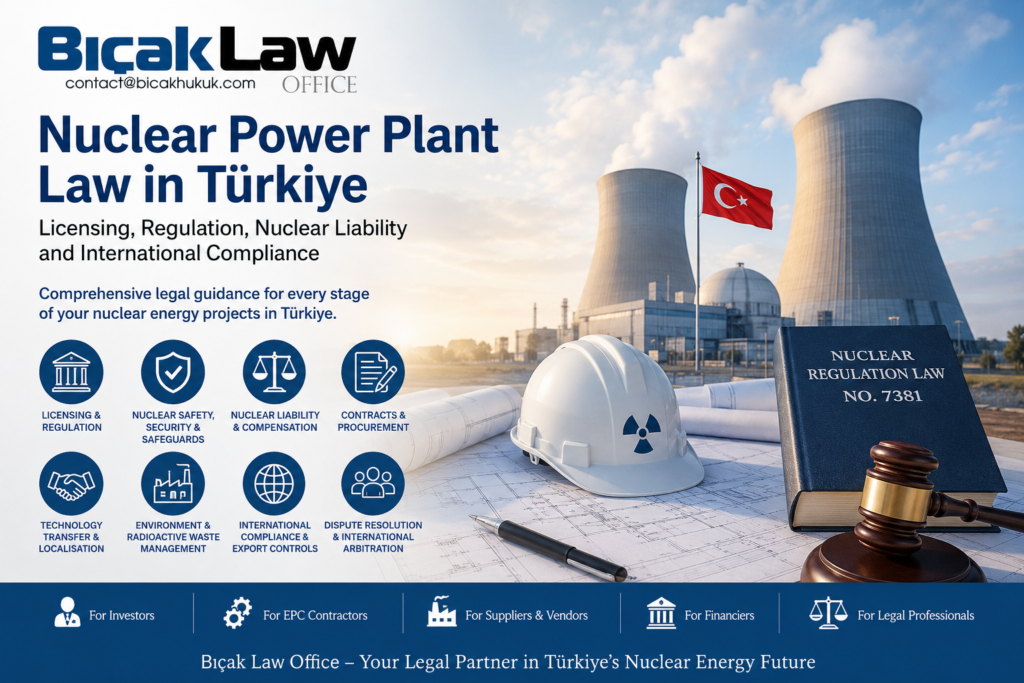
Nuclear power plant law in Turkey
Türkiye’s Transition to Nuclear Power
Türkiye has considered the introduction of nuclear-generated electricity since the 1950s. The Turkish Atomic Energy Commission was established in 1956, and Akkuyu on Türkiye’s Mediterranean coast was subsequently identified as a potential nuclear power plant site. Several earlier procurement and development initiatives did not result in construction, however, and Türkiye remained without an operating commercial nuclear power plant for decades. A decisive change occurred with the agreement signed between Türkiye and the Russian Federation on 12 May 2010 concerning the construction and operation of a nuclear power plant at Akkuyu. Unlike a conventional public procurement structure, the Akkuyu project was organised around a build-own-operate model under which the project company would construct, own and operate the plant.
The project comprises four VVER-1200 reactor units with an aggregate planned capacity of approximately 4.8 GW. Construction, regulatory approvals, commissioning preparations and power-system works have continued through successive phases. In January 2026, the project company reported completion of a connection operation intended to demonstrate the readiness of Unit 1’s power-distribution system to transfer electricity. The precise date of first generation and commercial operation nevertheless remains dependent on completion of technical work, testing and regulatory authorisations.
Türkiye’s nuclear strategy now extends beyond Akkuyu. Government policy envisages more than 20 GW of nuclear capacity by 2050, including conventional large reactors and potentially small modular reactors. Nuclear energy is expected to contribute to energy-security, decarbonisation and Türkiye’s net-zero emissions target for 2053. The resulting legal landscape is no longer limited to the licensing of one nuclear facility. It includes:
- Akkuyu’s construction, commissioning and future operation;
- the development and licensing of the Sinop site;
- negotiations concerning further large-scale capacity;
- potential small modular reactor deployment;
- nuclear component manufacturing and supplier qualification;
- technology transfer and localisation;
- nuclear fuel, radioactive material and waste management;
- cybersecurity and critical-infrastructure protection;
- project finance and investment protection; and
- the resolution of complex construction and commercial disputes.
The Turkish Nuclear Market Report 2026 accordingly characterises Türkiye’s nuclear programme as a multi-decade commercial market extending across construction, operation, maintenance, digital services, industrial participation and eventual lifecycle management. The report’s commercial projections should be treated as market assessments rather than official legal findings, but they demonstrate the increasing breadth of the sector.
The Constitutional and Legislative Structure of Turkish Nuclear Law
Turkish nuclear law is not contained in one statute. It consists of a hierarchy of constitutional principles, international agreements, legislation, presidential decrees, regulations, regulatory decisions, licences, approvals and technical requirements. The principal layers are:
- the Constitution of the Republic of Türkiye;
- international treaties and intergovernmental agreements;
- Nuclear Regulation Law No. 7381 and other statutes;
- presidential decrees, particularly Presidential Decree No. 95;
- regulations and communiqués;
- decisions and requirements issued by the Nuclear Regulatory Authority;
- licences, permits and approvals relating to individual facilities and activities; and
- applicable technical codes, standards and regulatory guidance.
Article 90 of the Constitution gives duly ratified international agreements the force of law. Where an international agreement concerning fundamental rights conflicts with domestic legislation, the international agreement prevails. Intergovernmental nuclear project agreements may therefore have a particularly important role in determining project structure, ownership, electricity purchasing arrangements, state commitments and certain responsibilities of the parties. At the same time, an intergovernmental agreement does not remove the project from the generally applicable nuclear safety and licensing system. The project company and operator must still comply with mandatory Turkish regulatory requirements unless a valid and applicable legal provision establishes otherwise.
Nuclear Regulation Law No. 7381
Türkiye reorganised its nuclear regulatory framework through Decree-Law No. 702 in 2018. That measure separated regulatory responsibilities from promotional and operational functions and established the Nuclear Regulatory Authority. Following the Constitutional Court’s annulment of the decree-law on procedural grounds, Parliament enacted Nuclear Regulation Law No. 7381, which entered into force on 8 March 2022. Presidential Decree No. 95 separately regulates the organisation and duties of the Nuclear Regulatory Authority. The OECD Nuclear Energy Agency identifies Law No. 7381 and Presidential Decree No. 95 as Türkiye’s primary nuclear legislation. Its updated 2025 country profile covers nuclear installations, radioactive substances, radiation protection, waste, transport, safeguards, physical protection and third-party liability. Law No. 7381 applies broadly to activities involving nuclear energy and ionising radiation. It addresses, among other matters:
- nuclear installations;
- radiation facilities and radiation practices;
- radioactive waste facilities;
- nuclear material and radioactive sources;
- authorisation and notification;
- nuclear safety;
- nuclear security;
- safeguards;
- radiation protection;
- inspections and enforcement;
- radioactive waste and decommissioning funds;
- civil liability for nuclear damage;
- insurance and financial security;
- administrative sanctions; and
- criminal offences.
The legislation reflects the internationally recognised 3S approach:
- Safety, meaning protection against radiological risks arising from authorised activities and facilities;
- Security, meaning prevention and detection of, and response to, theft, sabotage, unauthorised access and other malicious acts; and
- Safeguards, meaning accounting, control and verification measures intended to ensure that nuclear material is not diverted from peaceful purposes.
These concepts overlap but are legally and operationally distinct. Compliance with one does not replace compliance with the others.
Principal Nuclear Institutions in Türkiye
Ministry of Energy and Natural Resources
The Ministry of Energy and Natural Resources determines national energy policy and plays a central role in the development of Türkiye’s nuclear energy programme. Its responsibilities differ from those of the nuclear regulator: the Ministry promotes and coordinates energy policy, while the NDK performs independent regulatory functions. The distinction between promotion and regulation is fundamental to the credibility of a national nuclear programme. A body responsible for developing or operating nuclear facilities should not also be responsible for making independent safety determinations about those facilities.
Nuclear Regulatory Authority
The Nükleer Düzenleme Kurumu, or NDK, is the Turkish authority responsible for nuclear and radiation regulation. Its principal powers include:
- issuing regulatory requirements and decisions;
- determining authorisation conditions;
- granting, restricting, suspending, terminating and revoking authorisations;
- reviewing licence applications and technical documents;
- carrying out inspections and on-site investigations;
- approving matters relating to safety, security and safeguards;
- requiring additional safety assessments;
- verifying nuclear liability insurance or other financial security;
- monitoring radioactive sources and occupational radiation doses;
- maintaining nuclear material accounting and control systems;
- imposing administrative sanctions;
- cooperating with foreign regulators and international organisations;
- communicating extraordinary events to competent institutions; and
- requesting information and documents from public and private persons.
The OECD/NEA’s updated profile confirms that the current legal architecture is based principally on Law No. 7381 and Presidential Decree No. 95. The NDK must make its licensing determinations on the basis of nuclear safety, security, safeguards and radiation-protection requirements. Commercial pressure, project schedules or political objectives do not legally replace the regulator’s assessment.
Türkiye Nuclear Energy Company
Türkiye Nükleer Enerji Anonim Şirketi, known as TÜNAŞ, performs project-development, programme-management, supplier-development and infrastructure-related functions. Its publicly described activities include:
- Sinop nuclear power plant site studies;
- preparation of the Sinop site report;
- environmental impact assessment work;
- the Sinop ownership application;
- zoning and planning activities;
- nuclear project and programme management;
- supplier and infrastructure development;
- preparation of owner’s requirements;
- human-resource and competency planning; and
- assessment of small modular reactor designs.
TÜNAŞ submitted an application to be recognised as the owner of the Sinop project on 31 December 2022. The NDK recognised TÜNAŞ as the project owner on 27 January 2023, and TÜNAŞ states that a site-licence application has also been submitted.
TENMAK
The Turkish Energy, Nuclear and Mineral Research Agency, or TENMAK, conducts research, technology-development and technical activities in energy, nuclear science, ionising radiation, minerals and related fields. Its research and technical functions should be distinguished from the NDK’s regulatory authority and from TÜNAŞ’s project-development role.
NÜTED
NÜTED Nuclear Technical Support Joint Stock Company was created to provide technical support services required by the regulatory authority. Such services may include examination, assessment, inspection, testing, certification, research, training and technical consultancy. The use of a technical support organisation does not transfer the NDK’s regulatory decision-making authority. Licensing and enforcement decisions remain the responsibility of the legally competent regulator.
Other Relevant Authorities
A nuclear project may also require interaction with:
- the Ministry of Environment, Urbanisation and Climate Change;
- the Energy Market Regulatory Authority;
- the Ministry of Trade;
- the Ministry of Treasury and Finance;
- the Ministry of Transport and Infrastructure;
- the Disaster and Emergency Management Presidency;
- provincial and local administrations;
- customs authorities;
- competition and data-protection authorities; and
- security, emergency-response and law-enforcement bodies.
The precise institutional map depends on the project stage, the activity involved and the corporate and contractual model.
Secondary Nuclear Legislation
Türkiye has developed an extensive body of secondary legislation under the general framework of Law No. 7381. The TÜNAŞ legislation database identifies regulations dealing with:
- authorisations concerning nuclear facilities;
- nuclear power plant sites;
- special safety principles for nuclear power plants;
- nuclear power plant design principles;
- nuclear safeguards;
- physical protection and security;
- radiation protection;
- nuclear inspections and on-site investigations;
- nuclear export control;
- nuclear power plant building inspection;
- procurement of nuclear equipment and approval of manufacturers;
- management systems;
- organisational structure and personnel;
- transport of radioactive materials;
- radioactive waste and spent fuel;
- radioactive waste facilities;
- radioactive waste and decommissioning special accounts;
- radiation emergencies;
- national radiation monitoring;
- remediation of radioactively contaminated areas; and
- administrative sanctions.
This demonstrates why nuclear development cannot be managed through general energy, construction or company law alone. Nuclear-specific regulatory requirements extend through the entire life of the facility.
Licensing Nuclear Power Plants in Türkiye
Activities within the scope of Law No. 7381 may be subject to notification, registration, permission, approval or licensing. A nuclear facility cannot lawfully be constructed or operated solely on the basis of a company registration, electricity-market licence, construction contract or environmental approval. A nuclear authorisation is a public-law instrument granted by the NDK. It may contain technical, legal, administrative and financial conditions. The NDK may alter, restrict, suspend, terminate or revoke an authorisation where the statutory conditions are met. An authorisation generally does not relieve its holder from obtaining other approvals required under:
- environmental law;
- zoning and land-use law;
- coastal and construction legislation;
- electricity-market regulation;
- occupational health and safety law;
- customs and foreign-trade rules;
- transport legislation; or
- other applicable regulatory regimes.
Before the principal licensing stages begin, the applicant must be recognised as the owner of the proposed nuclear installation. Owner recognition allows the NDK to identify the legal person responsible for the project and to assess whether it possesses, or can establish, the organisational, technical and financial capacity necessary to discharge the owner’s responsibilities. Recognition as owner does not itself authorise construction or operation.
The site-licensing stage examines whether the proposed location is suitable for a nuclear installation. Issues may include:
- geology and seismology;
- geotechnical conditions;
- hydrology and hydrogeology;
- meteorology;
- flooding and coastal hazards;
- population distribution;
- external human-induced events;
- environmental characteristics;
- emergency planning;
- access and infrastructure;
- cooling-water availability; and
- interaction with other facilities or activities.
Site suitability is a nuclear safety question distinct from an environmental impact assessment. A positive EIA decision does not automatically establish nuclear site suitability, and a nuclear site licence does not replace the environmental approval.
The construction-licensing process examines the proposed design and the applicant’s arrangements for building the facility safely. Relevant documentation may include:
- preliminary safety analysis reports;
- design descriptions;
- safety classifications;
- quality-management arrangements;
- construction programmes;
- organisational and staffing plans;
- physical-protection arrangements;
- safeguards documentation;
- emergency-planning information;
- radioactive waste strategies;
- procurement and manufacturer-control systems; and
- arrangements for inspection and regulatory access.
Construction may also be divided by regulatory hold points. Certain preparatory or limited works may be authorised before the full construction licence, but only within the scope expressly permitted.
Completion of physical construction does not authorise nuclear operation. Commissioning normally includes staged testing of systems and structures to demonstrate that they perform in accordance with approved design and safety requirements. It may involve:
- component and system testing;
- cold functional testing;
- hot functional testing;
- pre-operational tests;
- fuel-loading readiness;
- initial criticality;
- low-power testing;
- power-ascension testing; and
- demonstration of operational performance.
Before nuclear material is brought onto the site, requirements concerning physical protection and nuclear material accounting and control must be satisfied. Emergency arrangements and operational readiness are also reviewed before fuel loading. The operating-licence stage examines whether the facility, organisation and operating arrangements satisfy applicable regulatory requirements. The NDK may review:
- the final safety analysis report;
- commissioning results;
- operating limits and conditions;
- staffing and competency;
- management systems;
- emergency arrangements;
- security and safeguards programmes;
- maintenance and surveillance programmes;
- ageing-management arrangements;
- radiation-protection measures;
- waste-management arrangements;
- insurance or financial security; and
- operational reporting systems.
The licence holder remains responsible for safety throughout operation. Responsibility cannot be transferred to a contractor merely through an EPC, operation and maintenance or technical-services agreement.
Significant modifications to plant design, operation, systems or safety arrangements may require prior regulatory approval. Continued operation may also require:
- periodic safety reviews;
- ageing-management programmes;
- equipment qualification;
- updated hazard assessments;
- cybersecurity improvements;
- operating-experience reviews; and
- compliance with new regulatory requirements.
The nuclear lifecycle does not end when electricity generation stops. Decommissioning requires planning for:
- removal of nuclear fuel;
- dismantling and decontamination;
- radioactive waste characterisation;
- transport, storage and disposal;
- radiation protection;
- site remediation;
- environmental monitoring;
- financing; and
- termination or transfer of regulatory control.
Türkiye has adopted regulations concerning radioactive waste, spent fuel and special accounts for waste management and decommissioning.
The Akkuyu Nuclear Power Plant
Intergovernmental and Corporate Structure
The Akkuyu project is based on the 2010 intergovernmental agreement between Türkiye and the Russian Federation. The agreement contemplated the establishment of a Turkish project company and required the Russian side’s authorised entities to retain at least 51% of that company. Akkuyu Nuclear Joint Stock Company was subsequently established as the project company. The project’s build-own-operate structure differs from conventional models in which the state directly procures construction and subsequently owns and operates the completed plant. In Akkuyu, project development, ownership and future operation are concentrated in the project company, subject to Turkish licensing and regulatory control.
Electricity Purchase Arrangements
The intergovernmental agreement provides for a long-term purchase arrangement covering specified proportions of electricity from the four units. The agreement’s original framework contemplated the purchase for 15 years of:
- 70% of electricity from Units 1 and 2; and
- 30% of electricity from Units 3 and 4,
at the contractual price stipulated in the agreement. Electricity outside the guaranteed quantities may be sold in the market in accordance with the applicable electricity-market framework. When describing these arrangements, it is important to distinguish between:
- the rights created by the intergovernmental agreement;
- the power-purchase implementation documents;
- electricity-market licences;
- grid-connection and system-use arrangements; and
- the nuclear operating authorisation.
Localisation and Human Resources
The Akkuyu agreement contains provisions concerning the training of Turkish personnel and participation of Turkish businesses in procurement, services and construction. Local participation has subsequently become an important feature of Türkiye’s broader nuclear strategy. The TNBP market report refers to substantial Turkish supplier participation and the development of a domestic nuclear industrial ecosystem. Such industry figures should be independently verified before being presented as official statistics, but localisation clearly raises important legal questions concerning supplier qualification, technology transfer, intellectual property and contractual performance.
Sinop and Further Nuclear Projects
Türkiye’s second major nuclear site is located at Sinop on the Black Sea coast. An earlier intergovernmental framework involving Japan was developed around a proposed project company and contemplated state participation, technology transfer and human-resource development. That particular commercial structure did not proceed to construction. The project itself has not disappeared. TÜNAŞ has continued:
- site studies;
- environmental assessment;
- zoning and planning;
- preparation of owner’s requirements;
- infrastructure development;
- owner-recognition procedures; and
- site-licensing work.
TÜNAŞ reports that Sinop obtained a positive environmental impact assessment decision in September 2020, that the NDK recognised TÜNAŞ as owner in January 2023 and that a site-licence application was submitted. This distinction should be maintained throughout the article “The termination or non-implementation of an earlier commercial partnership does not necessarily terminate the state’s nuclear project for that site“. Türkiye has also considered additional nuclear capacity in Thrace. The precise vendor, technology, ownership, financing and contracting structure of any such project will depend on future agreements and regulatory processes.
Small Modular Reactors
Small modular reactors, generally referred to as SMRs, are increasingly relevant to Türkiye’s long-term nuclear policy. SMRs may differ from conventional large reactors in several respects:
- lower output per module;
- factory-based manufacture;
- modular or phased deployment;
- standardised designs;
- potential deployment near industrial consumers;
- possible use for electricity, process heat, hydrogen or desalination; and
- different financing and construction profiles.
Türkiye has stated that its nuclear-capacity ambitions include SMRs, and TÜNAŞ has conducted a project assessing SMR designs from technical and financial perspectives. The existing legal framework is sufficiently broad to subject an SMR to nuclear authorisation, safety, security, safeguards and liability requirements. Nevertheless, practical regulatory questions may arise concerning:
- design approval;
- factory manufacture in another country;
- serial production;
- transport of modules;
- licensing multiple identical units;
- emergency-planning zones;
- multi-module control rooms;
- operator staffing;
- co-location with industrial facilities;
- shared systems;
- safeguards;
- spent fuel; and
- decommissioning.
The legal treatment of an SMR project will depend not merely on its generating capacity but on its technology, site, fuel, intended application and risk profile. The IBA analysis similarly identifies the need to consider how Türkiye’s existing legal framework will apply to emerging SMR technologies.
Nuclear Safety, Security and Safeguards
Nuclear Safety
Nuclear safety concerns the prevention of accidents and mitigation of their radiological consequences. The operator must maintain safety throughout:
- site evaluation;
- design;
- procurement;
- manufacture;
- construction;
- commissioning;
- operation;
- modification;
- shutdown;
- decommissioning; and
- waste management.
The operator has primary responsibility for safety. Regulatory approval, inspection or review does not transfer that responsibility to the NDK.
Nuclear Security
Nuclear security concerns protection against intentional unauthorised acts, including:
- theft of nuclear material;
- sabotage;
- unauthorised access;
- malicious cyber activity;
- unlawful transport interference; and
- acts of nuclear or radiological terrorism.
Security arrangements may involve:
- physical barriers;
- access controls;
- personnel reliability;
- protected and vital areas;
- transport security;
- cybersecurity;
- contingency planning;
- information classification; and
- cooperation with security authorities.
Safeguards and Non-Proliferation
Safeguards are intended to verify that nuclear material remains in peaceful use. Relevant obligations may include:
- nuclear material accounting;
- record-keeping;
- reporting;
- measurement and verification;
- inspections;
- containment and surveillance; and
- cooperation with the IAEA.
The legal and operational arrangements for safety, security and safeguards must be coordinated without treating them as interchangeable.
International Nuclear Law Applicable to Türkiye
Türkiye participates in a broad international legal framework governing peaceful nuclear activities.
Nuclear Safety and Emergency Response
Important instruments include:
- the Convention on Nuclear Safety;
- the Convention on Early Notification of a Nuclear Accident;
- the Convention on Assistance in the Case of a Nuclear Accident or Radiological Emergency; and
- the Joint Convention on the Safety of Spent Fuel Management and on the Safety of Radioactive Waste Management.
These instruments promote national safety responsibilities, international notification, assistance and review.
Nuclear Security and Physical Protection
Relevant instruments include:
- the Convention on the Physical Protection of Nuclear Material;
- the Amendment to that Convention;
- the International Convention for the Suppression of Acts of Nuclear Terrorism;
- the International Convention for the Suppression of Terrorist Bombings; and
- the International Convention for the Suppression of the Financing of Terrorism.
Non-Proliferation and Safeguards
Türkiye is a party to the Treaty on the Non-Proliferation of Nuclear Weapons and is subject to IAEA safeguards arrangements. These obligations are particularly important when contracts involve:
- nuclear material;
- controlled equipment;
- sensitive technology;
- fuel-cycle information;
- technical assistance;
- research cooperation; or
- international transfer of nuclear-related items.
Nuclear Third-Party Liability
Türkiye is a party to the Paris Convention on Third Party Liability in the Field of Nuclear Energy and to the Joint Protocol connecting the Paris and Vienna liability regimes. Law No. 7381 provides the principal domestic rules concerning operator liability, compensation, insurance and jurisdiction. The OECD/NEA country profile identifies the Law as Türkiye’s primary nuclear-liability legislation.
Civil Liability for Nuclear Damage
Strict Liability
Law No. 7381 imposes strict liability on the nuclear operator. The injured person is not generally required to prove that the operator acted negligently. The claimant must establish the nuclear incident, recoverable nuclear damage and the necessary causal connection. Strict liability reflects the exceptional nature of nuclear risk and the difficulty that injured parties might otherwise face in proving technical fault.
Legal Channelling to the Operator
Nuclear-liability law generally channels liability to the operator rather than distributing primary liability among:
- employees;
- designers;
- manufacturers;
- construction contractors;
- equipment suppliers;
- technology providers; and
- service companies.
This principle provides a clearly identifiable defendant and supports the availability of insurance. Legal channelling does not mean that contractors have no contractual exposure. The operator may have contractual rights concerning:
- breach;
- delay;
- defective equipment;
- non-compliance;
- indemnities;
- warranties; and
- recourse,
subject to mandatory nuclear-liability rules and the terms of the relevant agreements.
Liability Limits
The Law establishes different limits according to the facility or activity. The existing article identifies the following categories:
- EUR 700 million for nuclear reactors exceeding the applicable thermal threshold and other facilities placed in the corresponding category;
- EUR 70 million for other nuclear facilities;
- EUR 80 million for transport of nuclear material; and
- EUR 700 million for transit of nuclear material through Türkiye.
The precise applicable amount should be confirmed against the current statutory text, the classification made by the NDK and any amendments or applicable international rules at the time of the incident.
Mandatory Insurance or Financial Security
An operator must maintain insurance or another acceptable financial guarantee corresponding to its potential liability. The NDK is authorised to determine whether the operator has fulfilled its financial-security obligations. The insurance arrangements must be maintained in a manner consistent with the facility, activity, liability amount and licence conditions. Potential claimants may, within the statutory framework, pursue claims against the operator and the relevant insurer or financial-guarantee provider.
Public Compensation Mechanism
Where nuclear damage exceeds available operator liability and financial security, the Law contemplates a public compensation mechanism and the establishment of a Nuclear Damage Determination Commission.The Commission’s role may include receiving applications, assessing claims and administering compensation in accordance with the statutory framework.
Exclusions
The operator may be exempt from liability where nuclear damage results directly from specified exceptional events, including:
- armed conflict;
- hostilities;
- civil war; or
- insurrection.
Any exclusion should be interpreted within the text of Law No. 7381 and the applicable international convention.
Limitation Periods
The Law provides different long-stop periods for different types of damage. The existing statutory framework provides:
- 30 years for claims concerning death or personal injury; and
- 10 years for other categories of damage,
calculated from the nuclear incident, subject to the full rules governing knowledge, filing and procedural requirements.
Competent Courts
Turkish courts have jurisdiction over nuclear incidents occurring within Türkiye in the circumstances defined by the applicable legal regime. Law No. 7381 assigns jurisdiction in covered nuclear-damage proceedings to the Ankara courts. This special jurisdiction should be distinguished from the resolution of contractual disputes between the operator, EPC contractor, supplier or other project participants, which may be subject to arbitration.
Environmental Assessment, Land and Planning
A nuclear project requires compliance with both nuclear licensing rules and general environmental and planning legislation. Relevant legal issues may include:
- environmental impact assessment;
- public participation;
- coastal and marine impacts;
- cooling-water intake and discharge;
- biodiversity;
- water rights;
- waste and emissions;
- zoning plans;
- land acquisition;
- expropriation;
- construction permits;
- cultural and archaeological assets;
- forestry;
- emergency planning; and
- long-term environmental monitoring.
The EIA process and the nuclear site-licensing process serve different purposes. An EIA examines the project’s environmental effects under environmental legislation. The NDK separately determines whether the site and proposed facility satisfy nuclear safety requirements. A project may therefore require both a positive EIA decision and a nuclear site licence, together with further administrative permits.
Nuclear Procurement and Market Entry
Different Levels of Procurement
Nuclear procurement in Türkiye may take place at several levels. At the highest level, the selection of a reactor vendor and project structure may be influenced by:
- intergovernmental negotiations;
- sovereign commitments;
- financing packages;
- technology-transfer proposals;
- fuel-supply arrangements;
- localisation;
- geopolitical considerations; and
- long-term energy policy.
Below that level, procurement may be undertaken by:
- the project company;
- the reactor technology provider;
- the EPC contractor;
- major package contractors;
- the operator; or
- public or state-owned entities.
The applicable legal regime should be determined for each procurement. Not every procurement by a nuclear project company is automatically a public tender, and not every public-sector procurement is governed in the same manner.
Nuclear-Specific Procurement Requirements
Nuclear procurement may require:
- safety classification of equipment;
- nuclear-grade quality assurance;
- approval of manufacturers;
- technical qualification;
- traceability of materials;
- configuration control;
- inspection and testing;
- preservation of records;
- prevention of counterfeit or fraudulent items;
- regulator access;
- approval before subcontracting;
- cybersecurity assurance;
- export-control screening; and
- flow-down of requirements to lower-tier suppliers.
Türkiye has adopted a dedicated regulation governing the procurement process for equipment intended for nuclear facilities and the approval of manufacturers.
Supplier Due Diligence
International and Turkish participants should conduct enhanced due diligence addressing:
- corporate ownership and beneficial ownership;
- technical capability;
- financial capacity;
- nuclear certifications;
- sanctions exposure;
- export-control compliance;
- anti-bribery systems;
- quality management;
- cybersecurity;
- litigation and regulatory history;
- occupational safety;
- document retention; and
- ability to comply with nuclear safety culture requirements.
In a nuclear project, a deficiency at a lower supplier tier may affect licensing, safety, commissioning and the entire project schedule.
Nuclear EPC and Construction Contracts
The Contractual Structure
A nuclear project commonly involves a network of agreements rather than one standalone contract. These may include:
- an intergovernmental agreement;
- shareholders’ and project-development agreements;
- reactor technology agreements;
- EPC or engineering and construction contracts;
- civil works contracts;
- turbine-generator contracts;
- nuclear island and balance-of-plant packages;
- grid-connection agreements;
- nuclear fuel contracts;
- equipment-supply agreements;
- long-term service agreements;
- operation and maintenance arrangements;
- training agreements;
- insurance policies;
- financing agreements; and
- numerous subcontracts.
The contracts should be designed as an integrated structure. Inconsistent provisions concerning completion, force majeure, liability or dispute resolution may generate gaps or conflicting obligations.
Scope and Interface Risk
A nuclear EPC contract must clearly allocate responsibility for:
- engineering and design;
- design adaptation;
- procurement;
- civil construction;
- equipment manufacture;
- transport and customs;
- installation;
- licensing support;
- regulatory documentation;
- quality assurance;
- testing;
- commissioning;
- training;
- spare parts;
- operational readiness; and
- long-term support.
Where different contractors control different packages, interface risk becomes critical. Responsibility matrices should identify:
- design boundaries;
- information exchange;
- access and handover;
- temporary works;
- system integration;
- testing interfaces;
- commissioning sequence; and
- responsibility for delay affecting another package.
Regulatory Responsibility
The parties may contractually allocate responsibility for preparing reports, responding to regulator questions and supporting licence applications. They cannot, however, contract out of mandatory statutory responsibility. The owner and licence holder remain accountable to the NDK for matters assigned to them by law. The contract should therefore specify:
- who prepares each regulatory submission;
- who owns and controls the supporting data;
- who bears the cost of regulator-required changes;
- who responds to requests for additional information;
- what happens when a vendor refuses to disclose proprietary information;
- whether approval is a condition precedent;
- and how regulatory delay affects time and price.
Completion and Acceptance
Nuclear construction cannot ordinarily be reduced to one completion date. Relevant milestones may include:
- completion of civil works;
- mechanical completion;
- energisation;
- system turnover;
- cold testing;
- hot testing;
- fuel-loading readiness;
- first criticality;
- grid connection;
- power ascension;
- provisional acceptance;
- commercial operation; and
- final acceptance.
The contract should define the legal and financial consequence of each milestone.
Delay and Performance Damages
Delay liquidated damages may apply where the contractor fails to achieve a specified milestone on time. Performance liquidated damages may apply where the completed facility fails to achieve:
- required electrical output;
- thermal efficiency;
- availability;
- safety-related performance;
- fuel-cycle targets; or
- other guaranteed parameters.
The contract should address:
- separate or aggregate caps;
- exclusive-remedy wording;
- termination thresholds;
- relief events;
- interaction with insurance;
- and whether nuclear safety or regulatory non-compliance is excluded from ordinary limitation-of-liability provisions.
Change in Law
Long project durations make legal change particularly significant. A change-in-law clause should address:
- new nuclear safety requirements;
- new regulatory guidance;
- environmental obligations;
- customs and tax changes;
- sanctions;
- export controls;
- cybersecurity requirements;
- employment law;
- localisation requirements;
- and changes arising from international commitments.
The clause should distinguish between foreseeable regulatory development and an exceptional change occurring after the contractual baseline date.
Force Majeure and Supply-Chain Disruption
Nuclear projects depend on specialised components and cross-border supply chains. Contracts should address:
- pandemics;
- armed conflict;
- border closures;
- sanctions;
- export-licence refusal;
- blocked payments;
- state intervention;
- shipping disruption;
- loss of a critical manufacturer;
- inability to source an approved component;
- prolonged regulatory delay; and
- extraordinary natural events.
The TNBP report notes that Akkuyu’s project timeline has been affected by pandemic disruption, equipment-supply constraints and financing complications. These assertions illustrate the contractual importance of supply-chain and payment risks, although individual causes and their legal consequences require independent verification.
Localisation and Industrial Participation
Türkiye’s nuclear strategy places significant emphasis on domestic capability. Localisation may involve:
- Turkish construction companies;
- domestic equipment manufacturing;
- Turkish engineering;
- workforce development;
- training;
- supplier qualification;
- joint ventures;
- research cooperation;
- technology licensing; and
- development of regional export capacity.
Local-content obligations should be expressed through measurable contractual terms. Issues include:
- what expenditure qualifies as local;
- how local content is calculated;
- whether imported inputs count;
- required percentages or milestones;
- approved supplier lists;
- reporting;
- auditing;
- remedies for shortfall;
- substitutions;
- and interaction with competition and procurement law.
The TNBP report presents Akkuyu as having generated substantial local participation and refers to hundreds of Turkish companies with nuclear construction exposure. These figures provide useful market context, but they should be attributed to the report unless confirmed through official project or government records.
Technology Transfer and Intellectual Property
Technology transfer is likely to be central to future nuclear project negotiations. It may include:
- licences to use reactor or component technology;
- access to design documentation;
- manufacturing know-how;
- technical assistance;
- personnel training;
- software;
- maintenance information;
- localisation of component production;
- research cooperation; and
- rights to manufacture for regional export.
Agreements should distinguish between:
- pre-existing intellectual property;
- project-specific intellectual property;
- improvements;
- derivative works;
- manufacturing data;
- confidential know-how;
- operational data;
- and software.
Particular attention should be paid to:
- permitted use;
- sublicensing;
- territorial limits;
- ownership of improvements;
- employee inventions;
- post-termination rights;
- confidentiality;
- trade-secret protection;
- cybersecurity;
- source-code access;
- export-control restrictions; and
- unauthorised onward transfer.
Contractual access to technology remains subject to mandatory export controls and sanctions. A licence agreement cannot lawfully authorise transfer prohibited by the law of the exporting or importing jurisdiction.
Nuclear Export Controls, Sanctions and Customs
Export-Control Framework
Nuclear equipment, material, software and technical data may be subject to special export, import, transit and re-export controls. Türkiye has adopted a Regulation on Nuclear Export Control. Depending on the transaction, parties may need to consider:
- Turkish nuclear export authorisation;
- customs classification;
- dual-use controls;
- end-user and end-use restrictions;
- nuclear supplier-country licences;
- re-export consent;
- technology-transfer restrictions;
- sanctions;
- anti-diversion controls;
- and record-keeping.
Controlled Technology and Services
Export controls can apply not only to physical products but also to:
- technical drawings;
- source code;
- remote support;
- cloud access;
- engineering services;
- training;
- electronic transfer of data;
- and access by foreign nationals.
Technology-transfer and procurement contracts should allocate responsibility for obtaining licences and should address the consequences of refusal, delay, suspension or revocation.
Sanctions Risk
Nuclear projects often involve multiple jurisdictions, state-owned entities, financial institutions and specialised suppliers. Sanctions due diligence should cover:
- counterparties;
- beneficial owners;
- banks;
- vessels;
- insurers;
- technology;
- origin of components;
- payment currency;
- intermediaries;
- and end users.
The contract should not merely contain a general warranty of sanctions compliance. It should address blocked payments, alternative banks, licence applications, substitution, suspension, termination and responsibility for resulting costs.
Cybersecurity, Artificial Intelligence and Digital Nuclear Systems
Modern nuclear facilities depend on digital instrumentation, control systems, communications, data platforms and software-supported maintenance. Legal and contractual questions include:
- classification of critical systems;
- separation of operational and corporate networks;
- remote access;
- vendor access;
- software updates;
- vulnerability management;
- cyber incident reporting;
- supply-chain cyber risk;
- data localisation;
- cross-border data transfer;
- penetration testing;
- source-code access or escrow;
- maintenance of legacy systems;
- and allocation of liability for cyber events.
Artificial intelligence may be used in:
- predictive maintenance;
- anomaly detection;
- equipment monitoring;
- workforce planning;
- document analysis;
- and operational decision support.
Use of AI does not displace the operator’s regulatory responsibility. AI-supported systems should be assessed according to their function, safety significance, data quality, explainability, cybersecurity and human-oversight arrangements. The TNBP report identifies cybersecurity, predictive maintenance and digital services as areas of increasing commercial importance in Türkiye’s developing nuclear market.
Radioactive Waste and Spent Fuel
Radioactive waste management is a continuing legal responsibility, not a matter that may be postponed until plant closure. Relevant requirements concern:
- minimisation;
- classification;
- treatment;
- conditioning;
- storage;
- transport;
- disposal;
- record-keeping;
- security;
- safeguards;
- environmental monitoring;
- and financing.
Spent fuel may require separate arrangements depending on the reactor, fuel-supply agreement, intergovernmental framework and national policy. Türkiye has regulations governing:
- radioactive waste and spent fuel management;
- radioactive waste facilities;
- safe transport;
- radiation protection;
- and special accounts for waste management and decommissioning.
Contracts should identify responsibility for:
- ownership of spent fuel;
- return or reprocessing;
- transport;
- interim storage;
- final disposal;
- costs;
- title and risk;
- safeguards;
- and liability during transfer.
Emergency Preparedness and Response
Nuclear emergency arrangements require coordination between:
- the operator;
- the NDK;
- AFAD;
- ministries;
- provincial authorities;
- health services;
- security forces;
- local administrations;
- neighbouring jurisdictions where relevant; and
- international notification and assistance mechanisms.
Emergency plans may address:
- on-site response;
- off-site response;
- public warning;
- evacuation or sheltering;
- medical response;
- radiation monitoring;
- food and water controls;
- communications;
- exercises;
- and recovery.
Emergency preparedness must be established before operation and cannot be treated solely as a post-accident matter.
Nuclear Project Finance and Bankability
Nuclear projects require large, long-term capital commitments and may involve:
- state support;
- intergovernmental arrangements;
- equity;
- shareholder loans;
- export-credit agencies;
- commercial banks;
- multilateral institutions;
- sovereign guarantees;
- power-purchase arrangements;
- and political-risk insurance.
Legal due diligence for lenders and investors may cover:
- project-company ownership;
- licences and permits;
- land rights;
- environmental approvals;
- construction contracts;
- fuel supply;
- grid connection;
- power offtake;
- insurance;
- nuclear liability;
- decommissioning funding;
- sanctions;
- currency transfer;
- and dispute resolution.
Lenders may seek:
- assignment of project rights;
- security over shares or receivables;
- direct agreements;
- notice of default;
- cure periods;
- step-in rights;
- and restrictions on amendment or termination of key contracts.
These rights must be structured consistently with nuclear licensing rules. A lender cannot become the operator or exercise control over a nuclear installation without satisfying the applicable regulatory requirements.
Corporate Power Purchase Agreements, Industrial Users and CBAM
The commercial significance of nuclear power is not confined to sales into the general electricity market. Energy-intensive companies may seek long-term access to low-carbon electricity or heat through:
- corporate power purchase agreements;
- direct supply arrangements;
- industrial co-location;
- private-wire models;
- hydrogen production;
- desalination;
- or cogeneration.
The EU Carbon Border Adjustment Mechanism increases the importance of reliable carbon data for Turkish producers exporting covered products to the European Union. Contracts may need to address:
- proof of electricity source;
- environmental attributes;
- carbon accounting;
- availability;
- curtailment;
- pricing;
- change in law;
- grid charges;
- balancing;
- and termination.
The TNBP report argues that CBAM and demand from data centres and industrial consumers may strengthen the commercial case for firm low-carbon generation in Türkiye. This is a market assessment rather than a statement of legal obligation, but it highlights the interaction between nuclear investment, energy contracting and international trade regulation.
Dispute Resolution in Nuclear Projects
Nature of Nuclear Disputes
Nuclear projects may generate disputes concerning:
- design responsibility;
- delay;
- defective equipment;
- failure to obtain approval;
- change in law;
- variations;
- force majeure;
- sanctions;
- payment;
- localisation;
- intellectual property;
- quality assurance;
- testing;
- performance guarantees;
- termination;
- and interface responsibility.
Such disputes are often technically complex and may involve multiple contracts and parties.
Litigation and Administrative Proceedings
Regulatory decisions may be subject to Turkish administrative-law remedies under the conditions applicable to the relevant decision. Commercial and compensation claims may fall within the jurisdiction of judicial courts unless a valid arbitration agreement applies. Nuclear third-party liability claims are governed by the special jurisdictional rules discussed above and should not be confused with contractual disputes between project participants.
International Arbitration
International arbitration may be selected for EPC, technology-transfer, supply, financing or shareholder disputes. Potential rules include:
- ICC Arbitration Rules;
- UNCITRAL Arbitration Rules;
- ISTAC Arbitration Rules; and
- other institutional rules selected by the parties.
A carefully drafted nuclear project arbitration clause should address:
- seat;
- governing law;
- language;
- number and qualifications of arbitrators;
- confidentiality;
- emergency relief;
- joinder;
- consolidation;
- multiparty proceedings;
- coordination with related contracts;
- expert determination;
- interim measures;
- and enforcement.
In a multi-contract project, identical or compatible dispute-resolution clauses are generally preferable. Conflicting seats, institutions or governing laws may prevent consolidation and produce parallel proceedings.
Investment Treaty Protection
Foreign investors may also examine whether an applicable bilateral investment treaty or multilateral instrument protects their investment. Possible issues include:
- qualification as an investor;
- existence of a protected investment;
- fair and equitable treatment;
- expropriation;
- discrimination;
- transfer of funds;
- observance of obligations;
- and access to investor-state arbitration.
Investment-treaty protection does not replace proper contractual risk allocation.
Legal Due Diligence for Nuclear Market Participants
A foreign company considering participation in Türkiye’s nuclear sector should undertake legal due diligence before committing substantial resources. The review may include:
Regulatory status
- licences, permits and approvals;
- owner and operator status;
- regulatory conditions;
- pending applications;
- inspection findings;
- and enforcement history.
Corporate and ownership issues
- incorporation;
- shareholders;
- beneficial ownership;
- governance;
- state participation;
- and restrictions on changes of control.
Contracts
- intergovernmental arrangements;
- EPC agreements;
- supply contracts;
- technology licences;
- fuel arrangements;
- power purchase agreements;
- grid agreements;
- operation and maintenance contracts;
- and financing documents.
Land and environmental matters
- title;
- expropriation;
- leases;
- zoning;
- EIA;
- construction permissions;
- coastal and water rights;
- and remediation obligations.
Compliance
- export controls;
- sanctions;
- customs;
- anti-bribery;
- competition;
- cybersecurity;
- data protection;
- labour;
- occupational health and safety;
- and nuclear quality assurance.
Disputes and liabilities
- pending litigation;
- arbitration;
- regulatory investigations;
- claims;
- insurance;
- nuclear liability;
- indemnities;
- and contingent liabilities.
The purpose is not merely to identify problems. Due diligence should determine how each issue affects price, project structure, conditions precedent, contractual protection, insurance and the decision whether to proceed.
Legal Issues Throughout the Nuclear Project Lifecycle
| Project stage | Principal legal issues |
|---|---|
| National policy and project conception | Government policy, international cooperation, state support, investment strategy |
| Technology and vendor selection | Procurement, intergovernmental negotiations, export controls, localisation |
| Corporate structuring | Project company, shareholder rights, governance, foreign investment |
| Site development | Owner recognition, site licence, EIA, land, zoning, coastal and water rights |
| Financing | Bankability, security, direct agreements, political risk, sanctions |
| Design and licensing | Safety analysis, design responsibility, regulatory submissions, IP |
| Procurement and manufacturing | Manufacturer approval, quality assurance, traceability, customs |
| Construction | EPC risk, interfaces, delay, variations, inspections, occupational safety |
| Commissioning | Testing, fuel loading, regulator hold points, acceptance |
| Operation | Operating licence, safety, security, safeguards, maintenance, employment |
| Fuel and waste | Supply, transport, safeguards, storage, waste, spent fuel |
| Long-term operation | Periodic reviews, ageing management, modification, cybersecurity |
| Decommissioning | Funding, dismantling, waste, remediation, licence termination |
| Disputes | Administrative remedies, litigation, arbitration and treaty protection |
Frequently Asked Questions
Does Türkiye currently have a nuclear power plant in commercial operation?
Türkiye’s first commercial nuclear power plant is being developed at Akkuyu. The project has moved into advanced construction and commissioning-related preparations, but commercial operation depends on completion of testing and regulatory approvals.
Who regulates nuclear power plants in Türkiye?
The Nuclear Regulatory Authority, or NDK, is the principal independent regulator for nuclear energy and ionising-radiation activities.
What is the principal nuclear statute?
The principal statute is Nuclear Regulation Law No. 7381, which entered into force on 8 March 2022.
What are the main nuclear licensing stages?
The core stages include recognition of the owner, site licensing, construction licensing and operating licensing. Additional permits and regulatory hold points apply during construction and commissioning.
Is an environmental impact assessment sufficient to construct a nuclear plant?
No. An EIA approval and a nuclear site or construction licence are distinct legal requirements.
Can a foreign company own or participate in a Turkish nuclear project?
Foreign participation is possible, subject to the project structure, applicable intergovernmental arrangements, company law, licensing, security considerations and other regulatory requirements.
Are nuclear operators strictly liable for nuclear damage?
Yes. Law No. 7381 provides for strict operator liability, subject to statutory exclusions, limits and procedural rules.
Must the operator maintain insurance?
The operator must maintain insurance or other acceptable financial security corresponding to the applicable nuclear-liability amount.
Can a nuclear construction dispute be arbitrated?
Commercial disputes may be arbitrated where the parties have concluded a valid arbitration agreement. Third-party nuclear damage claims are subject to special statutory rules and jurisdiction.
Are nuclear equipment suppliers subject to special rules?
Yes. Nuclear equipment procurement, manufacturer approval, quality assurance, traceability, inspection and record retention may be subject to dedicated regulatory requirements.
Are export controls relevant even where no nuclear material is transferred?
Yes. Controls may apply to equipment, software, drawings, technology, services and technical data.
Does Türkiye regulate radioactive waste and spent fuel?
Yes. Turkish legislation contains rules concerning waste facilities, radioactive waste and spent-fuel management, transport, radiation protection and decommissioning funds.
Are small modular reactors covered by Turkish nuclear law?
The broad nuclear-authorisation framework can apply to SMRs, although technology-specific licensing and implementation questions may require further regulatory development.
What role does TÜNAŞ perform?
TÜNAŞ performs nuclear project-development, programme-management, supplier-development, infrastructure, owner’s-requirements and technology-assessment activities, including work connected with Sinop and SMRs.
Can the NDK suspend or revoke a licence?
Yes. The NDK has statutory powers to impose conditions and to restrict, suspend, terminate or revoke authorisations where the legal requirements are met.
How Bıçak Assists Nuclear-Sector Participants?
Nuclear projects require coordinated advice across public law, energy regulation, corporate transactions, construction, technology, international trade and dispute resolution. Bıçak assists domestic and international participants with matters including:
- interpretation of Turkish nuclear legislation;
- regulatory and licensing strategy;
- legal review of nuclear project structures;
- corporate establishment and foreign investment;
- nuclear EPC and construction contracts;
- equipment-supply and services agreements;
- project and supplier due diligence;
- procurement and manufacturer-compliance issues;
- technology-transfer and intellectual-property agreements;
- joint ventures and strategic partnerships;
- export controls, sanctions and customs;
- cybersecurity and data governance;
- environmental, land and permitting matters;
- nuclear insurance and liability analysis;
- radioactive waste and decommissioning arrangements;
- construction claims;
- administrative proceedings;
- international commercial arbitration;
- investment treaty analysis;
- cooperation with overseas counsel; and
- nuclear-law education and compliance training.
We also assist in evaluating whether project documents and commercial arrangements are consistent with Turkish legislation, applicable international agreements, licence conditions and nuclear safety, security and safeguards requirements. Nuclear projects are technically complex, politically sensitive and commercially long-term. Effective legal advice must therefore begin before contracts are signed and continue throughout licensing, construction, commissioning, operation and eventual decommissioning.
Concluding Assessment
Türkiye’s nuclear programme is entering a new legal and commercial phase. Akkuyu has transformed nuclear law from a largely prospective field into a functioning regulatory practice involving construction, inspection, commissioning preparation, supply chains and future operation. Sinop, possible additional large-scale plants and SMR initiatives may further expand the market. The key legal principle is that nuclear regulation cannot be separated from the project’s commercial structure. A technically viable project may still fail if its licensing, financing, procurement, technology-transfer, sanctions or liability arrangements are defective. Equally, a carefully negotiated contract cannot override mandatory nuclear safety requirements or the NDK’s regulatory powers.
International investors, reactor vendors, EPC contractors, manufacturers, financiers, insurers and professional advisers should therefore approach Türkiye’s nuclear sector through an integrated legal strategy addressing: “nuclear regulation, project structuring, procurement, financing, construction, localisation, technology, international compliance, liability and dispute resolution across the entire facility lifecycle“. This full-lifecycle perspective is essential for participating responsibly and effectively in Türkiye’s developing nuclear energy programme.
Comments
No comments yet.