 English
 Türkçe
 Français
 Deutsch

Drug trafficking by sea has become a structural feature of global trade, exploiting the scale, complexity, and legal fragmentation of the maritime domain rather than operating outside it. Recent record-scale seizures, including multi-ton cocaine interceptions on the high seas, demonstrate enforcement capacity but do not, by themselves, dismantle transnational trafficking networks. Maritime trafficking relies on camouflage strategies such as concealment in legitimate cargo, vessel identity manipulation, and complex routing that blends illicit activity into lawful commerce. Jurisdictional limits on the high seas, flag-state dependence, and selective international cooperation further constrain effective enforcement. As a result, interdictions often stop at the level of the vessel and crew, while organizers and financiers remain insulated. For shipping companies, port operators, insurers, and financiers, legal exposure increasingly arises from compliance gaps and facilitation risks rather than intentional wrongdoing. Effective risk management now requires robust, risk-based compliance systems, enhanced due diligence, and preparedness for multi-jurisdictional scrutiny following maritime seizures. In this evolving enforcement landscape, Bıçak provides practical legal guidance to maritime actors seeking to manage regulatory risk and strengthen compliance in relation to drug trafficking by sea.
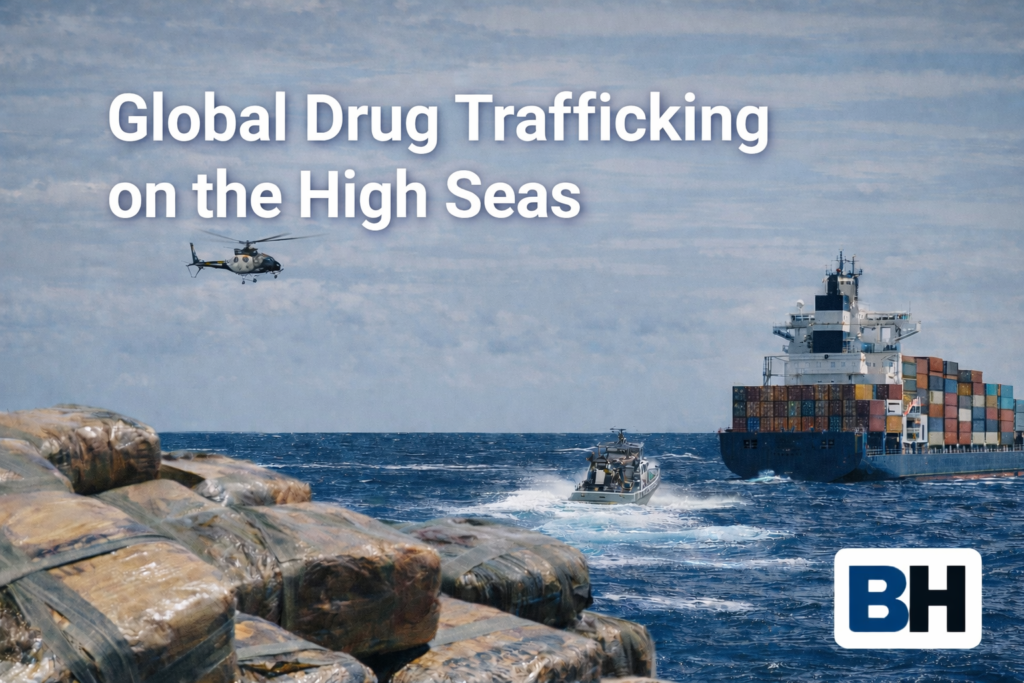
Global Drug Trafficking on the High Seas
1. Introduction: Why the Sea Has Become Central to Global Drug Trafficking
Maritime routes have become the primary artery of global drug trafficking, particularly in relation to cocaine. Contemporary trafficking networks rely overwhelmingly on the sea not only because of its capacity to move large volumes, but because the maritime domain offers structural, legal, and jurisdictional conditions that significantly constrain enforcement. As a result, drug trafficking by sea is no longer a peripheral issue of customs control but a central challenge of international criminal law and maritime governance. According to the United Nations Office on Drugs and Crime (UNODC), cocaine trafficking is increasingly transcontinental and maritime in nature, with South America – Europe routes dominated by container shipping, bulk carriers, and multipurpose merchant vessels. The scale of maritime transport allows criminal organizations to move multi-ton consignments in a single voyage, something that is neither economically nor operationally feasible through air or land routes.
Recent high-profile seizures illustrate this reality. In January 2026, Spanish authorities, acting in cooperation with international partners, intercepted a merchant vessel in Atlantic waters near the Canary Islands and seized approximately ten tonnes of cocaine concealed within a legitimate cargo. The operation, widely described as the largest maritime cocaine seizure in Spain’s history, underscores both the scale of maritime trafficking and the extent to which lawful commercial shipping can be exploited for illicit purposes (Euronews, 12 January 2026). From a legal perspective, such seizures should not be interpreted solely as enforcement successes. UNODC repeatedly cautions that record-breaking interceptions do not necessarily reflect effective disruption of trafficking networks, but may instead indicate increased trafficking volumes and adaptive criminal strategies (UNODC World Drug Report). In other words, maritime seizures often reveal the scale of the problem rather than its resolution.
Drug trafficking by sea differs fundamentally from land-based trafficking because enforcement is mediated through international maritime law. On the high seas, jurisdiction is primarily exercised by the flag state of the vessel, while coastal states’ powers are limited beyond territorial waters. Boarding, inspection, and seizure frequently depend on prior consent, intelligence sharing, and multilateral coordination, all of which introduce delay, fragmentation, and evidentiary challenges (United Nations Convention on the Law of the Sea (UNCLOS), General Framework) The maritime domain also depends heavily on private actors. Shipping companies, vessel managers, registries, insurers, port operators, and classification societies form the backbone of global maritime trade. While these actors are not criminal in themselves, their services are routinely exploited by trafficking organizations that conceal illicit cargo within otherwise lawful commercial operations. Investigative reporting and policy research have shown that criminal groups increasingly rely on older vessels, complex ownership structures, and frequent changes of flag or management to reduce scrutiny and diffuse responsibility (Le Monde, 4 March 2024).
This structural environment explains why maritime drug trafficking remains resilient despite intensified enforcement. The loss of a vessel or cargo is often treated by criminal organizations as a calculated operational risk rather than a fatal setback. The underlying networks – financiers, coordinators, and logistical planners – are typically land-based and insulated from direct contact with interdicted shipments, making them difficult to identify and prosecute even after major seizures (UNODC; DW analysis)
This article approaches drug trafficking by sea as a systemic phenomenon rather than a collection of isolated incidents. Using recent maritime seizures, including the ten-tonne Atlantic case, as illustrative examples, it examines how camouflage strategies, jurisdictional fragmentation, and the limits of maritime enforcement enable large-scale trafficking to persist. Comparative references to other maritime cases are used to demonstrate that these dynamics are not country-specific but inherent to the structure of global maritime trade. The analysis is intended for a practical legal and compliance-oriented audience, including shipping companies, logistics providers, insurers, port operators, and investors exposed – directly or indirectly – to maritime risk. The objective is not to attribute criminal responsibility to particular states or entities, but to clarify where legal exposure arises, why enforcement often stops at the level of the vessel, and what structural vulnerabilities continue to shape drug trafficking on the high seas.
2. The Maritime Trafficking Model: How Drugs Move Across the High Seas
Maritime drug trafficking operates through a structured and repeatable logistical model rather than ad hoc criminal improvisation. Understanding this model is essential for legal practitioners and commercial actors exposed to maritime risk, because liability and compliance failures often arise not from direct criminal intent but from systemic misuse of legitimate maritime infrastructure.
At its core, the maritime trafficking model mirrors lawful global trade. Drugs are inserted into existing commercial shipping flows, exploiting the scale, complexity, and opacity of maritime transport. According to the United Nations Office on Drugs and Crime (UNODC), the majority of cocaine destined for European markets now transits via maritime routes, primarily across the Atlantic, using container vessels, bulk carriers, and multipurpose merchant ships.
2.1. Production Zones and Maritime Export Points
Cocaine production remains concentrated in South America, particularly in the Andean region. From a maritime perspective, the critical legal and operational phase is not production itself but export. Drugs are consolidated near coastal zones and port areas, where they are introduced into maritime logistics chains. UNODC reporting shows that traffickers increasingly favor ports with high cargo throughput and limited inspection capacity, as well as jurisdictions where container screening is necessarily selective due to trade volume.
Export does not always occur through major, well-known ports. Comparative maritime cases demonstrate the use of secondary ports, anchorage zones, and offshore loading points to minimize exposure. In several Atlantic cases, including seizures involving fishing vessels and aging cargo ships, drugs were loaded at sea following departure from a legitimate port, thereby complicating origin tracing and evidentiary reconstruction (Global Initiative Against Transnational Organized Crime)
2.2. Vessel Types and Commercial Cover
The choice of vessel is central to the maritime trafficking model. Large container ships offer concealment through sheer volume, while bulk carriers and general cargo vessels allow drugs to be hidden within homogeneous commodities such as salt, grain, or agricultural products. The January 2026 seizure of nearly ten tonnes of cocaine concealed within a salt cargo illustrates how bulk commodities provide both physical concealment and documentary plausibility (Euronews, 12 January 2026).
Comparative cases confirm that traffickers frequently rely on older vessels nearing the end of their commercial life. Such vessels often operate under cost pressure, with limited compliance investment, fragmented ownership structures, and frequent changes in flag or management. Investigative reporting has documented repeated patterns in which vessels were sold or re-registered shortly before or after interdictions, creating legal and evidentiary distance between the shipment and its ultimate beneficiaries (Le Monde, 4 March 2024)
2.3. Routing, Transshipment, and the Use of the High Seas
Maritime drug trafficking routes are rarely linear. Instead, traffickers employ complex routing strategies that mirror legitimate trade patterns while introducing deliberate inefficiencies. Port hopping, indirect routes, and temporary anchoring on the high seas are used to reduce suspicion and fragment jurisdictional oversight. UNODC and European maritime enforcement agencies have consistently reported the use of ship-to-ship transfers in international waters as a means of redistributing cargo and breaking traceability chains.
From a legal standpoint, the high seas play a critical role in this model. Outside territorial waters, enforcement authority is limited and heavily dependent on flag-state consent and international cooperation. This creates operational windows in which traffickers can reorganize cargo, switch vessels, or alter routes with reduced risk of immediate interdiction. Comparative Atlantic and Caribbean cases demonstrate that even when intelligence exists, delays in authorization can allow traffickers to complete transfers before enforcement action is possible.
2.4. Separation of Logistics from Control
A defining feature of the maritime trafficking model is the strict separation between physical transport and organizational control. Crews are typically recruited for navigational and operational roles and may have limited knowledge of the broader network. Financiers, guarantors, and coordinators remain shore-based, often operating across multiple jurisdictions. This separation explains why maritime interdictions frequently result in crew arrests without corresponding progress against higher-level organizers.
UNODC and criminological analyses emphasize that this compartmentalization is deliberate. Maritime seizures generate visible enforcement outcomes while leaving financial and command structures intact. As a result, even large-scale interceptions do not necessarily disrupt supply chains in a durable manner.
2.5. Legal and Compliance Implications for Commercial Actors
For shipping companies, charterers, insurers, and port operators, the maritime trafficking model presents a distinct legal risk profile. Exposure often arises not from direct involvement but from inadequate due diligence, weak cargo controls, insufficient monitoring of vessel history, or reliance on opaque ownership structures. The repeated misuse of lawful shipping arrangements in maritime drug trafficking cases demonstrates that compliance failures can create both regulatory and reputational consequences, even in the absence of criminal intent. Understanding how drugs move across the high seas is therefore not merely a criminological exercise. It is a practical legal necessity for entities operating in or financing maritime trade, particularly as enforcement authorities increasingly scrutinize facilitators and enablers rather than focusing exclusively on interdicted vessels.
3. The High Seas as a Legal and Jurisdictional Grey Zone
Maritime drug trafficking derives much of its resilience from the legal architecture governing the high seas. Unlike land or territorial waters, the high seas are not subject to a single sovereign authority. Instead, enforcement powers are fragmented among flag states, coastal states, and international cooperation mechanisms. This fragmentation creates predictable legal and operational gaps that trafficking organizations exploit with considerable sophistication.
3.1. Flag-State Jurisdiction as the Primary Rule
Under international law, vessels on the high seas are subject primarily to the jurisdiction of the state whose flag they are entitled to fly. This principle, enshrined in the United Nations Convention on the Law of the Sea (UNCLOS), is designed to protect freedom of navigation and legal certainty for global trade. However, in the context of maritime drug trafficking, it also creates structural dependence on flag-state capacity, willingness, and responsiveness.
In practice, enforcement authorities seeking to board or search a vessel suspected of carrying drugs on the high seas must either establish an exception under international law or obtain the consent of the flag state. This consent-based regime introduces delay and uncertainty, particularly where vessels are registered under flags of convenience or in jurisdictions with limited enforcement resources. Comparative cases from the Atlantic and Caribbean consistently show that traffickers select flag states strategically, not for navigational reasons but for jurisdictional insulation.
3.2. Limited Exceptions and Their Practical Constraints
UNCLOS recognizes limited circumstances in which a warship may board a foreign vessel on the high seas without flag-state consent, such as piracy, slavery, or statelessness. Drug trafficking, however, is not included as an automatic exception. Instead, interdictions rely on specific treaties, bilateral agreements, or ad hoc consent procedures. This legal reality places maritime drug enforcement.
While many states participate in bilateral or regional maritime drug enforcement agreements, these frameworks vary widely in scope and effectiveness. Even where agreements exist, operational coordination depends on real-time intelligence sharing and rapid diplomatic communication. Delays of hours or even minutes can be decisive, particularly in cases involving ship-to-ship transfers or temporary anchoring on the high seas. UNODC has repeatedly noted that traffickers actively plan operations around these procedural constraints.
3.3. The High Seas as an Operational Buffer
From an operational perspective, the high seas function as a buffer zone between jurisdictions. Traffickers use this space to reorganize cargo, adjust routes, and conduct transfers with reduced immediate risk of enforcement. The legal requirement for flag-state consent, combined with the absence of permanent patrol presence, creates predictable enforcement windows. Comparative maritime cases show that vessels suspected of trafficking often remain just outside territorial waters while awaiting instructions, resupply, or transfer opportunities.
The January 2026 Atlantic interception illustrates this dynamic. Publicly available information indicates that the vessel was intercepted far from the nearest coastline, following a period of monitoring and international coordination. While the operation ultimately succeeded, it also highlights how enforcement action on the high seas requires sustained intelligence, multinational cooperation, and favorable legal conditions rather than spontaneous intervention.
3.4. Fragmentation of Evidence and Accountability
Jurisdictional fragmentation on the high seas does not only affect interdiction; it also complicates subsequent investigation and prosecution. Evidence may be collected by one state, suspects detained by another, and financial trails dispersed across multiple jurisdictions. For legal practitioners, this raises critical questions about admissibility, chain of custody, and mutual legal assistance. UNODC has emphasized that maritime drug cases frequently stall after seizure because evidentiary thresholds for linking cargo to financiers or organizers cannot be met across jurisdictions. This gap explains why maritime interdictions often result in prosecutions limited to crew members or immediate facilitators, while higher-level actors remain beyond reach.
3.5. Implications for Commercial and Compliance Risk
For commercial actors, the legal grey zone of the high seas has direct compliance implications. Shipping companies and insurers may assume that operating beyond territorial waters reduces exposure to regulatory scrutiny. In reality, the opposite is increasingly true. Enforcement authorities and regulators now examine vessel history, flag choice, ownership structures, and routing decisions retrospectively following seizures, often across multiple jurisdictions.
The absence of a single enforcing authority does not eliminate liability risk; it redistributes it. Civil forfeiture actions, insurance disputes, and compliance investigations may arise long after an interdiction, even where no criminal charges are brought against the vessel owner. As maritime drug trafficking continues to exploit jurisdictional fragmentation, commercial actors face growing pressure to demonstrate proactive risk management rather than rely on formal legal distance.
4. Camouflage at Sea: Concealment as the Core Strategy
Maritime drug trafficking is not primarily a problem of speed or stealth; it is a problem of camouflage. Successful operations depend on making illicit activity indistinguishable from lawful maritime commerce long enough to traverse jurisdictions and complete delivery. Camouflage at sea operates across three interlocking dimensions: cargo disguise, vessel identity manipulation, and operational masking. Together, these techniques exploit the scale and complexity of maritime trade and the legal constraints of enforcement on the high seas.
4.1. Cargo Disguise: Hiding Illicit Goods in Plain Sight
Cargo disguise is the most visible and consistently documented camouflage technique in maritime drug trafficking. Drugs are concealed within legitimate bulk or containerized cargoes that are common, homogeneous, and difficult to inspect at scale. UNODC reporting confirms that traffickers frequently select commodities such as salt, agricultural products, minerals, timber, or scrap materials because they provide both physical concealment and documentary plausibility. The January 2026 Atlantic seizure of nearly ten tonnes of cocaine concealed within a salt shipment exemplifies this approach. From a legal and compliance perspective, the choice of commodity matters. Bulk cargoes are rarely subject to full physical inspection due to time, cost, and safety constraints. Customs and port authorities rely heavily on risk profiling and documentation review, creating opportunities for traffickers to exploit low-risk cargo categories.
Comparative cases reinforce this pattern. Large cocaine seizures concealed in agricultural cargoes have been documented in ports across Spain, Belgium, the Netherlands, and France, often involving shipments that appeared commercially routine. UNODC cautions that as inspection technology improves, traffickers adapt by shifting to cargoes that are operationally impractical to screen exhaustively.
4.2. Vessel Identity Manipulation: Flags, Ownership, and Legal Distance
Cargo camouflage is reinforced by vessel identity manipulation. Traffickers do not require covert or unregistered ships; instead, they rely on legally registered vessels embedded within the global maritime system. Identity manipulation occurs through a combination of flag selection, ownership structuring, and timing of transactions.
Flags of convenience play a central role. While lawful in themselves, such registries may involve limited oversight, fragmented information sharing, or slow response to enforcement requests. From an enforcement perspective, this complicates consent-based boarding procedures and delays interdiction on the high seas. UNODC and maritime compliance bodies have noted repeated correlations between high-risk trafficking routes and vessels registered under flags with limited enforcement capacity.
Ownership and management structures further amplify legal distance. Investigative reporting and enforcement experience show that vessels used in trafficking are often owned through layered corporate entities across multiple jurisdictions, with frequent changes in registered owner or operator. In several maritime cases, vessels were sold or transferred shortly before interdiction, allowing beneficial owners to deny involvement and complicating asset tracing.
For clients operating in maritime trade, these patterns are legally significant. Post-seizure investigations increasingly scrutinize historical ownership, flag changes, and management decisions. Formal compliance with registration requirements does not preclude exposure if authorities conclude that structural arrangements facilitated concealment or reduced oversight.
4.3. Operational Masking: Routes, Signals, and Transfers
Operational masking completes the camouflage strategy. Rather than avoiding attention entirely, traffickers design voyages to resemble legitimate commercial patterns. This includes indirect routing, port hopping, and deliberate inefficiencies that mirror ordinary shipping behavior. UNODC analysis shows that such routing reduces anomaly detection and complicates intelligence-led interdiction.
Ship-to-ship transfers on the high seas are a particularly effective masking technique. Conducted outside territorial waters, these transfers exploit jurisdictional fragmentation and procedural delays. Comparative cases in the Atlantic and Caribbean demonstrate that transfers can be completed within short time windows, often before boarding authorization is secured. Even when detected, evidentiary challenges arise in linking transferred cargo to specific actors or contracts.
Signal management also plays a role. While not inherently unlawful, irregularities in Automatic Identification System (AIS) transmissions, temporary signal loss, or inconsistent reporting patterns have been cited in multiple maritime trafficking investigations as indicators of operational masking. Enforcement authorities caution, however, that such indicators must be assessed contextually to avoid conflating technical failures with criminal intent.
4.4. Legal Consequences of Camouflage for Enforcement and Compliance
Camouflage at sea does not merely hinder interdiction; it reshapes legal accountability. By embedding illicit activity within lawful trade, traffickers shift enforcement focus toward facilitators, intermediaries, and compliance systems rather than overt criminal acts. This has practical implications for shipping companies, charterers, insurers, and financiers, who may face scrutiny based on risk management failures rather than direct participation.
UNODC and international enforcement bodies increasingly emphasize that maritime drug trafficking cannot be addressed solely through seizures. Effective response requires identifying and disrupting camouflage mechanisms themselves, including weak cargo controls, opaque ownership structures, and insufficient monitoring of routing anomalies. For legal practitioners advising maritime clients, understanding camouflage strategies is essential to assessing exposure. The question is no longer whether a company knowingly carried illicit cargo, but whether its systems, structures, and decisions created foreseeable opportunities for concealment within the maritime domain.
5. Why the Ship is Caught but the Organization Survives
Large-scale maritime interdictions routinely result in the seizure of vessels, cargo, and the arrest of crews. Yet, despite record quantities intercepted at sea, transnational drug trafficking organizations continue to operate with remarkable continuity. This outcome is not accidental. It reflects deliberate organizational separation, evidentiary constraints inherent to maritime cases, and structural limits of enforcement that focus on logistics rather than control.
5.1. Organizational Separation: Logistics Without Command
A defining feature of maritime drug trafficking is the strict separation between those who move the cargo and those who control the operation. Vessels and crews function as logistical tools within a broader network, while financiers, coordinators, and guarantors remain shore-based and legally insulated. UNODC analysis consistently notes that maritime seizures disproportionately affect replaceable components of trafficking networks rather than decision-makers.
Crews are often recruited for navigational competence rather than criminal expertise and may have limited or compartmentalized knowledge of the cargo’s ownership or destination. This separation reduces the evidentiary value of post-interdiction statements and weakens the ability of prosecutors to trace responsibility beyond the vessel. Comparative cases across the Atlantic and Mediterranean demonstrate that even when crews cooperate, information rarely leads to higher-level organizers because operational knowledge is intentionally fragmented.
5.2. Evidentiary Limits in Maritime Interdictions
Maritime interdictions generate physical evidence of illicit cargo, but they often fail to produce legally sufficient proof linking that cargo to financiers or organizers. Evidence collected at sea is constrained by jurisdictional complexity, time delays, and the absence of contemporaneous financial or communications records. UNODC emphasizes that the chain of custody and admissibility standards across jurisdictions frequently limit the scope of prosecutions following maritime seizures.
Financial evidence presents a particular challenge. Payments for maritime shipments are commonly routed through layered corporate structures, informal value transfer systems, or offshore accounts unrelated to the vessel or its crew. As a result, the physical interception of drugs at sea does not automatically translate into traceable financial flows. This gap explains why high-volume seizures rarely coincide with asset forfeiture at the organizational level.
5.3. Jurisdictional Fragmentation and Prosecution Gaps
Jurisdictional fragmentation compounds evidentiary limitations. A single maritime case may involve a flag state, multiple coastal states, port states, and jurisdictions linked to ownership, insurance, and financing. Each jurisdiction applies its own procedural standards and prosecutorial priorities. While international cooperation mechanisms exist, they are often slow, selective, and constrained by domestic legal thresholds. Comparative enforcement experience shows that prosecutions frequently default to the jurisdiction where the interdiction occurred, focusing on readily available defendants such as crew members. Higher-level investigations into organizers or financiers require parallel proceedings in other jurisdictions, which may never materialize due to evidentiary insufficiency or resource constraints.
5.4. The Economic Logic of Replaceability
From an organizational perspective, the loss of a vessel or cargo is treated as an operational cost rather than a strategic defeat. Trafficking networks price in the risk of interdiction, relying on the replaceability of ships, crews, and routes. UNODC and policy research note that as long as organizational leadership and financial infrastructure remain intact, seizures – even at record scale – do not significantly disrupt supply chains. This economic logic explains why maritime drug trafficking continues to expand despite intensified enforcement. The visibility of seizures creates an impression of control, while the underlying organizational capacity remains largely untouched.
5.5. Practical Implications for Legal and Compliance Strategy
For clients operating in maritime trade, the persistence of trafficking organizations despite interdictions has direct legal implications. Authorities increasingly scrutinize facilitators, enablers, and compliance failures precisely because traditional prosecutions stop at the ship. Shipping companies, insurers, and financiers may therefore face exposure not for intentional wrongdoing, but for systemic weaknesses that allowed organizational separation to function. Understanding why the ship is caught but the organization survives is essential for anticipating regulatory expectations. Effective risk management now requires attention not only to physical interdiction risk but also to structural vulnerabilities that may attract retrospective enforcement or civil liability when maritime trafficking cases unravel beyond the vessel itself.
6. International Maritime Enforcement: Cooperation Without Uniformity
Maritime drug interdiction on the high seas is inherently international. No single state can effectively police transoceanic routes alone, and successful operations typically rely on multinational intelligence sharing, consent-based boarding, and coordinated enforcement actions. Yet, while cooperation is indispensable, it is rarely uniform. Participation varies by operation, jurisdiction, and moment in time, reflecting legal constraints, trust considerations, and operational pragmatism rather than political alignment.
6.1. The Architecture of Multinational Maritime Operations
International maritime drug enforcement operates through a layered architecture of bilateral agreements, regional task forces, and ad hoc cooperation. Organizations such as the Maritime Analysis and Operations Centre – Narcotics (MAOC-N) coordinate intelligence among participating states, while national agencies execute interdictions under their respective legal authorities. UNODC emphasizes that these arrangements are facilitative rather than hierarchical; no central authority directs participation across all cases. As a result, multinational operations are often assembled case by case. States contribute intelligence, assets, or legal authorizations depending on the vessel’s flag, route, and available evidence. This flexible structure enhances operational reach but also produces variability in participation and visibility.
6.2. Selective Participation and Intelligence Compartmentalization
Selective participation is a defining feature of maritime drug interdictions. Intelligence underlying an operation may originate from a limited number of sources and be shared only with states deemed operationally necessary. This compartmentalization is driven by confidentiality obligations, source protection, and the need to preserve investigative integrity. Comparative cases demonstrate that absence from a particular operation does not imply lack of cooperation or knowledge in general. Instead, it often reflects a judgment that involvement is not legally required or operationally efficient at that stage. UNODC and European enforcement bodies note that premature disclosure can jeopardize long-term investigations aimed at higher-level targets.
6.3. Legal Constraints Shaping Participation
Legal constraints play a decisive role in determining which states participate in maritime interdictions. Boarding a vessel on the high seas requires flag-state consent or a treaty-based authorization. Where the flag state is slow to respond, lacks capacity, or delegates consent to specific partners, enforcement action may proceed without broader involvement. Moreover, domestic legal thresholds for intelligence sharing, evidence use, and operational deployment vary widely. A state may possess relevant information yet refrain from operational participation due to evidentiary standards, jurisdictional limits, or ongoing parallel investigations. These constraints are structural and apply equally across regions.
6.4. The Case of Türkiye in Multinational Maritime Enforcement
Türkiye’s position in international maritime drug enforcement illustrates these dynamics. As a state with extensive maritime trade, strategic sea lanes, and active international law enforcement engagement, Türkiye participates in various bilateral and multilateral cooperation frameworks. At the same time, public discourse has periodically focused on Türkiye’s absence from specific high-profile maritime interdictions, including the January 2026 Atlantic seizure of nearly ten tonnes of cocaine. From a legal perspective, such absence should be interpreted cautiously. Participation in a given operation depends on flag-state jurisdiction, intelligence origin, and operational necessity rather than geographic proximity or political expectation. UNODC guidance underscores that multinational operations are not inclusive by default and that selective engagement is consistent with international practice.
Public and parliamentary debates in Türkiye have framed non-participation as a potential enforcement gap. While such discussions reflect legitimate policy concerns, they should be distinguished from legal conclusions. The absence of a national authority from an operation does not, in itself, establish non-cooperation or failure to act. It may instead reflect compartmentalized intelligence handling or the prioritization of parallel investigative strategies.
6.5. Practical Implications for Clients and Compliance
For maritime operators, insurers, and financiers, the uneven landscape of international cooperation has practical consequences. Companies should not assume that the presence or absence of a particular state in an enforcement operation limits future exposure. Information shared among a subset of authorities may later trigger compliance inquiries, civil actions, or regulatory scrutiny in other jurisdictions, including Türkiye. Effective risk management therefore requires anticipating multi-jurisdictional consequences rather than focusing narrowly on visible enforcement actors. Clients should be prepared for retrospective cooperation requests, document production, and compliance reviews arising from operations in which they were not initially involved.
7. Ports, Shipping Companies, and the Private Sector Dimension
Maritime drug trafficking would not be possible at scale without the infrastructure and services of lawful private actors. Ports, shipping companies, charterers, freight forwarders, insurers, and classification societies form the operational backbone of global maritime trade. While these actors are not criminal by default, enforcement practice increasingly recognizes that vulnerabilities within private-sector systems can be exploited to facilitate illicit trafficking. As a result, legal exposure is shifting from direct perpetrators toward facilitators and enablers whose controls prove insufficient.
7.1. Ports as Strategic Choke Points and Vulnerable Interfaces
Ports occupy a unique position in maritime drug trafficking. They are both the primary gateways for international trade and the most constrained environments for inspection. High cargo volumes, tight turnaround times, and commercial pressure limit the feasibility of comprehensive screening. UNODC has repeatedly identified ports with high throughput and selective inspection regimes as preferred entry points for cocaine consignments concealed within legitimate cargo.
From a legal perspective, port vulnerability does not equate to port liability. However, comparative cases in Europe and Latin America show that authorities increasingly examine port governance, access controls, and contractor oversight following major seizures. Failures in perimeter security, employee vetting, or cargo-handling procedures may give rise to regulatory sanctions, contractual disputes, or civil liability claims, even where no criminal complicity is established.
7.2. Shipping Companies and Charterers as Unwitting Facilitators
Shipping companies and charterers are central to the maritime trafficking model because traffickers rely on lawful transport capacity rather than bespoke smuggling vessels. Legal exposure arises not from carriage itself, but from how vessels are selected, operated, and monitored. Enforcement experience demonstrates that traffickers favor operators with limited compliance infrastructure, older fleets, or fragmented ownership and management arrangements that reduce oversight.
In the aftermath of maritime seizures, investigators often scrutinize voyage planning, charterparty arrangements, cargo declarations, and due diligence on counterparties. While criminal liability requires proof of intent or knowledge, civil and regulatory standards are lower. Authorities may assess whether operators exercised reasonable care in identifying high-risk routes, cargoes, or contractual relationships. UNODC guidance emphasizes that repeated misuse of lawful shipping arrangements places greater compliance expectations on industry participants.
7.3. Facilitator Liability and the Expanding Compliance Lens
The concept of facilitator liability is evolving in maritime drug enforcement. Rather than focusing exclusively on traffickers, regulators increasingly evaluate whether private actors indirectly enabled trafficking through systemic weaknesses. This approach mirrors developments in anti-money laundering and sanctions enforcement, where failure to implement effective controls can trigger penalties independent of criminal intent.
Comparative enforcement actions demonstrate that facilitators may face consequences ranging from enhanced monitoring and license conditions to financial penalties and asset seizures. Insurers and financiers, in particular, face heightened scrutiny regarding know-your-client (KYC) procedures, beneficial ownership transparency, and risk assessment of maritime ventures. UNODC and international compliance bodies have stressed that private-sector cooperation is essential to closing the gaps exploited by traffickers.
7.4. Türkiye and Regional Port Dynamics
Within public discourse, Türkiye is frequently referenced in discussions of maritime drug trafficking due to its strategic location, extensive port infrastructure, and integration into global trade routes. From a legal standpoint, this context underscores the importance of robust port governance and private-sector compliance rather than presuming state-level complicity. Recent reporting and policy debates highlight how ports connected to high-volume trade corridors face heightened risk of misuse by transnational trafficking networks. For commercial actors operating in or through Turkish ports, this translates into increased expectations regarding cargo scrutiny, partner due diligence, and cooperation with international enforcement requests. UNODC emphasizes that transit risk is a function of trade volume and logistics connectivity, not a determination of criminal responsibility.
7.5. Practical Compliance Expectations for Maritime Commercial Actors
For clients engaged in maritime trade, the private-sector dimension of drug trafficking demands proactive compliance strategies. Authorities increasingly expect companies to demonstrate risk-based controls tailored to maritime exposure, including route analysis, cargo-risk profiling, and transparency in ownership and management structures.
The legal trend is clear. Maritime drug trafficking cases now generate downstream consequences for private actors long after interdiction. Companies that can document robust compliance systems and timely cooperation with authorities are better positioned to mitigate regulatory and reputational risk. Those that cannot may find themselves drawn into complex, multi-jurisdictional proceedings despite the absence of criminal allegations.
8. From Seizure to Systemic Failure: The Limits of Maritime Enforcement
High-profile maritime drug seizures create a powerful impression of control. Images of interdicted vessels, seized cargo, and arrested crews dominate public discourse and are often presented as decisive victories against transnational drug trafficking. From a legal and policy perspective, however, such outcomes frequently mask deeper systemic failure. Interdictions at sea, while operationally significant, do not by themselves disrupt maritime drug trafficking networks.
8.1. Interdiction as a Reactive, Not Preventive, Tool
Maritime interdiction is inherently reactive. Enforcement action occurs only after drugs have been produced, financed, loaded, and transported across substantial distances. By the time a vessel is intercepted, the organizational decision-making, financial flows, and logistical planning that enabled the shipment have already taken place. UNODC analysis emphasizes that seizures represent the end point of trafficking operations rather than their disruption at source.
This reactive nature limits deterrence. Trafficking organizations anticipate interdiction risk and incorporate it into operational planning. The seizure of a shipment, even at record scale, does not necessarily alter future behavior if replacement capacity remains available. Comparative maritime cases across the Atlantic and Mediterranean demonstrate that routes, vessels, and cargo cover methods are rapidly adjusted following seizures, often within weeks.
8.2. The Illusion Created by Seizure Metrics
Enforcement metrics commonly emphasize quantities seized, number of vessels intercepted, or arrests made at sea. While these indicators are tangible and politically salient, they provide an incomplete measure of effectiveness. UNODC cautions that increased seizure volumes may reflect higher trafficking flows rather than improved enforcement performance. This phenomenon is particularly pronounced in maritime trafficking. As organizations scale operations, even substantial losses may represent a small fraction of total shipments. The January 2026 interception of nearly ten tonnes of cocaine, widely described as unprecedented, illustrates this paradox. The very feasibility of moving such quantities by sea suggests a level of organizational capacity that is not dismantled by a single interdiction, regardless of its scale.
8.3. Structural Resilience of Maritime Trafficking Networks
Maritime drug trafficking networks exhibit high structural resilience. They rely on diversified routes, interchangeable vessels, and compartmentalized roles that limit exposure to enforcement. When a vessel is seized, alternative assets are deployed, and logistical functions are redistributed. UNODC and policy research consistently note that network resilience, rather than tactical ingenuity, explains the persistence of maritime trafficking. This resilience is reinforced by the legal environment of the high seas. Jurisdictional fragmentation, consent-based boarding regimes, and evidentiary constraints slow the transition from interdiction to organizational accountability. As a result, seizures often generate legal closure at the level of the vessel while leaving broader networks operational.
8.4. Consequences for Legal and Policy Strategy
For policymakers, the limits of maritime enforcement call for caution in interpreting interdiction outcomes. Emphasizing seizure statistics without parallel analysis of financial disruption, organizational dismantling, or compliance improvement risks overstating success. UNODC advocates for a more comprehensive assessment framework that integrates interdiction data with intelligence on network capacity and adaptation.
For commercial actors and their legal advisors, the persistence of trafficking despite interdictions has direct implications. Seizures often trigger retrospective investigations into facilitators, compliance systems, and risk controls. Companies may face regulatory or civil exposure even as authorities publicly celebrate enforcement success. Understanding that interdiction does not equate to systemic control is essential for anticipating downstream legal risk.
8.5. Rethinking Effectiveness Beyond the Seizure
The limitations of maritime enforcement do not render interdictions irrelevant. Rather, they highlight the need to situate seizures within a broader strategy that targets structural enablers. This includes financial investigation, private-sector compliance, and international legal cooperation aimed at disrupting the conditions that allow maritime trafficking to persist. Without such an integrated approach, maritime drug enforcement risks repeating a cycle of visible success and invisible failure. Seizures reassure the public and demonstrate operational capacity, but they do not, on their own, alter the fundamental dynamics of drug trafficking on the high seas.
9. Rethinking Maritime Drug Control: Structural and Legal Responses
The persistence of maritime drug trafficking despite intensified interdiction efforts demonstrates that enforcement at sea, while necessary, is insufficient as a standalone strategy. A more effective response requires structural and legal recalibration that addresses the enabling conditions of maritime trafficking rather than its most visible manifestations. For maritime actors and their legal advisors, this shift has direct implications for compliance design, risk assessment, and engagement with regulators.
9.1. Moving Beyond Vessel-Centric Enforcement
Traditional maritime drug control focuses on the interception of vessels and seizure of cargo. While such actions remain indispensable, UNODC has consistently emphasized that vessel-centric enforcement captures only the logistical surface of trafficking operations [UNODC World Drug Report: https://www.unodc.org/unodc/en/data-and-analysis/world-drug-report.html]. Structural responses must therefore redirect attention toward upstream and downstream elements, including financing, coordination, and facilitation.
From a legal standpoint, this implies expanding investigative and regulatory focus beyond the moment of interdiction. Authorities increasingly examine patterns across multiple voyages, vessels, and corporate entities to identify systemic risk indicators. For clients, this trend underscores the importance of longitudinal compliance rather than transaction-by-transaction defensiveness.
9.2. Strengthening Private-Sector Compliance as a Control Layer
Private-sector compliance has emerged as a critical control layer in maritime drug control. Shipping companies, charterers, insurers, and port operators are now expected to function as active risk managers rather than passive service providers. UNODC guidance highlights the necessity of risk-based compliance frameworks tailored to maritime operations, including enhanced due diligence on routes, cargo types, counterparties, and vessel history.
Legal advisors increasingly recommend integrating drug trafficking risk into broader compliance regimes, alongside sanctions, export controls, and anti-money laundering measures. This integration reflects enforcement reality: regulators do not treat maritime drug trafficking as an isolated phenomenon but as part of a wider ecosystem of transnational organized crime.
9.3. Financial and Corporate Transparency as Enforcement Multipliers
Financial opacity remains one of the most significant enablers of maritime drug trafficking. While interdictions seize physical goods, financial investigations are essential to dismantling organizational structures. UNODC research indicates that effective disruption correlates more closely with asset tracing and forfeiture than with seizure volumes alone. For maritime actors, this translates into heightened expectations regarding corporate transparency, beneficial ownership disclosure, and transaction monitoring. Legal exposure may arise not only from carriage of illicit goods but from inadequate controls that allow maritime assets to be integrated into opaque financial arrangements. Advisors must therefore evaluate compliance systems with an eye toward financial traceability as well as operational risk.
9.4. Recalibrating International Legal Cooperation
International cooperation remains indispensable, but its effectiveness depends on legal coherence and operational trust. As discussed in earlier sections, cooperation in maritime drug enforcement is selective and constrained by jurisdictional rules. UNODC advocates for harmonization of legal standards and expedited consent mechanisms to reduce enforcement delays on the high seas. For states such as Türkiye, whose maritime sector is deeply integrated into global trade, recalibrated cooperation frameworks can mitigate reputational risk and enhance enforcement credibility without compromising legal safeguards. From a client perspective, clearer cooperation protocols reduce uncertainty regarding post-interdiction obligations and information-sharing expectations.
9.5. Policy Implications for Maritime Actors and Advisors
The shift toward structural responses alters the risk landscape for maritime actors. Compliance failures, rather than criminal intent, increasingly determine exposure following major seizures. Companies that proactively align internal controls with evolving enforcement expectations are better positioned to manage regulatory scrutiny and reputational impact. Legal advisors play a central role in this process. Effective counsel now involves anticipating how maritime assets and operations may be evaluated retrospectively in the context of drug trafficking investigations. This requires continuous monitoring of international enforcement trends, UNODC guidance, and comparative case law rather than reliance on formal compliance checklists.
9.6. From Enforcement to Governance
Ultimately, rethinking maritime drug control requires a transition from episodic enforcement to systemic governance. The objective is not to eliminate interdictions but to embed them within a broader framework that addresses the legal, financial, and commercial conditions enabling maritime trafficking. UNODC’s policy analysis consistently points toward governance-based approaches as the only sustainable response to transnational maritime crime. For maritime actors and their advisors, this evolution presents both risk and opportunity. Those who adapt to governance-oriented expectations can reduce exposure and strengthen market credibility. Those who do not may find that the limits of maritime enforcement are replaced by expanded regulatory and civil accountability.
10. Conclusion: Drug Trafficking by Sea as a System, Not an Exception
Drug trafficking by sea is not an aberration within global trade; it is a structural phenomenon that operates within the legal, commercial, and jurisdictional framework of maritime commerce. The recurring pattern of large-scale seizures, including the interception of nearly ten tonnes of cocaine in Atlantic waters in January 2026, underscores not only the scale of maritime trafficking but also the limitations of enforcement strategies that focus primarily on interdiction.
As the analysis throughout this article demonstrates, maritime drug trafficking thrives on camouflage, jurisdictional fragmentation, and the separation of logistics from organizational control. The sea provides both physical distance and legal insulation, enabling trafficking networks to exploit lawful trade infrastructure while minimizing exposure to prosecution. UNODC’s global assessments consistently confirm that seizures alone, even at unprecedented volumes, do not dismantle the underlying systems that sustain maritime drug trafficking.
For policymakers, the central lesson is that maritime drug control cannot rely solely on visible enforcement metrics. Quantities seized and vessels intercepted offer only a partial measure of effectiveness. Sustainable impact depends on addressing structural enablers, including financial opacity, weak private-sector controls, and gaps in international legal cooperation. UNODC’s policy guidance increasingly emphasizes governance-based approaches that integrate enforcement, regulation, and private-sector accountability.
For maritime actors and their advisors, the implications are immediate and practical. Shipping companies, port operators, insurers, and financiers operate within a risk environment shaped by retrospective scrutiny and expanding compliance expectations. Legal exposure increasingly arises from systemic weaknesses rather than intentional wrongdoing. Entities that can demonstrate robust risk-based controls, transparent ownership structures, and proactive engagement with enforcement authorities are better positioned to navigate this environment.
Türkiye’s experience, frequently referenced in public discourse due to its strategic maritime position and integration into global trade routes, illustrates the broader reality that transit risk is a function of logistics connectivity rather than state intent. From a legal perspective, the focus must remain on strengthening governance and compliance mechanisms rather than assigning categorical labels that obscure systemic dynamics.
Ultimately, drug trafficking by sea should be understood as a system embedded within global maritime commerce, not as an exceptional abuse of that system. Effective response requires moving beyond episodic interdictions toward structural, legally grounded solutions that align enforcement, regulation, and private-sector responsibility. For clients operating in the maritime domain, recognizing this reality is essential not only for managing legal risk, but for sustaining long-term operational integrity in an increasingly scrutinized global trade environment.
© 2026 Prof. Dr. Vahit Bıçak / Bıçak Law Firm – All rights reserved. This article was written by Prof. Dr. Vahit Bıçak for publication on the website www.bicakhukuk.com. Even if cited as a source, the full text of the article may not be used without prior permission. However, a portion of the article may be quoted, provided that an active link is included. Publishing the article in whole or in part without indicating the author and the source constitutes a violation of personal and intellectual property rights.
Reference: Bıçak Vahit (2026) “Drug Trafficking by Sea: Camouflage, Jurisdiction, and the Limits of Maritime Enforcement”, Bıçak Law Firm Blog, https://www.bicakhukuk.com/en/global-drug-trafficking-on-the-high-seas/, Prgf. __., Access Date: ….




Comments
No comments yet.