 English
 Türkçe
 Français
 Deutsch

Buying or selling a diplomatic vehicle in Türkiye requires more than an ordinary second-hand vehicle transaction because diplomatic, customs, tax and registration rules may all apply. The legal position of the vehicle depends on its owner, whether it is an official or private diplomatic vehicle, how it was acquired and which exemptions were used. Before inviting offers, the seller should confirm ownership, sale eligibility, Ministry of Foreign Affairs requirements, customs status, technical inspection and potential tax liabilities. A properly structured bidding process should clearly regulate vehicle information, inspection arrangements, submission methods, deadlines, confidentiality, evaluation criteria and the seller’s right to reject offers. The highest bid is not always the most suitable offer where payment, compliance, timing or completion risks are involved. Buyers should conduct both legal and technical due diligence and calculate the full acquisition cost, including taxes, duties, registration expenses, insurance and possible repairs. Successful completion may require governmental permission, customs clearance, secure payment, notarial transfer, cancellation of diplomatic plates and civilian registration. Bıçak Law Firm assists diplomatic missions, diplomats, international organisations and prospective buyers throughout the bidding, sale, transfer and registration of diplomatic vehicles in Türkiye.
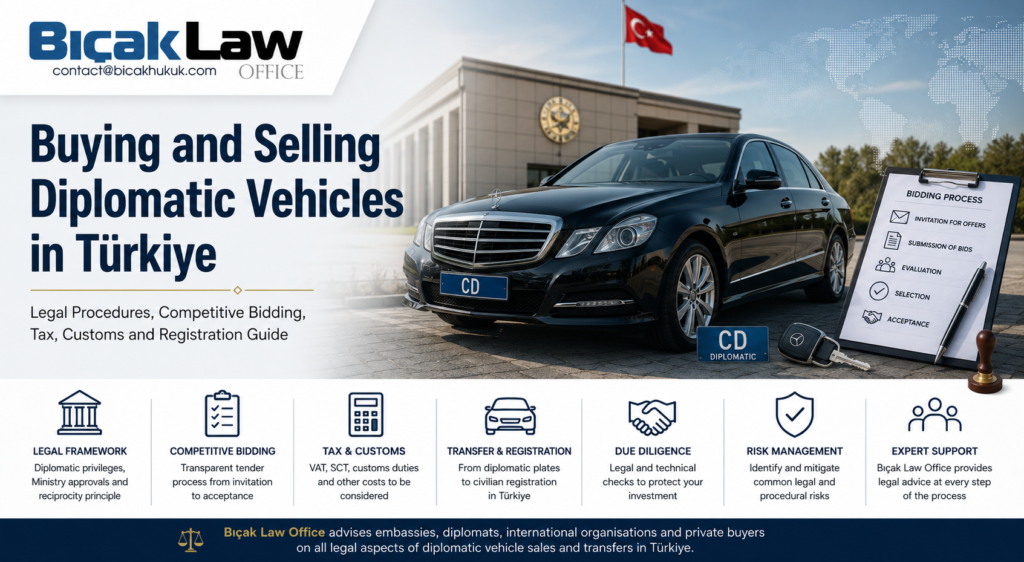
Buying and Selling Diplomatic Vehicles in Türkiye
The purchase or sale of a diplomatic vehicle in Türkiye is fundamentally different from an ordinary second-hand vehicle transaction. Diplomatic vehicles may have been imported free of customs duties or acquired in Türkiye under exemptions from Value Added Tax and Special Consumption Tax. They may also be registered in the name of a foreign mission, an international organisation, a diplomat, or a member of the administrative and technical staff. Consequently, a sale cannot safely be treated as a straightforward agreement between a willing seller and buyer. Before the vehicle can be advertised, sold, delivered or registered in the purchaser’s name, its diplomatic, customs, tax and registration status must be examined.
A properly managed transaction may require prior authorisation from the Turkish Ministry of Foreign Affairs, coordination with the customs administration, payment of applicable taxes and duties, cancellation of diplomatic registration, execution of the relevant transfer documents and completion of ordinary Turkish registration procedures. This guide explains the principal legal and practical issues arising when embassies, consulates, international organisations, diplomatic personnel or prospective purchasers buy, sell or transfer diplomatic vehicles in Türkiye.
What Is a Diplomatic Vehicle?
The expression “diplomatic vehicle” may refer to several legally distinct categories. A vehicle may belong to:
- an embassy or consulate and be used as an official service vehicle;
- an international organisation or its representation in Türkiye;
- a diplomatic or consular officer;
- a member of the administrative and technical staff of a foreign mission; or
- another person enjoying a recognised customs or tax exemption.
The legal position of the vehicle depends not only on its diplomatic registration plate but also on its ownership, the manner in which it entered Türkiye, the exemption under which it was acquired and the status of its owner.
A vehicle imported into Türkiye under a diplomatic exemption document may be subject to different rules from a vehicle purchased from the Turkish domestic market with VAT and Special Consumption Tax exemptions. Likewise, the rules applicable to an official mission vehicle may differ from those governing the privately owned vehicle of a diplomat. Under the Turkish Ministry of Foreign Affairs’ diplomatic guidance, imported diplomatic vehicles may generally be sold to persons who do not benefit from an exemption and transferred to persons who do benefit from an exemption. The applicable procedure, however, depends on the vehicle category, the owner’s status, reciprocity and the required governmental approvals.
Why Diplomatic Vehicle Transactions Require Special Planning
The transaction may involve several public and private institutions, including:
- the Ministry of Foreign Affairs;
- the competent customs administration;
- tax authorities;
- traffic registration authorities;
- notaries;
- insurance companies;
- technical inspection services; and
- banks or authorised payment service providers.
The transaction may therefore fail or be significantly delayed if the seller advertises and accepts an offer before confirming whether the vehicle is legally eligible for sale. A diplomatic seller should establish at an early stage:
- who is recorded as the legal owner;
- whether the vehicle is an official or private vehicle;
- whether it was imported or purchased domestically;
- which tax or customs exemptions were applied;
- whether the vehicle is eligible for sale to an ordinary purchaser;
- whether a minimum period must have elapsed since its acquisition or importation;
- whether the Ministry of Foreign Affairs’ prior permission is required;
- which taxes, duties and registration costs will become payable; andwhen the diplomatic plates and registration documents must be surrendered.
This preliminary legal assessment should be completed before the invitation for offers is issued. Otherwise, a mission may accept a bid for a vehicle that cannot yet be lawfully transferred to the intended purchaser.
Official Vehicles and Privately Owned Diplomatic Vehicles
A distinction must be made between an official service vehicle belonging to a mission and a privately owned vehicle belonging to an individual diplomat or eligible staff member. Foreign missions may import a reasonable number of service vehicles under diplomatic exemption arrangements, subject to the Ministry of Foreign Affairs’ approval and the principle of reciprocity. Diplomatic mission members and eligible administrative and technical personnel may also import private vehicles or acquire certain vehicles domestically under exemption arrangements.
The conditions governing a later sale may vary. For example, the Ministry’s published diplomatic guidance states that permission for the sale of certain private vehicles to persons who do not benefit from an exemption is generally granted after a specified period following importation. A reduced period may apply where the owner is leaving Türkiye permanently, while additional restrictions may apply to a vehicle that was already more than three years old when purchased by its diplomatic owner. Service vehicles are subject to separate time and reciprocity conditions. Accordingly, no general assumption should be made that every diplomatic vehicle can immediately be sold to a Turkish citizen or company.
Preliminary Legal Review Before Advertising the Vehicle
Before inviting prospective buyers to submit offers, the seller should assemble and review the vehicle file. The file will ordinarily include:
- the diplomatic exemption or franchise document;
- the original invoice or purchase document;
- customs import documentation, where applicable;
- the traffic registration certificate;
- the current compulsory insurance policy;
- technical inspection records;
- service and maintenance records;
- the chassis and engine numbers;
- any Ministry of Foreign Affairs correspondence;
- documentation relating to previous transfers or renewals; and
- evidence of the owner’s authority to sell.
The Ministry of Foreign Affairs requires sale permission applications to be submitted through a verbal note accompanied by documents including the relevant import exemption document, a recent insurance policy and a copy of the traffic licence. Sale authorisations are issued for a limited period and may, in certain circumstances, be extended once if an extension is requested before expiry. The seller should also confirm whether the vehicle has passed the mandatory periodic technical inspection. According to the Ministry’s guidance, technical inspection is compulsory, its fee is not covered by diplomatic exemption, and permissions concerning sale, transfer and re-export are issued only for vehicles that have cleared the required inspection.
Preparing an Invitation for Offers
A diplomatic mission does not necessarily have to dispose of a vehicle through a public auction. Depending on its internal rules, the mission may choose to collect written offers through a structured bidding process. A properly drafted invitation for offers should give potential purchasers sufficient information to assess the vehicle while preserving the mission’s discretion and protecting it against avoidable disputes. The notice should generally identify:
- the make and model;
- model year;
- fuel type and engine information;
- mileage;
- colour;
- ownership status;
- chassis or VIN information, where appropriate;
- general condition;
- available service history;
- inspection arrangements;
- deadline for submitting offers;
- permitted submission methods;
- minimum or reserve price, if any;
- responsibility for taxes and registration expenses;
- payment requirements;
- any deposit requirement;
- the seller’s right to reject offers;
- the proposed completion timetable; and
- contact details for enquiries and appointments.
If the vehicle is intended to be sold in its existing condition, the seller may state that it is offered on an “as is, where is” basis. Such wording should not be used as a substitute for truthful disclosure. The seller should not conceal known material defects or provide inaccurate information concerning the vehicle’s history, ownership, tax status or condition.
Legal Nature of the Invitation for Offers
A key legal distinction must be maintained between an invitation to submit an offer and an offer that is itself capable of immediate acceptance. A diplomatic vehicle sale announcement will ordinarily be framed as an invitation for prospective buyers to submit bids. In that structure:
- the announcement invites offers;
- each bidder submits an offer to purchase;
- the seller evaluates the offers; and
- the transaction proceeds only when the seller accepts a selected offer in accordance with the announced conditions.
The publication of a vehicle description and deadline should therefore not automatically bind the mission to sell the vehicle to any person who responds. The bidding conditions should expressly state whether:
- the seller is bound to accept the highest bid;
- the seller may reject any or all offers;
- incomplete or conditional bids will be disregarded;
- the process may be extended, cancelled or repeated;
- bidders may withdraw their offers;
- the winning offer remains subject to governmental permission; and
- final transfer depends on payment of taxes and completion of registration procedures.
Choosing the Bidding Method
Diplomatic missions may adopt different methods for receiving offers. Common methods include:
- sealed envelopes delivered by hand;
- registered postal submissions;
- email submissions to a designated address;
- submissions through an appointed legal adviser;
- a combination of physical and electronic delivery; or
- a professionally managed auction or tender.
The chosen process should be clear, consistent and verifiable. Where sealed envelopes are used, the notice should state how the envelope must be marked and where it must be delivered. The receiving officer should record the date and time of receipt without opening the bid before the deadline. Where offers are accepted by email, access to the designated inbox should be limited. The mission should determine in advance which timestamp will govern, whether late messages caused by technical problems will be excluded and whether bidders will receive confirmation of receipt. An offer submitted by registered post may arrive after the deadline even though it was posted earlier. The bidding conditions should therefore state whether the relevant time is the date of posting or the date of actual receipt.
Information to Be Required from Bidders
The mission should request enough information to identify and contact each prospective buyer. Depending on the transaction, the bidder may be asked to provide:
- full name or registered company name;
- address;
- telephone number;
- email address;
- Turkish identity number, foreign identity number or tax number;
- company registration information;
- offered purchase price;
- currency of the offer;
- offer validity period;
- proposed payment method;
- confirmation that the bidder has reviewed the sale conditions;
- confirmation that taxes and registration costs will be paid as allocated;
- confirmation that the vehicle has been inspected or that inspection has been waived; and
- proof of authority where the offer is signed on behalf of a company.
The mission should avoid collecting information that is not reasonably necessary for the sale and should protect the personal information submitted by unsuccessful bidders.
Deadline and Validity of Offers
The invitation should state a precise closing date and time. Where international participants may be involved, the applicable time zone should also be identified. The notice should clarify:
- whether late offers will automatically be rejected;
- whether an incomplete offer may be corrected;
- whether a bidder may revise an offer before the deadline;
- how long the offer must remain valid;
- whether bids will be opened immediately after closing; and
- when the successful bidder is expected to be notified.
An offer validity period is important because regulatory approvals and tax calculations may take time. If bids expire too quickly, the seller may be unable to complete the required administrative steps before the purchaser is free to withdraw.
Confidentiality and Equal Treatment
A structured bidding process should protect the confidentiality of bids. Before the deadline, the price offered by one bidder should not be disclosed to another bidder. Bidders should receive the same material information about the vehicle and, where practical, equivalent opportunities to inspect it. The mission may appoint a small internal committee to open and assess the offers. It is prudent for at least two authorised representatives to be present when sealed bids are opened. A written record may identify:
- the number of bids received;
- the identity of the bidders;
- the date and time of receipt;
- the offered prices;
- whether each bid complied with the requirements;
- any late, incomplete or conditional offers;
- the evaluation decision; and
- the authority approving the result.
This record may become important if a bidder later alleges that the announced procedure was not followed.
Is the Highest Bidder Always Entitled to Purchase?
Not necessarily. The seller may decide that the highest monetary offer should be accepted, but price need not be the only relevant consideration unless the notice makes it the sole criterion. A lower offer may, for example, be commercially preferable where the bidder:
- offers immediate and verifiable payment;
- accepts all taxes and costs without qualification;
- can complete registration promptly;
- submits a fully compliant bid;
- does not make the offer conditional on financing; or
- provides stronger evidence of its ability to complete the purchase.
By contrast, the highest offer may be rejected where it:
- is submitted after the deadline;
- is conditional or ambiguous;
- excludes taxes that the bidder was required to bear;
- proposes an uncertain instalment arrangement;
- lacks the bidder’s identity or contact information;
- is made without proper company authority;
- conflicts with the published conditions; or
- raises legitimate compliance concerns.
The mission should preserve the right to reject any or all bids unless its own rules require acceptance of the highest compliant offer.
Conditional and Non-Compliant Offers
Bidders sometimes submit a headline price that is subject to deductions, conditions or later negotiations. Examples include:
- an offer subject to a satisfactory mechanical inspection;
- a price stated to be inclusive of unknown taxes;
- an offer dependent on bank financing;
- an offer payable in instalments;
- a price subject to delivery before a particular date;
- an offer requiring the seller to repair defects;
- an offer that shifts all registration responsibilities to the mission; or
- an unsigned or anonymous offer.
The invitation should explain whether conditional bids will be accepted. Where the mission intends to compare bids principally on price, allowing materially different conditions can make a fair comparison impossible.
Vehicle Inspection and Technical Due Diligence
Prospective buyers should normally be given an opportunity to inspect the vehicle before submitting a bid. The inspection arrangements may specify:
- the location of the vehicle;
- available dates and hours;
- the need for a prior appointment;
- whether a test drive will be permitted;
- whether an independent mechanic may attend;
- whether diagnostic equipment may be used;
- which documents may be reviewed; and
- whether the mission accepts responsibility for inspection-related damage.
A buyer should consider examining:
- the engine and transmission;
- steering and suspension;
- braking system;
- tyres;
- electrical and electronic systems;
- air-conditioning;
- four-wheel-drive components, where applicable;
- diagnostic fault codes;
- bodywork and paint;
- evidence of collision repair;
- actual mileage and service history;
- technical inspection status; and
- outstanding recall or maintenance issues.
Photographs and a brief visual examination are not substitutes for an independent technical assessment.
Acceptance of the Successful Bid
Once the evaluation is complete, the selected bidder should receive a written notice of acceptance. The notice should identify:
- the accepted purchase price;
- the vehicle;
- the deadline for payment;
- the permitted payment method;
- any required deposit;
- responsibility for taxes, duties and registration costs;
- the intended signing date;
- required buyer documents;
- conditions relating to governmental approval;
- the proposed delivery date; and
- the consequences of the buyer’s failure to complete.
The acceptance should make clear whether it creates an immediately binding agreement or whether the transaction remains subject to specified conditions precedent. Those conditions may include:
- approval of the Ministry of Foreign Affairs;
- customs clearance;
- determination and payment of applicable taxes;
- cancellation of diplomatic registration;
- execution of a final sale document;
- completion of notarial or registration procedures; and
- receipt of the purchase price through the required payment mechanism.
The seller may also keep the second-highest compliant offer open for a limited period in case the selected bidder fails to complete.
Ministry of Foreign Affairs Sale Permission
Prior permission from the Ministry of Foreign Affairs is a central element in the sale of many diplomatic vehicles. The Ministry’s published guidance states that permission for sale is requested through a verbal note. The application should include the relevant diplomatic exemption documentation, current insurance policy and traffic registration document. The vehicle must satisfy the applicable Ministry conditions. A sale authorisation has limited validity. The timing of the bidding process should therefore be coordinated with the permission period. Obtaining permission too early may cause it to expire before the transaction is ready to close, while commencing the sale too early may create expectations before eligibility has been confirmed. Where the owner is departing Türkiye permanently, the departure date should be stated in the verbal note. Special timing rules may apply, and an authorisation linked to permanent departure may not be extendable.
Sale to a Person Without Diplomatic or Tax-Exempt Status
The sale of a diplomatic vehicle to a Turkish citizen, resident foreign national or ordinary commercial company may cause previously exempt taxes and duties to become payable. The Ministry’s guidance provides that, following sale authorisation, the vehicle is delivered to the customs administration. Delivery to the purchaser follows payment of the taxes and duties required by the relevant legislation and issuance of a final sales document identifying the purchaser. The exact tax consequences should not be assumed from the diplomatic plate alone. They may depend on:
- whether the vehicle was imported or acquired domestically;
- the original exemption documentation;
- the date of import or first acquisition;
- the vehicle’s age at the time of acquisition;
- the category and status of the seller;
- the status of the buyer;
- the period for which the vehicle was held;
- reciprocity;
- bilateral arrangements; and
- the tax rules in force at the time of sale.
Official Turkish diplomatic correspondence has also indicated that where vehicles purchased in the Turkish market under VAT and Special Consumption Tax exemptions are subsequently sold to a person without exemption status, Special Consumption Tax may become payable by reference to the relevant statutory basis and the rate applicable at the time of sale. Before determining its maximum bid, a purchaser should therefore establish the total acquisition cost, including:
- purchase price;
- customs duties;
- Special Consumption Tax;
- VAT, where applicable;
- registration expenses;
- notarial charges;
- compulsory insurance;
- technical inspection;
- licence plates;
- professional fees; and
- immediate repair or maintenance costs.
Transfer to Another Exempt Person
A transfer to another diplomat, mission or person enjoying customs exemption is legally different from a sale to an ordinary purchaser. The Ministry’s guidance states that service vehicles and eligible private diplomatic vehicles may be transferred to persons who enjoy customs exemption, without a general time limitation on the transfer procedure. The mission must apply through a verbal note identifying the vehicle, the parties and the diplomatic registration number, supported by the relevant exemption, insurance and licence documents. The transfer is carried out on the basis of the permit issued by the Ministry of Foreign Affairs. Registration in the name of the new owner is treated as the new import date for the vehicle. A transaction should therefore be classified correctly as either:
- a sale to a non-exempt buyer; or
- a transfer to another exempt person.
Using the wrong procedure may cause customs, tax and registration complications.
Sale Agreement
Even where a competitive bidding process has been conducted, a written sale agreement should ordinarily be prepared. The agreement should address:
- the full legal identity of the seller and purchaser;
- the seller’s authority to dispose of the vehicle;
- vehicle make, model, model year and VIN;
- registration and diplomatic plate details;
- purchase price and currency;
- payment method;
- any deposit;
- allocation of taxes, duties, fees and expenses;
- regulatory approvals;
- customs formalities;
- cancellation of diplomatic registration;
- condition of the vehicle;
- known defects;
- inspection and acceptance;
- representations and warranties;
- date and place of delivery;
- transfer of possession, risk and ownership;
- keys, accessories and documents to be delivered;
- buyer default;
- seller default;
- governing law; and
- dispute resolution.
The agreement should also explain that physical delivery of the vehicle does not by itself complete the legal transfer. Payment, customs, Ministry approval, registration and any mandatory notarial procedures must be coordinated.
Notarial Transfer and Registration
Under Turkish traffic legislation and practice, ordinary transfers of registered motor vehicles are generally completed through notaries using the vehicle registration records. The Ministry of Foreign Affairs has previously notified diplomatic missions that the notarial transfer system also applies to diplomatic and consular personnel in relevant transactions. It has also recognised certain procedural distinctions for transfers between persons holding the same exempt status. The required sequence must be established for the particular transaction. Depending on the vehicle’s status, the process may include:
- Ministry of Foreign Affairs permission;
- customs assessment;
- payment of taxes and duties;
- issuance of the final sales or transfer document;
- cancellation or surrender of diplomatic plates;
- notarial transfer, where applicable;
- compulsory insurance in the purchaser’s name;
- technical inspection;
- ordinary traffic registration; and
- issuance of civilian licence plates.
The buyer should not assume that possession of the vehicle, the keys or a signed private agreement is sufficient to establish registered ownership.
Secure Payment
Payment should be coordinated with completion of the legal transfer. For ordinary second-hand motor vehicle transactions in Türkiye, use of the Secure Payment System became mandatory for relevant cash, bank-transfer and electronic payment transactions from 27 September 2024. Under the system, the seller registers the seller, buyer and vehicle information, while the buyer confirms the transaction and transfers the purchase price to the designated system account before the notarial transfer is completed. Whether and how that system applies to a particular diplomatic sale should be confirmed with the notary and the institutions administering the transaction. Diplomatic and customs formalities may require additional sequencing. Depending on the circumstances, the parties may also consider:
- payment against completion;
- a controlled deposit;
- escrow arrangements;
- bank confirmation of funds;
- simultaneous payment and document release; or
- staged payment linked to regulatory clearance.
Large cash payments, unexplained third-party payments and payments from unrelated foreign accounts should be avoided because they may create evidential, compliance and anti-money-laundering concerns.
Delivery of the Vehicle
Delivery should take place only when the agreed legal and financial conditions have been satisfied. A delivery record should identify:
- the vehicle and VIN;
- date, time and location of delivery;
- mileage at delivery;
- visible condition;
- number of keys;
- documents supplied;
- maintenance records;
- equipment and accessories;
- plates surrendered or retained;
- payment confirmation; and
- signatures of the parties.
The seller should not permit the purchaser to use diplomatic plates after the purchaser has ceased to be entitled to them. The purchaser should arrange valid insurance and registration before driving the vehicle on public roads.
Common Legal and Commercial Risks
Diplomatic vehicle sales may create avoidable disputes where:
- the vehicle is advertised before sale eligibility is confirmed;
- the seller accepts an offer before obtaining the necessary approval;
- taxes are described incorrectly;
- bidders are not told who bears registration costs;
- the highest bid is mistakenly treated as automatically binding;
- conditional offers are compared with unconditional bids;
- known defects are not disclosed;
- the diplomatic plate is not surrendered on time;
- the vehicle is delivered before payment;
- payment is made before the transfer can lawfully be completed;
- customs records do not match the VIN or engine number;
- technical inspection has expired;
- the buyer cannot register the vehicle;
- the seller lacks authority to sign;
- personal information of bidders is improperly disclosed; or
- the parties rely solely on informal correspondence.
A carefully drafted invitation, documented evaluation procedure and coordinated completion process can significantly reduce these risks.
Checklist for Embassies, Consulates and Diplomatic Sellers
Before advertising the vehicle:
- confirm legal ownership;
- classify the vehicle as official or private;
- review the original acquisition and exemption documents;
- check whether it may be sold to a non-exempt person;
- determine the applicable waiting period;
- confirm required Ministry and customs approvals;
- verify technical inspection and insurance;
- calculate potential taxes and duties;
- establish a reserve price;
- decide whether inspection and test drives will be permitted;
- prepare the invitation and bidding conditions; and
- designate authorised personnel to manage the process.
During the bidding process:
- provide equal material information;
- keep offers confidential;
- record receipt dates and times;
- reject or clarify incomplete bids consistently;
- document the opening and evaluation;
- confirm the successful bidder’s identity and authority;
- assess the bidder’s ability to complete; and
- retain an evaluation record.
After selecting the purchaser:
- issue written conditional acceptance;
- obtain final governmental approvals;
- confirm taxes and registration costs;
- prepare the sale agreement;
- coordinate secure payment;
- surrender diplomatic plates;
- complete customs and notarial procedures;
- arrange registration and insurance;
- sign a delivery record; and
- retain a complete transaction file.
Checklist for Prospective Buyers
Before submitting an offer:
- identify the legal owner;
- verify the vehicle’s diplomatic and customs status;
- confirm that the seller is authorised to sell;
- inspect the original documents;
- conduct an independent technical inspection;
- verify the VIN and engine number;
- review service and accident history;
- understand whether the offer will be binding;
- clarify all taxes and duties;
- calculate the full registration cost;
- confirm the payment procedure;
- review the proposed sale agreement; and
- ensure that the vehicle can be registered in the buyer’s name.
A bid should be based on the total cost of acquiring and registering the vehicle, not merely on the amount offered to the diplomatic seller.
Frequently Asked Questions
Can a Turkish citizen purchase a diplomatic vehicle? Potentially yes, provided that the particular vehicle is legally eligible for sale to a person without exemption status and the required Ministry, customs, tax and registration procedures are completed.
Can a Turkish company submit an offer? Generally, a company may submit an offer if the bidding conditions allow corporate bidders. The company must provide its registration information and evidence that the signatory has authority to bind it.
Is the highest bidder automatically entitled to purchase the vehicle? Not unless the seller has expressly undertaken to accept the highest compliant bid. The bidding conditions may reserve the right to reject any or all offers.
Is a diplomatic vehicle sale tax-free? Not necessarily. A vehicle may originally have been acquired free of tax, but its sale to a non-exempt purchaser can trigger customs duties, Special Consumption Tax, VAT or other costs, depending on the transaction.
Who pays the taxes and registration expenses? This should be stated expressly in the bidding conditions and sale agreement. In many transactions, the purchaser bears taxes, duties and ordinary registration costs, but the allocation must be confirmed.
Can a bidder inspect the vehicle? The seller may permit inspection by appointment. A prudent buyer should conduct an independent mechanical and electronic examination before bidding.
Can the mission reject all offers? Yes, where the bidding terms reserve that right and the mission’s internal rules permit it.
Can an embassy sell directly without collecting bids? Potentially yes. Whether a competitive process is required may depend on the mission’s internal financial and administrative rules rather than Turkish vehicle law alone.
Can the vehicle be transferred to another diplomat? Yes, eligible diplomatic vehicles may be transferred to another person enjoying customs exemption, subject to the Ministry of Foreign Affairs procedure.
Is a private written agreement sufficient? No. A private agreement alone does not replace Ministry approval, customs clearance, tax payment, notarial transfer or registration requirements that apply to the transaction.
Can the buyer use the diplomatic plates? A purchaser without diplomatic entitlement should not use diplomatic plates. The plates and diplomatic registration must be dealt with through the competent procedures.
How long does the process take? The duration varies depending on document completeness, Ministry approval, customs assessment, tax payment, notarial availability, technical inspection and registration.
Does the embassy provide a warranty? That depends on the sale terms. Many institutional vehicle sales are made on an “as is” basis, but the seller should still provide accurate information and disclose known material matters.
How Bıçak Law Firm Can Assist
Diplomatic vehicle transactions require coordination between contract law, diplomatic practice, customs, taxation, registration and regulatory procedure. Bıçak Law Firm advises embassies, consulates, international organisations, diplomatic personnel, foreign nationals, companies and private purchasers in relation to diplomatic vehicle sales and transfers in Türkiye. For diplomatic missions and sellers, our services may include:
- reviewing the vehicle’s legal and customs status;
- determining whether and when the vehicle may be sold;
- advising on the Ministry of Foreign Affairs procedure;
- drafting the invitation for offers;
- preparing bidding and inspection conditions;
- assisting with bid opening and evaluation;
- drafting notices of acceptance;
- preparing the vehicle sale agreement;
- advising on taxes, payment and completion;
- liaising with customs, notaries and registration authorities; and
- coordinating delivery and transfer documentation.
For buyers, our services may include:
- reviewing the sale announcement and bidding terms;
- conducting legal due diligence;
- verifying ownership and regulatory eligibility;
- assessing tax and registration exposure;
- reviewing or preparing the purchase offer;
- negotiating the sale agreement;
- advising on secure payment;
- checking transfer documents; and
- representing the purchaser during customs, notarial and registration procedures.
Obtaining legal advice before submitting or accepting a bid can help the parties identify the true cost of the transaction, avoid invalid or incomplete transfers and ensure that the vehicle is lawfully delivered and registered.
Conclusion
The sale of a diplomatic vehicle in Türkiye is not merely a matter of agreeing on a price. The process may involve diplomatic authorisation, customs clearance, taxation, technical inspection, secure payment, notarial transfer and the conversion of diplomatic registration into ordinary civilian registration. For diplomatic sellers, the safest approach is to establish the vehicle’s legal status before advertising it, use clear bidding conditions, preserve confidentiality, document the evaluation and coordinate acceptance with the necessary governmental permissions. For buyers, the principal risks lie in underestimating taxes and registration costs, relying on incomplete documentation and paying before the vehicle is legally capable of being transferred. A carefully structured process protects both sides and enables the transaction to be completed transparently, efficiently and in compliance with Turkish law.
This article provides general information and does not constitute legal or tax advice. The applicable procedure and financial liabilities must be assessed separately for each vehicle, seller and purchaser.


Comments
No comments yet.