 English
 Türkçe
 Français
 Deutsch


Opening a bank account in Türkiye requires foreign individuals and companies to navigate legal, regulatory and practical requirements. Turkish banking legislation and anti-money laundering regulations impose customer identification, beneficial ownership verification and risk assessment obligations on financial institutions. Foreign nationals, foreign-owned Turkish companies, overseas businesses, branches and liaison offices face different documentation and compliance requirements. Recent regulatory amendments introduced in June 2026 have expanded remote identification opportunities for foreign nationals, subject to specific safeguards and restrictions. Banking practices also vary considerably among major institutions, including İş Bankası, QNB, DenizBank, Garanti BBVA, Yapı Kredi, VakıfBank, Ziraat Bankası and Halkbank. Meeting the formal documentation requirements does not guarantee account approval, unrestricted banking services or international payment capabilities. Account refusals, transaction restrictions and termination of banking relationships must be assessed according to their specific legal and contractual grounds. Bıçak Law Firm assists foreign individuals, investors and businesses with banking-related legal requirements, compliance assessments, documentation and disputes in Türkiye.
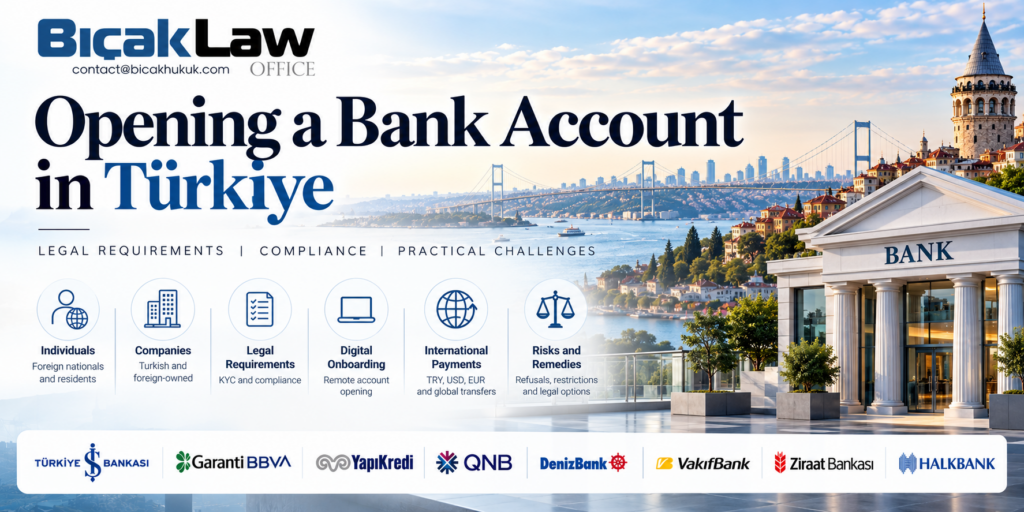
Bank account opening in Türkiye
Opening a bank account in Türkiye is an important step for foreign individuals, international investors and businesses operating in the country. It may be necessary for personal expenditure, property transactions, company operations, investment activities or international payments. However, the process is not simply a matter of presenting a passport, tax identification number or company registration certificate. Banks must comply with customer identification and anti-money laundering obligations, assess the purpose of the proposed relationship and determine whether they can accept the applicant under their applicable policies. A foreign individual may be eligible to apply for an account without being guaranteed approval. Similarly, a Turkish company may be properly incorporated yet encounter difficulties establishing banking arrangements for its operations. Recent regulatory developments, including changes introduced in June 2026, have expanded the possibilities for remotely identifying foreign nationals. These developments are significant but remain subject to specific legal safeguards and practical limitations.
This guide explains the legal framework, required documentation, compliance obligations, remote onboarding procedures, bank-specific practices, account restrictions and possible remedies relevant to opening bank accounts in Türkiye
Part I – Legal Framework and Banking Access
1. Introduction: Why Opening a Bank Account in Türkiye Requires Legal Planning
A Turkish bank account may facilitate salary payments, property-related transactions, commercial receipts, supplier payments and the management of funds in Turkish lira or foreign currencies. The appropriate banking arrangements depend on the applicant’s circumstances. A foreign individual living in Türkiye, a non-resident investor, a Turkish company with foreign shareholders and an overseas company without a Turkish establishment may face substantially different requirements.
An effective application should address three distinct questions: whether the applicant has legal capacity to establish a banking relationship; whether the applicable identification and compliance requirements can be satisfied; and whether the selected institution offers and approves the requested services. These questions should be considered before substantial commercial commitments are made in reliance on anticipated banking access. The distinction is particularly important for foreign investors. Establishing a company, obtaining a Turkish tax number and arranging representation are separate steps from securing a functioning corporate bank account.
2. The Legal Framework Governing Bank Accounts in Türkiye
The principal framework comprises Banking Law No. 5411, Law No. 5549 on the Prevention of Laundering Proceeds of Crime and the Regulation on Measures Regarding Prevention of Laundering Proceeds of Crime and Financing of Terrorism. Banking Law No. 5411 governs the banking sector and the regulatory framework applicable to banks. Law No. 5549 and its implementing legislation impose preventive obligations, including customer identification and suspicious transaction reporting.
The Financial Crimes Investigation Board (MASAK) plays a central role in the anti-money laundering and counter-terrorist financing framework. The Banking Regulation and Supervision Agency (BDDK) regulates banking institutions and relevant aspects of electronic banking and remote customer onboarding. Other legislation may be relevant depending on the applicant and transaction, including the Turkish Commercial Code No. 6102, legislation concerning payment services and applicable measures relating to terrorist financing and proliferation financing. MASAK General Communiqué No. 19 is particularly relevant to remote customer identification, including subsequent amendments concerning legal entities and foreign nationals. MASAK General Communiqué No. 5 and the associated regulatory framework may also be relevant where simplified due diligence measures are legally permitted. These rules should be read together without treating them as interchangeable. Corporate capacity, customer identification, contractual acceptance and international payment execution are separate legal and operational questions.
3. Legal Eligibility, Customer Acceptance and Banking Discretion
Legal eligibility to apply for a bank account does not establish an unconditional right to approval. Banks must identify customers, obtain information concerning the purpose of the relationship and apply other required preventive measures. They also operate customer acceptance and risk-management procedures.
Article 22 of the Regulation on Measures Regarding Prevention of Laundering Proceeds of Crime and Financing of Terrorism provides for refusal to establish a business relationship or execute a requested transaction where the prescribed customer identification requirements cannot be met or sufficient information about the purpose of the relationship cannot be obtained. This mandatory rule should be distinguished from a bank’s broader commercial and risk-based assessment of an application.
A refusal is not necessarily unlawful. Equally, a bank’s reference to compliance considerations does not automatically resolve every question concerning the legality of its decision. The circumstances must be examined by reference to the applicable statutory requirements, contractual framework, evidence and nature of the requested service. A further distinction should be made between a bank declining to establish a new relationship and restricting or terminating an existing account. These decisions may engage different contractual and legal considerations.
Part II – Bank Accounts for Individuals and Companies
4. Opening a Personal Bank Account as a Foreign National
Foreign nationals may apply for personal bank accounts in Türkiye, subject to applicable identification rules and the institution’s acceptance procedures. Depending on the applicant’s status and the identification method used, banks may request a valid passport or another accepted identity document, a foreigner identification number or tax identification number where applicable, contact details and evidence of address. Additional enquiries may concern residence, employment, occupation, anticipated transactions and the source of funds.
A distinction should be drawn between foreign nationals residing in Türkiye and those living abroad. Non-resident applicants may be asked to explain their connection with Türkiye and the intended use of the account. A residence permit is not an invariably applicable prerequisite for every foreign applicant. Conversely, possession of a tax identification number does not establish that all customer due diligence requirements have been satisfied.
The existence of dedicated banking services for foreign customers should also be distinguished from a promise to approve every foreign applicant. For example, QNB publicly describes foreign-customer relationship managers, multilingual banking support and an international branch serving foreign clients. These services demonstrate that the institution serves foreign customers, but they do not remove its identification and customer acceptance requirements. Applicants should confirm the selected bank’s current requirements before arranging translations, notarisation or travel.
5. Opening a Corporate Bank Account for a Turkish Company
Turkish limited liability companies and joint-stock companies commonly require corporate accounts for commercial transactions. The bank must establish the company’s legal identity and verify the authority of the persons acting on its behalf. It may also investigate ownership, beneficial ownership and the expected use of the account.
Relevant documents may include trade registry records, articles of association, tax registration information, evidence of representation authority, identification documents for representatives and supporting information concerning shareholders. Additional documentation may be requested where the company’s activities, ownership structure or anticipated transactions require closer examination.
The legal requirements governing payment of share capital during incorporation should not be confused with the requirements for opening an operational corporate bank account. Applicable capital-payment rules depend on the company type and current company legislation.
A completed company registration does not guarantee that a bank will accept the company as a customer. It is therefore advisable to assess the proposed banking arrangements during the incorporation planning stage, especially where the company will have foreign shareholders or conduct substantial cross-border transactions.
6. Foreign-Owned Turkish Companies and Beneficial Ownership
A company incorporated under Turkish law remains a Turkish legal entity even if its shareholders are foreign individuals or companies. Foreign ownership does not itself prohibit an application for a Turkish corporate bank account. Nevertheless, foreign corporate shareholders and multi-layered ownership structures may require additional verification. The bank may request foreign incorporation documents, shareholder records, an ownership chart and information identifying the natural persons who ultimately own or control the company.
Legal ownership, beneficial ownership and authority to operate the account are distinct concepts. Identifying a company’s registered shareholders or authorised signatories does not necessarily complete the beneficial ownership assessment. Foreign ownership may also affect eligibility for a particular digital onboarding channel. Some banks expressly restrict specified remote corporate applications to companies meeting conditions concerning shareholder nationality, the number of shareholders or the identity of the authorised representative. Such restrictions should not be confused with a general prohibition on foreign-owned Turkish companies opening bank accounts. A transparent and properly documented ownership structure can reduce avoidable questions during the application process.
7. Foreign Companies, Turkish Branches and Liaison Offices
Foreign businesses may operate in Türkiye through several legal structures, each with different consequences for banking. A Turkish subsidiary is a separately incorporated Turkish legal entity, even when wholly foreign-owned. A Turkish branch of a foreign company is connected to the overseas parent rather than constituting a separately incorporated subsidiary. Banking documentation may therefore concern both the parent and the registered branch. A liaison office is established under the applicable foreign investment framework with permission from the Ministry of Industry and Technology. It cannot undertake ordinary commercial activities. Its banking arrangements must remain consistent with its authorised, non-commercial functions.
A foreign company without a Turkish establishment presents a different question. Whether an institution is prepared to accept it directly as a non-resident corporate customer requires bank-specific assessment. These structures should not be treated as equivalent. In particular, a liaison office account should not be used to conduct commercial transactions beyond the office’s permitted activities.
8. Required Documents, Legalisation and Powers of Attorney
Foreign documents may require notarisation, apostille certification, consular legalisation or certified Turkish translation, depending on their origin, nature and intended use. The applicable process should be established before documents are executed or dispatched. An apostille is not a universal substitute for all legalisation requirements.
A power of attorney may enable a legal representative to assist with documentation, correspondence and certain banking formalities. However, a power of attorney does not displace the bank’s obligation to identify the customer and relevant representatives. Nor does it guarantee that personal attendance or additional verification will be unnecessary.
The proposed authority should be tailored to the intended banking tasks and checked against the receiving institution’s requirements. Where a company has several directors, shareholders or representatives, the precise scope of signing authority should be established before the bank application begins.
Part III – Compliance and Risk Assessment
9. Customer Due Diligence and Know Your Customer Requirements
Customer due diligence, often described as Know Your Customer or KYC, is a legal requirement rather than a discretionary administrative formality. Under Law No. 5549 and the implementing measures, banks must identify customers and apply the preventive measures required for an ongoing business relationship. These obligations may include identifying representatives, determining beneficial ownership, understanding the purpose of the relationship and maintaining appropriate ongoing monitoring.
The scope of the assessment depends on the applicable requirements and the risks presented by the customer and transactions. Customer due diligence also continues after an account has been opened. A bank may therefore request updated information or supporting documents during the relationship. A bank’s decision to request further documents should not automatically be treated as an accusation of unlawful conduct. Such enquiries may form part of ordinary compliance procedures.
10. Ultimate Beneficial Ownership, Source of Funds and Business Purpose
Beneficial ownership identification seeks to determine the natural persons who ultimately own or control a legal entity or otherwise qualify as beneficial owners under the applicable rules. The bank may require an explanation of the ownership chain and evidence supporting the information supplied. It may also seek information about the source of funds, anticipated transaction volumes, business activities and the commercial purpose of payments. For example, a Turkish company that receives international customer payments and regularly transfers funds to an affiliated foreign service provider may need to document the underlying contractual and commercial arrangements.
Relevant supporting material may include contracts, invoices, company accounts, business plans and transaction records. The objective is to establish a credible connection between the customer’s declared activities and expected banking transactions. The legal threshold for identifying beneficial owners must be assessed under the applicable rules; an individual bank’s request for information about additional shareholders should not be confused with the statutory definition itself.
11. Enhanced Due Diligence, Sanctions and High-Risk Relationships
Certain customers and transactions may require enhanced scrutiny. Relevant factors can include complex ownership arrangements, politically exposed persons, higher-risk jurisdictions, unusual transaction patterns and other circumstances identified through a risk-based assessment.
International sanctions may also affect the availability of banking services. Türkiye’s domestic legal obligations must be distinguished from sanctions imposed by foreign jurisdictions. US, EU or UK sanctions do not automatically become part of Turkish law merely because they have been adopted abroad. Nevertheless, foreign sanctions can affect transactions involving a relevant jurisdictional connection, restricted parties, correspondent banks or financial institutions applying their own compliance policies. An international transfer may therefore encounter obstacles even where the underlying transaction is not prohibited under Turkish law.
A proper assessment should identify the applicable rules, ownership and control issues, counterparties and payment routes rather than assuming that all sanctions regimes have identical legal effects. Banks may also apply enhanced due diligence to relationships involving certain industries, payment structures or jurisdictions, even where no specific sanctions prohibition has been identified.
12. International Payments and Foreign-Currency Accounts
Turkish banks may offer accounts denominated in Turkish lira and foreign currencies, including US dollars and euros. However, a foreign-currency account does not guarantee unrestricted international payment facilities. Cross-border payments may involve correspondent banks, sanctions screening, transaction documentation, foreign exchange requirements and additional compliance enquiries. Applicants anticipating regular international transfers should explain the expected payment flows during onboarding.
The bank’s acceptance of a customer does not constitute advance approval of every future transfer. Particular payments may still be delayed, rejected or subjected to further checks. Where an international business depends on payments between Türkiye and other jurisdictions, the availability of the relevant payment routes should be considered separately from the initial account-opening decision.
Part IV – Digital Banking and Practical Procedures
13. Remote Account Opening and Electronic Customer Onboarding
Türkiye’s regulatory framework permits specified forms of remote customer identification and electronic contracting. The BDDK regulation on remote identification and electronic contractual relationships entered into force in May 2021. Amendments published in May 2023 expanded the framework for eligible legal entities. A further development occurred on 27 June 2026, when MASAK General Communiqué No. 32 amended General Communiqué No. 19 by introducing Article 4/C. The new provision permits remote identification of foreign nationals using a passport compliant with ICAO Document 9303 and equipped with near-field communication functionality, subject to prescribed safeguards.
The procedure includes verification involving an account or bank or credit card held in the customer’s own name. The relevant identification and verification requirements must be completed in accordance with the applicable rules. Importantly, the provision establishes special restrictions on international transfers involving accounts opened through this method. Incoming transfers from abroad and outgoing transfers abroad are restricted to accounts held in the customer’s own name, subject to the precise regulatory conditions.
The regulation provides for the removal of those restrictions following the additional in-person identification contemplated by the relevant provision. The 2026 amendment also addresses the remote identification of foreign-national representatives of eligible registered legal entities.
Regulatory permission does not mean that every bank offers this service to every foreign applicant. The institution must operate an appropriate onboarding channel and independently complete its customer acceptance assessment. Published bank procedures illustrate this distinction. The published arrangements demonstrate that remote onboarding is available for selected customer categories. They do not establish universal eligibility for foreign nationals, foreign-owned companies or overseas legal entities.
14. Practical Bank Account Opening Process
A properly prepared application usually involves several stages.
Preliminary assessment. The applicant should identify the purpose of the account, required currencies, expected transaction volumes and anticipated international payments.
Selection of an institution. The applicant should identify a bank serving the relevant customer category and offering the required services. A bank’s published digital onboarding channel may not be suitable for the proposed ownership or representation structure.
Document preparation. Identity documents, corporate records, representation authorisations and supporting materials should be assembled, with legalisation or translation where necessary.
Customer due diligence. The bank reviews the applicant’s identity, beneficial ownership, business purpose and risk profile.
Additional enquiries. Further information may be requested about ownership, activities, funds, counterparties or anticipated international transfers.
Customer acceptance and contracting. If the application is approved, the relevant agreements and authorisations are completed.
Account activation and ongoing monitoring. The account becomes available in accordance with the bank’s procedures and any applicable restrictions. Further compliance checks may occur during the relationship.
Processing times vary. No general timetable should be presented as a guaranteed legal or operational standard.
15. Bank-Specific Requirements and Common Documentation Problems
Official information published by major Turkish banks demonstrates that customer onboarding procedures vary considerably. The different examples illustrate differences in specific onboarding channels and customer categories, not a general legal prohibition against foreign-owned companies or non-resident applicants opening accounts.
Common practical difficulties include inconsistent company records, incomplete representation documents, unclear beneficial ownership, missing translations, unverified addresses and insufficient explanations of international payment arrangements.
A bank’s published product conditions may also be narrower than the possibilities permitted by legislation. Because institutional policies and digital eligibility criteria change, applicants should obtain current confirmation directly from the selected institution before relying on any particular procedure.
Part V – Refusal, Restrictions and Legal Remedies
16. Why Banks May Refuse to Open an Account
A bank may decline an application for different reasons, which should not be legally conflated. Under Article 22 of the MASAK Measures Regulation, an obliged institution must not establish a business relationship or execute a requested transaction where the applicable customer identification requirements cannot be fulfilled or sufficient information concerning the purpose of the relationship cannot be obtained. The same provision addresses the termination of an existing relationship in circumstances involving unresolved doubts about customer identification information. These are mandatory compliance consequences.
Other refusals may arise from customer acceptance policies, the nature of the requested services or the institution’s assessment of applicable risks. A bank’s published conditions for a particular digital product may also make an applicant ineligible for that channel without necessarily preventing an application through another channel. The legal evaluation of a refusal depends on its basis, the parties’ circumstances and the applicable rules. There is no general justification for assuming either that every refusal is unlawful or that every refusal is immune from review.
17. Account Restrictions, Transaction Delays and Termination
An existing account may be affected by transaction-specific compliance enquiries, contractual limitations, legally imposed restrictions or termination of the banking relationship.
These situations must be distinguished. A delayed international payment is not necessarily equivalent to a frozen account. A contractual termination is different from a judicial attachment or another legally imposed restriction. A bank may also request additional information after onboarding where a transaction differs materially from the customer’s expected activity. The appropriate response depends on identifying the actual measure, the authority or contractual provision relied upon and the relevant evidence. Customers should retain banking agreements, transaction records, correspondence and supporting documentation.
18. Legal Remedies and Dispute Resolution
Where an application is refused or an existing account is restricted, a written enquiry to the bank may help establish whether the issue concerns missing documentation, a compliance assessment, contractual conditions or another legal basis. Eligible individuals may have access to the Turkish Banks Association’s Individual Customer Arbitration Committee for qualifying individual banking disputes. However, the Committee does not accept applications from legal entities or disputes arising from commercial or other non-individual activities, even where the applicant is a natural person.The applicable procedural conditions must also be satisfied, including an initial written application to the bank.
Supervisory complaints and judicial proceedings may be relevant in appropriate circumstances, but neither provides an automatic entitlement to account approval. For corporate disputes, the appropriate legal route depends on the underlying rights, contractual framework, parties and nature of the claim. No conclusion about litigation prospects should be reached without examining the relevant documents and facts.
19. Fraud Risks and Unauthorised Account-Opening Intermediaries
Foreign applicants may encounter intermediaries offering guaranteed bank accounts or claiming that funds will be released after payment of an activation charge, compulsory insurance premium or purported regulatory fee. Such claims require independent verification.
Applicants should confirm the identity and authority of the institution, the contractual basis of any fee and the legitimacy of the proposed payment recipient. Particular caution is warranted where an intermediary requests substantial transfers to an unrelated individual or company, claims that payment will guarantee bank approval or refuses to provide verifiable documentation.
An unusual fee is not, by itself, proof of fraud. However, it should not be accepted as an authentic bank or government charge without reliable supporting evidence. Suspected misconduct may require preservation of documents and communications, investigation of payment routes and consideration of appropriate civil, regulatory or criminal remedies.
Part VI – Legal Assistance and Conclusions
20. How Bıçak Law Firm Assists Foreign Individuals and Companies
Bıçak Law Firm advises foreign individuals, investors and companies on legal matters associated with banking access in Türkiye. Our assistance may include preliminary legal assessments, review of corporate and ownership structures, preparation and examination of supporting documents, consideration of representation arrangements and coordination with banking institutions. We also advise on relevant compliance questions involving beneficial ownership, customer due diligence, international transactions and account-related disputes.
For international businesses, banking arrangements may need to be assessed alongside company formation, commercial contracts, tax structuring and ongoing regulatory obligations. Our role is to identify applicable legal requirements, assist with an appropriately documented application and address legal difficulties arising during the process.
We cannot guarantee that a bank will approve an account, provide a particular service or execute a proposed international payment. These decisions remain subject to applicable law and the institution’s independent procedures. Dedicated bank account opening assistance is separately scoped and should not be assumed to be included in standard company incorporation services.
21. Frequently Asked Questions
Can a foreign national open a bank account in Türkiye? Foreign nationals may apply, subject to applicable identification requirements and the bank’s customer acceptance procedures. Approval is not automatic.
Is a Turkish residence permit always required? Not necessarily. Requirements depend on the applicant’s circumstances, the applicable identification method and the selected bank.
Is a Turkish tax identification number sufficient? No. A tax identification number does not replace customer identification, beneficial ownership enquiries where relevant or other required compliance checks.
Can a foreign national open an account remotely? The June 2026 MASAK amendment permits qualifying passport-based remote identification, subject to specific safeguards and restrictions. Availability depends on the bank’s onboarding arrangements and the applicant’s eligibility.
Do all Turkish banks offer remote onboarding to foreign nationals? No such general conclusion can be drawn. Banks offer different onboarding channels, and their published standard procedures may not include foreign passport holders.
Can a foreign-owned Turkish company open a corporate account? It may apply. The bank can require information about foreign shareholders, ultimate beneficial owners, representatives and intended transactions.
Does exclusion from a bank’s digital onboarding channel mean the company cannot open an account at that bank? Not necessarily. Digital eligibility criteria may be narrower than the institution’s broader customer acceptance arrangements. The availability of another application channel should be confirmed directly.
Can an overseas company open an account without a Turkish subsidiary? This requires individual assessment. The bank may distinguish between a registered Turkish branch and a foreign company without a Turkish establishment.
Can a lawyer open an account under a power of attorney? A representative may assist with permitted formalities, but a power of attorney does not override mandatory identification requirements or the bank’s procedures.
How long does the process take? There is no universal processing period. Timing depends on the applicant’s circumstances, documentation and the bank’s review.
Does a USD or EUR account guarantee international transfers? No. International payments remain subject to the relevant banking facilities and transaction-specific checks.
Can a bank refuse an application? Yes, including where mandatory customer identification or due diligence requirements cannot be met. The legality of other refusals depends on their circumstances and legal basis.
Can a corporate applicant use the Turkish Banks Association’s Individual Customer Arbitration Committee? No. That mechanism is intended for qualifying individual banking disputes and does not accept applications from legal entities.
22. Conclusion: A Legally Informed Approach to Banking Access in Türkiye
Opening a bank account in Türkiye requires careful coordination of legal capacity, documentation, customer identification and banking compliance. Foreign individuals must consider their residence status, available identification methods and intended use of the account. Companies must additionally address their legal structure, representation, ownership and commercial activities. The 2026 expansion of passport-based remote identification provides new possibilities for foreign nationals, but it does not eliminate compliance obligations or guarantee unrestricted banking services.
Official information from major Turkish banks also confirms that the availability of digital onboarding depends on the particular institution, applicant category and product. A bank may serve foreign customers while restricting a specific remote application channel to narrower categories.
A well-prepared application should explain who the customer is, why the account is required, how it will be used and whether the relevant documents and proposed transactions are consistent with the applicable rules.
Where difficulties arise, the legal basis of the bank’s decision should be identified before considering remedies. For foreign investors and international businesses, appropriately scoped legal assistance can help reduce avoidable delays and address the legal complexities associated with banking access in Türkiye.
…
This article provides general information concerning Turkish law and banking practice as at 26 October 2026. It does not constitute legal advice for a particular applicant or transaction. Regulatory requirements and bank-specific procedures should be confirmed at the time of application.







Comments
No comments yet.