 English
 Türkçe
 Français
 Deutsch

Turkey’s 2026 Wealth Amnesty introduces a significant new legal framework for the declaration and repatriation of offshore and unrecorded domestic financial assets. The new regime extends the declaration period until 31 July 2027 and introduces a graduated tax structure that may reduce the applicable tax rate to zero depending on long-term holding commitments. The legislation also expands the scope of eligible instruments by including venture capital investment funds, thereby aligning tax incentives with Türkiye’s broader investment and innovation strategy. Alongside asset declaration opportunities, the reform is complemented by a 20-year foreign-source income tax exemption for qualifying new tax residents, strengthening Türkiye’s position as an attractive destination for globally mobile capital. The framework offers important opportunities for high-net-worth individuals, international investors, entrepreneurs, and multinational businesses seeking lawful asset regularization and strategic wealth restructuring. However, the regime does not eliminate obligations under Turkish anti-money laundering rules, MASAK compliance requirements, customs regulations, or international tax transparency frameworks such as CRS and FATCA. Successful use of the new system therefore requires careful legal planning, technical compliance analysis, and a precise understanding of cross-border reporting obligations. Bıçak Law Firm provides sophisticated legal counsel on Turkey’s Wealth Amnesty regime, including asset declaration structuring, MASAK compliance analysis, international tax coordination, and confidential strategic advisory services for domestic and international clients
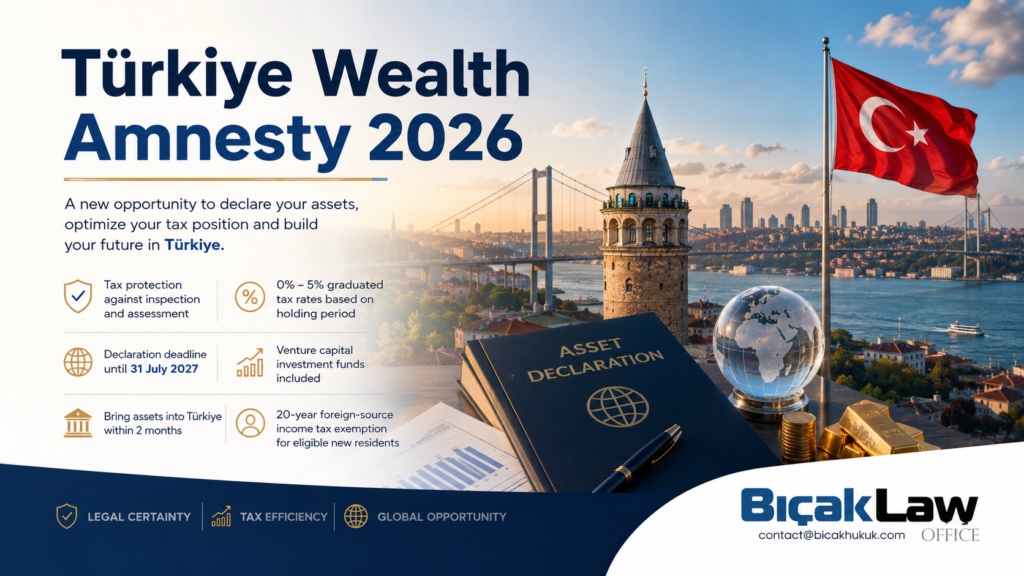
Türkiye Wealth Amnesty 2026
Turkey has once again introduced a comprehensive Asset Peace (Varlık Barışı) regime through a major legislative reform adopted by the Turkish Grand National Assembly on 21 May 2026 and entered into force upon its publication in the Official Gazette on 4 June 2026. The new framework significantly extends the declaration window for offshore and unrecorded domestic financial assets until 31 July 2027, introduces a sophisticated graduated tax structure capable of reducing taxation to 0%, and forms part of a broader package of tax and investment incentives designed to strengthen Türkiye’s position as a regional financial and investment hub..
The Wealth Amnesty Law is Now in Force
On 4 June 2026, following presidential approval, the Law on Amendments to Certain Laws was published in the Official Gazette and entered into force. The legislation includes the new Asset Peace regime, a 20-year income tax exemption for qualifying new tax residents on foreign-source income, extended incentives for the Istanbul Finance Center, and a range of measures aimed at encouraging capital inflows and long-term investment in Türkiye. The publication of the law eliminates the uncertainty that previously existed during the legislative process and allows taxpayers, investors, financial institutions, and advisors to begin implementing the new framework.
This legislative development is not merely another tax amnesty. It represents a strategic recalibration of Türkiye’s investment ecosystem, combining:
- capital repatriation incentives,
- long-term wealth retention mechanisms,
- enhanced financial center incentives,
- foreign-source income exemptions for new residents,
- tax reductions for key sectors, and
- incentives designed to attract globally mobile wealth.
For international investors, offshore asset holders, family offices, entrepreneurs, multinational corporate groups, and high-net-worth individuals considering tax-efficient relocation, the 2026 Turkish Wealth Amnesty offers substantial opportunities. At the same time, careful legal structuring remains essential due to the continuing application of anti-money laundering, customs, foreign exchange, and international tax transparency obligations.
Understanding Turkey’s Asset Peace Regime
The Turkish Wealth Amnesty is a statutory legal mechanism allowing real persons and legal entities to voluntarily declare previously undisclosed financial assets and integrate them into the Turkish financial system under a protected fiscal framework. Where statutory requirements are fulfilled, the regime offers:
- immunity from tax inspection in relation to declared assets,
- immunity from tax assessment,
- reduced or zero-rate taxation,
- accounting regularization,
- legal balance sheet restructuring,
- enhanced financial transparency.
The Turkish model differs from traditional amnesty frameworks used in many jurisdictions. Rather than functioning as a punitive disclosure mechanism requiring substantial penalties, Türkiye’s approach is designed as a proactive capital attraction instrument. This reflects a recurring legislative pattern. Since 2008, successive Turkish governments have implemented multiple Asset Peace regimes as part of broader fiscal policy. The 2026 version represents the most technically sophisticated iteration to date.
The 2026 Legislative Reform: What Changed?
Extended Declaration Period
Eligible assets may be declared until: 31 July 2027. The President retains authority to extend this deadline by up to one additional year through six-month extensions. This unusually long declaration window creates significant strategic planning flexibility for cross-border asset restructuring.
Graduated Tax Structure (0%–5%)
The most innovative element of the reform is its retention-based tax model. The applicable tax depends on how long declared assets remain within qualifying Turkish financial instruments.
|
Commitment Period |
Tax Rate |
| At least 5 years | 0% |
| At least 4 years | 1% |
| At least 3 years | 2% |
| At least 2 years | 3% |
| At least 1 year | 4% |
| No commitment | 5% |
Declarations made between 1 January 2027 and 31 July 2027 incur an additional 0.5% increase. This structure effectively rewards long-term capital commitment to Türkiye.Venture Capital
Investment Funds Included
For the first time, declared assets may benefit from favorable treatment when invested in venture capital investment funds. This is strategically important for:
- technology entrepreneurs,
- startup founders,
- digital investors,
- venture capital participants,
- innovation-focused family offices.
The reform directly aligns Asset Peace with Türkiye’s broader innovation ecosystem strategy.
Two-Month Transfer Requirement
Declared offshore assets must be transferred into Turkish bank or intermediary institution accounts within:
- Two months: Physical transportation remains possible but requires customs documentation. Failure to comply results in loss of statutory protection.
- The Parallel 20-Year Foreign Income Tax Exemption: The 2026 tax package introduced another transformative incentive. Individuals becoming Turkish tax residents from 1 January 2026 onward may benefit from:
- 20 years of Turkish income tax exemption on foreign-source income
Eligibility generally requires:
- no Turkish domicile during the preceding three calendar years;
- no Turkish tax liability during that period.
This creates one of the most generous internationally competitive tax residence regimes currently available.
Why This Matters for High-Net-Worth Individuals
For internationally mobile wealth holders, the combined effect of:
- Wealth Amnesty,
- foreign-source income exemption,
- Istanbul Finance Center incentives,
- venture capital incentives
creates a uniquely powerful tax planning environment. Potential use cases include:
- Wealth Re-Domiciliation: International families seeking tax-efficient wealth relocation.
- Family Office Restructuring: Consolidation of global financial assets within a favorable legal environment.
- Entrepreneurial Exit Planning: Post-liquidity-event wealth repositioning.
- Digital Nomad Structuring: Optimization of location-independent income streams.
- Portfolio Reorganization: Transitioning offshore holdings into regulated Turkish structures.
Unlike previous proposals and draft discussions, the Asset Peace framework is now fully effective law. Individuals and companies may immediately begin planning declarations, transfers, and compliance procedures under the statutory framework published in the Official Gazette. The declaration period remains open until 31 July 2027, subject to any future extensions that may be granted by the President under the law.
Why the Official Gazette Publication Matters
The publication of the law in the Official Gazette transforms the Asset Peace regime from a legislative proposal into an enforceable legal mechanism. This development provides:
- legal certainty for offshore asset holders,
- greater predictability for banks and intermediary institutions,
- a defined compliance framework for tax advisors and legal counsel,
- a practical implementation timeline for international investors,
- increased confidence for individuals considering relocation to Türkiye.
For many international investors, the publication date represents the appropriate moment to begin evaluating asset declaration strategies and cross-border wealth restructuring opportunities.
Comparative Jurisdiction Benchmarking
Türkiye’s 2026 regime invites comparison with other international wealth-attraction frameworks.
Portugal (Former NHR Model)
Portugal’s historical Non-Habitual Resident regime offered tax advantages but involved increasingly complex qualification rules and significant political uncertainty. Türkiye offers greater procedural simplicity.
Italy Flat Tax Regime
Italy imposes a fixed annual substitute tax for qualifying foreign-source income. Türkiye’s model can produce materially lower effective taxation where conditions are satisfied.
Spain Beckham Law
Primarily employment-income focused. Less suited for passive offshore asset restructuring.
United Arab Emirates
Offers zero personal income tax but often requires substantial practical business substance. Türkiye offers a more integrated banking, financial, and corporate ecosystem for regional operations.
Greece
Provide attractive tax migration incentives but typically involve narrower scope or more formal residency requirements. Türkiye’s 20-year duration is unusually expansive.
MASAK and Anti-Money Laundering Considerations
This is the most legally sensitive aspect of the 2026 framework. The Asset Peace regime provides:
Tax Protection: It protects against:
- tax inspection,
- tax assessment.
It does not provide immunity from:
- MASAK scrutiny,
- suspicious transaction reporting,
- customs investigations,
- anti-smuggling controls,
- criminal law enforcement,
- international AML cooperation.
This distinction is critical.
MASAK Reporting Obligations Remain Fully Applicable
Banks and intermediary institutions remain obligated under Turkish anti-money laundering legislation to apply:
- customer due diligence,
- beneficial ownership checks,
- source-of-funds review,
- suspicious transaction monitoring.
Accordingly, declaration under Asset Peace does not eliminate AML compliance obligations.
FATF Context
Türkiye’s removal from the FATF grey list in June 2024 heightened international expectations regarding AML enforcement consistency. As a result, Turkish financial institutions are expected to maintain rigorous compliance scrutiny. This makes legal pre-assessment essential.
Interaction with CRS, FATCA and Foreign Reporting Rules
International clients must also evaluate:
- CRS Reporting: Automatic exchange of financial account information.
- FATCA: US taxpayers remain subject to worldwide taxation.
- EU Reporting Rules: DAC6, AMLD obligations and national disclosure requirements.
The Turkish Wealth Amnesty does not override foreign tax disclosure obligations.
Risks of Improper Structuring
Protection may be lost where:
- transfer deadlines are missed,
- tax is unpaid,
- retention commitments are breached,
- documentation is defective,
- declarations are incomplete.
Potential consequences include:
- retroactive tax exposure,
- default interest,
- administrative scrutiny,
- regulatory complications.
Strategic Planning for International Relocation
The 2026 framework is particularly attractive for individuals considering relocation to Türkiye. An integrated relocation strategy may combine:
- Step 1: Tax residence migration analysis
- Step 2: Asset declaration structuring
- Step 3: Wealth repatriation
- Step 4: Banking and investment positioning
- Step 5: Long-term compliance optimization
This requires coordinated tax, immigration, banking, and regulatory planning.
Frequently Asked Questions
- Is Turkey’s Wealth Amnesty legal? Yes. It is established by formal legislation adopted by the Turkish Parliament.
- Does the regime eliminate AML scrutiny? No. MASAK obligations remain fully applicable.
- Can foreign nationals benefit? Yes, depending on asset ownership structure and compliance positioning.
- Can cryptocurrency be included? Potentially, provided declaration and transfer structures satisfy regulatory requirements. Specific legal assessment is required.
- Do I need to become a Turkish resident? No. Asset declaration may be available independently of tax residency. However, residency can unlock additional benefits.
- Does the regime require proof of source of funds? Tax legislation itself does not impose comprehensive source substantiation requirements. However, financial institutions may require documentation under AML obligations.
- What happens if deadlines are missed? The statutory protection may be lost.
Why This Reform Matters Internationally
The 2026 package signals Türkiye’s deliberate effort to compete with established international capital attraction jurisdictions. The combination of:
- capital repatriation flexibility,
- zero-rate possibilities,
- long-term tax exemptions,
- financial center incentives
places Türkiye in direct strategic competition with major relocation and tax optimization jurisdictions.
How Bıçak Law Firm Assists
The legal opportunities created by the 2026 regime are substantial. So are the technical risks. Bıçak Law Firm advises domestic and international clients on:
- Asset Peace Structuring: Eligibility analysis and declaration strategy.
- MASAK / AML Risk Assessment: Pre-declaration compliance review.
- International Tax Coordination: Cross-border tax exposure assessment.
- HNWI Relocation Planning: Integrated Turkish residency and wealth structuring.
- Corporate Financial Regularization: Balance sheet restructuring.
- Confidential Legal Representation: End-to-end implementation support.
Our team provides discreet, sophisticated, and strategically tailored legal guidance for high-value cross-border asset regularization matters.
Conclusion
Following its publication in the Official Gazette on 4 June 2026, Türkiye’s new Wealth Amnesty regime is now fully in force. The legislation introduces one of the most significant asset declaration and wealth regularization frameworks adopted in recent years and reflects Türkiye’s continuing effort to attract international capital, encourage long-term investment, and strengthen its position as a regional financial center. For investors, entrepreneurs, family offices, and internationally mobile wealth holders, the regime presents rare planning opportunities. However, successful implementation requires precise legal analysis, AML-sensitive structuring, and careful cross-border compliance coordination. Bicak stands ready to assist clients in navigating these opportunities with the highest level of legal sophistication and confidentiality.



Comments
No comments yet.