 English
 Türkçe
 Français
 Deutsch

Gambia Day 2026, hosted by the Embassy of the Republic of The Gambia in Ankara on 18 September 2026, highlighted the country’s tourism, trade and investment potential. The event reflected the expanding relationship between Türkiye and The Gambia, which now extends well beyond traditional diplomatic cooperation. Bilateral engagement encompasses trade, infrastructure, ports and logistics, energy, tourism, defence and security, education and development. Turkish companies are increasingly involved not only in merchandise trade but also in long-term projects and strategic infrastructure in The Gambia. The country’s participation in ECOWAS and the African Continental Free Trade Area also adds a regional dimension to its investment proposition, subject to applicable trade and customs rules. These opportunities raise important legal considerations concerning investment structuring, contracts, regulatory compliance, project development and dispute resolution. Bıçak Law Firm provides legal counsel to the Embassy of the Republic of The Gambia in Ankara and supports African businesses and institutions engaging with Türkiye. Through its Africa Country Desk, the Firm also assists Turkish businesses with cross-border matters involving African jurisdictions, coordinating with appropriately qualified local counsel where domestic African law advice is required.
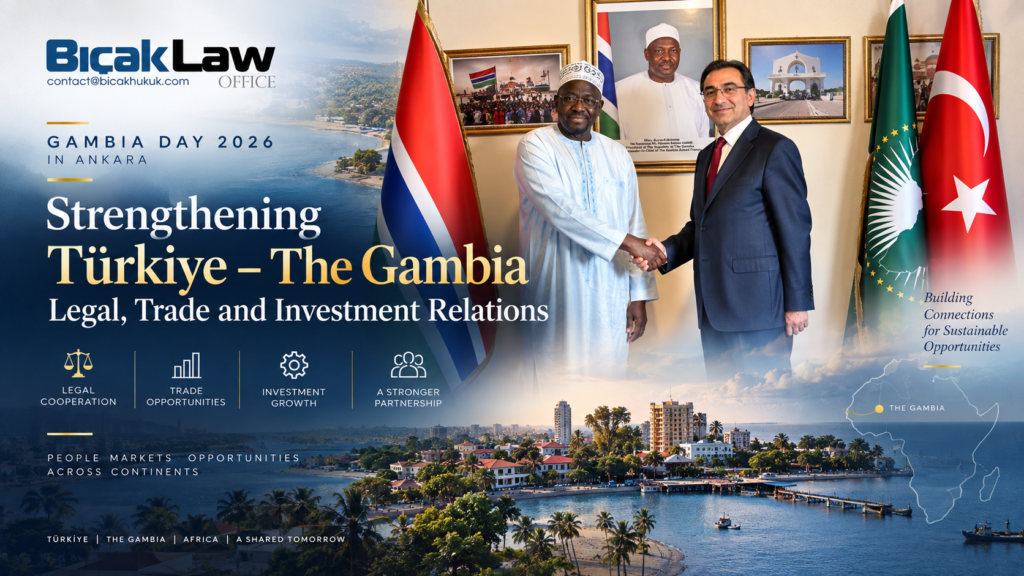
Türkiye – Gambia Legal, Trade and Investment
On 18 September 2026, the Embassy of the Republic of The Gambia in Ankara hosted Gambia Day 2026, bringing together representatives of the diplomatic community, public institutions and the business and investment sectors. Held under the theme “The Gambia as a Tourism and Investment Promotion Destination,” the event presented the country not only as the “Smiling Coast of Africa,” but also as a destination for trade, investment and wider economic cooperation. Bıçak Law Firm participated in the event as part of its continuing engagement with African diplomatic missions and Türkiye-Africa legal and commercial relations.
Gambia Day 2026 reflected the broader development of relations between Türkiye and The Gambia. What began as a diplomatic relationship has expanded into cooperation encompassing trade, infrastructure, energy, tourism, security, education and development. The event therefore provides a timely perspective from which to examine the commercial opportunities emerging between the two countries and the legal considerations accompanying them.
Gambia Day 2026: Tourism Promotion Meets Investment Diplomacy
Tourism was placed within a broader investment narrative at Gambia Day 2026. While The Gambia is internationally recognised for its Atlantic coastline, cultural heritage, biodiversity and established tourism sector, the Ankara event presented a wider proposition: a country seeking international investment, strategic infrastructure and stronger commercial partnerships.
This positioning was reflected in an audience drawn from diplomatic, governmental and business circles. The programme highlighted opportunities connected with tourism, infrastructure, energy, transport and regional trade. Bıçak Law Firm’s event report similarly records that the event was intended to promote The Gambia not only as a tourism destination but also as an investment hub. The involvement of Turkish business was also visible. Albayrak Group, through Alport Banjul, supported the event as a sponsor, illustrating the connection between investment promotion and existing Turkish commercial engagement in The Gambia.
Ankara as a Platform for The Gambia’s Tourism and Economic Diplomacy
Gambia Day followed another Gambian engagement in Ankara. On 16–17 September 2026, The Gambia participated in the 27th Meeting of the COMCEC Tourism Working Group, focused on the impacts of climate change and mitigation strategies for sustainable tourism across OIC member countries. Represented by the Gambia Tourism Board and Ministry of Tourism, Arts and Culture, the country participated in discussions on climate resilience, sustainability and tourism policy.
The timing is noteworthy. The COMCEC meeting concluded on 17 September and Gambia Day took place the following day. Although the two events were distinct, together they illustrate complementary dimensions of Gambian engagement in Türkiye: participation in multilateral tourism-policy discussions alongside direct tourism and investment promotion to diplomatic, institutional and business audiences.
Türkiye and The Gambia: From Diplomatic Relations to a Multidimensional Partnership
Türkiye and The Gambia established diplomatic relations when The Gambia gained independence in 1965. Cooperation developed particularly through the military field and international organisations before becoming substantially broader following the establishment of resident embassies. Türkiye’s Embassy in Banjul began operating in 2011. High-level visits subsequently reinforced bilateral ties. Gambian President Adama Barrow paid an official visit to Türkiye in February 2018, while President Recep Tayyip Erdoğan visited The Gambia on 27 January 2020—the first presidential visit from Türkiye to the country. Today, bilateral cooperation extends across defence and security, development, education, tourism and economic relations. This institutional foundation provides the wider context within which trade and investment ties are developing.
Türkiye – The Gambia Trade: An Economic Relationship with Room to Grow
Merchandise trade remains relatively modest compared with the breadth of diplomatic relations but involves an increasingly diverse range of products. According to the Republic of Türkiye Ministry of Trade’s 2026 Country Profile for The Gambia, Türkiye exported approximately USD 61.2 million in goods to The Gambia in 2025, while imports amounted to approximately USD 10.5 million. Cement was Türkiye’s largest individual export item, followed by products including pasta and couscous, eggs, petroleum products, vegetable oils, reinforcing steel, furniture, flour and machinery. Türkiye’s imports from The Gambia were more concentrated, principally involving animal-feed products, oilseeds and fish oils. These figures also show that the relationship should not be assessed through merchandise trade alone. Turkish participation in major projects adds an important investment dimension.
Beyond Trade: Turkish Investment in Ports, Energy and Infrastructure
Ports provide one of the clearest examples of longer-term Turkish commercial involvement. Albayrak Group has become involved in Gambian maritime infrastructure through port operations and the development of the Sanyang Deep Sea Port, alongside its activities connected with Banjul Port. Energy represents another area of Turkish corporate involvement. Gambia Day discussions identified ports, energy and transport among the principal areas in which Turkish companies are active. Such projects differ fundamentally from ordinary merchandise trade. Infrastructure and energy investments can involve concessions, public-sector relationships, financing, land rights, construction and operating contracts, regulatory approvals, taxation and long-term allocation of commercial and legal risk.
The Gambia as a Gateway to West African and Continental Markets
The Gambia’s domestic market is relatively small, but its membership in the Economic Community of West African States (ECOWAS) and participation in the African Continental Free Trade Area (AfCFTA) place it within wider regional and continental integration frameworks. This potential was also emphasised during Gambia Day. For investors, however, regional membership should not be treated as equivalent to automatic duty-free access throughout Africa. Preferential treatment may depend on rules of origin, product classification, customs procedures, implementation schedules and the applicable trade regime. Businesses considering The Gambia as part of a regional strategy should therefore examine market-access assumptions against their specific products and supply chains.
Investment Environment and Priority Sectors in The Gambia
The country’s investment priorities overlap with sectors in which Turkish companies possess significant international experience, including infrastructure and construction, ports and logistics, energy, tourism, agriculture and fisheries, manufacturing and services. Several of these areas were specifically highlighted during Gambia Day. The Gambia’s import profile provides additional context. Petroleum products, motor vehicles, rice, cement, wheat and fertilisers were among its major imports in 2024. Some of these categories overlap with Türkiye’s existing export profile. Investment opportunities nevertheless need to be assessed alongside applicable licensing, land, environmental, taxation, customs, employment and incentive requirements. Commercial potential and legal feasibility are related, but they are not the same question.
Tourism, Sustainability and New Areas of Cooperation
Tourism remains central to The Gambia’s international economic profile. Beyond its coastal offering, the country possesses cultural heritage, biodiversity and river-based and nature-oriented tourism potential. Gambia Day also highlighted Kunta Kinteh Island and related cultural heritage as part of this tourism proposition. The COMCEC discussions held immediately before Gambia Day add another dimension: climate resilience. The meeting examined how tourism-dependent economies can respond to climate-related pressures while pursuing sustainable sector development. For investors, this can translate into opportunities and regulatory considerations involving hospitality, transport, renewable energy, environmental requirements, tourism infrastructure and related services.
Defence, Security, Education and Development: The Wider Bilateral Relationship
Economic relations sit within a broader institutional partnership. Türkiye’s Ministry of Foreign Affairs traces bilateral military training and logistical cooperation to the 1990s. TİKA opened its Programme Coordination Office in Banjul in 2018, while scholarships have been provided to Gambian students since 1992. The Turkish Maarif Foundation has also operated a school in Banjul since 2017. The continuing importance of defence and security cooperation was emphasised again in September 2026 by Türkiye’s outgoing Ambassador to The Gambia, Fahri Türker Oba, who referred to military training and wider institutional cooperation when reviewing bilateral relations. These longstanding connections provide an institutional backdrop to the more recent expansion of business and investment ties.
Legal Considerations for Turkish Companies Investing in The Gambia
Turkish businesses considering projects or long-term operations in The Gambia should assess the legal framework early in the investment process. Market entry may require decisions concerning the corporate vehicle, shareholders or joint-venture arrangements, due diligence on counterparties, beneficial ownership, investment registration, licensing and eligibility for incentives. Projects involving infrastructure, energy, logistics or tourism can add questions concerning land and concession rights, public procurement, environmental approvals, construction and operating contracts, employment, taxation, customs and financing. Cross-border compliance may also require consideration of AML/CTF, anti-bribery and corruption controls, sanctions and export controls, beneficial-ownership transparency and counterparty due diligence, depending on the parties, goods, technology, financial institutions and jurisdictions involved.
Contracts should address risk before disputes arise. Governing law, jurisdiction or arbitration, payment security, guarantees, termination rights and enforcement mechanisms can materially affect the position of an investor if a project encounters difficulty. Effective support therefore requires coordination between Turkish law, international contractual and compliance considerations, and Gambian domestic law. Advice on Gambian law should be provided or confirmed by appropriately qualified counsel admitted to practise in The Gambia.
The Other Direction: Supporting Gambian Businesses and Institutions in Türkiye
The legal relationship is not one-way. Gambian companies, investors and institutions entering Türkiye may require assistance with company establishment, investment structures, commercial and distribution agreements, regulatory matters, taxation and customs, employment, real estate, debt recovery and dispute resolution. Business mobility can add immigration, residence and work-permit requirements, while diplomatic missions and other institutions may encounter Turkish-law issues involving contracts, employment, property or administrative procedures A mature Türkiye–The Gambia economic relationship therefore requires legal infrastructure operating in both directions: supporting Turkish activity in The Gambia while facilitating Gambian business and institutional engagement in Türkiye.
Bıçak Law Firm, the Embassy of the Gambia and the Africa Country Desk
Bıçak Law Firm’s engagement with The Gambia extends beyond participation in diplomatic and business events. The Firm maintains an established professional relationship with the Embassy of the Republic of The Gambia in Ankara and provides legal counsel to the diplomatic mission in Türkiye. This forms part of Bıçak Law Firm’s broader practice advising foreign embassies and international clients on Turkish legal matters. Diplomatic missions may encounter issues involving contracts, employment, property and leasing, administrative procedures, disputes and interactions with public authorities. The Firm’s work relating to The Gambia also sits within its Africa Country Desk, structured around relationships operating in both directions. The Desk supports African diplomatic missions, businesses and investors in Türkiye, while assisting Turkish businesses with trade, investment and projects involving African jurisdictions, coordinating with appropriately qualified local counsel where domestic African law is concerned.
Looking Ahead: Building the Legal Infrastructure for Deeper Cooperation
Gambia Day 2026 illustrated a relationship whose economic dimension is becoming broader. Tourism remains prominent, but trade, ports, logistics, infrastructure, energy and investment are creating additional areas for cooperation. Turning those opportunities into durable projects requires more than commercial interest. Appropriate investment structures, regulatory approvals, reliable contracts, compliance systems and effective dispute-resolution mechanisms help determine how cross-border risks are identified and allocated. For Turkish businesses entering The Gambia, this means combining commercial assessment with legal due diligence and qualified Gambian legal advice. Gambian businesses and institutions engaging with Türkiye similarly require an understanding of the Turkish regulatory environment.
Bıçak Law Firm’s Africa Country Desk supports this two-way relationship through Turkish-law advice, cross-border transactions and international legal coordination, working with local counsel where the domestic law of an African jurisdiction is involved. Through this approach, the Firm seeks to contribute to legally sound and sustainable relations between Türkiye and The Gambia.
Disclaimer: This article is provided for general informational purposes only and does not constitute legal or investment advice. Laws, regulations, investment incentives and regional trade arrangements may change and should be assessed in light of the circumstances of each project. Advice on Gambian law should be obtained from appropriately qualified counsel in the Gambia.
Comments
No comments yet.