 English
 Türkçe
 Français
 Deutsch

Türkiye has become one of the Mediterranean’s leading destinations for tourism, holiday home ownership and cross-border real estate investment, driving significant growth in the short-term rental market. The introduction of Law No. 7464 and its implementing Regulation established the first comprehensive legal framework governing tourism-purpose residential rentals in Türkiye. Residential properties rented for 100 days or less are generally subject to a permit-based regulatory regime administered by the Ministry of Culture and Tourism. Property owners and investors must now consider permit requirements, condominium rules, operational compliance, guest registration obligations, taxation and administrative inspections before offering accommodation through platforms such as Airbnb and Booking.com. This guide explains the legal framework governing short-term rentals from the perspective of foreign investors, property owners, developers and professional advisers. It examines the permit application process, the legal implications of the 100-day rule, the different treatment of apartments, detached houses and high-quality residential developments, and the principal compliance obligations imposed under Turkish law. The publication also highlights the importance of legal due diligence, careful investment planning and ongoing regulatory compliance in protecting the long-term value of tourism-related real estate investments. Whether purchasing a holiday home, operating a short-term rental business or advising international clients, readers will find a practical and comprehensive legal roadmap for navigating Türkiye’s evolving short-term rental regime.
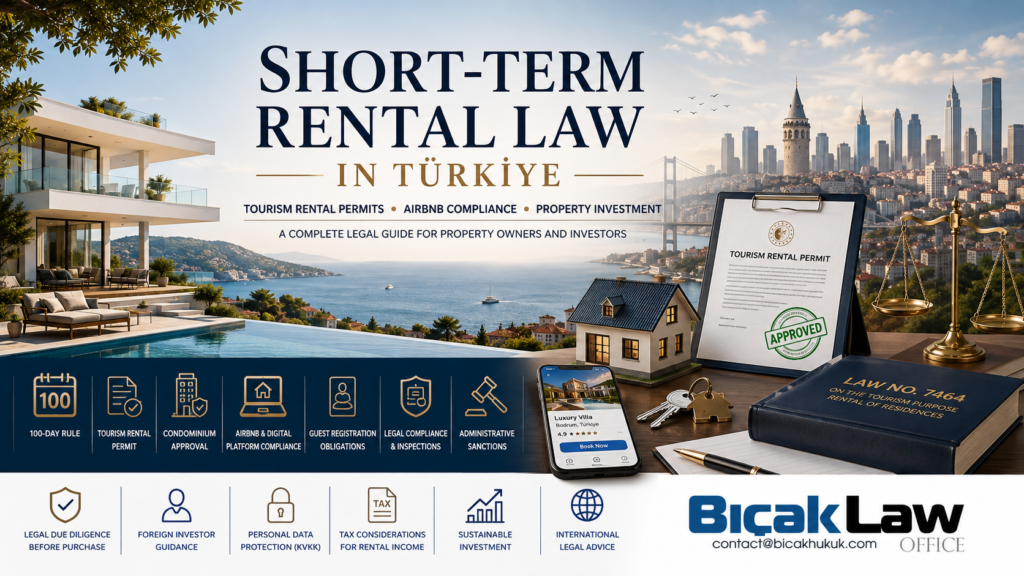
Short-Term Rental Law in Türkiye
(Editorial Note: This guide provides a comprehensive overview of the Turkish legal framework governing short-term residential rentals as of the date of publication. It is intended for general informational purposes and reflects the legislation, implementing regulations and administrative framework applicable at that time. Because legislation, regulatory practice and administrative guidance may evolve, investors, property owners and accommodation providers should obtain professional legal advice before making investment or operational decisions. Nothing in this publication should be construed as legal advice for any specific transaction.)
1. Introduction
Over the past decade, Türkiye has established itself as one of the Mediterranean region’s leading destinations for international tourism, holiday home ownership and cross-border real estate investment. Coastal destinations such as Bodrum, Marmaris, Fethiye, Göcek, Kaş and Kalkan, together with metropolitan centres including Istanbul, have attracted growing numbers of foreign buyers seeking either investment opportunities or second homes for seasonal use. At the same time, the emergence of digital accommodation platforms has fundamentally transformed the tourism industry. Services such as Airbnb, Booking.com, Vrbo and other online marketplaces have enabled private property owners to participate directly in the tourism economy by offering residential accommodation to short-term visitors from around the world. This transformation has expanded consumer choice, increased investment opportunities and contributed significantly to local tourism markets. However, the rapid expansion of short-term rentals also generated important regulatory challenges. The widespread use of residential properties as tourist accommodation raised questions concerning consumer protection, public safety, taxation, building management, neighbourhood security, guest registration, fair competition within the accommodation sector and the protection of permanent residential communities.
For many years, these issues were addressed primarily through general legal principles rather than a dedicated legislative framework. As the market expanded, however, it became increasingly apparent that tourism-purpose residential rentals required a specialised regulatory regime capable of balancing commercial innovation with public interest considerations. The enactment of Law No. 7464 on the Tourism Purpose Rental of Residences marked a significant turning point in Turkish tourism legislation. Rather than prohibiting short-term rentals, the legislature adopted a licensing and compliance model intended to integrate residential tourism accommodation into the country’s broader regulatory framework. Under this approach, qualifying properties may continue to operate, provided that they satisfy the statutory requirements governing permits, operational standards and continuing regulatory oversight.
For international investors, these developments have fundamentally changed the legal analysis that should precede any acquisition intended for short-term rental purposes. Selecting an attractive property and forecasting rental income are no longer sufficient. Successful investment now requires careful consideration of issues including permit eligibility, ownership structure, condominium rules, management plans, legal due diligence, tax implications, guest reporting obligations and the continuing compliance responsibilities imposed by Turkish law.
Against this background, understanding the legal framework governing short-term residential rentals has become an essential element of responsible investment planning. This guide examines that framework from both a legal and practical perspective, providing property owners, investors and professional advisers with a comprehensive overview of the principal issues affecting tourism-purpose residential leasing in Türkiye.
2. The Evolution of Short-Term Rentals in Türkiye
The rapid expansion of short-term residential rentals has fundamentally reshaped the global accommodation industry over the past decade. Digital platforms such as Airbnb, Booking.com, Vrbo and similar online marketplaces have enabled private property owners to participate directly in the tourism economy without operating traditional hotels or licensed accommodation establishments. This transformation has created new investment opportunities, diversified accommodation choices for travellers and contributed significantly to local tourism markets. Türkiye has been one of the principal beneficiaries of this global trend. The country’s expanding tourism sector, attractive coastal destinations, competitive real estate market and growing number of foreign property owners have contributed to a substantial increase in short-term residential accommodation. Villas, apartments and holiday homes are now routinely offered to domestic and international visitors for periods ranging from a few nights to several weeks. While this development has generated considerable economic benefits, it has also raised important legal and regulatory challenges. Residential buildings originally designed for permanent occupation increasingly began functioning as tourism accommodation, often without a dedicated legal framework governing licensing, safety standards, guest registration, condominium relations or administrative supervision.
From a regulatory perspective, the market had developed more rapidly than the applicable legislation. Different public authorities possessed partial regulatory responsibilities, yet no comprehensive legal regime specifically addressed tourism-purpose residential rentals. As a result, uncertainty existed for property owners, neighbours, accommodation providers and administrative authorities alike. The enactment of Law No. 7464 therefore represents not merely the introduction of a permit requirement but the establishment of an entirely new regulatory model governing an increasingly significant segment of Türkiye’s tourism economy.
3. Why Was Law No. 7464 Enacted?
The introduction of Law No. 7464 should be understood within the broader context of Türkiye’s evolving tourism policy and regulatory objectives. The legislature did not seek to prohibit short-term residential rentals. On the contrary, it recognised that tourism-purpose accommodation had become a permanent feature of the modern tourism industry and an important contributor to economic activity. The objective was therefore to integrate this rapidly expanding sector into a transparent and enforceable legal framework rather than allowing it to continue operating within a fragmented regulatory environment.
Several practical considerations influenced the adoption of the legislation. First, the authorities sought to establish a uniform licensing system capable of identifying properties lawfully operating as tourism accommodation. Prior to the introduction of the permit regime, determining whether a particular residential property was being used as an authorised tourism establishment was often difficult from both an administrative and enforcement perspective. Secondly, the legislation aims to strengthen consumer protection by ensuring that properties offered for tourism purposes satisfy minimum legal and operational standards. Visitors using short-term accommodation increasingly expect levels of transparency, safety and reliability comparable to those associated with licensed hospitality providers. Another important objective concerns public safety. Short-term accommodation involves a continuous turnover of guests, making accurate guest identification and cooperation with public authorities an important component of national security and public order. The legislation therefore complements the existing obligations arising under the Identity Notification Law, integrating tourism rentals into Türkiye’s broader accommodation reporting system. The legislature also sought to promote fair competition within the tourism industry. Hotels, aparthotels and other licensed accommodation providers have long operated within comprehensive regulatory frameworks involving licensing, inspections and operational requirements. Introducing comparable obligations for tourism-purpose residential rentals was intended to reduce regulatory disparities between different forms of accommodation. Finally, the legislation contributes to administrative transparency by enabling the authorities to supervise an increasingly important segment of the tourism economy, improve regulatory consistency and support the sustainable development of tourism throughout the country.
Rather than viewing Law No. 7464 as a restrictive measure, it is more accurately understood as legislation designed to facilitate the continued growth of short-term rentals within a clearly defined legal framework.
4. Legislative Objectives
The structure of Law No. 7464 demonstrates that its objectives extend well beyond the introduction of a licensing requirement. The legislation seeks to create a comprehensive regulatory ecosystem governing the operation of tourism-purpose residential accommodation throughout its entire lifecycle. Among its principal objectives are:
- establishing a transparent permit regime for tourism-purpose rentals;
- protecting the rights and legitimate interests of neighbouring property owners;
- promoting consumer confidence in short-term accommodation;
- strengthening public safety through effective guest registration mechanisms;
- supporting regulatory oversight and administrative inspections;
- reducing informal accommodation activities;
- encouraging fair competition within the tourism sector; and
- promoting the sustainable development of tourism in accordance with national policy.
These objectives illustrate that the legislation is designed not merely to regulate individual transactions but to provide an institutional framework capable of supporting the long-term development of Türkiye’s tourism accommodation market. From an international investor’s perspective, understanding these policy objectives is important because they explain many of the practical requirements introduced by the legislation. Permit procedures, condominium approvals, operational standards and inspection powers should all be interpreted within the broader objective of balancing private investment with public interest considerations.
5. Scope of Law No. 7464
One of the first questions property owners should consider is whether their proposed activity actually falls within the scope of the legislation. Law No. 7464 applies to residential properties offered for tourism purposes where the duration of the rental does not exceed the statutory threshold established by the legislation. It therefore creates a specialised legal regime governing a particular category of residential accommodation rather than replacing the general rules applicable to residential leases under the Turkish Code of Obligations.
The legislation primarily concerns apartments, detached houses, villas and other residential units made available for temporary accommodation. However, determining whether a particular property falls within the statutory framework requires consideration not only of the duration of the rental but also of the legal characteristics of the property, the operational model adopted by the owner and the applicable provisions of the implementing Regulation.
Equally important is recognising what the legislation does not regulate. Long-term residential leases generally remain subject to the ordinary provisions of Turkish private law. Consequently, investors should avoid assuming that every residential lease is governed by tourism legislation merely because the property is located in a popular holiday destination. Understanding the precise scope of Law No. 7464 is therefore the essential starting point for every legal compliance assessment.
6. The 100-Day Rule
Perhaps the most widely discussed feature of Law No. 7464 is the 100-day rule. Under the legislation, a residential property rented for 100 days or less in a single rental transaction is generally regarded as a tourism-purpose rental and therefore falls within the specialised regulatory framework established by the Law. Although frequently described as a simple numerical threshold, the rule performs a much more significant legal function.
Its primary purpose is to distinguish between two fundamentally different legal relationships. On one hand are ordinary residential leases, where the principal objective is to provide long-term accommodation and establish a stable landlord–tenant relationship governed by the Turkish Code of Obligations. On the other are tourism-purpose rentals, where accommodation is provided on a temporary basis for travellers, holidaymakers, business visitors or other short-term occupants and therefore requires a dedicated regulatory framework reflecting the commercial nature of the activity.
The legislature deliberately adopted the duration of the rental as an objective legal criterion because it provides considerably greater certainty than attempting to determine the subjective purpose of each individual stay. Whether a guest visits Türkiye for leisure, business, medical treatment or temporary relocation is generally less important than whether the accommodation falls within the statutory duration established by the legislation.
Property owners should nevertheless avoid viewing the 100-day threshold as a mechanism for circumventing regulatory requirements. Administrative authorities are entitled to examine the practical realities of the activity rather than relying exclusively upon contractual terminology or formal documentation. Artificial arrangements designed solely to avoid the application of the legislation may therefore give rise to regulatory scrutiny.
For international investors, the practical lesson is straightforward: the business model should always be structured around genuine commercial objectives and full regulatory compliance rather than assumptions that minor contractual modifications will alter the legal classification of the activity.
7. Why the 100-Day Rule Matters for Investors
From an investment perspective, the 100-day rule influences much more than permit eligibility. It affects the legal due diligence process undertaken before acquisition, the projected business model, financing assumptions, operational planning and long-term asset management. Investors who intend to generate income through high-turnover holiday accommodation must evaluate the property against the tourism rental framework from the outset, whereas those planning conventional residential leasing will generally focus on a different set of legal considerations. Accordingly, identifying whether the proposed use of the property falls within the tourism rental regime should be one of the first issues examined during any investment transaction. Addressing this question at an early stage is considerably more efficient—and often significantly less costly—than attempting to restructure the investment after completion of the purchase.
8. The Tourism Rental Permit System
The cornerstone of Türkiye’s regulatory framework governing short-term residential rentals is the requirement to obtain a Tourism Rental Permit before commencing operations. Introduced by Law No. 7464, this permit system transformed tourism-purpose residential leasing from a largely unregulated activity into a licensed and continuously supervised sector. From a legal perspective, the permit is not simply an administrative formality. It represents the State’s confirmation that the property satisfies the statutory conditions required for lawful tourism operation. Operating without the necessary authorisation may expose property owners to substantial administrative sanctions, while obtaining the permit establishes the legal basis upon which tourism accommodation may be offered through digital platforms and other distribution channels.For international investors, the permit should therefore be regarded as an essential component of the investment itself rather than a post-acquisition administrative procedure.
9. Who Must Obtain a Permit?
As a general rule, any person intending to lease a residential property for tourism purposes for 100 days or less must obtain a Tourism Rental Permit before the activity begins. The obligation applies irrespective of whether reservations are accepted directly or through online platforms such as Airbnb, Booking.com, Vrbo or similar accommodation marketplaces. The legislation is intended to regulate the activity itself rather than the booking channel through which accommodation is offered. Consequently, advertising a property through multiple online platforms does not eliminate the obligation to obtain the necessary authorisation. From an investor’s perspective, permit compliance should be considered during the earliest stages of project planning rather than after marketing activities have commenced.
10. Competent Authority
The authority responsible for issuing Tourism Rental Permits is the Ministry of Culture and Tourism. Applications are submitted electronically through the designated administrative system together with the supporting documentation required under the Law and the implementing Regulation. During the review process, the Ministry evaluates whether the applicant, the property and the proposed operation satisfy the legal requirements governing tourism-purpose residential rentals. Depending upon the characteristics of the property, additional documentation relating to ownership, condominium approvals or operational compliance may also be required. ssuance of the permit does not terminate the owner’s legal obligations. On the contrary, it marks the beginning of an ongoing compliance relationship between the permit holder and the regulatory authorities.
11. The Permit Is Not a One-Time Approval
One of the most common misconceptions among property owners is that obtaining the Tourism Rental Permit completes the legal process. In practice, the permit functions as the starting point of an ongoing regulatory framework. Permit holders remain subject to continuing obligations concerning operational standards, guest registration, administrative cooperation and compliance with the conditions under which the permit was granted. The competent authorities retain inspection powers throughout the operational life of the property, and non-compliance may result in administrative sanctions or, in appropriate cases, revocation of the permit. Accordingly, successful operation of a tourism rental business requires continuous legal compliance rather than a single administrative application.
12. Legal Due Diligence Before Acquisition
A comprehensive legal due diligence investigation should always precede the acquisition of any property intended for tourism-purpose rental. Among other matters, legal due diligence should examine:
- ownership and title deed records;
- mortgages, liens and encumbrances;
- zoning and planning status;
- condominium structure;
- management plan restrictions;
- existing permits and licences;
- ongoing litigation;
- administrative sanctions affecting the property;
- occupancy restrictions;
- suitability for tourism-purpose rental under the applicable legislation.
Many regulatory problems encountered after completion of a purchase could have been identified – and frequently avoided – through an appropriately structured due diligence exercise before the transaction was finalised.Accordingly, legal due diligence should not be regarded as an optional precaution but as an essential element of responsible investment planning.
13. Choosing the Right Property
Not every residential property is equally suitable for tourism-purpose rental. An attractive location alone does not guarantee that the property can lawfully operate under Law No. 7464. Before signing a purchase agreement, investors should evaluate:
- whether the property is located within an apartment building or is detached;
- whether unanimous condominium approval may be required;
- whether the management plan restricts tourism activities;
- whether the physical characteristics of the property satisfy the applicable standards;
- whether the proposed business model is compatible with the regulatory framework.
Purchasing first and investigating these issues afterwards may expose investors to unnecessary legal and financial risk.
13. Foreign Investors and Cross-Border Transactions
Türkiye continues to attract substantial numbers of foreign purchasers seeking holiday homes and investment properties. For international buyers, however, acquiring property for tourism purposes frequently involves additional legal considerations beyond those applicable to domestic purchasers. These may include:
- foreign ownership rules;
- transaction structuring;
- tax planning;
- currency transfer considerations;
- representation through a Power of Attorney;
- succession planning;
- long-term residence planning.
Consequently, investment decisions should ideally integrate both real estate law and tourism legislation from the outset rather than addressing regulatory issues separately after acquisition. Readers interested in purchasing property in Türkiye may also find useful information in our related guide Buying Property in Türkiye, which examines the legal aspects of cross-border real estate transactions in greater detail.
14. Using a Power of Attorney
Many foreign investors complete property acquisitions and permit-related procedures without travelling to Türkiye. Turkish law generally permits appropriately authorised representatives to undertake a wide range of legal and administrative procedures on behalf of foreign clients through a properly executed Power of Attorney. Depending upon the circumstances, a Power of Attorney may authorise legal representatives to:
- conduct legal due diligence investigations;
- obtain title deed information;
- represent the client before public authorities;
- execute acquisition documents;
- complete permit-related administrative procedures;
- coordinate post-acquisition compliance requirements.
Where the Power of Attorney is executed abroad, attention should be given to the applicable authentication requirements, including apostille procedures or consular legalisation where appropriate. A carefully drafted Power of Attorney should clearly define the representative’s authority, ensuring that the scope of representation corresponds to the legal requirements of the proposed transaction while avoiding unnecessary or excessively broad authorisations.
15. Apartments, Detached Houses and High-Quality Residential Developments
Although Law No. 7464 establishes a unified regulatory framework for tourism-purpose residential rentals, the legal requirements applicable to a property vary according to its physical and legal characteristics. The distinction between an apartment, a detached house and a high-quality residential development is not merely descriptive; it directly affects permit eligibility, condominium approval requirements and the overall feasibility of operating a short-term rental business. Accordingly, investors should evaluate the legal status of the property before acquisition rather than assuming that all residential properties may be used for tourism accommodation under identical conditions.
15.1. Apartments and the Requirement for Unanimous Consent
One of the most distinctive features of the Turkish regulatory framework is the requirement for unanimous consent in many apartment buildings. As a general rule, where an independent section within an apartment building is intended to be used for tourism-purpose rental, the consent of all condominium owners in the relevant building must be obtained before a Tourism Rental Permit can be issued. This requirement reflects the legislature’s attempt to balance two competing interests. On the one hand, individual property owners enjoy the constitutional right to use and benefit from their property. On the other hand, apartment buildings constitute shared living environments in which the rights and legitimate expectations of neighbouring owners also deserve protection.
Unlike conventional residential leasing, short-term accommodation typically involves a continuous turnover of guests, increased use of common areas and a higher level of daily activity. The legislature therefore concluded that introducing tourism operations into a residential building should generally require the collective agreement of the condominium community. From a practical perspective, this requirement has become one of the most significant legal considerations for investors purchasing apartments specifically for Airbnb or similar accommodation platforms.
15.2. The Importance of the Management Plan
Foreign investors frequently focus on title deeds and purchase agreements while overlooking another document that may prove equally important – the management plan of the building. The management plan regulates many aspects of condominium life, including the administration of common areas, the allocation of rights and obligations among owners and, in some cases, restrictions affecting the commercial use of individual units.
Although compliance with Law No. 7464 remains essential, investors should also ensure that the intended operation is compatible with the building’s management plan and the applicable condominium regime. Accordingly, reviewing the management plan should form an integral part of every legal due diligence investigation undertaken before acquiring a property intended for tourism-purpose rental. Before signing a purchase agreement, investors should always request and review the condominium management plan together with the title deed documentation. Identifying restrictions before acquisition is considerably easier than attempting to resolve disputes after completion.
15.3. Detached Houses
Detached houses generally present a different legal profile. Because detached properties do not ordinarily involve the same condominium relationships that exist within apartment buildings, the issues associated with unanimous owner approval may not arise in the same manner. Nevertheless, detached houses remain fully subject to the broader requirements of Law No. 7464. Owners must still satisfy the applicable permit conditions, comply with operational obligations and observe all continuing regulatory requirements imposed by the legislation and the implementing Regulation. Investors should therefore avoid assuming that detached properties are exempt from the tourism rental regime simply because condominium approval is not required in the same way as for apartments.
15.4. High-Quality Residential Developments
The implementing Regulation recognises a distinct category of high-quality residential developments, often referred to internationally as serviced residences or luxury residential complexes. These projects typically provide integrated services such as:
- reception facilities;
- twenty-four-hour security;
- housekeeping services;
- maintenance and technical support;
- recreational facilities;
- fitness centres;
- swimming pools;
- concierge services; and
- professionally managed common areas.
Because these developments are designed to operate with hotel-like infrastructure while maintaining residential ownership structures, the regulatory framework applicable to them differs in several important respects. Rather than applying identical requirements to all residential properties, the legislation recognises the operational characteristics of these developments and provides a more flexible legal approach where the statutory conditions are satisfied.
15.5. Why High-Quality Residential Developments Are Treated Differently
The rationale behind this distinction is primarily functional. Unlike conventional apartment buildings intended exclusively for permanent residential occupation, professionally managed residential developments are often specifically designed to accommodate temporary residents, business travellers and international visitors. Security procedures, reception services, building management systems and operational infrastructure are generally already in place. Consequently, many of the practical concerns that justify unanimous condominium approval in ordinary apartment buildings arise in a different context. For investors, this distinction may significantly influence both investment strategy and regulatory planning. High-quality residential developments frequently offer greater operational certainty for professionally managed short-term rental activities, provided that all statutory requirements continue to be satisfied.
16. Operational Standards
Obtaining a permit does not merely authorise the commercial use of a property. It also creates an obligation to maintain the property in accordance with the standards required under Turkish legislation. The implementing Regulation establishes minimum operational expectations designed to ensure that tourism-purpose residences provide safe and appropriate accommodation for guests. Although the detailed technical requirements may evolve over time, operators should generally ensure that the property:
- remains safe and fit for occupation;
- contains the essential furniture and equipment appropriate to its intended use;
- complies with applicable fire safety requirements;
- provides functioning sanitary facilities;
- maintains appropriate living conditions throughout the period of operation.
Operational compliance should therefore be viewed as a continuing obligation rather than a condition assessed only during the initial permit application.
16.1. Occupancy Capacity
The implementing Regulation also addresses the maximum occupancy of tourism-purpose residences. These limitations are intended to promote guest safety, preserve the residential character of accommodation and prevent properties from operating beyond their intended capacity. Operators should ensure that occupancy arrangements remain consistent with the applicable regulatory framework and avoid accepting reservations exceeding the legally permitted capacity. Failure to observe occupancy limits may expose operators to administrative sanctions and should therefore form part of every property’s internal compliance programme.
16.2. Property Management Companies
Many foreign owners choose not to manage their Turkish properties personally. Instead, they appoint professional property management companies responsible for reservations, guest communications, maintenance, cleaning, key management and operational coordination. While professional management frequently improves operational efficiency, it should not be assumed that appointing a management company transfers all statutory responsibilities from the owner to the manager. The allocation of contractual responsibilities between the parties does not necessarily alter the legal obligations imposed by public law. Accordingly, management agreements should clearly define:
- the scope of operational authority;
- responsibility for regulatory compliance;
- guest registration procedures;
- maintenance obligations;
- reporting responsibilities;
- insurance arrangements;
- dispute resolution mechanisms.
A carefully drafted management agreement may significantly reduce future disputes while improving regulatory compliance throughout the operation of the property. Many disputes arise because property management agreements focus primarily on commercial issues while failing to allocate legal compliance responsibilities with sufficient precision. Before appointing a management company, owners should ensure that the agreement clearly distinguishes operational services from statutory legal obligations.
16.3. Professional Compliance Throughout the Operational Lifecycle
From an international investor’s perspective, legal compliance should be regarded as a continuous management process rather than a single administrative event. Successful operators typically establish internal procedures governing:
- permit maintenance;
- guest registration;
- occupancy monitoring;
- cooperation with public authorities;
- documentation management;
- periodic legal compliance reviews.
This proactive approach not only reduces regulatory risk but also contributes to the long-term commercial sustainability of the investment. As Türkiye’s tourism accommodation market continues to mature, professionally managed compliance programmes are likely to become an increasingly important competitive advantage for both individual investors and institutional accommodation providers.
16.4. Guest Registration and Identity Reporting Obligations
Operating a tourism-purpose rental property in Türkiye involves obligations that extend well beyond obtaining a permit and welcoming guests. One of the most important continuing responsibilities concerns the registration and reporting of guest identity information. Like hotels and other licensed accommodation providers, operators of tourism-purpose residences are required to comply with the Identity Notification Law and the relevant secondary legislation governing guest reporting.
The purpose of this obligation is to support public safety, assist law enforcement authorities and maintain an accurate record of temporary accommodation throughout the country. Accordingly, every operator should establish reliable internal procedures ensuring that guest information is collected, verified and reported in accordance with the applicable legal requirements. For foreign investors, guest registration should not be viewed as an administrative inconvenience but as one of the core legal obligations associated with operating licensed tourism accommodation in Türkiye.
16.5. Personal Data Protection (KVKK)
Guest registration inevitably involves the processing of personal data. Consequently, operators must ensure that their activities comply not only with tourism legislation but also with Turkish Personal Data Protection Law (Law No. 6698 – KVKK). In practice, operators may process information such as:
- names and surnames;
- passport or identity document details;
- nationality;
- contact information;
- reservation records;
- arrival and departure dates;
- payment-related information.
Processing this information creates legal responsibilities concerning data security, confidentiality and lawful processing. Although tourism legislation requires certain information to be collected and reported, operators should avoid collecting unnecessary personal data or retaining information for longer than required under the applicable legal framework. Foreign investors operating properties remotely should also ensure that any property management company, booking platform or service provider handling guest information implements appropriate contractual and organisational safeguards. Tourism legislation and personal data protection legislation operate together rather than independently. Compliance with one framework does not automatically ensure compliance with the other.
17. Digital Accommodation Platforms
The growth of Airbnb, Booking.com, Vrbo and similar online platforms has fundamentally transformed the short-term rental market. These platforms provide property owners with global visibility, reservation management systems and access to international travellers while significantly reducing barriers to market entry. However, the use of digital platforms does not alter the legal responsibilities imposed upon property owners by Turkish law. Whether reservations are accepted through an international platform, a local agency or the owner’s own website, the underlying legal obligations concerning permits, guest registration and operational compliance remain unchanged. Digital platforms facilitate commercial activity; they do not replace regulatory compliance.
17.1. Advertising Properties on Online Platforms
Before advertising a property for tourism purposes, owners should ensure that all statutory conditions required for lawful operation have been satisfied. Publishing accommodation listings before obtaining the necessary authorisation may expose operators to regulatory consequences depending upon the circumstances of the individual case and the applicable administrative practice. Accordingly, marketing strategies should be coordinated with legal compliance rather than treated as separate commercial activities. Professional investors generally establish compliance procedures before launching marketing campaigns, thereby reducing the likelihood of future regulatory intervention.
17.2. Working with Airbnb and Booking.com
Many foreign investors assume that successful listing approval on a major accommodation platform confirms the legal status of the property. This assumption is incorrect. Platform acceptance and governmental authorisation serve entirely different purposes. Digital platforms primarily facilitate reservations and commercial transactions, whereas the Ministry of Culture and Tourism determines whether the property satisfies the legal conditions required for tourism-purpose operation under Turkish law. Consequently, approval by Airbnb or Booking.com should never be regarded as evidence that all statutory requirements have been fulfilled. Property owners remain independently responsible for ensuring compliance with Turkish legislation irrespective of the commercial platform through which bookings are received.
18. Tax Considerations
Income generated from tourism-purpose residential rentals may give rise to various tax obligations under Turkish law. The applicable tax treatment depends upon several factors, including:
- the legal status of the owner;
- the structure of the activity;
- the nature and frequency of operations;
- applicable tax legislation;
- the owner’s overall tax position.
Because taxation issues frequently involve both Turkish law and, in cross-border situations, the tax laws of another jurisdiction, investors should obtain professional tax advice before commencing operations. From an investment planning perspective, tax considerations should be evaluated together with property acquisition, financing and operational strategy rather than after rental activities begin. International investors should consider obtaining coordinated legal and tax advice before purchasing a property intended for short-term rental in order to optimise both regulatory compliance and long-term investment efficiency.
19. Administrative Inspections
Law No. 7464 establishes an ongoing system of administrative supervision rather than a one-time licensing procedure. Accordingly, tourism-purpose residences may be subject to inspections by the competent authorities to verify continued compliance with the applicable legislation. Inspections may examine matters including:
- permit status;
- operational compliance;
- documentation;
- guest registration procedures;
- physical conditions of the property;
- fulfilment of continuing legal obligations.
From a practical perspective, operators should maintain organised documentation demonstrating compliance throughout the operational lifecycle rather than attempting to assemble records only when an inspection occurs. A well-managed compliance programme significantly reduces administrative risk.
20. Administrative Sanctions
The legislation provides for a comprehensive system of administrative sanctions intended to encourage compliance with the regulatory framework. Administrative consequences may arise where operators fail to satisfy the legal requirements governing tourism-purpose residential rentals. Depending upon the nature of the violation, the applicable legislation may provide for:
- administrative monetary penalties;
- orders requiring deficiencies to be remedied;
- suspension of activities where legally justified;
- revocation of permits under the circumstances prescribed by law;
- other administrative measures available under the applicable legal framework.
Because the legal consequences depend upon the specific facts of each case, operators should respond promptly to any communication received from the competent authorities and obtain legal advice whenever significant regulatory issues arise.
21. Avoiding Common Compliance Mistakes
Experience demonstrates that many regulatory difficulties arise not because investors deliberately disregard the law but because compliance planning begins too late. Among the most common mistakes are:
- purchasing a property before confirming permit eligibility;
- failing to review the condominium management plan;
- assuming that platform approval replaces governmental authorisation;
- overlooking guest registration obligations;
- neglecting personal data protection requirements;
- using incomplete or poorly drafted management agreements;
- treating legal compliance as a one-time administrative exercise.
These issues are generally preventable through careful planning undertaken before the investment is completed. Attempting to resolve compliance issues after guests have already been accepted is often significantly more expensive and disruptive than incorporating legal compliance into the investment strategy from the outset.
21.1. Building a Long-Term Compliance Strategy
Successful tourism rental operations are rarely the result of permit approval alone. Rather, they depend upon the implementation of an effective long-term compliance strategy that integrates legal, operational and commercial considerations. A well-designed compliance programme typically includes:
- periodic legal reviews;
- monitoring of legislative developments;
- internal documentation procedures;
- staff training where appropriate;
- regular review of management agreements;
- cooperation with qualified legal and tax advisers.
As Türkiye’s tourism accommodation market continues to develop, investors who integrate compliance into their business model from the beginning are likely to be better positioned to protect both operational continuity and long-term asset value.
21.2. Practical Compliance Checklist for Property Owners
Obtaining a Tourism Rental Permit represents only one stage of the legal compliance process. Property owners should adopt a structured approach throughout the entire investment and operational lifecycle. The following checklist provides a practical overview of the principal legal issues that should normally be considered before and during the operation of a tourism-purpose residence.
Before Purchasing the Property
- Confirm that the property is legally suitable for tourism-purpose rental.
- Conduct comprehensive legal due diligence covering title deed records, encumbrances, zoning status and regulatory restrictions.
- Review the condominium management plan.
- Determine whether unanimous condominium owner approval is required.
- Consider taxation, succession planning and long-term investment objectives.
- Assess whether the proposed business model is compatible with Law No. 7464.
Before Applying for a Permit
- Confirm ownership documentation.
- Prepare the required administrative documentation.
- Verify that the property satisfies the applicable operational requirements.
- Review any management arrangements.
- Ensure that the proposed operational structure complies with the applicable legislation.
Before Accepting Guests
- Obtain the required Tourism Rental Permit.
- Implement guest registration procedures.
- Establish personal data protection measures.
- Prepare emergency and operational procedures.
- Ensure that online listings accurately reflect the legal status of the property.
During Operation
- Maintain continuing compliance.
- Monitor legislative developments.
- Maintain accurate documentation.
- Cooperate with inspections.
- Periodically review legal compliance with professional advisers.
22. Practical Guidance for Foreign Investors
Foreign investors frequently focus on the commercial aspects of the transaction while underestimating the importance of legal planning. Experience demonstrates that successful investments are rarely determined solely by location or projected rental income. Long-term profitability is equally influenced by the legal suitability of the property, the regulatory environment and the owner’s ability to maintain continuing compliance throughout the operational lifecycle. Accordingly, foreign investors should integrate legal analysis into every stage of the investment process rather than treating legal advice as a post-acquisition formality. For many investors, this begins with selecting the appropriate ownership structure, conducting comprehensive due diligence and evaluating whether the intended use of the property is compatible with the applicable tourism legislation. The following issues frequently arise during tourism-purpose residential investment projects:
- purchasing property before confirming permit eligibility;
- overlooking condominium restrictions;
- failing to review the management plan;
- assuming that digital platform approval replaces governmental authorisation;
- inadequate guest registration procedures;
- non-compliance with personal data protection requirements;
- poorly drafted property management agreements;
- failure to monitor legislative developments;
- insufficient legal due diligence before acquisition.
Most of these risks can be significantly reduced through careful legal planning undertaken before the investment is completed.
23. Frequently Asked Questions (FAQ)
23.1. What is considered a short-term rental under Turkish law?
As a general rule, a residential property rented for 100 days or less in a single rental transaction is treated as a tourism-purpose rental under Law No. 7464.
23.2. Do I always need a Tourism Rental Permit?
In principle, yes. Properties falling within the scope of Law No. 7464 generally require a permit before tourism operations begin.
23.3. Can foreign nationals obtain a Tourism Rental Permit?
Foreign ownership does not, by itself, prevent compliance with the permit regime. However, investors must satisfy the applicable legal requirements governing both property ownership and tourism-purpose rental activities.
23.4. Is Airbnb legal in Türkiye?
Airbnb itself is not prohibited. However, properties advertised through Airbnb must comply with the applicable Turkish legal framework governing tourism-purpose residential rentals.
23.5. Does listing a property on Booking.com replace governmental approval?
No. Platform approval and governmental authorisation are entirely different matters.
23.6. What happens if I operate without a permit?
Operating without the required authorisation may expose the owner to administrative sanctions under the applicable legislation.
23.7. Do apartment owners need unanimous consent?
In many apartment buildings, unanimous condominium owner approval constitutes an important legal requirement before a permit may be issued.
23.8. Are detached houses treated differently?
Detached properties are generally subject to a different legal analysis concerning condominium approval, although they remain subject to the broader requirements of Law No. 7464.
23.9. What are high-quality residential developments?
These are professionally managed residential developments providing hotel-like services and operating under a distinct regulatory framework established by the implementing Regulation.
23.10. Is legal due diligence necessary before purchasing?
Yes. Comprehensive legal due diligence should form an essential part of every investment transaction involving tourism-purpose residential property.
23.11. Can I appoint a property management company?
Yes. Many foreign investors appoint professional property managers. However, statutory legal obligations cannot automatically be transferred simply by contract.
23.12. Do I have guest registration obligations?
Yes. Operators must comply with the applicable guest reporting requirements under Turkish law.
23.13. Does Turkish personal data protection law apply?
Yes. Operators processing guest information must comply with the applicable provisions of Law No. 6698 (KVKK).
23.14. Will my property be inspected?
The competent authorities possess inspection powers under the applicable legislation.
23.15. Can a permit be revoked?
Yes. Under circumstances prescribed by law, permits may be suspended or revoked where statutory requirements are no longer satisfied.
23.16. Is tax advice also necessary?
Frequently yes. Investors should consider obtaining coordinated legal and tax advice before commencing operations.
23.17. Should I review the management plan before purchasing?
Absolutely. The management plan may significantly affect the property’s suitability for tourism-purpose rental.
23.18. Can I complete the purchase through a Power of Attorney?
Yes. Properly drafted Powers of Attorney are commonly used in international real estate transactions.
23.19. Is legal advice necessary before purchasing?
Obtaining legal advice before acquisition is generally more efficient and considerably less costly than attempting to resolve regulatory problems after completion.
23.20. How often should compliance be reviewed?
Legal compliance should be regarded as an ongoing process. Investors should periodically review both legislative developments and their operational procedures.
24. How Bıçak Law Firm Assists
Bıçak Law Firm advises domestic and international clients throughout every stage of tourism-purpose real estate investment and regulatory compliance in Türkiye. Our services include:
- legal due diligence before acquisition;
- review and negotiation of real estate transactions;
- Tourism Rental Permit advisory services;
- preparation and review of Powers of Attorney;
- condominium and management plan analysis;
- regulatory compliance assessments;
- property management agreement review;
- administrative proceedings before public authorities;
- legal advice concerning inspections and administrative sanctions;
- dispute resolution relating to tourism-purpose residential rentals.
Because many tourism investments involve interconnected issues of real estate law, foreign investment, tax planning, residence planning and commercial law, we adopt a multidisciplinary approach designed to protect both the legal security and commercial objectives of our clients.
25. Conclusion
The introduction of Law No. 7464 has fundamentally reshaped the legal landscape governing short-term residential rentals in Türkiye. What was once an area characterised by fragmented regulation has evolved into a structured licensing and compliance regime balancing investment opportunities with consumer protection, public safety and sustainable tourism policy.
For investors, successful participation in this market now requires considerably more than acquiring an attractive property or creating an online listing. Every stage of the investment lifecycle – from property selection and legal due diligence to permit applications, operational management and continuing compliance – requires careful legal planning.
From an international perspective, Türkiye continues to offer significant opportunities within its dynamic tourism and real estate sectors. Investors who integrate commercial objectives with sound legal governance are likely to be better positioned to protect their investments, minimise regulatory risk and achieve sustainable long-term returns.
Obtaining legal advice before purchasing or operating a tourism-purpose rental property is therefore not merely a matter of regulatory compliance; it is an important component of prudent investment strategy.










Comments
No comments yet.