 English
 Türkçe
 Français
 Deutsch

The Embassy of the Kingdom of Morocco in Ankara hosted a reception to commemorate the 27th Anniversary of the Accession of His Majesty King Mohammed VI to the Throne, bringing together senior Turkish officials, ambassadors, business leaders and members of the diplomatic community. Prof. Dr. Vahit Bıçak represented Bıçak Law Firm at the event, reaffirming the firm’s commitment to strengthening international legal and commercial relations. The reception also marked the 70th anniversary of diplomatic relations between Türkiye and Morocco, highlighting the long-standing friendship and expanding cooperation between the two countries. Ambassador Mohammed Ali Lazreq emphasised Morocco’s remarkable economic transformation under the leadership of King Mohammed VI and outlined the country’s growing role as one of Africa’s leading industrial and investment destinations. The article examines the rapid expansion of bilateral trade, the importance of the Türkiye–Morocco Free Trade Agreement, and Morocco’s strategic position as a gateway to African markets. It also explores the legal and commercial opportunities arising from Morocco’s preparations to co-host the 2030 FIFA World Cup, particularly in infrastructure, construction and international investment. As economic cooperation continues to deepen, businesses increasingly require sophisticated legal support for cross-border investments, commercial transactions and regulatory compliance. Bıçak remains committed to supporting Moroccan and Turkish businesses and international investors by providing comprehensive legal services that facilitate stronger Türkiye–Morocco economic, commercial and legal cooperation.
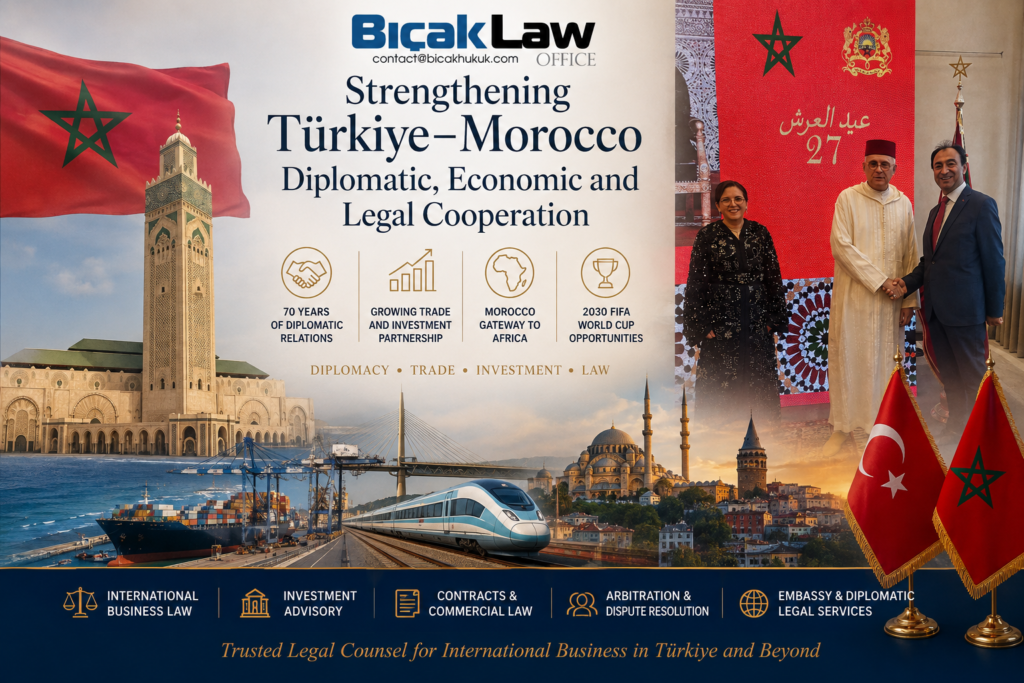
Morocco’s Throne Day Reception in Ankara
1. Giriş
Prof. Dr. Vahit Bıçak represented Bıçak Law Firm at the reception hosted by the Embassy of the Kingdom of Morocco in Ankara to mark the 27th anniversary of the accession of His Majesty King Mohammed VI to the Throne. The event not only celebrated one of Morocco’s most important national occasions but also highlighted the remarkable progress achieved in Türkiye -Morocco relations over the past seven decades. Bringing together senior Turkish government officials, ambassadors, business representatives and members of the diplomatic community, the reception reflected the growing strategic partnership between the two countries and their shared commitment to expanding cooperation in diplomacy, trade, investment and regional development.
2. Celebrating Morocco’s Throne Day in Ankara
The Embassy of the Kingdom of Morocco in Ankara hosted an official reception to commemorate the 27th Anniversary of the Accession of His Majesty King Mohammed VI to the Throne of Morocco, one of the country’s most significant national celebrations. The reception was graciously hosted by H.E. Mr. Mohammed Ali Lazreq, Ambassador of the Kingdom of Morocco to the Republic of Türkiye, and H.E. Mrs. Nawal Bouchekkif, who welcomed a distinguished gathering of government officials, ambassadors, representatives of international organisations, members of the diplomatic corps, business leaders and invited guests. Representing Bıçak Law Firm, Prof. Dr. Vahit Bıçak attended the reception alongside members of Türkiye’s diplomatic and international business community. His participation reflected the firm’s continuing commitment to strengthening relationships with foreign embassies and supporting the development of international legal and commercial cooperation.
The event was attended by Minister of Environment, Urbanisation and Climate Change Murat Kurum, Deputy Ministers of Foreign Affairs Ambassador Musa Kulaklıkaya and Ambassador Hacı Ali Özel, former Minister of Family and Social Services Zehra Zümrüt Selçuk, ambassadors accredited to Türkiye and numerous representatives of public institutions, academia and the private sector. Beginning with the national anthems of Morocco and Türkiye, the reception celebrated not only Morocco’s national day but also the close friendship that has long existed between the two nations.
A National Celebration with Deep Historical Significance
In his welcoming remarks, Ambassador Mohammed Ali Lazreq emphasised that the anniversary of the accession of His Majesty King Mohammed VI carries a significance that extends far beyond a national celebration.
For the Moroccan people, Throne Day symbolises the enduring historical relationship between the monarchy and the nation. It represents continuity, stability and the shared vision that has guided Morocco’s political, economic and social development during the reign of King Mohammed VI.
The Ambassador recalled the ambitious reform agenda implemented over the past twenty-seven years, highlighting comprehensive initiatives that have transformed Morocco across multiple sectors. These reforms have contributed to significant progress in political modernisation, industrial development, infrastructure, education, tourism, renewable energy and international investment.
Rather than reflecting solely on past achievements, Ambassador Lazreq described the occasion as an opportunity to look confidently toward Morocco’s future and its continuing aspiration to become one of Africa’s leading economic and industrial powers.
The reception therefore served not only as a celebration of Morocco’s national achievements but also as an opportunity for dialogue between Morocco’s diplomatic partners, international investors and representatives of the wider diplomatic community in Ankara.
3. Seventy Years of Türkiye–Morocco Diplomatic Relations
This year’s celebration carried an additional symbolic importance because 2026 marks the seventieth anniversary of diplomatic relations between Türkiye and Morocco. Diplomatic relations between the two countries were formally established shortly after Morocco regained its independence in 1956. Since then, bilateral relations have steadily evolved from traditional diplomatic contacts into a multidimensional partnership encompassing political dialogue, trade, investment, education, tourism, culture and regional cooperation. Despite the considerable geographical distance separating the two countries, Türkiye and Morocco have maintained a relationship characterised by mutual respect, political dialogue and a shared commitment to regional stability.
Both countries occupy strategically important positions at the crossroads of Europe, Africa and the Mediterranean. Türkiye serves as a bridge between Europe, Asia and the Middle East, while Morocco provides one of the principal gateways to North and West Africa. This complementary geographical position has increasingly translated into stronger economic and commercial cooperation. Today, Türkiye and Morocco cooperate actively within numerous international organisations, including the United Nations, the Organisation of Islamic Cooperation and various regional initiatives promoting sustainable development, economic integration and international dialogue. The Ambassador underlined that the seventieth anniversary provides an excellent opportunity not only to celebrate the achievements of the past but also to identify new areas of cooperation for the decades ahead.
4. Morocco’s Remarkable Economic Transformation Under King Mohammed VI
One of the central themes of Ambassador Lazreq’s address was Morocco’s remarkable economic transformation during the reign of King Mohammed VI. Over the past two decades, Morocco has pursued an ambitious programme of economic modernisation aimed at improving competitiveness, attracting foreign investment and positioning the country as one of Africa’s leading industrial economies. Significant investments have been made in transport infrastructure, logistics, renewable energy, manufacturing and digital transformation. International observers increasingly recognise Morocco as one of the continent’s most dynamic economies, supported by political stability, improving infrastructure and an expanding industrial base.
The Ambassador referred to recent international assessments placing Morocco among Africa’s most advanced industrial economies, reflecting years of sustained investment in strategic sectors. The country’s industrial policy has focused particularly on automotive manufacturing, aerospace, renewable energy, textiles, agribusiness and logistics. These industries have attracted substantial international investment and have contributed to Morocco’s growing role within global supply chains. At the same time, Morocco has invested heavily in transport infrastructure, including highways, high-speed rail connections and port facilities, creating an increasingly attractive environment for international trade and manufacturing. This transformation has not only strengthened Morocco’s domestic economy but has also enhanced its position as a strategic commercial gateway linking Europe, Africa and the Middle East.
5. Trade and Investment Relations: From Partnership to Strategic Cooperation
The growing political dialogue between Türkiye and Morocco has been accompanied by an equally significant expansion of economic and commercial relations. Today, the two countries enjoy one of the most dynamic bilateral economic partnerships connecting Europe, the Mediterranean and Africa. While trade has increased steadily over the past two decades, the relationship is gradually evolving beyond the exchange of goods toward deeper industrial cooperation, joint investment and long-term strategic partnerships.
The legal framework supporting this relationship has also matured. The Free Trade Agreement (FTA) signed between Türkiye and Morocco in 2004 and entering into force in 2006 established the foundation for expanding bilateral commerce by progressively eliminating tariffs on industrial products while providing greater legal certainty for businesses operating across both jurisdictions. More recently, the agreement has been updated to respond to changing economic realities and to encourage a more balanced and sustainable commercial relationship.
Today, bilateral trade reaches several billions of US dollars annually and continues to grow despite fluctuations in the global economy. Türkiye exports a broad range of industrial products to Morocco, including machinery, textiles, iron and steel products, electrical equipment, chemicals, automotive components and construction materials. Morocco, in turn, exports vehicles, automotive parts, agricultural products, fertilisers, textiles and various manufactured goods to Türkiye.
Beyond trade statistics, the relationship increasingly reflects mutual confidence between the business communities of both countries. Turkish companies have established a significant presence in Morocco across numerous sectors, while Moroccan enterprises continue to explore commercial opportunities in Türkiye. The expansion of investment flows demonstrates that economic relations have moved beyond traditional import-export activities toward long-term industrial cooperation.
Official Turkish sources indicate that approximately 160 Turkish companies currently operate in Morocco, employing thousands of Moroccan workers and contributing to local economic development. Turkish contractors have also undertaken infrastructure and construction projects worth several billion US dollars, reflecting Türkiye’s internationally recognised expertise in engineering, construction and project management.
For legal professionals, these developments are particularly significant because increased cross-border investment inevitably creates demand for sophisticated legal services. Corporate establishment, commercial contracts, employment matters, construction agreements, tax planning, regulatory compliance, dispute resolution and international arbitration all become increasingly important as commercial relationships deepen. For law firms with an international outlook, supporting this growing economic relationship requires more than knowledge of domestic legislation. It requires an understanding of international commerce, foreign investment, cross-border transactions and the commercial expectations of businesses operating in multiple jurisdictions.
6. The Free Trade Agreement: A Stable Legal Foundation for Business
One of the principal drivers of economic cooperation between Türkiye and Morocco has been the Türkiye–Morocco Free Trade Agreement, which has provided businesses with a predictable legal framework for nearly two decades. The agreement significantly reduced customs barriers, facilitated market access and strengthened legal certainty for companies engaged in bilateral trade. More importantly, it established institutional mechanisms allowing both governments to address emerging commercial issues through regular dialogue and consultation.
In recent years, the agreement has evolved to reflect changing economic priorities. Rather than focusing exclusively on tariff reductions, bilateral discussions increasingly address investment promotion, industrial cooperation, sustainable trade, rules of origin, customs procedures and the competitiveness of domestic industries. This evolution demonstrates the maturity of Türkiye–Morocco economic relations. Modern trade agreements are no longer limited to customs duties; they increasingly regulate the legal environment in which international businesses operate.
For companies considering expansion into either market, understanding the legal implications of the Free Trade Agreement has become an important component of commercial planning. Rules concerning customs procedures, product origin, technical standards, contractual obligations and dispute resolution all influence the success of cross-border transactions. Accordingly, legal advisers play an increasingly important role in helping businesses structure investments, negotiate commercial agreements and manage regulatory compliance within the framework established by bilateral and international trade law.
7. Morocco: A Strategic Gateway to Africa
Morocco occupies a unique geopolitical position that extends far beyond North Africa. Situated only a short distance from Europe while maintaining deep economic and political relationships throughout the African continent, Morocco has become one of the principal gateways for international companies seeking access to African markets. Over the past decade, Morocco has invested heavily in transport infrastructure, logistics, industrial zones and international connectivity. Major projects, including the development of Tangier Med Port, extensive motorway networks, high-speed railway connections and modern industrial parks, have significantly enhanced the country’s attractiveness as a regional business hub. This transformation has encouraged numerous multinational corporations to establish manufacturing and regional distribution operations in Morocco. Automotive manufacturers, aerospace companies, renewable energy developers and logistics providers increasingly view Morocco as a platform for serving both European and African markets.
For Turkish businesses, Morocco offers strategic advantages that extend beyond the domestic market of approximately 38 million people. Companies establishing operations in Morocco may benefit from access to broader regional markets through Morocco’s extensive network of international trade agreements and its well-developed transport infrastructure. These developments create important opportunities for legal advisers capable of supporting businesses during every stage of international expansion – from market entry and company formation to regulatory compliance, commercial contracting and dispute resolution. The legal environment governing cross-border investment therefore becomes a key element of commercial success, particularly for companies operating simultaneously in multiple jurisdictions.
8. Morocco and the 2030 FIFA World Cup: Legal Opportunities Beyond Sport
One of the Ambassador’s most forward-looking observations concerned Morocco’s preparations for the 2030 FIFA World Cup, which the country will jointly host with Spain and Portugal. The tournament represents far more than a sporting event. It is expected to generate one of the largest infrastructure and investment programmes ever undertaken in Morocco, encompassing transport systems, stadium construction, hotels, tourism facilities, urban regeneration, telecommunications, renewable energy and public infrastructure. Large-scale international projects of this nature inevitably generate significant legal work. International procurement, construction contracts, engineering agreements, project finance, environmental regulation, labour law, public-private partnerships, insurance, dispute avoidance and international arbitration all become critical components of successful project delivery.
For Turkish companies – particularly those active in construction, engineering, architecture, transport, tourism and infrastructure – the 2030 World Cup presents substantial commercial opportunities. Turkish contractors have already established a strong international reputation through projects completed across Europe, the Middle East, Central Asia and Africa. As commercial activity increases, demand for experienced legal advisers capable of supporting international transactions, managing contractual risk and resolving cross-border disputes is also expected to grow. The World Cup therefore represents not only a sporting milestone for Morocco but also a catalyst for deeper economic cooperation between Moroccan and international businesses, including companies from Türkiye.
9. Shared Regional Vision and International Cooperation
Beyond economics, Türkiye and Morocco continue to share common perspectives on many regional and international issues. Both countries support multilateral diplomacy, dialogue among civilisations, sustainable development and greater regional cooperation. They maintain active participation within international organisations and frequently cooperate on matters relating to Africa, the Mediterranean region and the broader Islamic world. Ambassador Lazreq also referred to climate change and sustainable development as areas where both countries share common objectives. Having successfully hosted the United Nations Climate Change Conference (COP22) in Marrakesh, Morocco expressed its support and best wishes for Türkiye’s preparations to host a future Conference of the Parties. These shared priorities demonstrate that Türkiye -Morocco relations extend beyond bilateral trade. They increasingly encompass global challenges requiring international cooperation, technical expertise and long-term institutional partnerships. For internationally active law firms, this broader context is important because many modern legal projects – particularly in infrastructure, energy, environmental regulation and international investment – are closely connected to wider geopolitical and economic developments.
10. Continuing Engagement with the Moroccan Diplomatic and Business Community
As economic relations between Türkiye and Morocco continue to deepen, the role of trusted legal advisers becomes increasingly important. Cross-border investments, international commercial transactions and long-term business partnerships require not only sound commercial judgment but also a thorough understanding of the legal systems governing both jurisdictions.
Bıçak Law Firm has long maintained an international outlook, providing legal services to foreign investors, multinational companies, diplomatic missions and international organisations operating in Türkiye. Our participation in diplomatic events is not merely ceremonial. Rather, it reflects our commitment to developing professional relationships with foreign embassies, promoting dialogue with international business communities and supporting the legal infrastructure that underpins international commerce. Representing the firm at Morocco’s Throne Day Reception, Prof. Dr. Vahit Bıçak had the opportunity to exchange views with members of the diplomatic corps, public officials and representatives of the international business community on the expanding cooperation between Türkiye and Morocco. Such occasions provide valuable opportunities to better understand the priorities of partner countries while identifying emerging areas for legal and commercial collaboration. Over recent years, Bıçak Law Firm has steadily expanded its engagement with embassies and diplomatic missions in Türkiye through legal advisory services, legal-awareness programmes, investment-related initiatives and participation in diplomatic and international business events. These activities form part of the firm’s broader commitment to supporting cross-border legal cooperation and facilitating international business relationships.
As Morocco continues its ambitious programme of economic modernisation and regional integration, and as Turkish companies increasingly explore opportunities across North and West Africa, access to reliable legal advice will remain an essential component of successful international business. Whether assisting foreign investors entering the Turkish market, advising Turkish companies expanding overseas, supporting diplomatic missions or contributing to international legal dialogue, Bıçak Law Firm remains committed to promoting legal certainty, commercial confidence and sustainable international partnerships.
11. Looking Ahead: New Opportunities for Türkiye – Morocco Cooperation
The future of Türkiye–Morocco relations appears exceptionally promising. The political goodwill that has characterised bilateral relations for seventy years is now being complemented by rapidly expanding commercial ties, increasing investment, closer institutional dialogue and growing people-to-people contacts. These developments provide a strong foundation for a new phase of cooperation extending well beyond traditional trade. Several sectors are particularly well positioned for future collaboration. Infrastructure development, renewable energy, automotive manufacturing, aerospace, logistics, tourism, digital technologies, agriculture and construction all present significant opportunities for businesses from both countries. Morocco’s preparations for the 2030 FIFA World Cup are expected to accelerate investment in many of these sectors, while Türkiye’s internationally recognised expertise in engineering, construction and manufacturing positions Turkish companies as natural partners in major development projects. At the same time, Morocco’s strategic location and extensive network of international trade agreements continue to enhance its attractiveness as a gateway to African markets. Likewise, Türkiye’s position at the crossroads of Europe, Asia and the Middle East provides Moroccan companies with an important platform for accessing regional markets and international supply chains.
These opportunities will inevitably generate increasingly sophisticated legal needs. Cross-border investments require carefully structured corporate vehicles, well-drafted commercial agreements, effective regulatory compliance, employment planning, intellectual property protection and efficient mechanisms for resolving international disputes. Legal advisers capable of understanding both commercial objectives and the broader international context will therefore play an increasingly important role in facilitating successful business relationships. The celebration of the 27th Anniversary of the Accession of His Majesty King Mohammed VI to the Throne was therefore much more than a diplomatic ceremony. It reflected the confidence, mutual respect and shared ambitions that continue to shape one of North Africa’s most important bilateral relationships. For Bıçak Law Firm, participation in this distinguished event represented another opportunity to strengthen relationships with the Moroccan diplomatic community and to reaffirm our commitment to supporting international cooperation through high-quality legal services. As diplomatic engagement increasingly translates into commercial partnerships and investment opportunities, we look forward to contributing to the continued development of Türkiye–Morocco diplomatic, economic and legal relations.
12. Concluding Remarks
Diplomatic receptions often celebrate national milestones, but they also provide valuable opportunities to reflect on the broader trajectory of bilateral relations and the possibilities that lie ahead. Morocco’s Throne Day Reception in Ankara demonstrated how diplomacy, business and international cooperation increasingly complement one another in today’s interconnected world. The relationship between Türkiye and Morocco has evolved far beyond traditional diplomatic contacts. It now encompasses growing trade and investment, expanding business partnerships, cultural exchanges, tourism, regional cooperation and shared engagement with global challenges. As both countries continue to strengthen these ties, the legal framework supporting international commerce and cross-border investment will become even more significant. Against this background, Bıçak Law Firm is proud to maintain close engagement with the diplomatic community and to support international businesses, investors and institutions seeking reliable legal counsel in Türkiye. By combining international perspective with deep knowledge of Turkish law, the firm remains committed to facilitating sustainable cross-border cooperation and contributing to the continued success of Türkiye’s international partnerships.


Comments
No comments yet.