 English
 Türkçe
 Français
 Deutsch

Diplomas and certificates obtained from universities in the Turkish Republic of Northern Cyprus (TRNC) require a unique legal process to be recognized internationally. Due to the TRNC’s limited international recognition and its non-participation in the Hague Apostille Convention, documents cannot be apostilled directly in Northern Cyprus. Instead, academic documents must first be translated into Turkish, notarized by a Turkish Notary Public, and often attested by the Turkish Ministry of Foreign Affairs. Following these steps, such documents are generally treated as Turkish-certified documents and may then be apostilled in Türkiye or legalized through consular channels. Recognition by the Council of Higher Education (YÖK) is essential for obtaining equivalency (denklik) for official use in Türkiye. The process varies depending on the destination country, particularly where additional consular legalization requirements apply. Despite procedural completion, some jurisdictions may still impose additional scrutiny due to the TRNC’s legal status. Bıçak Law Firm provides end-to-end legal support to ensure compliance, efficiency, and international usability of Northern Cyprus academic documents.
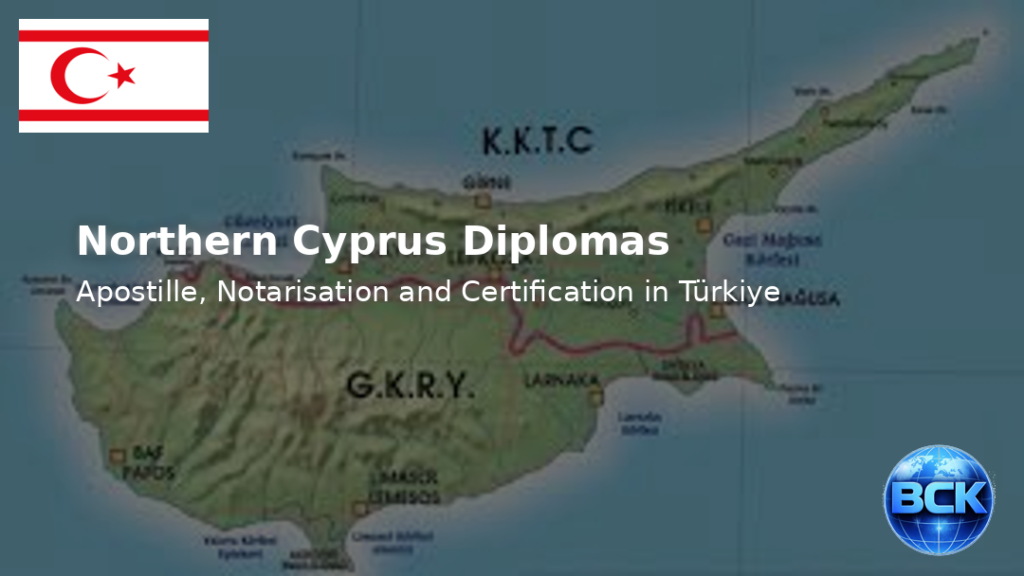
Northern Cyprus Diplomas Apostille Guide
I. Introduction: Why Northern Cyprus Diplomas Require Special Handling
The Turkish Republic of Northern Cyprus (TRNC) occupies a unique position in international law. It is recognized only by Türkiye, which directly affects how academic documents issued by TRNC universities are treated abroad. As a result, diplomas and certificates issued by universities in Northern Cyprus cannot follow a standard apostille process directly. Instead, they must be processed through Türkiye’s legal and administrative system to gain international usability.
II. Leading Universities in Northern Cyprus


- Near East University
- Eastern Mediterranean University
- Girne American University
- European University of Lefke
- Cyprus International University
- University of Kyrenia
- Bahçeşehir Cyprus University
- Final International University
- Cyprus Health and Social Sciences University
- Cyprus Science University
These institutions attract a large number of international students, making the legal usability of their diplomas a highly practical issue.
III. Legal Status of TRNC Documents
The TRNC is not a party to the Hague Apostille Convention. Therefore:
- Apostille cannot be issued in Northern Cyprus
- Documents are not automatically recognized internationally
- Türkiye acts as the primary legalization gateway
This creates a hybrid legal framework where documents are effectively “re-qualified” through Turkish administrative procedures.
IV. Core Legal Principle: Transformation into Turkish-Recognized Documents
Once a diploma is:
- Translated into Turkish
- Notarized in Türkiye
- Attested by relevant Turkish authorities
…it is generally treated as a Turkish-certified document, which can then be:
- Apostilled by Turkish authorities, or
- Legalized via consular channels
This transformation is the cornerstone of the entire process.
V. Step-by-Step Certification Procedure
1. Certified Translation into Turkish
All diplomas and transcripts must be translated by a sworn translator in Türkiye.
2. Notarisation
The translated documents must be certified by a Turkish Notary Public.
3. University Recognition Check
Recognition by Council of Higher Education (YÖK) is critical for:
- Academic equivalency (denklik)
- Public sector employment
- Professional licensing
4. Ministry of Foreign Affairs Attestation
Documents are often submitted to the Ministry of Foreign Affairs of Turkey for authentication.
5. Apostille or Consular Legalisation
- If the destination country is a party to the Apostille Convention → Apostille in Türkiye
- If not → Consular legalization via embassy/consulate
VI. Apostille vs. Consular Legalisation
| Procedure | When Used | Authority |
|---|---|---|
| Apostille | Hague Convention countries | Turkish Governorships |
| Consular Legalisation | Non-member countries | MOFA + Embassy |
Important: Apostille becomes possible only after Turkish notarisation/attestation.
VII. Equivalency (Denklik) Requirement
For official use in Türkiye:
- A Denklik Certificate must be obtained from YÖK
- This process evaluates:
- Accreditation of the university
- Program equivalence
- Academic standards
Without denklik, the diploma may not be valid for employment or further education in Türkiye.
VIII. Role of Turkish Embassies and Consulates
For individuals residing in Cyprus:
- The Turkish Embassy in Nicosia plays a key role in:
- Initial certification
- Document routing
- Administrative facilitation
IX. Practical Challenges and Risks
Due to the partial recognition of the TRNC:
- Some countries may reject documents despite apostille
- Additional legalization steps may be required
- Recognition depends on:
- Destination country policy
- Institutional discretion
This makes case-by-case legal assessment essential.
X. Processing Time and Practical Considerations
Typical timeline:
- Translation & notarisation: 1–2 days
- MOFA attestation: 1–2 days
- Apostille/legalisation: 1–2 days
Average total: ~3 – 6 days
XI. Conclusion: A Hybrid Legal Pathway
Northern Cyprus diplomas exist within a unique legal ecosystem:
- Not directly apostillable
- Processed through Türkiye
- Conditionally recognized internationally
For students and professionals, the key takeaway is clear:
The legal validity of TRNC diplomas depends not on their origin, but on their successful transformation through Turkish legal procedures.
XII. How Bıçak Law Firm Can Assist
Bıçak Law Firm provides comprehensive services including:
- Certified legal translations
- Notarisation coordination
- Apostille and consular legalization
- YÖK denklik advisory
- Cross-border document strategy
If you require assistance in using your Northern Cyprus diploma internationally, a structured legal approach is essential to avoid delays or rejection risks.
Comments
No comments yet.