 English
 Türkçe
 Français
 Deutsch

Pepper spray is legally sold and carried by civilians in Türkiye and is not classified as a firearm under Turkish law. However, when used offensively, courts treat it as a “weapon” within the meaning of Article 6 of the Turkish Penal Code, which may aggravate criminal liability. Misuse can lead to charges such as aggravated assault, armed threat, robbery, or obstruction of a public official. Turkish jurisprudence applies a strict proportionality analysis under Article 25 TPC when evaluating self-defense claims. Lawful defensive use is possible, but only where an imminent and unlawful attack exists and the response is necessary and proportionate. Commercial actors must therefore consider criminal exposure, product positioning, and compliance risks when entering the Turkish market. Proper labeling, distribution controls, and legal structuring significantly reduce regulatory vulnerability. Bıçak advises international manufacturers and distributors on Turkish weapons classification, criminal risk exposure, regulatory compliance, and strategic market entry structuring.
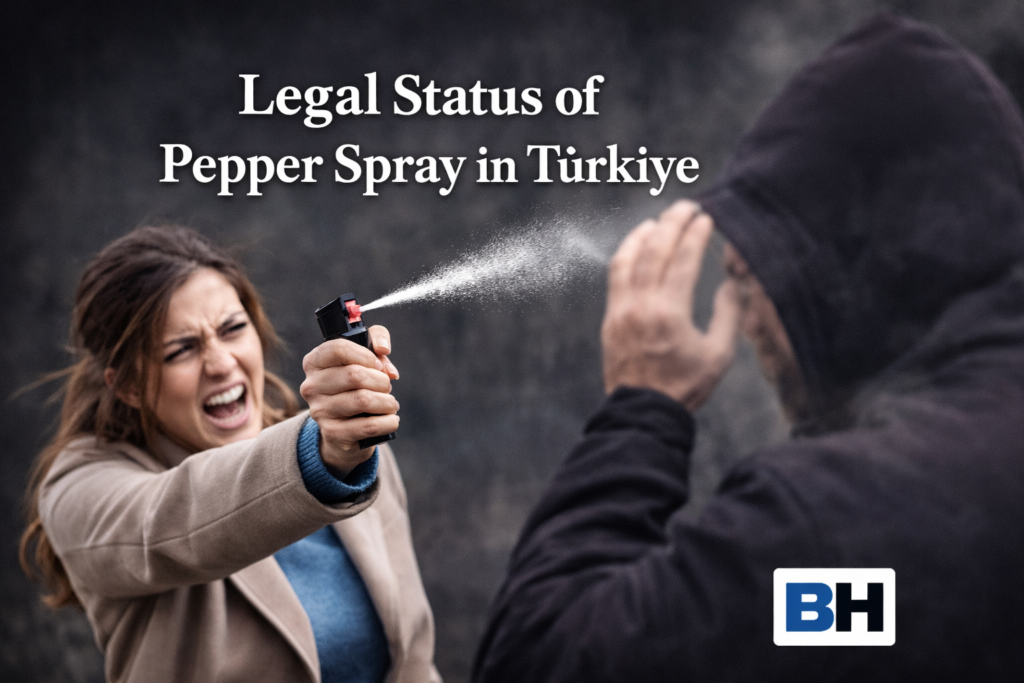
Legal Status of Pepper Spray in Türkiye
1. Introduction: Why Pepper Spray Law Matters for the Industry
The European self-defence market is expanding rapidly, and pepper spray products have moved from a niche tactical segment into mainstream retail distribution. Civilian demand for compact personal protection devices continues to grow across both urban and outdoor markets. However, as sales volumes increase, so does regulatory sensitivity. Pepper spray occupies a legally ambiguous space in many jurisdictions: it is a consumer product, yet it can be treated as a weapon under criminal law when misused. For manufacturers, distributors and retailers operating across borders, the real question is not whether pepper spray is “legal”, but rather under what conditions it may be manufactured, imported, marketed, sold, carried and used without triggering criminal or administrative exposure. Regulatory frameworks in Europe vary significantly, ranging from outright prohibition to conditional legality. This divergence creates compliance complexity for businesses.
Türkiye represents a particularly relevant jurisdiction in this context. It is a large consumer market with increasing e-commerce penetration, a growing tactical and outdoor industry, and a strategic geographic position connecting the European Union, the Balkans and the Middle East. At the same time, Turkish criminal law classifies certain chemical agents as “weapons” depending on context and use. As a result, commercial actors must carefully distinguish between lawful product distribution and conduct that may generate criminal risk. Recent judicial decisions demonstrate that Turkish courts treat pepper spray as a weapon when it is used in the commission of offences such as assault, robbery or obstruction of public officials. This functional classification has direct implications for retailers, importers and brand owners. Product positioning, labeling, marketing language, concentration levels, and distribution channels can all become legally relevant in the event of misuse.
For manufacturers, distributors and investors active in the tactical, outdoor and personal protection sectors, understanding the Turkish legal landscape is not merely an academic exercise. It is a practical necessity for structuring distribution agreements, managing export documentation, assessing sanctions exposure and mitigating criminal liability risks. Companies entering or expanding within the Turkish market must align product strategy with regulatory reality. Türkiye presents both commercial opportunity and regulatory sensitivity. Pepper spray products are not prohibited per se; however, their legal character may shift depending on product specifications, manner of use, and contextual factors under criminal law. This dual nature makes regulatory foresight and contractual structuring essential for businesses operating in this field. This guide examines the legal status of pepper spray in Türkiye from a criminal law, regulatory compliance and cross-border trade perspective. It provides a structured risk analysis intended for companies operating in regulated and trade-sensitive sectors seeking legally resilient market positioning.
2. Legal Definition and Regulatory Classification in Türkiye
Türkiye does not have a dedicated statute or licensing regime that exclusively regulates civilian-grade pepper spray. In practice, the legal status of pepper spray is assessed through a combination of the Turkish Penal Code (Law No. 5237), Law No. 6136 on Firearms, Knives and Other Instruments, general criminal law principles, security-related administrative rules (especially for high-security venues), and – most decisively – judicial interpretation. As a result, legality is not determined only by “what the product is”, but also by how it is classified, how it is marketed, and how it is used in a concrete setting. For market participants, this means compliance analysis must be layered rather than statute-centric.
The central reference point is the functional definition of “weapon” in Article 6 of the TPC. The statutory definition is broad and captures not only classic weapons but also objects and substances that are capable of being used for attack or defense. In that framework, pepper spray – typically OC-based – can be treated as a weapon in criminal proceedings where it is deployed against a person in a way that is capable of causing injury or incapacitation. This functional approach matters commercially: a product that is lawfully sold as a personal safety item may still be qualified as a “weapon” once it becomes part of an alleged offence.
Turkish appellate practice (especially Yargıtay) consistently treats pepper spray as a weapon when it is used to injure, threaten, coerce, or facilitate another offence. Two recent illustrations are (Yargıtay 5th Criminal Chamber, 20.09.2023, E.2022/2210, K.2023/8787) and (Yargıtay 6th Criminal Chamber, 29.03.2023, E.2021/24099, K.2023/9638). The practical consequences include aggravation of the base offence (and therefore higher sentencing exposure), seizure/confiscation dynamics (including potential confiscation under Article 54 TPC), and the product becoming key evidentiary material in the file.
A commercially important distinction exists between low-capacity civilian sprays designed for personal defense and high-capacity riot-control or tactical dispersal devices intended for law enforcement. Türkiye does not publish a universally applicable “bright-line” civilian concentration threshold in a single pepper-spray-specific statute; in practice, authorities and courts may evaluate technical characteristics case-by-case (capacity, discharge mechanism, effective range, potency, and how the product is positioned). Products presented as “military-grade”, “police-use”, “NATO-type”, or “tactical deployment” are more likely to trigger scrutiny – particularly at customs and in criminal files – because they may be interpreted as law-enforcement equipment rather than ordinary consumer defensive goods.
Pepper spray in Türkiye should be treated as a dual-character product: commonly tolerated as a consumer safety item in ordinary possession, yet legally sensitive at the moment of misuse and frequently qualified as a “weapon” once it becomes part of a criminal allegation. That duality should inform product positioning, labeling, warnings, distribution architecture, and downstream risk allocation (including contractual and reputational planning).
3. Carrying and Possession of Pepper Spray in Türkiye: Scope and Limitations
There is no categorical criminal prohibition on civilians possessing commercially available, civilian-grade pepper spray for defensive purposes. Pepper spray is not a firearm and is not subject to a firearms licensing model. In ordinary daily life, carrying pepper spray in a bag or pocket, or keeping it in a vehicle, is generally not unlawful on its face.
The legal risk profile changes significantly in high-security environments and controlled-entry venues. Aviation security rules prohibit pepper spray in aircraft cabins and, in practice, it is typically not accepted in baggage either; detection may lead to confiscation and questioning. Entry to courthouses, police buildings, ministries, parliament-related areas, and correctional facilities is subject to enhanced security checks; the item may be refused at entry or temporarily held. In correctional settings, attempting to introduce prohibited items can create separate criminal exposure depending on the circumstances and the applicable offence provisions.
In mass gatherings, demonstrations, and certain large events, law enforcement and private security often apply preventive security logic. Even where possession is not inherently criminal, pepper spray may be treated as a risk object, leading to confiscation, denial of entry, or administrative measures depending on context and local security instructions.
Even without discharge, confrontational display, brandishing, or using pepper spray as a coercive tool can shift the analysis from lawful possession to criminal conduct – most notably threat-related offences where “weapon” qualification becomes relevant. This is why “possession rules” cannot be separated from the manner and purpose of carrying.
For commercial actors, the key point is predictability: possession is broadly tolerated for civilian-grade products, but location-based controls and context-driven security rules are common. User guidance should therefore clearly address where carrying may trigger confiscation or legal trouble, and should avoid any implication of unrestricted portability “everywhere.”
4. Criminal Liability Exposure: Use of Pepper Spray Under Turkish Penal Law
Pepper spray’s legal character changes most sharply at the point of use. Once deployed against a person, courts frequently treat it as a weapon within the meaning of Article 6 TPC, which can aggravate a range of offences.
Yargıtay’s functional approach means that pepper spray used to injure, intimidate, or compel is commonly treated as a weapon element for sentencing purposes. This is reflected in (Yargıtay 5th Criminal Chamber, 20.09.2023, E.2022/2210, K.2023/8787) and (Yargıtay 6th Criminal Chamber, 29.03.2023, E.2021/24099, K.2023/9638), where pepper spray appears as a legally significant instrument in the criminal assessment.
When used offensively, pepper spray can trigger aggravated intentional injury analysis, robbery/yağma-related qualification where coercion is present, weapon-based threat exposure where intimidation is established (even without discharge), and “resistance to prevent the execution of duty” dynamics where public officials are targeted during official actions. Use in crowded places can also raise public-safety concerns depending on concrete risk and outcomes.
Pepper spray used in an offence is typically seized as evidence and may become subject to confiscation logic under the general rules of instruments used in crime, including the application of Article 54 TPC where conditions are met. This remains true even if the product itself was lawfully purchased.
End-user misuse does not automatically create criminal liability for manufacturers or retailers. However, inadequate warnings, irresponsible marketing, poor channel control, or fact patterns suggesting knowing facilitation can create indirect exposure (civil claims, regulatory attention, and reputational harm). The compliance goal is not to eliminate all downstream misuse, but to demonstrate responsible product positioning and reasonable preventive measures.
5. Self-Defense and Proportionality: When Use May Be Lawful Under Article 25 TPC
Article 25 TPC provides the principal justification framework for self-defense and necessity. Defensive conduct is lawful where it is used to repel an unlawful attack that is occurring, imminent, or certain to recur, and where the response is necessary and proportionate in the circumstances.
Pepper spray use is most defensible when tied to a concrete, unlawful, present danger. If the threat has ended, or if the situation is primarily a verbal dispute without a present unlawful attack, reliance on self-defense becomes significantly weaker and may be rejected as retaliation rather than protection.
Courts assess whether the defensive act was necessary at the moment. If avoidance, withdrawal, or other realistic protective options were available, necessity may be questioned. This assessment is fact-intensive and scenario-specific.
Proportionality is often the decisive element in pepper spray files. Factors commonly evaluated include intensity of the attack, imbalance between the parties, duration and amount of discharge, whether spraying continued after the attacker was neutralized, and resulting harm. Excessive use may lead to liability even if the initial defensive impulse was legitimate.
Article 25(2) covers necessity where a person acts to avoid an unavoidable, grave, and certain danger not caused intentionally, with proportionality preserved. Depending on facts, this can be relevant in some urgent protection scenarios, but it does not remove the proportionality filter.
For market participants, aligning product instructions and consumer messaging with the Article 25 framework is a practical risk-management tool: defensive-only positioning, proportionality warnings, and clear “do not use for intimidation or retaliation” guidance reduce downstream legal and reputational risk.
6. Retail and Commercial Compliance in Türkiye
Pepper spray is not regulated like firearms under a strict licensing model, yet the market is not unregulated. Compliance emerges from the intersection of product safety, consumer protection, customs practice, public-order sensitivities, and the criminal-law “weapon” doctrine that becomes relevant upon misuse. Commercial feasibility therefore depends on disciplined product and channel governance rather than a single permit.
Import and market-entry risk typically concentrates around technical classification, documentation quality, and how the item appears in practice (civilian safety product versus tactical dispersal device). Customs scrutiny can increase where capacity, discharge mechanism, or marketing cues suggest law-enforcement grade equipment. Accurate technical files, consistent labeling, and a defensible product narrative are essential to reduce delays and seizure risk.
Under Turkish consumer and product-safety logic, distributors and sellers should ensure clear Turkish-language instructions, safe-storage warnings, foreseeable misuse cautions, first-aid guidance, and appropriate age practice. The aim is twofold: user safety and demonstrable due diligence if the product becomes linked to an incident.
Marketing should remain defensive and safety-oriented. Messaging that highlights offensive capability, “tactical dominance,” or guaranteed incapacitation can be counterproductive, because it may be cited in reputational narratives and can invite scrutiny where misuse occurs. Conservative positioning is a practical compliance asset.
Even if not mandated as “firearms controls”, reasonable channel measures are advisable: age checks in practice, staff awareness, avoidance of suspicious bulk sales patterns, traceable distribution, and contractual commitments with resellers to maintain lawful-use framing. These measures strengthen risk allocation and show responsible distribution standards.
Because confiscation is common at airports, controlled-entry venues, and certain events, it is commercially wise to warn consumers clearly that “lawful ownership” does not guarantee “lawful entry” everywhere. This reduces consumer disputes and protects brand credibility.
7. Judicial Practice and Recent Court Decisions
Turkish appellate jurisprudence is relatively consistent: pepper spray is not inherently illegal, but misuse is treated seriously and often triggers weapon qualification. The value of case law for compliance is that it shows how courts operationalize Article 6 (weapon definition), Article 25 (justification), and confiscation rules in real files.
In (Yargıtay 5th Criminal Chamber, 20.09.2023, E.2022/2210, K.2023/8787), pepper spray was used against an official during an auction-related event; the Court’s reasoning underscores that pepper spray functions as a legally significant instrument when deployed to exert force, and confiscation analysis becomes relevant. In (Yargıtay 6th Criminal Chamber, 29.03.2023, E.2021/24099, K.2023/9638), pepper spray appears in the factual matrix of a robbery scenario, reinforcing that intimidation or coercion supported by pepper spray can lead to aggravated offence qualification.
Across offence types, courts typically focus on how the spray was used (defensive versus offensive), the immediacy of the threat, the extent and duration of exposure, and the harm profile. Where intimidation, coercion, retaliation, or public-order endangerment is indicated, justification arguments weaken and aggravated qualification becomes more likely.
This case-law consistency creates predictability: responsible products and responsible messaging remain commercially manageable, while “tactical-grade” positioning and end-user misuse increase the probability that a product is framed as a weapon in criminal files. The commercial lesson is not that the product is prohibited, but that the legal narrative around it is highly sensitive to context and presentation.
8. Strategic Risk Management and Market Entry Guidance
Pepper spray can be commercially sold and is commonly tolerated in civilian possession, but it becomes legally high-risk when misused and is frequently treated as a weapon in criminal proceedings. The compliance goal is to structure market conduct so that the product is consistently understood and documented as a civilian defensive safety item.
Risk is reduced when technical specifications, packaging, and manuals remain aligned with civilian defensive use. Avoiding law-enforcement cues, keeping product descriptions consistent with personal protection, and providing robust warnings/instructions help preserve the “civilian-grade” narrative and reduce enforcement friction.
Market-entry planning should include distributor agreement design, traceability expectations, Turkish-language labeling readiness, documented age-practice policies, and a marketing review process that filters out militarized or offensive claims. These are practical, defensible measures if the product later appears in an investigation.
High-visibility incidents can lead to requests for product origin information, distribution chain questions, warning adequacy review, and technical specification scrutiny. Having a structured compliance file (technical documentation, labeling versions, instruction sets, distributor undertakings) is a practical form of crisis readiness.
Türkiye is not a closed market for pepper spray, but it is a context-sensitive market where courts apply a functional “weapon” doctrine. Commercial success and risk containment depend on disciplined product framing, careful channel controls, and user-facing guidance that tracks Turkish criminal-law boundaries—especially proportional self-defense under Article 25 TPC.
9. Conclusion
Pepper spray occupies a legally nuanced position under Turkish law. It is not classified as a firearm and its civilian sale, possession, and defensive carriage are generally lawful. However, TPC practice – particularly under Articles 6, 86, 106, 148–149 and 25 – demonstrates that legality turns on use, not mere possession.
Judicial interpretation consistently treats pepper spray as a “weapon” when used offensively or coercively. This classification significantly increases criminal exposure in cases of assault, threat, robbery, or obstruction of public duty. At the same time, lawful defensive use remains protected where the strict conditions of proportionality, necessity, and immediacy under Article 25 of the TPC are satisfied. Recent appellate decisions confirm three core principles:
- Pepper spray may qualify as a weapon even though it is commercially available.
- Misuse can elevate ordinary offences into aggravated forms.
- Self-defense claims are assessed under a rigorous proportionality test.
For manufacturers, distributors, and retailers, the Turkish market presents a legally accessible but compliance-sensitive environment. Regulatory risk does not stem from prohibition, but from improper positioning, distribution, labeling, or insufficient legal structuring. A forward-looking compliance model – integrating criminal law awareness, consumer safety standards, customs accuracy, and crisis management planning – is therefore essential for sustainable commercial activity. Pepper spray in Türkiye is not a banned product. It is a legally tolerated defensive instrument whose misuse transforms it into a source of aggravated liability.





Comments
No comments yet.