 English
 Türkçe
 Français
 Deutsch

Embassies, consulates and international organisations in Türkiye may purchase or lease real estate for chanceries, official residences, staff accommodation, cultural offices and other operational purposes. These transactions are governed by Turkish property, contract, zoning, construction and tax law together with diplomatic law, reciprocity and any applicable international agreements. Prior notification to and approval from the Turkish Ministry of Foreign Affairs may be required before a purchase, lease, sale, renovation, expansion or change of use is completed. Missions should therefore avoid entering into unconditional agreements before official approval and should include clear provisions on deposits, advance payments and the consequences of refusal or delay. Comprehensive due diligence should cover title records, encumbrances, zoning, occupancy permits, condominium restrictions, structural safety, earthquake risk and the authority of the seller or landlord. Embassy lease agreements should also regulate rent, currency, renewal, security improvements, maintenance, early termination, diplomatic break clauses and restoration obligations. Tax exemptions, inviolability, jurisdictional immunity and immunity from enforcement must be assessed separately and should never be assumed to apply automatically. Bıçak advises diplomatic missions and international organisations throughout Türkiye on property acquisitions, leases, Ministry procedures, due diligence, tax exemptions, renovation projects, termination and related disputes.
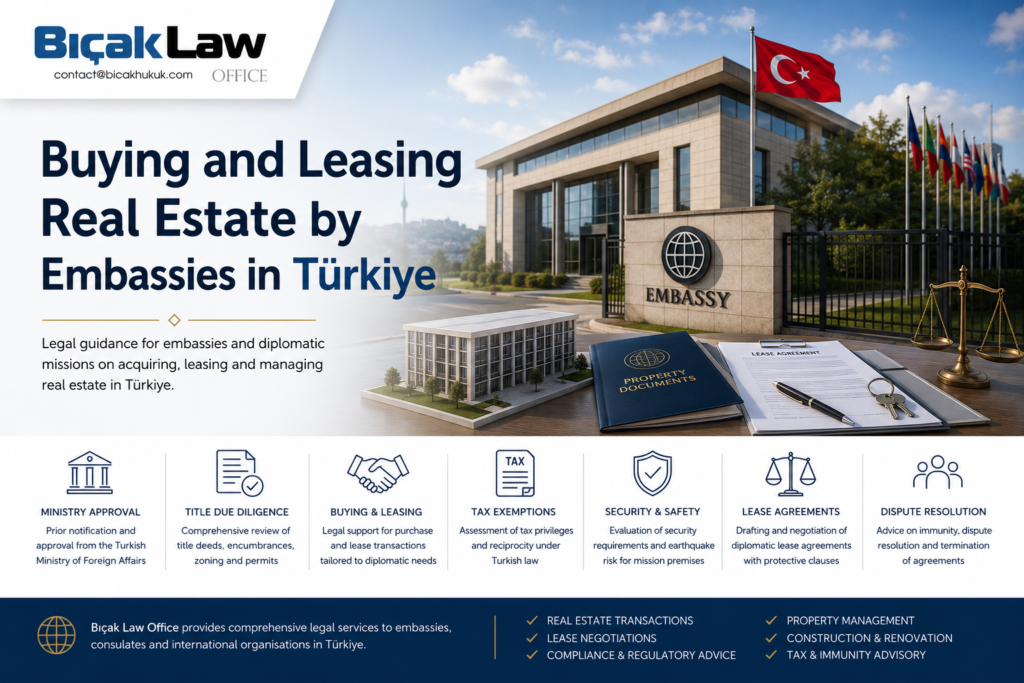
Buying – Leasing Real Estate by Embassies in Türkiye
1. Introduction
Embassies, consulates and international organisations operating in Türkiye may need to purchase or lease real estate for a wide range of official and residential purposes. These properties may serve as a chancery, consular office, ambassador’s residence, diplomatic staff housing, cultural centre, trade office, archive, storage facility or other operational premises. A diplomatic property transaction is not, however, an ordinary commercial purchase or lease. It lies at the intersection of Turkish property law, contract law, planning and construction rules, taxation, diplomatic privileges, security requirements and public international law.
The identity of the acquiring or leasing institution, the intended use of the premises, the location of the property and the applicable principle of reciprocity may all affect the procedure. Transactions involving international organisations may additionally be governed by constituent treaties or host country agreements. Most importantly, foreign missions must involve the Turkish Ministry of Foreign Affairs before completing a purchase, lease, sale, renovation, expansion or change-of-use transaction. Proceeding without the required notification and approval may expose the mission to substantial financial, legal and operational risks. This guide explains how embassies, consulates and international organisations can safely acquire, lease, occupy, renovate, manage and dispose of real estate in Türkiye.
2. Institutions Covered by This Guide
The principles discussed in this guide may be relevant to:
- Embassies;
- Consulates and consulates general;
- Permanent missions;
- Representations of international organisations;
- United Nations agencies;
- Cultural institutes;
- Commercial and trade offices;
- Defence, liaison and technical offices;
- Other foreign representations enjoying privileges or immunities in Türkiye.
The applicable rules are not identical for every institution. Diplomatic missions and consular posts are principally governed by the Vienna conventions, Turkish law and reciprocity. International organisations may benefit from different privileges under their constituent instruments, international conventions and host country agreements concluded with Türkiye. Each proposed transaction should therefore begin with an institutional-status review rather than an assumption that all foreign representations enjoy the same rights and exemptions.
3. Types of Diplomatic Property
The legal treatment of a property may depend substantially on its official designation and actual use. Common categories include:
- A chancery or embassy office;
- A chancery annex;
- A consulate or consulate general;
- The official residence of the head of mission;
- Residences occupied by diplomatic, administrative or consular personnel;
- Cultural, educational or commercial offices;
- Archives and secure document-storage facilities;
- Warehouses and operational support premises;
- Official parking areas;
- Property undergoing construction, redevelopment or major renovation.
The distinction matters because approval procedures, planning rules, tax exemptions and diplomatic protections may differ according to whether the property is used as an official mission building, a chief-of-mission residence, staff accommodation or another type of facility. A property approved for diplomatic or consular use should normally be used in accordance with that declared purpose. Its use by another governmental office, a third party or a commercial operator may require additional consent from the Ministry of Foreign Affairs.
4. International and Turkish Legal Framework
Diplomatic real estate transactions in Türkiye are governed by several overlapping legal regimes. The international framework includes:
- The Vienna Convention on Diplomatic Relations of 1961;
- The Vienna Convention on Consular Relations of 1963;
- Customary international law;
- Bilateral agreements;
- The principle of reciprocity;
- Constituent treaties of international organisations;
- Host country agreements.
The relevant domestic framework may include:
- Turkish land registry and cadastral legislation;
- The Turkish Code of Obligations;
- Zoning, planning and construction legislation;
- Municipal regulations;
- Condominium law;
- Tax legislation;
- Environmental and heritage-protection rules;
- Earthquake and building-safety requirements;
- Civil procedure and enforcement law.
Diplomatic status does not remove a transaction from Turkish property, planning or contract law. Immunity and inviolability protect particular sovereign interests, but they do not eliminate the need to obtain planning permission, verify title, draft an enforceable agreement or comply with building-safety requirements.
5. The Role of the Ministry of Foreign Affairs
The Directorate-General of Protocol of the Turkish Ministry of Foreign Affairs plays a central role in diplomatic property transactions. Foreign missions must notify the Ministry before a proposed:
- Purchase;
- Lease;
- Sale;
- Other acquisition or disposal;
- Construction project;
- Alteration;
- Expansion;
- Major renovation;
- Change in use.
The Ministry’s review is intended to ensure that the location and use of the proposed premises are compatible with planning, municipal, traffic and security considerations. The Ministry has expressly stated that it may decline to approve a transaction completed without prior approval. The fact that a mission has already signed a contract, made a payment, taken possession or moved into the property does not bind the Ministry to approve the arrangement retrospectively. Early consultation is therefore essential. Diplomatic approval should be treated as a central transaction condition, not as an administrative formality to be completed after signing.
6. Notification and Approval Procedure
The review procedure is initiated by a diplomatic note submitted to the Protocol Department. The notification should contain, at minimum:
- The exact address of the property;
- The apartment, suite or independent-unit number, where applicable;
- The proposed use of the premises;
- The method of acquisition;
- The proposed lease term, where relevant;
- A copy of the title deed.
The Ministry has also requested that notifications include available block, map and parcel information relating to the property. The official procedure allows the Ministry up to 60 days to review a request, although the 2005 circular indicates that many applications may be resolved sooner. Missions should nevertheless plan on the basis that the full review period may be required. A transaction timetable should therefore provide sufficient time for:
- Ministry review;
- Municipal and planning enquiries;
- Security assessment;
- Legal due diligence;
- Technical inspection;
- Contract negotiation;
- Tax-exemption applications;
- Registration or delivery.
7. Agreements Signed Before Approval
A mission should generally avoid entering into an unconditional purchase or lease agreement before receiving the Ministry’s approval. Where commercial circumstances require an agreement to be signed earlier, the contract should state expressly that its effectiveness or completion is conditional upon approval by the Ministry of Foreign Affairs. This approach is specifically contemplated by the Ministry’s official procedure. A properly drafted condition precedent should address:
- The authority responsible for seeking approval;
- The documents to be submitted;
- A long-stop date for receiving approval;
- The consequences of refusal;
- The return of deposits and advance rent;
- Responsibility for legal and technical expenses;
- Whether possession may be delivered before approval;
- Whether either party may terminate during the approval period;
- Whether partial or conditional approval is acceptable.
A general phrase such as “subject to official approval” may be insufficient. The agreement should define precisely which approval is required and what happens if it is delayed, refused or granted subject to conditions.
8. Preliminary Needs and Site Assessment
Before searching for property, the mission should prepare a written operational brief. This should identify:
- The intended legal and operational use;
- Whether the property will be purchased or leased;
- Required floor area and capacity;
- Public-access needs;
- Parking requirements;
- Security and perimeter requirements;
- Emergency access;
- Accessibility;
- Communications infrastructure;
- Archive and storage requirements;
- Staff-residential needs;
- Future expansion possibilities;
- Budget and expected occupancy period.
The mission should also decide whether the property must be capable of immediate occupation or whether substantial fit-out and structural works are acceptable. A clear brief prevents the mission from investing time in properties that are attractive commercially but unsuitable from a diplomatic, planning, structural or security perspective.
9. Buying Versus Leasing
The decision to purchase or lease should be based on legal, financial and operational factors. Purchasing may provide:
- Long-term security of occupation;
- Greater control over structural alterations;
- Reduced exposure to rent increases;
- A long-term institutional asset;
- Greater freedom to implement mission-specific security measures.
It may also require:
- A larger initial capital commitment;
- More extensive title and technical due diligence;
- Responsibility for structural maintenance;
- Long-term property management;
- A later disposal procedure;
- Detailed tax and registration planning.
Leasing may provide:
- Lower initial expenditure;
- Greater flexibility;
- Easier relocation;
- Reduced long-term asset-management responsibility.
However, a lease may expose the mission to:
- Rent-adjustment disputes;
- Restrictions on alterations;
- Dependence on the landlord;
- Renewal uncertainty;
- Termination and eviction disputes;
- Deposit-recovery issues;
- Difficulties installing specialist security infrastructure.
The choice should be aligned with the anticipated duration of the mission’s use, the strategic importance of the location and the scale of planned modifications.
10. Identifying the Correct Purchaser or Tenant
One of the most important drafting issues is identifying the proper legal party. Depending on the transaction, the purchaser or tenant may be described as:
- The sending state;
- The government of the sending state;
- The embassy acting on behalf of the sending state;
- A consular post acting through the embassy;
- An international organisation with separate legal personality;
- An authorised governmental institution;
- A duly authorised representative acting for the relevant entity.
The institution’s internal terminology should be reconciled with Turkish registration and contractual requirements. Naming an ambassador, diplomat or employee personally as purchaser or tenant may create serious complications unless the transaction is genuinely personal. A person acting in an official capacity should not be confused with the state or organisation that will own, occupy or finance the property. The agreement should state clearly:
- The legal identity of the party;
- Its official capacity;
- Its address for contractual purposes;
- The source of the signatory’s authority;
- Whether the transaction is official or private;
- Whether the property will qualify as mission premises.
11. Authority and Representation Documents
The seller, landlord, land registry directorate, bank, municipality or other authority may require evidence that the person signing for the mission has authority to do so. Depending on the transaction, relevant documents may include:
- A diplomatic note;
- A letter of authority;
- A governmental decision;
- A power of attorney;
- An appointment or accreditation document;
- Signature authorisation;
- An organisational resolution;
- Evidence of the international organisation’s legal personality.
Foreign documents may need to be translated into Turkish and, depending on their nature and the applicable diplomatic or legal channel, authenticated or legalised. The required form should be confirmed at an early stage. A transaction may be delayed even after commercial terms are agreed if the signing authority or representation documents are not acceptable to the relevant Turkish institution.
12. Legal Due Diligence Before Purchase
A diplomatic purchaser should conduct comprehensive legal due diligence before making a binding commitment. The review should include:
- Confirmation of the registered owner;
- Verification of cadastral information;
- Identification of the relevant independent unit;
- Review of mortgages;
- Attachments and enforcement annotations;
- Easements;
- Usufruct rights;
- Rights of residence;
- Litigation annotations;
- Expropriation or public-project risks;
- Preliminary sales agreements;
- Rights of first refusal;
- Restrictions arising from co-ownership;
- Condominium-management rules;
- Common-area rights;
- Existing leases or occupation;
- Outstanding municipal or management liabilities.
The title deed alone may not reveal every legal, planning or physical problem. Due diligence should therefore extend to land registry records, cadastral information, municipal files, the condominium-management plan and relevant contracts. A purchaser should not rely solely on documents supplied by the seller.
13. Zoning, Permitted Use and Occupancy
The property’s existing physical appearance does not establish that it may lawfully be used as a chancery, consulate or institutional office. The mission should verify:
- The applicable zoning plan;
- The registered use of the property;
- The construction permit;
- The occupancy permit;
- Whether office or institutional use is permitted;
- Whether a change of use is required;
- Whether the premises comply with fire and accessibility rules;
- Whether alterations were carried out lawfully;
- Whether condominium rules restrict the proposed use.
The Turkish Ministry of Foreign Affairs specifically requires foreign missions to comply with applicable municipal, building and land-use rules. For chanceries and chancery annexes in Ankara, an occupancy permit must be obtained before occupation, and certain municipal permits require the written concurrence of the Protocol Department. A residential title classification does not necessarily mean that the premises may be converted into an embassy office without further approval.
14. Chancery Premises in Ankara
The official procedure gives particular attention to chanceries and chancery annexes in Ankara. The Protocol Department assesses whether a proposed location is acceptable and whether alterations or expansion comply with applicable local requirements. Municipal occupancy and planning approvals are also required. Where construction or alteration permits are needed, project plans may first have to be submitted to the Protocol Department for review and transmission to the appropriate local authority. An Ankara chancery transaction should therefore coordinate:
- Ministry approval;
- Municipal planning review;
- Occupancy permission;
- Construction and alteration permits;
- Security considerations;
- Traffic and access issues;
- Legal and technical due diligence.
The purchase or lease agreement should not assume that a building currently used as an office is automatically acceptable for diplomatic use.
15. Consular Properties Outside Ankara
Purchases, leases, alterations, expansions and changes of use involving consular properties are also subject to prior notification. Consular posts are expected to submit property notifications to the Ministry through their embassies. They must additionally comply with the planning, building and permit requirements of the municipality or local authority where the property is located. A consulate in Istanbul, İzmir, Antalya or another city may therefore face a different municipal process from a chancery in Ankara. Local due diligence should address:
- Municipal zoning;
- Building-use classifications;
- Local traffic and access conditions;
- Fire-safety requirements;
- Historic-building restrictions;
- Earthquake-risk status;
- Construction and renovation permits.
The mission should not assume that approval practices are uniform across all Turkish cities.
16. Residences for Heads of Mission and Diplomatic Personnel
Residential properties purchased or leased by foreign missions for members of the mission are subject to the Ministry’s notification requirements. A distinction should be made between:
- The official residence of the head of mission;
- Residences leased by the sending state for diplomatic personnel;
- Privately rented accommodation;
- Staff housing used by administrative or service personnel;
- Mixed official and private use.
The distinction may affect:
- The identity of the tenant or purchaser;
- Eligibility for tax privileges;
- Responsibility for rent and utilities;
- Diplomatic designation;
- Termination rights;
- Maintenance obligations;
- Protection and inviolability.
The agreement should clearly identify whether the property is being occupied in an official or private capacity.
17. Lease Due Diligence
Before entering into a lease, the mission should verify both the property and the landlord. The review should establish:
- That the landlord is the registered owner or duly authorised representative;
- Whether the property is co-owned;
- Whether all required owners have consented;
- Whether the property is mortgaged or subject to attachment;
- Whether another tenant or occupier has rights over the premises;
- Whether the intended use is lawful;
- Whether alterations require the consent of third parties;
- Whether condominium-management rules permit the proposed use;
- Whether the building has an occupancy permit;
- Whether there are outstanding management or utility debts;
- Whether the property has structural or safety defects.
Where the landlord acts through a power of attorney, the scope and continuing validity of that authority should be checked carefully. A long-term diplomatic lease should generally receive a level of legal and technical scrutiny comparable to a purchase.
18. Essential Clauses in Embassy Lease Agreements
A diplomatic lease should be tailored to the mission’s operational requirements rather than based on a standard residential or commercial template. Key provisions should address:
- The identity and authority of the parties;
- The official use of the premises;
- Ministry approval as a condition precedent;
- The lease commencement date;
- The duration of the lease;
- Renewal and extension options;
- Rent and payment currency;
- Rent-adjustment mechanisms;
- Deposit or security;
- Delivery condition;
- Fit-out rights;
- Structural alterations;
- Security installations;
- Maintenance and repair;
- Insurance;
- Utilities and management expenses;
- Access by the landlord;
- Confidentiality;
- Assignment and subletting;
- Early termination;
- A diplomatic break clause;
- Force majeure;
- Closure or relocation of the mission;
- Restoration obligations;
- Handover at termination;
- Governing law;
- Dispute resolution;
- Notices.
The lease should also determine which provisions survive termination, particularly confidentiality, restoration, liability and dispute-resolution clauses.
19. Rent, Currency and Payment
Rent provisions should comply with the mandatory rules applicable at the time the agreement is made. The parties should clearly regulate:
- The currency of rent;
- The payment date;
- The receiving bank account;
- Transfer charges;
- Applicable withholding or indirect taxes;
- Whether rent is stated inclusive or exclusive of taxes;
- The adjustment mechanism;
- Late-payment consequences;
- Advance rent;
- Payment during renovation or delayed occupation.
Currency and rent-adjustment rules may change over time. Their application may also depend on the legal identity of the parties and the nature of the transaction. The agreement should therefore be reviewed under the rules in force on the signing date rather than relying on an older standard form. Diplomatic status should not be assumed to remove all payment, tax or documentation requirements.
20. Deposit and Financial Security
A landlord may request:
- A cash deposit;
- Advance rent;
- A bank guarantee;
- A governmental guarantee;
- Another form of security.
The lease should specify:
- The amount and currency;
- Where the deposit will be held;
- Whether it earns interest;
- The permitted grounds for deduction;
- The procedure for documenting damage;
- The repayment deadline;
- The treatment of ordinary wear and tear;
- The effect of early termination;
- The impact of Ministry approval being refused.
A deposit should not become an undefined source of compensation for the landlord. Any right of deduction should be linked to identifiable contractual obligations and supported by evidence. Where a significant advance payment is required, the mission should consider whether escrow or another protected payment arrangement is appropriate.
21. Renovation, Construction and Fit-Out
Diplomatic premises often require specialised works that go beyond ordinary office decoration. These may include:
- Reinforced entrances;
- Controlled-access systems;
- Security rooms;
- Perimeter works;
- Generators;
- Electrical and communications infrastructure;
- Secure meeting facilities;
- Archive protection;
- Fire-safety systems;
- Accessibility improvements;
- Flagpoles or signage;
- Parking and vehicle-control installations.
Alterations, additions and changes of use are themselves subject to prior notification to the Ministry. Construction and major renovation may also require municipal permits and compliance with local building regulations. The mission should obtain clarity on:
- Ownership of installed equipment;
- Landlord consent;
- Permit responsibility;
- Design approval;
- Contractor liability;
- Health and safety;
- Insurance;
- Completion testing;
- Removal or restoration at the end of the lease.
Fit-out works should be governed by a separate, detailed construction or services agreement where their scale justifies it.
22. Earthquake and Structural Safety
Structural safety is a critical part of property selection in Türkiye. A legal review should be supported by qualified technical professionals who can assess:
- The age of the building;
- Construction system;
- Available structural plans;
- Soil and foundation conditions;
- Visible defects;
- Previous alterations;
- Earthquake performance;
- Retrofitting history;
- Risky-building determinations;
- Fire and emergency systems;
- Evacuation routes.
The mission should also determine who bears responsibility for structural strengthening and whether the building can remain occupied during works. For a leased building, the agreement should deal expressly with:
- Structural defects;
- Mandatory evacuation;
- Government-ordered works;
- Rent suspension;
- Alternative premises;
- Early termination;
- Insurance proceeds;
- Responsibility for retrofitting costs.
A favourable title review cannot compensate for an unsafe building. Legal and engineering due diligence should proceed in parallel.
23. Historic and Protected Properties
Historic buildings may be attractive for diplomatic use because of their architectural character and location. They may also be subject to extensive restrictions. The mission should investigate:
- Whether the building is officially registered;
- Whether it lies within a protected area;
- Whether conservation-board approval is required;
- Restrictions on façade alterations;
- Limitations on internal changes;
- Rules on signage and security installations;
- Restoration obligations;
- Archaeological or cultural-heritage constraints.
Works that would be straightforward in a modern office building may be prohibited or heavily regulated in a protected property. The purchase or lease should not be completed until the mission knows whether its operational and security requirements can lawfully be implemented.
24. Security and Operational Suitability
Security assessment should take place before the mission becomes contractually committed. Relevant considerations may include:
- Site perimeter;
- Vehicle and pedestrian access;
- Emergency routes;
- Setback from public areas;
- Parking;
- Surrounding buildings;
- Visibility and exposure;
- Public gatherings and traffic;
- Police and emergency access;
- Secure communications capability;
- Continuity of utilities;
- Evacuation planning.
The Ministry’s approval process expressly takes security and traffic considerations into account. Public legal guidance should not disclose operational security details. Nevertheless, the transaction documentation must give the mission sufficient authority to implement approved security measures and restrict unauthorised landlord or contractor access.
25. Inviolability of Diplomatic Premises
The Vienna Convention on Diplomatic Relations protects the inviolability of mission premises. Agents of the receiving state may not enter without the consent of the head of mission, and the receiving state has a special duty to protect the premises against intrusion, damage and disturbance. Inviolability is conceptually distinct from ownership.
A building may constitute mission premises even where it is leased rather than owned, provided it is lawfully used for the purposes of the mission. Conversely, foreign-state ownership alone does not necessarily mean that every part of a property enjoys diplomatic protection. The distinction should be maintained between:
- Ownership rights;
- Contractual occupation rights;
- Official designation and use;
- Inviolability;
- Jurisdictional immunity;
- Enforcement immunity.
Inviolability does not extinguish rent, repair, contractual or tax obligations. Nor does it validate an acquisition, use or alteration carried out without the required approval.
26. Tax Exemptions and Reciprocity
Foreign governments may benefit from exemptions concerning properties owned by the government and used for diplomatic purposes. The Ministry’s official guidance identifies chanceries, chancery annexes and residences of heads of mission among the properties that may qualify. Residences occupied by diplomatic personnel may also receive exemptions on the basis of reciprocity. Potential areas requiring review include:
- Charges connected with title registration;
- Transfer-related taxes;
- Annual real estate tax;
- Value-added tax;
- Stamp tax;
- Environmental charges;
- Municipal fees;
- Other transaction-related liabilities.
Exemptions should never be assumed. Their availability may depend on:
- The owner’s identity;
- The property’s use;
- Reciprocity;
- A bilateral agreement;
- The institution’s status;
- Ministry confirmation;
- The nature of the particular tax or charge.
The mission should seek formal confirmation before calculating the transaction budget on the basis of an exemption.
27. Property Taxes, Utilities and Service Charges
An exemption from real estate taxation does not necessarily extend to charges imposed for specific services. The Ministry’s guidance distinguishes property-tax exemptions from charges relating to utilities, water, sewerage and refuse collection. A mission may therefore remain responsible for:
- Electricity;
- Natural gas;
- Water;
- Telecommunications;
- Internet;
- Waste services;
- Building-management fees;
- Heating and cooling;
- Private security;
- Cleaning and maintenance;
- Other property-specific services.
The purchase or lease agreement should allocate these costs clearly. In a multi-unit building, the mission should also review the management plan and budget to determine whether extraordinary common expenses may be charged to the owner, tenant or occupier.
28. Insurance and Risk Allocation
The insurance programme should reflect the nature of the property and its diplomatic use. Relevant coverage may include:
- Compulsory earthquake insurance where applicable;
- Building insurance;
- Contents insurance;
- Tenant liability;
- Third-party liability;
- Construction-all-risks insurance;
- Employer and contractor liability;
- Business interruption;
- Political violence or terrorism coverage;
- Cyber and communications risks.
The contract should identify:
- Which party obtains each policy;
- Minimum coverage levels;
- Who receives insurance proceeds;
- Whether the other party is named as an additional insured;
- Notification obligations;
- Treatment of uninsured losses;
- Reinstatement obligations following damage.
The existence of insurance should not replace technical due diligence or proper contractual allocation of risk.
29. Condominium and Building-Management Issues
Diplomatic premises located in apartment blocks, office towers or mixed-use developments may be subject to a condominium-management plan. The mission should review rules concerning:
- Permitted use;
- Common expenses;
- Parking;
- Access control;
- Security personnel;
- Signage and flags;
- Alterations;
- Use of common areas;
- Delivery and visitor procedures;
- Generators and technical equipment;
- Noise and working hours.
A landlord may be willing to accept a proposed use while the building’s management rules prohibit or restrict it. The mission should also assess whether the common management’s access rights, maintenance procedures and emergency arrangements are compatible with the operational requirements of diplomatic premises.
30. Property Management and Continuing Compliance
Compliance does not end when the title is registered or the keys are delivered. The mission should maintain systems for:
- Preventive maintenance;
- Structural inspections;
- Fire and emergency compliance;
- Utilities;
- Building-management payments;
- Contractor supervision;
- Security-vendor management;
- Health and safety;
- Insurance renewal;
- Permit renewal;
- Documentation of alterations;
- Incident response.
Contracts with property managers, engineers, cleaning companies, security providers and maintenance contractors should include appropriate provisions on confidentiality, access, data protection and liability. The mission should preserve a complete property file containing approvals, permits, plans, title records, contracts, inspection reports and correspondence with public authorities.
31. Sale, Relocation and Disposal
The Ministry’s notification requirement extends to the sale and other disposal of diplomatic or consular property. Before disposal, the mission should review:
- Authority to sell;
- Ministry approval;
- Land registry requirements;
- Existing tax exemptions;
- Potential tax consequences;
- Encumbrances;
- Buyer due diligence;
- Removal of official designation;
- Vacating and handover;
- Protection of archives and communications systems;
- Removal of security installations;
- Utility closure;
- Treatment of personnel or tenants in occupation.
The sale contract should address the transition from diplomatic use to ordinary private or public use. Where only part of a property is being sold, leased commercially or transferred to another governmental body, the effect on diplomatic status and tax privileges should be examined carefully.
32. Termination, Disputes and Immunity
A diplomatic lease may end because of:
- Expiry;
- Non-renewal;
- Early termination;
- Material breach;
- Structural defects;
- Security concerns;
- Relocation;
- Closure of the mission;
- Deterioration in diplomatic relations;
- Force majeure;
- Governmental prohibition of use.
The lease should include a diplomatic break clause allowing termination in defined institutional circumstances, subject to reasonable notice and an agreed financial mechanism. Disputes may concern:
- Rent;
- Repairs;
- Alterations;
- Deposit repayment;
- Damage;
- Restoration;
- Eviction;
- Access;
- Tax allocation;
- Early termination.
State immunity, diplomatic inviolability, jurisdictional immunity and immunity from enforcement must be examined separately. The fact that a property transaction is contractual or commercial does not automatically permit enforcement measures against mission premises or other protected state property. Appropriate dispute-resolution mechanisms may include negotiation, diplomatic channels, mediation, Turkish court proceedings or arbitration, depending on the parties, the subject matter and mandatory law. Any waiver of immunity should be drafted with exceptional care. A waiver of jurisdictional immunity should not automatically be treated as a waiver of immunity from enforcement.
33. Practical Transaction Roadmap
A well-managed diplomatic property transaction may proceed through the following stages:
Institutional planning: Define the purpose, budget, location, security needs and acquisition model.
Property selection: Identify candidate premises capable of satisfying operational and planning requirements.
Preliminary review: Examine title, municipal status, technical condition and landlord or seller authority.
Security assessment: Determine whether the site is operationally suitable without disclosing sensitive requirements unnecessarily.
Conditional offer: Record commercial terms without creating an unconditional obligation.
Diplomatic notification: Submit the diplomatic note and supporting documents to the Ministry of Foreign Affairs.
Detailed due diligence: Complete land registry, zoning, technical, tax and contractual reviews.
Contract negotiation: Include Ministry approval, payment protection, fit-out rights, tax allocation and exit provisions.
Municipal and technical approvals: Obtain occupancy, renovation, construction or change-of-use permissions where required.
Completion: Sign final documents, make protected payment and complete registration or delivery.
Tax and exemption applications: Obtain formal confirmation rather than assuming automatic relief.
Fit-out and occupation: Complete authorised works, inspections, insurance and operational preparations.
Continuing compliance: Maintain permits, records, insurance, repairs and contractor controls.
34. How Bıçak Law Firm Can Assist
Bıçak Law Firm advises embassies, consulates, international organisations and other foreign representations throughout the diplomatic property lifecycle. Our services may include:
- Preliminary legal and regulatory assessment;
- Coordination of property-search legal requirements;
- Title deed and cadastral due diligence;
- Review of zoning, occupancy and permitted use;
- Drafting and negotiation of purchase agreements;
- Drafting and negotiation of diplomatic leases;
- Review of authority and representation documents;
- Assistance with Ministry of Foreign Affairs procedures;
- Tax and exemption analysis;
- Coordination with engineers, architects and technical consultants;
- Construction and renovation contracts;
- Property-management and service agreements;
- Negotiation with owners, developers and contractors;
- Lease termination, settlement and dispute resolution;
- Sale and disposal of diplomatic property.
A coordinated legal, technical and diplomatic process helps ensure that the selected premises are not only commercially attractive but also legally usable, structurally appropriate, secure and sustainable for the mission’s long-term operations.
35. Conclusion
Buying or leasing real estate for an embassy, consulate or international organisation in Türkiye requires more than agreeing on a price and signing a contract. The transaction should be planned around the intended diplomatic use, the correct institutional party, prior Ministry approval, title and zoning due diligence, structural safety, security requirements, tax treatment and the limits of diplomatic immunity. A contract signed before these matters are resolved may expose the mission to loss of deposits, unusable premises, permit problems, tax liabilities, construction delays or prolonged disputes. Early legal and technical coordination enables diplomatic missions to protect public funds, preserve operational continuity and occupy premises that comply with both Turkish law and the applicable diplomatic framework.
This article provides general information and does not constitute legal advice. Each transaction should be assessed in light of the property, parties, applicable reciprocity, international agreements and Turkish legislation in force at the relevant time.




Comments
No comments yet.