 English
 Türkçe
 Français
 Deutsch


The academic paper “Strengthening Anticorruption in Turkey – Reforming the Penal Code,” co-authored by Prof. Dr. Vahit Bıçak and Mathias Nell, was presented at the European Criminal Bar Association (ECBA) Spring Conference in Budapest on 7 May 2011. The research examines how criminal-law reforms can strengthen anti-corruption enforcement beyond the traditional reliance on severe penalties. It explores the role of voluntary disclosure, effective repentance, and legal incentives in disrupting corrupt relationships between bribe-givers and bribe-takers. Focusing on Articles 252 and 254 of the Turkish Penal Code, the authors propose legislative reforms designed to encourage disclosure and undermine corrupt agreements. The study also draws on the United Nations Convention against Corruption and combines criminal-law analysis with economic reasoning. Bıçak Law Firm now makes the original academic paper available to researchers, legal practitioners, and policymakers interested in anti-corruption law and criminal justice reform.
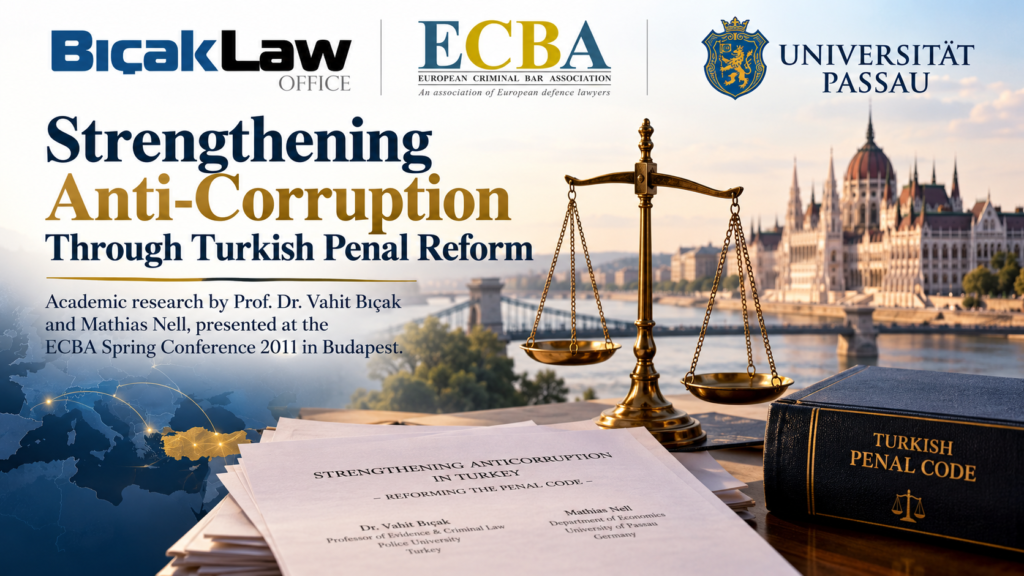
Strengthening Anti-Corruption Through Turkish Penal Reform
Revisiting academic research by Prof. Dr. Vahit Bıçak and Mathias Nell, presented at the European Criminal Bar Association Spring Conference in Budapest.
An Academic Contribution to Anti-Corruption Reform
Can criminal law do more than punish corruption after it occurs? Can the design of criminal liability and effective repentance provisions actively undermine the relationships that allow bribery to flourish?
These questions are central to Strengthening Anticorruption in Turkey – Reforming the Penal Code, an academic paper jointly authored by Prof. Dr. Vahit Bıçak and Mathias Nell of the University of Passau, Germany.
The research was presented by Prof. Bıçak at the European Criminal Bar Association (ECBA) Spring Conference in Budapest on 7 May 2011.
Combining criminal-law analysis with economic reasoning, the paper examines whether voluntary disclosure mechanisms can be structured to destabilize corrupt transactions, weaken incentives for mutual silence, and improve the effectiveness of anti-corruption enforcement.
Bıçak Law Firm is making the original research paper available to academics, legal practitioners, policymakers, and other researchers interested in corruption, criminal justice, and legislative reform.
The ECBA Spring Conference in Budapest: Context and Significance
The European Criminal Bar Association held its Spring Conference in Budapest, Hungary, on 6–7 May 2011, under the theme “Fight against corruption and the reality of defence in these cases.”
The conference brought together criminal defence practitioners and other participants to examine the legal and practical challenges arising in corruption investigations and prosecutions.
On Saturday, 7 May 2011, Prof. Dr. Vahit Bıçak participated in the panel entitled “Panel of Defence Practitioners on the Challenges of Defending Persons Accused of Corruption,” scheduled between 14:15 and 15:45 and chaired by Scott Crosby.
His contribution addressed strengthening anti-corruption enforcement in Türkiye through reform of the Turkish Penal Code, drawing on research conducted jointly with Mathias Nell.
The ECBA’s official conference report records Prof. Bıçak’s contribution, while the original programme confirms the conference dates, panel arrangements, and his participation.
The historical records remain available through the ECBA Conference Report – Budapest 2011 and the official conference programme (PDF).
International Perspectives on Corruption and Criminal Defence
The Budapest conference situated anti-corruption enforcement within a broader discussion of criminal justice and the rights of persons accused of corruption.
Its programme addressed the practical realities of defending corruption cases, alongside international developments in anti-corruption policy and legislation. The conference materials also reflected discussions involving Transparency International and the United Kingdom’s Bribery Act.
This context is important because the effectiveness of anti-corruption legislation cannot be assessed solely by examining statutory penalties.
Investigation, evidentiary standards, procedural safeguards, cooperation with authorities, and the conduct of individuals involved in illicit transactions all influence how criminal-law provisions operate in practice.
The research presented by Prof. Bıçak contributed to this discussion by examining how the structure of legal incentives may affect the willingness of participants in corrupt arrangements to disclose information and cooperate with investigators.
Why Severe Penalties Alone May Not Prevent Bribery
Severe criminal penalties are commonly regarded as essential instruments for deterring corruption. However, Bıçak and Nell identify a potential difficulty with relying on punishment alone.
Bribery typically involves at least two participants whose cooperation is necessary for the illicit transaction to succeed. Once an agreement has been reached, each participant may possess information capable of incriminating the other.
The prospect of criminal punishment can therefore create a relationship of mutual dependence.
A bribe-giver may threaten to report a public official who fails to deliver an agreed benefit. Conversely, a public official may threaten disclosure if the promised bribe is not paid.
These threats can sometimes function as informal mechanisms for enforcing agreements that would otherwise lack legal protection.
The authors argue that criminal sanctions, while necessary for deterrence, may under certain conditions contribute to the stability of corrupt arrangements by reinforcing reciprocal threats and mutual silence.
Their analysis consequently shifts attention from the severity of punishment alone to the design of incentives that influence participants before and after corrupt transactions.
Voluntary Disclosure, Effective Repentance and Corrupt Reciprocity
A central contribution of the paper concerns voluntary disclosure programmes and their relationship with effective repentance.
Such mechanisms offer individuals involved in criminal conduct an opportunity to obtain exemption from punishment or other forms of leniency when specified statutory conditions are satisfied.
The authors distinguish voluntary disclosure before detection from cooperation arrangements negotiated after an offence has already been discovered.
The distinction matters because a predictable statutory opportunity to report wrongdoing may affect the behaviour of individuals even before an illicit agreement is completed.
Yet the availability of leniency is not necessarily sufficient to undermine corruption.
If a participant can report an offence and avoid punishment at almost any stage of the transaction, that opportunity may become a credible threat against a counterpart who refuses to fulfil an unlawful promise.
The authors therefore examine how the timing and conditions of voluntary disclosure can influence what they describe as corrupt reciprocity.
Their central proposition is that carefully designed reporting incentives may weaken the trust necessary to sustain corrupt agreements, increasing uncertainty and the likelihood of disclosure.
Rather than simply encouraging participants to confess, the proposed approach seeks to make corrupt cooperation itself less reliable.
Reform Proposals Concerning Articles 252 and 254 of the Turkish Penal Code
The paper focuses on Articles 252 and 254 of the Turkish Penal Code as they stood within the legal framework examined by the authors.
Article 252 addressed bribery, while Article 254 regulated effective repentance in connection with bribery offences.
The research evaluates whether the conditions governing exemption from punishment could unintentionally provide bribe-givers or bribe-takers with leverage over one another.
Using hypothetical public procurement transactions, the authors illustrate how a bribe-giver may threaten disclosure when a public official fails to award a promised contract, or how a public official may use a reporting threat when the agreed payment is withheld.
The paper proposes a more differentiated approach to voluntary disclosure in cases of active and passive bribery.
For active bribery, the authors consider linking exemption from punishment to reporting after the public official has acted in the giver’s interest, together with the provision of testimony against the official.
For passive bribery, they examine whether leniency should depend on receipt of the undue advantage and cooperation against the bribe-giver.
These proposals are intended to reduce opportunities for using statutory leniency as a means of enforcing corrupt arrangements.
The authors also address the need for particular caution where bribery involves coercion, intimidation, or threats.
Importantly, these are academic legislative reform proposals developed in the context of the legal framework examined in the paper. They should not be interpreted as descriptions of the present wording or application of Articles 252 and 254.
The United Nations Convention against Corruption and Legislative Design
The research also draws on the United Nations Convention against Corruption (UNCAC), particularly Articles 15 and 37.
Article 15 concerns the criminalization of active and passive bribery involving national public officials.
Article 37 addresses cooperation with law enforcement authorities, including measures encouraging individuals involved in corruption offences to provide information and assistance useful for investigation and prosecution.
The Convention thus provides an international framework within which states may consider appropriately structured cooperation and leniency mechanisms.
Bıçak and Nell use this framework to develop their own proposals for the Turkish Penal Code.
Their recommendations should be distinguished from the Convention’s binding obligations and discretionary provisions: the particular reporting conditions proposed in the paper represent the authors’ legislative analysis rather than requirements prescribed by UNCAC.
The Continuing Relevance of Interdisciplinary Anti-Corruption Research
Although the paper was presented in 2011, the questions it raises remain relevant to academic debates concerning criminal-law policy and institutional design.
Anti-corruption enforcement involves more than defining offences and prescribing penalties. It also requires consideration of how individuals respond to legal incentives, how evidence becomes available to investigators, and how criminal justice institutions can discourage illicit cooperation.
The research illustrates the value of examining these issues through both legal and economic perspectives.
Its analysis is particularly relevant to comparative scholarship concerning voluntary disclosure, effective repentance, cooperation with prosecuting authorities, and the relationship between deterrence and criminal enforcement.
The paper also invites further investigation into whether theoretically effective leniency arrangements can operate fairly and predictably in practice, particularly where coercion, unequal bargaining power, or procedural safeguards are involved.
Revisiting the research does not imply that its proposals have been adopted into Turkish legislation or that the legal framework has remained unchanged since 2011.
Instead, making the paper accessible provides an opportunity to examine an earlier contribution to an enduring discussion about the design of effective and legally sound anti-corruption mechanisms.
Access the Full Academic Paper
Bıçak Law Firm is pleased to make the original academic paper available for research and educational purposes.
Title: Strengthening Anticorruption in Turkey – Reforming the Penal Code
Authors: Prof. Dr. Vahit Bıçak and Mathias Nell
Conference: European Criminal Bar Association (ECBA), Spring Conference 2011
Presentation: 7 May 2011, Budapest, Hungary
Language: English
Document: Full academic paper, 11 pages, PDF
Read or Download the Full Academic Paper (PDF)
Researchers may also consult the ECBA’s official conference report and the original conference programme for the historical context of the presentation.
Research and Historical Context Note
This paper reflects the legal framework and academic debates examined at the time of its preparation and presentation in 2011. It contains legislative reform proposals and should not be treated as an updated statement of Turkish criminal law or as legal advice. Readers conducting contemporary legal analysis should consult the current legislation, applicable judicial decisions, and subsequent legal developments.
Bıçak Law Firm | Academic Research & Legal Insights
Supporting the dissemination of legal scholarship on criminal justice, anti-corruption law, economic crime, evidence, and institutional accountability.






Comments
No comments yet.