 English
 Türkçe
 Français
 Deutsch

Business email compromise (BEC) and payment diversion fraud can transform a routine international commercial transaction into a complex cross-border asset recovery matter. In this anonymised case handled by Bıçak Law Firm, a U.S.-based commercial buyer was induced through fraudulent payment communications to transfer funds intended for its long-standing Turkish business partner to bank accounts controlled by third parties in Türkiye. Following discovery of the fraud, legal action was pursued through the Turkish criminal investigation to trace the diverted funds and prevent identifiable assets from being dissipated. A portion of the transferred funds was successfully identified and frozen in a Turkish bank account, securing the assets while the criminal proceedings continued. The funds remained preserved for approximately three years, demonstrating the important distinction between freezing assets and actually recovering them. In August 2026, following an order of the competent Public Prosecutor, the previously frozen funds were released and collected from the relevant bank on behalf of the client. The case demonstrates the importance of prompt evidence preservation, independent verification of changed payment instructions, early asset tracing, effective freezing measures and sustained legal follow-up in cross-border fraud matters. More broadly, it illustrates that successful asset recovery requires not merely locating and preserving diverted funds, but pursuing the legal process until preserved assets can, where legally possible, be converted into actual recovery for the victim.
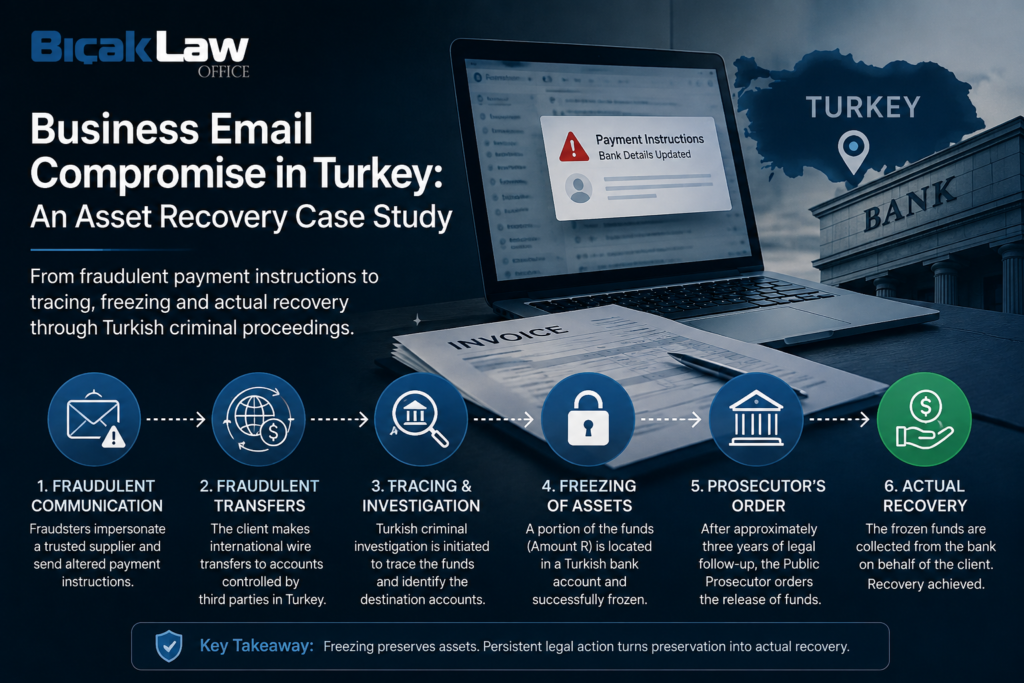
Business Email Fraud Recovery in Türkiye
1. The Case at a Glance
The client was a U.S.-based commercial buyer with a long-established business relationship with a Turkish manufacturer. The parties had conducted legitimate cross-border business over an extended period, and their commercial dealings involved purchase orders, invoices, shipping arrangements and payment communications. The underlying commercial relationship itself was genuine. The available documentation includes a genuine proforma invoice identifying the U.S.-based customer and Turkish supplier and setting out the relevant order and commercial arrangements. The invoice also contained defined delivery and payment terms and genuine supplier banking information.
Against this background of an established relationship, fraudulent communications intervened in the payment process. The buyer was induced to transfer funds to accounts that were not the genuine supplier’s intended accounts. What initially appeared to be an ordinary international payment therefore developed into a cross-border business email compromise and payment diversion fraud requiring urgent legal action in Türkiye.
2. How the Business Email Compromise Occurred
Business email compromise is particularly dangerous in established commercial relationships because the fraud does not necessarily begin with an obviously suspicious transaction. Instead, fraudsters may exploit the appearance of an existing supplier relationship, familiar payment process or apparently legitimate commercial correspondence. In this case, the fraudulent activity was connected to payment communications relating to genuine commercial dealings. The client believed that it was acting upon legitimate instructions associated with its Turkish business partner. Funds were consequently transferred through a series of international payments, anonymised in this case study as Transfers X, Y and Z.
The scheme is appropriately described here as a business email compromise, email impersonation and payment diversion scenario. We deliberately do not characterise the incident as a proven hacking of a particular email account or information system, because the materials presently available for this case study do not require that technical conclusion. From an asset recovery perspective, the decisive issue was not merely how the fraudulent communication had been created. Once the payments had been made, the immediate question became whether the destination of the funds could be identified and whether assets remaining within Türkiye could be preserved before they disappeared.
3. Discovering the Fraud and Verifying the Genuine Payment Instructions
Once the discrepancy became apparent, it was necessary to distinguish the fraudulent payment instructions from the genuine commercial arrangements between the parties. This required examination of the underlying transaction documents and verification of the genuine supplier information. The original commercial documentation was particularly important because it established that there was a real transaction between genuine businesses rather than a fictitious underlying purchase. The proforma invoice recorded the customer, order information, goods, delivery arrangements and payment terms.
The genuine banking information appearing in the commercial documentation could then be considered against the payment instructions involved in the disputed transfers. The invoice expressly identified the account holder and banking information associated with the Turkish supplier. Direct verification with the genuine commercial counterparty also formed part of the factual clarification process. This distinction between genuine transaction documents and fraudulent payment instructions became important for explaining the suspected fraud and supporting the subsequent legal response in Türkiye.
4. Immediate Legal Action in Türkiye
Once a fraudulent international transfer reaches Türkiye, time can become critical. Funds held in a bank account may be transferred onwards, withdrawn or dispersed through additional accounts, making subsequent recovery substantially more difficult. The matter therefore required action within the Turkish legal system. The available evidence concerning the commercial relationship, communications and payment transfers was assembled and the matter was pursued through the criminal investigation in Türkiye. An important objective at this stage was to move beyond establishing that the client had apparently been defrauded. The legal process also needed to identify where the transferred money had gone and whether any portion of it remained capable of being secured. This distinction is fundamental in fraud recovery cases. A criminal complaint may initiate an investigation, but the practical recovery prospects often depend on whether the financial trail can be followed quickly enough to locate assets that remain available for preservation.
5. Tracing and Freezing the Funds
The fraudulent transfers involved several payments, referred to in this anonymised account as Transfers X, Y and Z. Following the legal and investigative process in Türkiye, a portion of the diverted funds was identified in a Turkish bank account. That identifiable portion is referred to here as Amount R. Measures pursued during the criminal investigation resulted in Amount R being frozen. The significance of the measure was immediate: the funds could no longer simply be treated as money that had disappeared into the broader payment chain. An identifiable asset had been located and preserved within the Turkish banking system. For confidentiality reasons, neither the actual amounts of Transfers X, Y and Z nor the value of Amount R are disclosed in this case study. The identities of the client, Turkish commercial counterparty, account holders, relevant bank and other persons involved have likewise been omitted or generalised. What matters from an asset recovery perspective is the procedural progression: international fraudulent transfer → tracing → identification of recoverable funds → freezing of the identified assets. But that was not the end of the case.
6. Freezing is not Recovery
One of the most important lessons from this matter is the distinction between freezing assets and recovering assets. A freezing measure can prevent funds from being dissipated and preserve them while an investigation or related legal process continues. It can therefore be indispensable to an eventual recovery. Yet frozen money does not automatically become money returned to the victim. In this case, Amount R had been successfully secured in a Turkish bank account, but the client did not immediately regain control of it. The funds remained frozen for approximately three years while the criminal proceedings and related legal process continued. This distinction is sometimes overlooked in international fraud matters. A victim may understandably regard confirmation that money has been found and frozen as the conclusion of the recovery process. Legally and practically, however, it may represent an intermediate stage. The objective must therefore be considered in two phases: first, prevent the identifiable assets from disappearing; second, establish the procedural basis on which those preserved assets can actually be returned. The case demonstrates why asset preservation and asset recovery should be treated as related but distinct objectives from the beginning.
7. Three Years of Preservation and Continued Legal Follow-Up
The preservation of Amount R over approximately three years was important because the passage of time did not eliminate the client’s interest in recovering the funds. During this period, continued legal follow-up of the criminal proceedings remained necessary. The existence of a freezing measure did not remove the need to monitor the status of the funds and pursue the procedural steps relevant to their eventual release. Cross-border fraud victims should therefore be cautious about assuming that asset recovery will necessarily be immediate once funds have been identified. Depending on the circumstances of the investigation, competing claims, available evidence and procedural decisions, the transition from preservation to return may take time. At the same time, this case demonstrates the practical value of an effective preservation measure. Although the proceedings continued for a prolonged period, the identified funds remained available rather than being dissipated while the legal process developed. That preservation ultimately made the next stage possible.
8. From Frozen Assets to Actual Recovery
The decisive development occurred in August 2026. Following continued legal action in connection with the criminal proceedings, the competent Public Prosecutor authorised the release of the previously frozen funds. Amount R was then collected from the relevant Turkish bank on behalf of the client. The significance of this development goes beyond the lifting of a freezing measure. The case had progressed through the full practical asset-recovery sequence: fraudulent payment → tracing → freezing → preservation → prosecutorial decision → actual monetary recovery. The funds that had remained secured for approximately three years were no longer merely identifiable assets protected within a bank account. They had been converted into an actual recovery for the client.
The distinction is important when evaluating the effectiveness of legal action following financial fraud. Identifying perpetrators or obtaining procedural decisions may be important objectives in their own right, but for a victim who has suffered a financial loss, a central practical question remains whether identifiable assets can ultimately be returned. In this matter, the portion successfully preserved as Amount R progressed from frozen assets to actual recovery.
9. What This Case Shows About Fraud Recovery in Türkiye
Although every fraud case depends on its own facts, several practical lessons emerge from this matter. First, speed matters. Once payment diversion is discovered, delays may reduce the prospect of finding funds before they are moved onwards. Second, changes to payment instructions deserve independent verification. Where a supplier unexpectedly provides a new account, beneficiary or payment route, verification through a previously established and independent communication channel can provide an important fraud-prevention safeguard. Third, asset tracing should be considered from the beginning. Establishing that fraud occurred is not necessarily enough to produce financial recovery if the assets can no longer be located. Fourth, freezing is an important preservation mechanism but should not be confused with final recovery. The procedural strategy must contemplate what happens after assets have been secured. Finally, cross-border fraud can require sustained legal follow-up. This matter continued for approximately three years between preservation of the identified funds and their actual recovery. The experience therefore reinforces a broader principle: in international financial fraud, an effective response should combine evidence preservation, prompt legal action, financial tracing, asset preservation and a strategy for ultimate recovery.
10. What Should a Company Do After Discovering a Fraudulent Transfer to Türkiye?
A company that discovers that funds may have been fraudulently transferred to Türkiye should act promptly while avoiding steps that could unnecessarily compromise evidence. Relevant emails, invoices, payment instructions, SWIFT records, bank correspondence and communications with the genuine commercial counterparty should be preserved in their original form wherever possible. The sending bank should normally be informed promptly so that available banking measures can be considered. The genuine supplier or counterparty should also be contacted through an independently verified communication channel, rather than simply replying to the same email chain suspected of having been compromised or impersonated. Where the funds have entered the Turkish banking system, early Turkish legal assessment can help determine what criminal and other recovery mechanisms may be available and what evidence should accompany the initial application to the competent authorities.
The precise response will depend on the facts. However, the practical sequence is often: preserve evidence → notify the relevant financial institutions → verify genuine payment instructions → identify the destination of funds → obtain Turkish legal advice → pursue available tracing and preservation measures → continue the process toward recovery. Early action cannot guarantee recovery, but delay can materially affect the available options.
11. How Bıçak Law Firm Assists in Cross-Border Fraud and Asset Recovery
Bıçak Law Firm advises international businesses and individuals in Türkiye-related financial fraud and asset recovery matters. Depending on the circumstances of the case, legal assistance may include initial case assessment, review and preservation of evidence, preparation and pursuit of criminal complaints, representation during Turkish criminal investigations, requests relating to the tracing and preservation of assets, procedural follow-up, and coordination of the steps required to pursue the return of recoverable funds.
Cross-border cases may additionally require coordination between foreign clients, banks, commercial counterparties and Turkish authorities, together with careful assessment of the documentary record created outside Türkiye. The objective is not limited to establishing that a fraudulent act may have occurred. Where assets can be identified, the legal strategy should also consider whether they can be preserved and what subsequent steps may be available to pursue their actual recovery.
12. Related Guide
For a broader explanation of financial fraud investigations, asset tracing, freezing measures, criminal and civil remedies and cross-border recovery mechanisms under Turkish law, see Bıçak Law Firm’s comprehensive guide, Financial Fraud and Asset Recovery in Turkey. The present case study should be read as an anonymised practical illustration of how some of those mechanisms may operate in an individual matter rather than as a substitute for case-specific legal advice.
Important Confidentiality and Results Notice: This case study has been anonymised to protect client confidentiality. Names, transaction amounts, banking information, locations and certain other identifying circumstances have been omitted or generalised. X, Y and Z are anonymisation devices used to describe different fraudulent transfers, while R denotes the portion of the funds that was identified, frozen and subsequently recovered; none represents an actual published transaction amount. Every financial fraud and asset recovery matter depends on its individual facts, available evidence, location and status of assets, procedural circumstances and decisions of the competent authorities. The outcome described in this case study does not constitute or imply a guarantee that the same or a similar result can be achieved in another matter.


Comments
No comments yet.