 English
 Türkçe
 Français
 Deutsch

The International Sanctions and Export Controls Society hosted an international webinar on sanctions and export controls for fintechs, addressing how global rules impact cross-border payments and digital finance. Professor Dr. Vahit Bıçak of Bıçak Law Firm participated as a featured speaker alongside Justin Muscolino and Jeanine McGuinness. The session highlighted that sanctions compliance is now an operational necessity for fintech companies rather than a purely regulatory obligation. Key discussions focused on real-time payment risks, fintech–bank accountability, and the challenges of managing cross-border financial transactions. Speakers emphasized the importance of lifecycle-based compliance controls, including onboarding, transaction monitoring, and ongoing risk assessment. A major theme of the webinar was the growing relevance of export controls, particularly in relation to SaaS platforms, encryption technologies, and cross-border data access. Practical insights included identifying sanctions red flags, strengthening internal controls, and learning from recent enforcement cases. Bıçak Law Firm continues to provide strategic legal guidance on sanctions, export controls, anti-money laundering, and cross-border compliance for fintech and financial institutions.
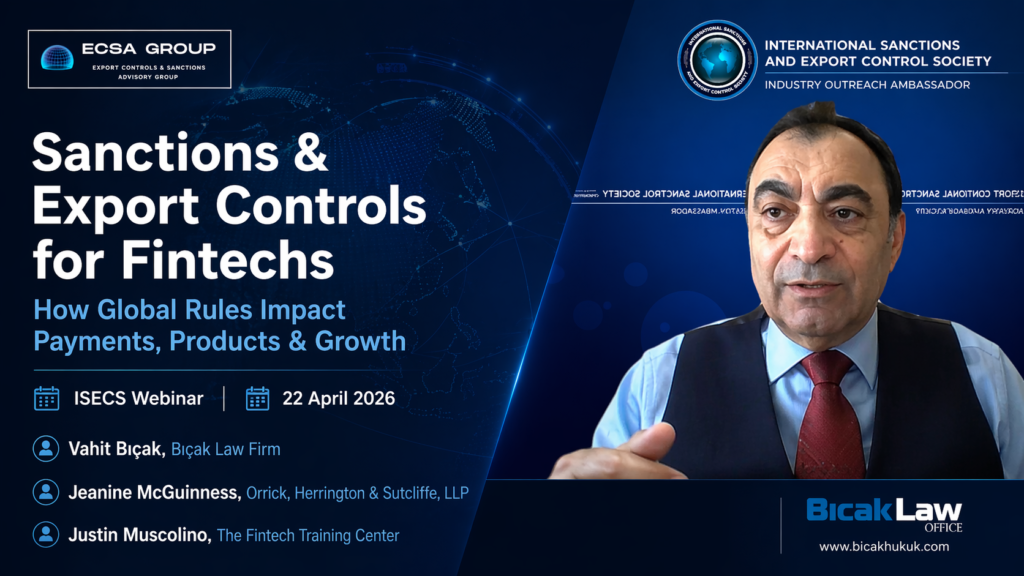
Webinar on Sanctions and Export Controls for Fintechs
I. Overview of the Event
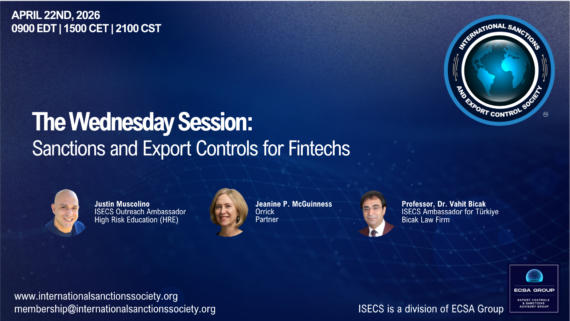
International Sanctions and Export Controls Society successfully hosted its international webinar titled “Sanctions & Export Controls for Fintechs: How Global Rules Impact Payments, Products & Growth” on 22 April 2026. The session brought together leading experts in sanctions, export controls, and financial regulation to examine the growing impact of global compliance frameworks on fintech companies operating in cross-border environments. Professor Dr. Vahit Bıçak, Chairman of Bıçak Law Firm and ISECS Ambassador for Türkiye, participated as a featured speaker alongside Justin Muscolino and Jeanine McGuinness.
II. Key Themes and Discussions
The webinar focused on the increasing intersection between financial technology and international regulatory regimes. Key topics addressed during the session included:
- The operational nature of sanctions risks in fintech business models
- The impact of real-time cross-border payment systems on compliance exposure
- The role of sponsor banks and third-party relationships in allocating responsibility
- The importance of lifecycle-based compliance controls, from onboarding to transaction monitoring
- Emerging risks linked to crypto assets, APIs, and embedded finance
The speakers emphasized that sanctions compliance is no longer a peripheral legal requirement but a central operational concern for fintech companies.
III. Export Controls and Technology Risk
A key highlight of the session was the growing relevance of export controls in the fintech sector. Participants discussed how fintech companies increasingly function not only as financial service providers but also as technology exporters, particularly through:
- Software-as-a-Service (SaaS) platforms
- Cross-border data access and cloud-based systems
- Encryption technologies and algorithmic tools
This perspective underscored the need for fintech companies to adopt integrated compliance frameworks addressing both sanctions and export control obligations.
IV. Practical Compliance Insights
The session provided practical guidance for fintech stakeholders, including:
- Identification of common sanctions “red flags” such as VPN usage, inconsistent customer data, and unusual payment routing
- The importance of real-time transaction monitoring and ongoing re-screening
- Lessons learned from enforcement actions, including failures in internal controls and governance structures
The discussion highlighted that weak compliance frameworks may quickly result in enforcement actions, reputational harm, and loss of banking relationships.
V. Bicak Law Firm’s Contribution
Professor Dr. Vahit Bıçak contributed to the session by offering a structured analysis of fintech risk exposure and emphasizing the importance of integrating sanctions and export control compliance into business operations. His remarks highlighted that:
- Sanctions risk in fintech is operational rather than theoretical
- Responsibility for compliance must be clearly defined across fintech and banking partnerships
- Export controls represent an often-overlooked but critical risk area for technology-driven financial services
VI. Conclusion
The ISECS webinar demonstrated that sanctions and export controls are becoming increasingly central to the legal and operational landscape of fintech companies. As global regulatory scrutiny intensifies, fintech firms must adopt proactive and integrated compliance strategies to manage risks effectively and maintain sustainable growth in international markets. Bıçak Law Firm continues to actively participate in international legal and compliance discussions and remains committed to supporting clients in navigating complex sanctions, export control, and cross-border regulatory environments.


Comments
No comments yet.