 English
 Türkçe
 Français
 Deutsch

The International Sanctions and Export Control Society (ISECS) has published “Principles for Responsible AI Use in Trade Compliance,” establishing 15 principles for the responsible application of artificial intelligence in international trade regulation. The principles provide a practical framework for integrating AI into sanctions screening, export controls, customs compliance, risk assessment, and regulatory decision-making. They emphasise human oversight, accountability, transparency, data quality, and continuous monitoring to ensure that AI supports rather than replaces professional judgment. Particular attention is given to cybersecurity, data protection, legal privilege, confidential information, and the risks associated with third-party AI providers. The framework also addresses the importance of explainability, auditability, bias mitigation, and alignment with applicable national and international legal requirements. For businesses operating in Türkiye, responsible AI adoption requires careful consideration of Turkish data protection legislation, export-control requirements, international sanctions exposure, and professional confidentiality obligations. Professor Dr. Vahit Bıçak, Founder of Bıçak Law Firm and ISECS Ambassador for Türkiye, is acknowledged among the contributors to the ISECS publication. This article examines all 15 principles and offers practical legal and compliance recommendations for organisations seeking to use AI responsibly in increasingly complex international trade environments.
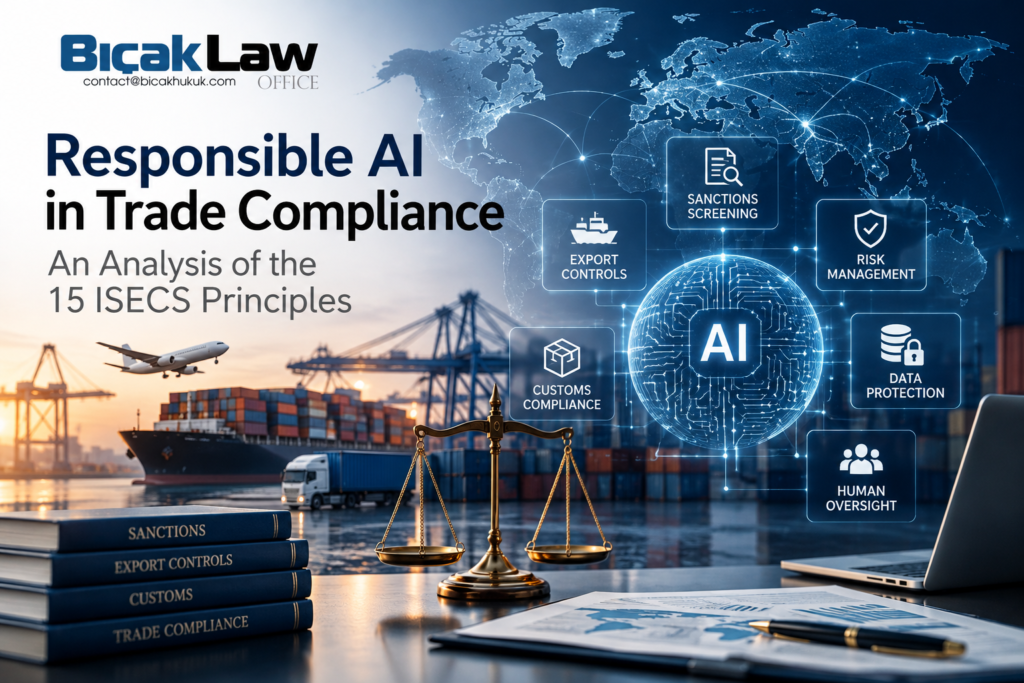
Responsible AI in Trade Compliance: ISECS Principles
1. Introduction: Artificial Intelligence Meets International Trade Regulation
Artificial intelligence is increasingly influencing how businesses identify sanctions exposure, classify goods, assess export-control restrictions, screen counterparties, review customs documentation and monitor international supply chains. Its capacity to process substantial quantities of information creates opportunities to improve efficiency, consistency and the early identification of compliance risks. However, international trade compliance is not simply a data-processing exercise. It involves the interpretation of legal obligations, the assessment of complex commercial relationships, the verification of facts and the exercise of professional judgment.
An incorrect classification, an overlooked sanctions designation, an inaccurate assessment of beneficial ownership or an unauthorised transfer of controlled technical information may have serious regulatory and commercial consequences. Against this background, the International Sanctions and Export Control Society (ISECS) has published its Principles for Responsible AI Use in Trade Compliance, prepared on 14 September 2026. The document establishes 15 recommended principles addressing the governance, deployment, validation, security and oversight of artificial intelligence in sanctions, export controls, customs and related compliance activities.
This article examines those principles individually, considers their legal and operational significance, and discusses their application to businesses operating in Türkiye and across international markets. Its central proposition is that AI may support trade compliance, but it cannot replace legal accountability, reliable evidence or informed human judgment.
2. The Legal Status and Purpose of the ISECS Principles
The ISECS document is a professional guidance instrument rather than legislation, a binding regulatory standard or an official certification programme. Its legal disclaimer expressly explains that the principles are intended for general educational and informational purposes. They do not constitute legal, regulatory, technical or compliance advice, nor do they guarantee that an organisation adopting them will satisfy every applicable legal requirement. This distinction is important because international trade compliance operates across overlapping legal systems.
An organisation may be subject to Turkish customs legislation, European Union export controls, United States sanctions, contractual restrictions, data-protection requirements and sector-specific rules, depending on the particular transaction and the relevant jurisdictional connections. No single AI governance document can eliminate the need to identify and apply those requirements.
The contribution of the ISECS Principles lies instead in providing a structured professional framework through which organisations can assess whether their use of AI is appropriately supervised, documented, tested and controlled. The 15 principles can be understood as an integrated governance framework extending from initial system selection to ongoing operation, external communications, incident response and eventual system retirement.
3. Principle 1: Human Oversight and Accountability
The first principle establishes the foundation of responsible AI deployment: artificial intelligence should assist qualified trade compliance professionals rather than replace them. Final decisions involving sanctions screening, tariff classification, export-control classification, licensing, customs valuation and regulatory filings should remain subject to appropriate human review and documented approval. This is particularly important where an AI system produces a plausible answer without adequately identifying the applicable legal authority or the facts supporting its conclusion. For example, an AI tool may conclude that a transaction is permissible because the immediate counterparty does not appear on a sanctions list. That conclusion may be incomplete if the counterparty is owned by blocked persons, the transaction involves controlled technology, or the ultimate destination creates additional restrictions. The organisation must therefore establish clear responsibilities for reviewing, approving, overriding and escalating AI-assisted determinations.
Legal implication: Responsibility for a compliance decision remains with the relevant organisation and its authorised decision-makers. Deploying an automated system does not, by itself, transfer regulatory responsibility to the software provider.
4. Principle 2: Risk-Based Deployment
The second principle requires AI systems to be deployed proportionately to the legal and operational risks of the relevant activity. Not every compliance task requires the same level of human intervention. AI may be suitable for assisting with routine document organisation, identifying missing information or preparing preliminary summaries of published regulatory materials. By contrast, higher-risk applications require more stringent safeguards. These may include assessing transactions involving restricted destinations, complex ownership structures, military end users, sensitive technology or uncertain licensing requirements. A risk-based deployment policy should consider the nature of the products, counterparties, destinations, transaction values, applicable regulatory regimes and potential consequences of an incorrect result.
Practical implication: Organisations should classify AI use cases according to their risk and determine which activities may be automated, which require mandatory human validation and which should not be delegated to AI.
5. Principle 3: Transparency and Explainability
The third principle concerns the ability to understand and explain AI-assisted compliance outcomes. A system that identifies a transaction as high risk should provide sufficient information to enable a compliance professional to evaluate that conclusion. The reviewer should be able to identify the relevant data sources, assumptions, legal references and material factors contributing to the result. A risk score without an intelligible explanation may be insufficient for a consequential legal decision. For example, if a screening tool flags a Turkish exporter because of a possible relationship with a designated entity, the reviewer should be able to determine whether the result arises from a name similarity, a verified ownership relationship, a transaction pattern or another identifiable factor.
Legal implication: Explainability supports internal accountability, regulatory examinations, contractual disputes and the ability to demonstrate that an organisation conducted a meaningful compliance assessment.
6. Principle 4: Data Quality and Governance
AI-assisted compliance is only as reliable as the information on which it depends. The fourth principle emphasises accurate, authoritative, relevant and current data. International sanctions lists, export-control classifications, customs tariff schedules and licensing requirements may change rapidly. Customer information, beneficial ownership records and product specifications may also become outdated. An AI system relying on incomplete or obsolete data may produce misleading results even when its underlying technology functions as designed. Data governance should therefore address the provenance, accuracy, validation, accessibility, storage, retention and permitted use of information. Particular attention is required where the system processes personal data, commercially sensitive information, export-controlled technology or confidential legal documents.
Practical implication: Organisations should establish identifiable authoritative data sources and procedures for updating and validating the information used in compliance decisions.
7. Principle 5: Continuous Monitoring, Testing, and Incident Response
The fifth principle recognises that successful initial deployment does not establish permanent reliability. AI systems should be tested before implementation and monitored throughout their operational life. Testing should examine accuracy, false positives, false negatives, model drift and performance against expert-reviewed historical decisions. The distinction between false positives and false negatives is particularly significant. A false positive may delay a legitimate shipment or payment. A false negative may permit a prohibited transaction to proceed without appropriate review. ISECS therefore recommends not only reviewing transactions flagged by an AI system, but also conducting risk-based sampling of transactions that the system has automatically cleared. This is a particularly important safeguard. A compliance programme that reviews only identified alerts may never discover that the system is systematically overlooking particular categories of risk. The principle also addresses incident response. Organisations should establish criteria for suspending an AI system, reverting to manual procedures and reviewing earlier transactions where material errors or security incidents are identified.
Legal implication: Continuous testing and documented corrective action can help demonstrate the organisation’s approach to identifying and managing compliance failures, although they do not automatically establish a defence against enforcement.
8. Principle 6: Legal and Regulatory Alignment
International trade compliance frequently involves several legal regimes operating simultaneously. The sixth principle requires organisations to evaluate AI systems against applicable sanctions, export controls, customs legislation, privacy requirements, contractual obligations and AI-specific regulations. A transaction may be lawful under one jurisdiction’s rules while triggering restrictions under another jurisdiction’s legislation. An AI system that treats all sanctions lists or ownership tests as legally equivalent may therefore produce incorrect conclusions. The principle also identifies a less obvious issue: the AI system itself may create export-control or technology-transfer risks. Models, software, technical data, semiconductors, training materials and remote access arrangements may be subject to applicable restrictions. For example, uploading controlled engineering drawings to an overseas AI service may raise a different legal question from using AI to summarise publicly available sanctions guidance.
Practical implication: Organisations must assess both the compliance tasks performed by AI and the legal implications of the AI infrastructure used to perform those tasks.
9. Principle 7: Documentation and Auditability
The seventh principle requires organisations to maintain records sufficient to reconstruct material AI-assisted compliance decisions. These records may include the model version, applicable screening-list version, system configuration, input data, prompts, outputs, timestamps, reviewer comments, overrides and final approvals. The objective is not necessarily to reproduce an identical AI-generated answer. Some AI systems may produce different outputs when given the same prompt. Rather, the organisation should be able to demonstrate which information, systems and human-review procedures were used at the relevant time. This distinction is important in sanctions investigations and customs disputes, where the legal assessment may depend on the rules and information available when the transaction occurred.
Legal implication: An auditable decision-making record may be essential when responding to regulatory enquiries, litigation, internal investigations or contractual disputes. Retention periods must be determined under the applicable legal regime rather than assumed to be uniform across jurisdictions.
10. Principle 8: Bias and Fairness Mitigation
The eighth principle addresses systematic inaccuracies, unsupported assumptions and unintended bias. Trade compliance screening frequently involves names expressed in different languages and writing systems. Transliteration between Arabic, Cyrillic, Chinese, Latin and other scripts can produce spelling variations that affect automated matching. Poorly calibrated similarity thresholds may generate excessive false positives or fail to identify relevant designated persons. Complex corporate ownership structures create additional difficulties, particularly where indirect holdings, aggregated ownership or different jurisdictional control tests must be evaluated. An AI model may also reproduce historical classification errors if it has been trained on unreliable earlier decisions.
Practical implication: Organisations should validate screening logic, transliteration methods, matching thresholds and ownership-analysis procedures rather than assuming that an AI-generated risk score is inherently objective.
11. Principle 9: Security and System Integrity
The ninth principle concerns the protection of AI systems against unauthorised access, manipulation, disclosure and compromise. Trade compliance systems may process sensitive customer information, technical specifications, shipping records, contractual documents and confidential business intelligence. Security controls should therefore address both conventional cybersecurity risks and vulnerabilities associated specifically with AI. The ISECS document identifies risks such as prompt injection, data poisoning, compromised training data and unauthorised model manipulation. It also highlights the importance of the location and architecture of the system. Cloud hosting, multi-tenant infrastructure and remote technical support may create additional risks where sensitive information becomes accessible across national borders.
Practical implication: Organisations should consider the sensitivity of the information before selecting public cloud, private cloud or on-premises deployment arrangements.
12. Principle 10: Controlled Use of Generative AI
Generative AI can assist trade compliance teams with drafting, research, summarisation and preliminary analysis. However, its outputs may contain inaccurate legal references, invented facts, outdated regulatory information or unsupported conclusions. The tenth principle therefore calls for clear policies defining approved and prohibited uses. Organisations should distinguish between publicly accessible AI applications and enterprise-approved environments with appropriate contractual and technical safeguards. Confidential transaction records, controlled technical information and privileged legal materials should not be entered into unapproved systems. Nor should a generative AI response serve as the sole basis for a final sanctions, customs or export-control determination.
Legal implication: The apparent fluency of an AI-generated explanation must not be confused with legal reliability. Material conclusions require independent verification against authoritative sources.
13. Principle 11: External Communications, Reliance, and Legal Risk
The eleventh principle concerns the legal consequences of sharing AI-assisted compliance conclusions with third parties. A company may use AI to prepare an export-control classification, sanctions screening certificate, customs declaration or compliance statement. Once communicated externally, that output may influence another party’s commercial or regulatory decisions. An incorrect statement could create contractual disputes, misrepresentation concerns or regulatory exposure, depending on the facts and applicable law. Organisations should therefore establish procedures governing the review, approval and release of AI-assisted outputs. Contractual provisions addressing reliance, confidentiality and responsibility may be appropriate, but disclaimers cannot replace substantive accuracy and responsible decision-making.
Practical implication: External compliance statements should be approved by authorised personnel who understand both the underlying legal assessment and the potential consequences of third-party reliance.
14. Principle 12: Integration with Existing Compliance Programs
The twelfth principle discourages treating AI as an isolated compliance mechanism. AI-generated alerts should feed into established procedures for due diligence, sanctions screening, licensing, escalation, investigation and transaction approval. An automated tool should not bypass existing safeguards merely because it can process information more quickly. For example, where an AI system identifies an unusual payment route, a possible restricted end user or inconsistent shipping documentation, the issue should be assessed through the organisation’s established compliance process.
Practical implication: AI should strengthen existing internal controls rather than create an informal parallel decision-making system without clear responsibilities.
15. Principle 13: Third-Party Vendor Management
Many businesses obtain AI capabilities through external technology providers. The thirteenth principle requires risk-based due diligence on those vendors and their systems. Relevant enquiries include how data is processed, whether customer information is used for model training, where systems are hosted, who may access information, how subcontractors are managed and what audit rights are available. The ISECS document places particular emphasis on cross-border technical access. Remote maintenance, troubleshooting or system administration may expose controlled technical information to personnel located in another jurisdiction. Depending on the applicable export-control rules and the nature of the information, such access may require authorisation.
Legal implication: Outsourcing AI infrastructure does not necessarily transfer responsibility for regulatory compliance to the provider. Contracts should address confidentiality, permitted data use, hosting locations, subcontracting, security incidents, auditability and relevant changes in service arrangements.
16. Principle 14: Protection of Legal Privilege and Confidential Information
The fourteenth principle is especially important for lawyers, internal legal departments and compliance professionals conducting sensitive investigations. AI systems may be used to analyse legal advice, internal investigation materials, regulatory correspondence, voluntary disclosures, litigation documents and confidential commercial information. Uploading such materials to an unsuitable external system may create risks involving unauthorised disclosure, contractual confidentiality obligations, data protection or the preservation of applicable legal privilege. The ISECS document therefore recommends express approval and appropriate safeguards before privileged or highly sensitive information is processed through AI. The relevant legal protections differ across jurisdictions. For example, the treatment of attorney-client privilege and work-product protection under U.S. law should not be assumed to correspond precisely to professional secrecy and confidentiality obligations under Turkish law.
Practical implication: Legal departments and external counsel should evaluate AI use against the specific confidentiality and professional obligations applicable to their work.
17. Principle 15: Proportional Benefits and Ongoing Governance
The final principle addresses whether AI delivers measurable compliance benefits proportionate to its cost, complexity and risk. Organisations should not assume that introducing AI necessarily improves compliance. A system that generates excessive alerts, introduces unreliable classifications or requires extensive corrective work may reduce overall effectiveness. Performance should be evaluated through meaningful indicators, including accuracy, consistency, error reduction, escalation quality and operational efficiency. Governance must continue throughout the system’s lifecycle, including procurement, development, deployment, monitoring, modification and retirement.
Practical implication: Responsible AI adoption requires periodic reassessment of whether the technology continues to support the organisation’s legal obligations and compliance objectives.
18. Application to Türkiye: Sanctions, Export Controls, Customs and Data Protection
The ISECS Principles are internationally oriented. Their application in Türkiye requires additional consideration of the domestic legal framework and the particular international transactions undertaken by the business.
18.1 Turkish Law and Foreign Sanctions Exposure
Türkiye does not automatically incorporate every unilateral sanctions measure adopted by the United States, the European Union or the United Kingdom. However, Turkish businesses may encounter foreign sanctions exposure through relevant jurisdictional connections, designated counterparties, financial institutions, controlled goods or activities potentially subject to secondary sanctions. AI systems used by Turkish companies must therefore distinguish between domestic legal obligations, applicable foreign prohibitions, potential secondary-sanctions consequences and the commercial policies of banks or other intermediaries. A screening tool should not simply label a transaction “illegal” without identifying the relevant jurisdiction and legal authority.
18.2 Export Controls and Controlled Technical Information
Turkish businesses operating in defence, aerospace, advanced manufacturing, electronics and other technology-intensive sectors may process technical information subject to national or foreign export-control requirements. AI deployment may raise questions concerning the transfer, disclosure or accessibility of controlled technical data. For example, remote access by an overseas AI vendor to sensitive engineering documentation may require an assessment of the applicable technology-transfer rules. Relevant Turkish regulatory frameworks may include the controls applicable to military equipment, dual-use goods and strategic materials, depending on the particular product and transaction.
18.3 Personal Data Protection under the KVKK
The Turkish Personal Data Protection Law, Law No. 6698, is relevant where AI systems process personal data relating to employees, customers, beneficial owners, company representatives or other identifiable individuals. AI-assisted compliance screening may involve the collection, matching, profiling, storage and transfer of personal information. Organisations should assess the legal basis for processing, data minimisation, transparency obligations, security measures and applicable rules on international transfers. In particular, using an overseas AI provider may require careful examination of cross-border data-transfer arrangements. The fact that a system is used for sanctions compliance does not automatically eliminate applicable data-protection obligations.
18.4 Commercial Confidentiality and Professional Secrecy
Turkish businesses should also consider contractual confidentiality duties, trade-secret protection and professional secrecy obligations. For lawyers, the duty of confidentiality under the Turkish legal profession’s governing framework requires particular attention when using external AI services. The availability of a technologically convenient tool does not itself establish that confidential client material may be uploaded or processed through that tool. Organisations should establish clear internal rules identifying which information may be processed, through which approved systems, and subject to what safeguards.
18.5 Customs and Trade Documentation
AI may assist Turkish importers and exporters with tariff classification, document consistency checks, customs valuation analysis and identification of unusual trading patterns. However, the legal responsibility for customs declarations and other regulatory submissions remains governed by applicable law. AI-generated classifications and recommendations should therefore be checked against the relevant tariff provisions, binding decisions where applicable, product specifications and supporting documentation.
19. Relationship with International AI Governance Frameworks
The ISECS document identifies three international frameworks as relevant points of alignment:
- ISO/IEC 42001 provides a management-system framework for organisations developing, providing or using AI systems.
- The NIST AI Risk Management Framework offers a structured approach to identifying, assessing and managing AI-related risks.
- The European Union AI Act establishes a regulatory framework whose requirements depend on the nature of the AI system, the role of the relevant operator, applicable scope provisions and implementation dates.
These frameworks have different legal characteristics. ISO/IEC 42001 is a voluntary international management-system standard unless its application becomes obligatory through another legal or contractual mechanism. The NIST framework is guidance rather than generally binding legislation. The EU AI Act is legislation, but its obligations and application dates require assessment under its specific provisions.
ISECS does not state that adopting its 15 principles constitutes certification under ISO/IEC 42001, compliance with the NIST framework or satisfaction of the EU AI Act. Instead, the principles provide trade-compliance-specific guidance that may complement broader AI governance arrangements.
20. From Principles to Practice: An Organisational Implementation Approach
The 15 ISECS Principles can be translated into a practical implementation programme. An organisation considering AI for trade compliance should begin by identifying the activities for which AI assistance is proposed and the legal consequences of errors. It should then establish a governance structure identifying responsible personnel, permitted use cases, mandatory review procedures and escalation channels. Before deployment, the organisation should assess the quality of the underlying data, the reliability of the model, applicable data-protection obligations, vendor arrangements and any restrictions on technical information. Testing should include representative historical transactions, difficult ownership structures, name variations and other scenarios that may expose weaknesses in the system. Once operational, the organisation should monitor both flagged and automatically cleared transactions, document material decisions and establish procedures for incident response. Finally, the organisation should periodically evaluate whether the system continues to deliver demonstrable benefits without introducing disproportionate legal or operational risks. This implementation approach is an analytical synthesis of the ISECS Principles, rather than a separate mandatory procedure prescribed by ISECS.
21. Bıçak Law Firm’s Perspective: Technology Must Strengthen Legal Judgment
The increasing use of artificial intelligence in international trade compliance reflects a broader transformation in legal and regulatory practice. AI can support the identification of risks, the processing of regulatory information and the organisation of complex commercial data. Yet legal responsibility cannot be reduced to an algorithmic output.
In cross-border trade, the same transaction may raise questions under several jurisdictions’ sanctions, export-control, customs and data-protection regimes. These questions frequently require factual investigation, interpretation of legal rules and an understanding of the commercial context.
The ISECS Principles appropriately emphasise that human oversight, reliable information, transparent reasoning, effective security and documented accountability remain essential. For businesses operating in Türkiye, responsible AI deployment should therefore be integrated with existing legal and compliance arrangements, rather than treated as a substitute for them. The central objective is not to automate legal responsibility, but to use technology to support better-informed, more consistent and more defensible compliance decisions.
22. Conclusion: Responsible AI as a Continuing Compliance Obligation
The publication of the Principles for Responsible AI Use in Trade Compliance represents a contribution to the professional discussion about the role of artificial intelligence in international trade regulation. Its 15 principles address the full lifecycle of AI-assisted compliance, from initial deployment and data governance to human review, auditability, vendor management, confidentiality and ongoing monitoring. Three conclusions are particularly important.
- First, AI should support, not displace, qualified human decision-making in legally consequential compliance matters.
- Second, effective AI governance requires more than technical performance. It must incorporate legal analysis, reliable data, security, documentation and accountability.
- Third, international businesses should evaluate AI systems against the particular sanctions, export-control, customs and data-protection rules applicable to their activities.
As AI becomes more deeply embedded in international trade operations, organisations that establish robust governance arrangements will be better positioned to use these technologies responsibly while managing the legal and operational risks they create.
About the ISECS Publication
The International Sanctions and Export Control Society (ISECS) prepared Principles for Responsible AI Use in Trade Compliance on 14 September 2026. The document identifies 15 recommended principles and acknowledges contributions from members of the ISECS leadership and international professional network, including Professor Dr. Vahit Bıçak, ISECS Ambassador for Türkiye. Bıçak Law Firm welcomes the publication as a basis for continued professional discussion concerning AI governance, sanctions compliance, export controls and cross-border regulatory obligations.
Original publication: ISECS – Principles for Responsible AI Use in Trade Compliance
Legal Disclaimer: This article is provided for general informational and educational purposes only and does not constitute legal advice. The ISECS Principles are non-binding professional guidance. References to Turkish or foreign legal requirements are general and must be evaluated against the legislation, regulatory guidance and circumstances applicable to each particular case. Publication of the principles does not constitute ISECS approval or certification of any AI product, vendor or compliance programme.

Comments
No comments yet.