 English
 Türkçe
 Français
 Deutsch

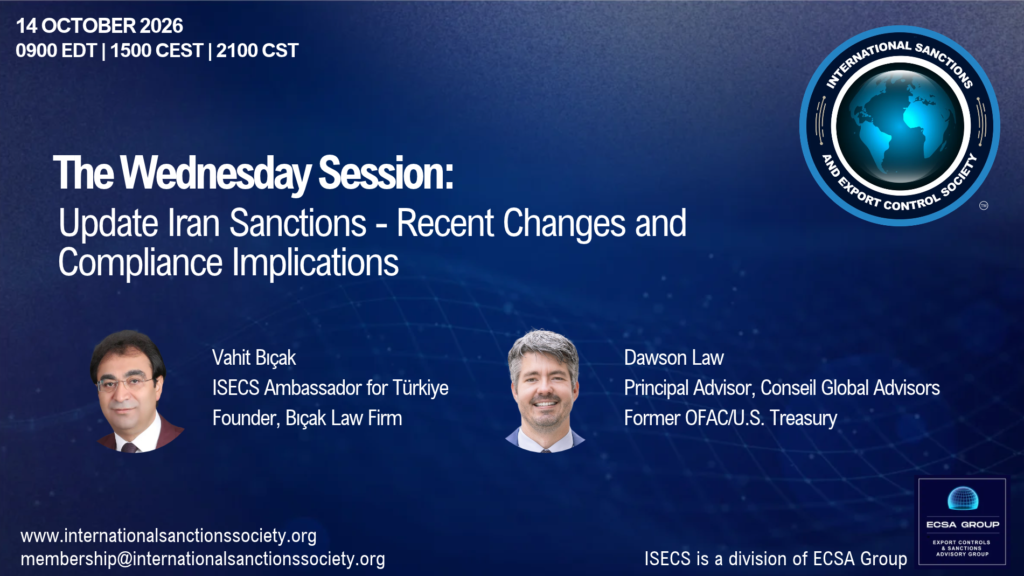
The International Sanctions and Export Control Society (ISECS) successfully hosted its Wednesday Session, “Update Iran Sanctions – Recent Changes and Compliance Implications”, on 14 October 2026. The webinar featured Dawson Law, Founder of Conseil Global Advisors and former U.S. Treasury and OFAC official, alongside Professor Dr. Vahit Bıçak, Founder of Bıçak Law Firm and ISECS Ambassador for Türkiye. Moderated by Alexander Witt, the event attracted strong attendance, active participation and positive audience feedback. Professor Bıçak delivered a presentation entitled “Iran Sanctions in 2026: Türkiye and the Third-Country Compliance Perspective”, examining recent sanctions developments and their implications for international businesses. His analysis addressed the Golden Global Bank case, Türkiye-based industrial and aviation companies, maritime transportation networks and international payment systems. He emphasised that transactions lawful under Turkish domestic legislation may nevertheless create exposure under foreign sanctions regimes or encounter significant international banking restrictions. The presentation outlined practical compliance priorities, including comprehensive counterparty screening, beneficial ownership verification, assessment of financial and logistical risks, and continuous regulatory monitoring. The session highlighted the importance of international cooperation and legally informed compliance strategies in navigating the increasingly complex global sanctions environment.
Iran Sanctions 2026: Türkiye Risks
The International Sanctions and Export Control Society (ISECS) successfully held its Wednesday Session, “Update Iran Sanctions – Recent Changes and Compliance Implications”, on 14 October 2026, bringing together international sanctions, export controls, legal and compliance professionals to examine recent developments concerning Iran. The webinar featured Dawson Law, Founder of Conseil Global Advisors and a former U.S. Department of the Treasury and OFAC official, alongside Professor Dr. Vahit Bıçak, Founder of Bıçak Law Firm and ISECS Ambassador for Türkiye. The session was moderated by Alexander Witt and attracted strong attendance and active audience participation, according to feedback shared by the organisers and speakers following the event.
1. International Perspectives on an Evolving Sanctions Landscape
The webinar examined recent changes in Iran-related sanctions and their implications for international businesses, financial institutions and compliance professionals. Bringing together experience in U.S. sanctions administration and cross-border legal practice, the session provided complementary perspectives on the challenges arising from increasingly complex international sanctions measures.
Professor Bıçak delivered a presentation entitled “Iran Sanctions in 2026: Türkiye and the Third-Country Compliance Perspective”. His presentation examined recent U.S. sanctions actions involving Türkiye-based financial institutions, industrial suppliers, aviation companies and maritime transportation networks, together with their implications for businesses operating across multiple jurisdictions. A central proposition of his presentation was: “A transaction may be lawful under Turkish law and yet expose the parties to significant international sanctions risks.”
Building on this distinction, Professor Bıçak explained why sanctions compliance requires separate consideration of domestic legality, foreign sanctions exposure, access to international banking services and the practical feasibility of commercial transactions.
His analysis included the September 2026 designation of Golden Global Bank, the subsequent Turkish banking regulatory measures, recent sanctions involving Türkiye-based industrial and aviation businesses, and the October developments concerning maritime transportation and international payment networks.
2. A Changing Sanctions Landscape: August-October 2026
The presentation began by examining the acceleration of U.S. sanctions measures during August, September and October 2026. Under the initiative described by the U.S. Treasury as Operation Economic Outcast, recent actions have extended across petroleum and petrochemicals, financial services, aviation, automotive supply chains and maritime transportation.
Several developments were particularly relevant:
- On 24 August, U.S. authorities announced measures affecting Iranian petroleum and petrochemical networks and expanded the sectors potentially subject to designation under Executive Order 13902.
- On 4 September, OFAC designated Türkiye-based Golden Global Yatırım Bankası and two related companies.
- On 8 September, aviation-related sanctions included several Türkiye-based logistics and aviation businesses.
- On 1 October, additional measures addressed the Iranian automotive sector and associated international suppliers.
- On 5 October, OFAC issued an alert concerning foreign financial institutions’ dealings with sanctioned Iranian financial institutions.
- On 8 October, Treasury announced sanctions against 17 vessels associated with the transportation of Iranian petroleum and petrochemical products.
The broader significance of these developments lies in the increasing attention directed towards international commercial networks and intermediaries, rather than Iranian counterparties alone.
3. Why Türkiye and Other Third Countries Face Distinctive Risks
Türkiye occupies an important position between European, Asian and Middle Eastern markets. Its businesses participate in international manufacturing, financial services, aviation, energy, maritime transportation and logistics. These activities may create exposure to transactions involving Iranian counterparties, Iranian-origin goods, or intermediary networks associated with sanctioned persons. However, the legal analysis requires care.
U.S. unilateral sanctions are not automatically incorporated into Turkish domestic law. A transaction restricted under U.S. law is therefore not necessarily independently prohibited under Turkish law. Nevertheless, businesses must consider several additional dimensions.
Primary sanctions exposure may arise where the relevant conduct falls within U.S. jurisdiction, including through U.S. persons, blocked property or certain U.S.-connected financial services.
Secondary sanctions exposure may arise from specified conduct by non-U.S. persons, subject to the conditions of the applicable legal authority.
Other applicable sanctions regimes, including EU or UK measures, may create additional obligations where the necessary jurisdictional connections exist.
Commercial and operational exposure may arise where banks, insurers, carriers or other service providers decline to participate, even when the transaction is not prohibited for the Turkish business itself.
Professor Bıçak emphasised that domestic legality, foreign sanctions exposure and commercial feasibility must be assessed as separate questions.
4. Golden Global Bank: Distinguishing U.S. Sanctions from Turkish Regulatory Action
One of the principal case studies concerned Golden Global Yatırım Bankası A.Ş. On 4 September 2026, the U.S. Treasury announced the designation of the bank and two related Turkish entities under Executive Order 13902. Treasury alleged that the bank had participated in financial arrangements connected with Iranian petroleum revenues and associated networks. These allegations should be attributed to the U.S. authorities. Golden Global Bank publicly disputed them. An administrative sanctions designation should not be represented as a criminal conviction or as judicial proof of every factual allegation.
A separate development occurred in Türkiye. Under BDDK Decision No. 11569, dated 16 September 2026, the Turkish Savings Deposit Insurance Fund (TMSF) was authorised, pursuant to Article 18(5) of Banking Law No. 5411, to exercise shareholder rights – excluding dividend rights – associated with 99.98% of the bank’s shares.
The distinction between these two actions is legally significant. The Turkish announcement concerned the exercise of specified shareholder rights. It did not, by itself, establish a transfer of share ownership to the state, the revocation of the bank’s operating licence, or its liquidation. Nor does the announcement, standing alone, establish that the U.S. designation legally or factually caused the Turkish regulatory decision. The case demonstrates the importance of distinguishing measures adopted by different authorities, under different legal powers, even when those measures concern the same financial institution.
5. Industrial Supply Chains: Petrochemicals, Aviation and Automotive Components
The presentation then examined sanctions exposure beyond the banking sector. In August 2026, U.S. authorities identified several Türkiye-based companies in connection with alleged Iranian petrochemical transactions.
In September, aviation-related designations included Sky Phoenix, S Sistem and MES Kargo, among other targets. These Türkiye-based entities were designated under Executive Order 13224, a counterterrorism sanctions authority.
In October, OFAC identified Troy Trading, an Istanbul-based business, in measures associated with Iran’s automotive sector under Executive Order 13902.
The legal authorities and underlying allegations differed across these cases. Nevertheless, the examples illustrate a recurring issue: a business may face sanctions exposure through its role as a supplier, distributor, freight forwarder, agent or intermediary, even when it is neither the original manufacturer nor the ultimate customer. Consequently, sanctions due diligence should not end with checking the immediate buyer’s name against a sanctions list. It should also examine the ultimate destination, intended end use, ownership relationships, intermediary companies and relevant transportation arrangements.
6. International Payments: Legal Permission Does Not Guarantee Banking Access
Another central element of Professor Bıçak’s presentation concerned the international payment chain. Consider a Turkish exporter selling industrial equipment to a foreign customer. Even where the underlying sale is permissible, the payment may involve an originating bank, one or more correspondent banks and a beneficiary institution. Each institution may conduct its own sanctions assessment.
A payment may be delayed, rejected or subjected to further investigation where a bank identifies a sanctioned party, a relevant Iranian financial connection or another material compliance concern. This creates a distinction between legal sanctions risk and operational banking risk.
The former requires an assessment of the applicable prohibitions and potential secondary-sanctions consequences. The latter concerns the willingness and ability of financial institutions to complete the transaction.
The presentation therefore recommended assessing payment feasibility before commercial commitments become difficult to reverse. Businesses should also consider appropriately drafted contractual provisions addressing sanctions-related payment difficulties, delivery disruption and the allocation of performance risk. Alternative payment arrangements must remain lawful and must not be used to conceal sanctioned parties or circumvent restrictions.
7. Maritime Transportation and the Shadow-Fleet Problem
The maritime sector provides another illustration of network-based sanctions exposure. On 8 October 2026, the U.S. Treasury announced designations involving 17 vessels associated with Iranian petroleum and petrochemical transportation under Executive Order 13902. For maritime businesses, screening a vessel by its current name alone may be insufficient. A vessel may change its name or flag, while its registered owner, commercial operator, technical manager and charterer may be separate entities. The International Maritime Organization (IMO) number provides a more durable vessel identifier, although it does not replace broader due diligence.
Relevant enquiries may include vessel ownership and management, cargo origin, ship-to-ship transfers, routing patterns, insurance arrangements and the identity of payment intermediaries. The October measures demonstrate why sanctions compliance in maritime trade must examine the underlying commercial network rather than a single vessel name.
8. Four Distinct Categories of Transaction Risk
Professor Bıçak proposed a four-part analytical framework for international businesses.
Primary sanctions risk concerns whether a transaction falls within an applicable prohibition, including through a relevant jurisdictional connection.
Secondary sanctions risk concerns the possible consequences of specified activities by non-U.S. persons, even where an ordinary U.S. jurisdictional connection is absent.
Banking-access risk concerns whether participating financial institutions will process payments and maintain the necessary commercial relationships.
Commercial-performance risk concerns whether the goods, services, transportation, insurance and contractual obligations can actually be delivered.
A transaction may satisfy one of these tests while failing another. Effective compliance therefore requires a structured assessment of the applicable law, the commercial facts and the operational dependencies of the transaction.
9. Five Practical Compliance Priorities
The presentation concluded its substantive analysis with five recommendations for companies and their legal and compliance advisers.
First, map the applicable legal regimes. Identify relevant jurisdictions, sanctions authorities, exemptions and licensing possibilities. U.S., EU, UK and Turkish rules should not be treated as interchangeable.
Second, screen the wider commercial network. Examine counterparties, beneficial ownership, intermediaries, financial institutions, vessels and service providers. Applicable ownership and control rules must be assessed under the relevant legal regime.
Third, verify goods, end use and destination. Review product descriptions, commercial documentation, routing arrangements and the identity of the ultimate recipient. Inconsistencies may warrant further investigation without necessarily proving wrongdoing.
Fourth, assess payment and logistical feasibility. Establish whether the transaction can be financed, insured, transported and performed in practice.
Fifth, document decisions and monitor developments. Maintain a defensible record of screening, legal assessments, approvals and escalation decisions, and revisit the analysis when circumstances or sanctions measures change.
These priorities are especially important for internationally active businesses without extensive internal sanctions-compliance resources.
10. Three Conclusions for International Business
Professor Bıçak’s presentation identified three overarching lessons.
First, domestic legality does not eliminate international sanctions exposure. Businesses must distinguish Turkish legal requirements from the potential consequences of applicable foreign sanctions regimes.
Second, compliance must follow commercial networks. Recent measures involving banks, industrial suppliers, aviation businesses and maritime operators demonstrate the importance of examining ownership, intermediaries, transportation and payments.
Third, legal precision is indispensable. An OFAC designation, a Turkish banking regulatory decision, a secondary-sanctions exposure, a licensing restriction and a bank’s commercial refusal are different legal and operational events.
The central message is that effective sanctions compliance requires more than checking whether a name appears on a list. It requires understanding the applicable law, the transaction itself and the relationships connecting the participants.
11. International Professional Engagement and Sanctions Compliance
Bıçak Law Firm appreciates the efforts of ISECS, moderator Alexander Witt, the organising team and fellow speaker Dawson Law in facilitating this international exchange. The firm’s participation reflects its continuing engagement with international sanctions, export controls and cross-border regulatory compliance, particularly where international legal measures affect businesses operating in Türkiye. The discussion also reinforced the importance of cooperation among legal practitioners, compliance professionals, financial institutions and regulatory specialists in addressing the increasingly interconnected risks associated with international trade.
The principal lesson remains clear: effective sanctions compliance requires an understanding not only of the applicable legal rules, but also of the commercial networks, financial relationships and operational arrangements through which international transactions are carried out.
Bıçak Law Firm’s participation in the ISECS Wednesday Session reflects its ongoing engagement with international sanctions, export controls, financial regulation and cross-border legal compliance. As ISECS Ambassador for Türkiye, Professor Dr. Vahit Bıçak contributes to international professional dialogue concerning the legal and operational challenges faced by businesses navigating different sanctions regimes. The firm continues to examine developments affecting Türkiye-based businesses, including cross-border payments, trade finance, maritime transportation, industrial supply chains and international regulatory risk. The October 2026 Iran sanctions developments demonstrate the importance of proactive, legally grounded and commercially informed compliance programmes.
Legal notice: This article provides general information and commentary based on the presentation prepared for the ISECS Wednesday Session and publicly available regulatory materials. It does not constitute legal advice. References to allegations made by regulatory authorities do not imply independent findings of wrongdoing. The legal consequences of any transaction depend on its particular facts, applicable jurisdictions and the rules in force at the relevant time.

Comments
No comments yet.